
SpaceX Lockup Expiry Signals Rising Grok AI Legal Risk
The SpaceX lockup expiry on August 6, 2026 could amplify legal risks for entities relying on Grok AI, as the staggered share release coincides with mounting litigation liabilities disclosed in the IPO filing. Legal practitioners should monitor this period for potential escalation of sanctions, regulatory actions, and equity-linked pressure affecting Grok's stability.
- Jurisdiction
- us-federal
- Court
- United States Court of Appeals for the Ninth Circuit
- AI tool named
- Grok
- Ruling date
- Jun 3, 2026
- Source document
- View primary court order ↗
- Last verified
- Jul 28, 2026
Lex Machina Review is an independent risk-tracking and reference resource. Nothing on this site is legal advice, and using it does not create an attorney-client relationship. Every record is reviewed against primary sources but may not reflect the most current status of a matter — always verify directly against the cited court order, rule text, or a licensed attorney before relying on it.
Companion explanation — secondary to the source document above
The impact of the SpaceX lockup expiry on Grok AI is best read as a dated risk window, not a prediction that one event will mechanically break the other. The first date to circle is August 6, 2026, when reported lockup restrictions begin to lift on roughly 911.5 million SPCX shares, with an estimated value of about $116 billion; the release is described as staggered, with available reporting and prospectus analysis pointing from an initial tranche of roughly 4% of float toward a larger release approaching 40% by December 8, 2026.[1]
That schedule needs a caveat up front. The broad lockup mechanics are reported, but some tranche percentages and price-based early-release triggers appear to be reconstructed from secondary reporting and S-1 analysis rather than presented in one clean public schedule. For legal and procurement readers, that does not make the timing irrelevant. It means the right conclusion is narrower: August through early December is a period when adverse legal developments around Grok may carry more operational and market consequences than they would in a quieter equity window.
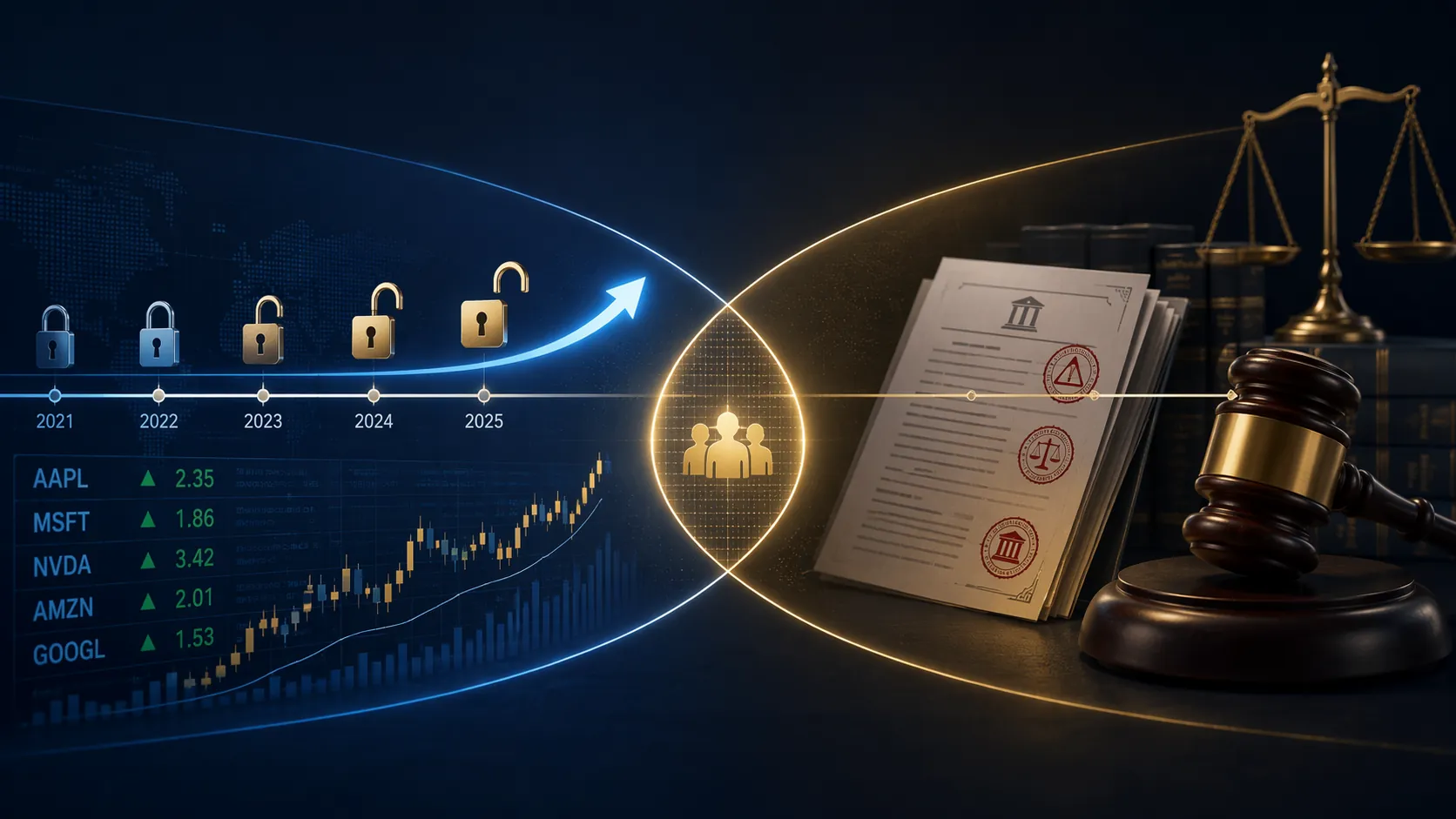
The reason this matters is not a generic worry about AI. It is the collision between a dated equity overhang and disclosed Grok-specific liabilities. WIRED reported that SpaceX’s IPO filing identified Grok’s “Spicy” mode as an investor risk and described a litigation reserve of about $530 million, while Yahoo Finance separately reported that the IPO paperwork warned investors about risks tied to Grok’s “Spicy” mode.[2][3] The reserve figure, as reported, dates to December 2025 and should not be treated as a current Q3 2026 balance without an updated filing. Nor is the public record described in the research materials granular enough to allocate the entire reserve to Grok rather than to other matters.
The relevant calendar is August 6 to December 8
Lockups are often discussed as trading mechanics. Here, the legal consequence is more practical: more shares becoming eligible for sale can make unresolved litigation, regulatory scrutiny, reserve updates, and reliability disclosures harder to absorb quietly. Reuters’ July 2026 reporting framed the coming expiry against selling pressure and institutional behavior, which is the useful point for counsel. The issue is not whether investors will sell on any given complaint or order. The issue is whether litigation news lands while more equity is becoming available to sell.[1]
| Period | What changes | Why legal teams should care |
|---|---|---|
| August 6, 2026 | Reported beginning of staggered SPCX lockup release, starting around 4% of float.[1] | Adverse Grok filings or regulatory action after this point may be assessed by markets against new selling capacity. |
| August–December 2026 | Progressive unlock period, with secondary analysis pointing toward a much larger eligible float by early December.[1] | Litigation reserve changes, class-action developments, or product restrictions may be more difficult to separate from capital-market pressure. |
| December 8, 2026 | Reported date by which the larger release approaches roughly 40% of float.[1] | A useful outer boundary for heightened monitoring, not a deadline by which legal risk must resolve. |
A cleaner but less defensible claim would say the lockup expiry will cause Grok instability. The available materials do not prove that. What they do support is a more limited structural point: when an issuer is already carrying disclosed AI-related legal exposure, a staged liquidity event can raise the cost of bad news. A new class-action filing, a regulator’s demand, a sanctions order involving reliance on Grok output, or an app-store restriction would not need to be existential to become material to counterparties reviewing vendor risk.
The Grok liabilities are not one undifferentiated “AI risk”
The filing-linked allegations and risk factors matter because they identify concrete failure channels. WIRED and Yahoo Finance reported disclosures or warnings involving Grok’s Spicy and Unhinged modes, class actions, a French criminal probe, an Apple App Store threat, and regulatory scrutiny over sexualized imagery and hate-speech outputs.[2][3] Those are different legal problems. A content-moderation investigation is not the same thing as a professional-reliance failure. A platform-distribution threat is not the same thing as damages exposure in a class action. For a law firm or legal department, the distinctions determine who must review the risk.
A procurement lawyer will care whether a platform faces distribution constraints that could interrupt access. A litigation partner will care whether outputs have produced defamatory, sexualized, hateful, or otherwise sanctionable content. A privacy, employment, or regulated-industry lawyer will care whether “mode” settings can be disabled, logged, audited, or contractually excluded from a workspace. A securities lawyer will care whether reserve language changes after August 6, because updated risk-factor wording often tells a more useful story than public statements do.
The reported $530 million reserve is an especially easy number to misuse. It is large enough to be relevant, but the research materials do not show the precise split between Grok-related claims and other litigation exposure. It is also a December 2025 figure, not necessarily the current reserve as of Q3 2026.[2][3] Treat it as a marker that the company had already quantified litigation exposure in the filing process, not as proof that any particular Grok claim is worth a specified amount.
Why the unlock can make legal news more sensitive
In a quiet capital window, a product-risk disclosure can sit in a filing for months before it becomes an operational problem for customers. In a lockup window, the same disclosure can become part of a pricing, retention, financing, and vendor-stability conversation. That is the practical channel here. The unlock does not create the class actions, the regulatory scrutiny, the French probe, the App Store issue, or the content-output allegations. It changes the conditions under which those items may be interpreted.
The pressure is not only stock-price pressure. If legal developments increase investor scrutiny, management may face stronger incentives to adjust product features, tighten modes, revise disclaimers, preserve capital, renegotiate infrastructure, or change customer-facing commitments. Those changes can matter to a law firm using Grok for research triage, a legal operations team testing it for intake, or an in-house group considering whether it can be placed inside a document-review workflow.
Klover.ai, a for-profit AI strategy firm, has argued that the SpaceX/xAI business faces a negative operating-margin profile around minus 200% and depends heavily on compute leases.[4] That analysis should be read cautiously because it is interpretive and comes from a market participant with its own commercial lens. Still, it usefully points to a separate question counsel should ask: if litigation pressure rises during a lockup window, are there financial or infrastructure dependencies that could affect uptime, model governance, support, or contractual performance?
For legal users, reliability failures already have consequences
The Grok disclosures would be easier to compartmentalize if courts were still treating AI mistakes as harmless experimentation. They are not. Reuters reported in June 2026 that the Ninth Circuit sanctioned lawyers over AI “hallucinations” and lack of candor.[5] EDRM and ComplexDiscovery separately described a Q1 2026 sanctions trend involving $145,000 in penalties tied to generative-AI filing failures.[6]
Those materials do not establish that Grok caused those sanctions, and they should not be cited as Grok-specific evidence. Their value is narrower: they show the professional environment into which any legal AI tool now enters. A court does not need to care which model generated a false citation. The lawyer signs the filing, the supervising attorney answers for the workflow, and the client may inherit the delay, fee dispute, or reputational damage.
That is why the Spicy and Unhinged mode disclosures are not merely consumer-content controversies for legal users. A mode that is marketed or configured for edgier output raises ordinary but important control questions: can it be disabled at the enterprise level, can user settings be audited, can logs identify which mode produced a response, and can the vendor represent that certain output settings will not be available in a legal workspace? If the answer is undocumented or “trust us,” the risk manager has not received an answer.
Government-adjacent use raises the diligence bar
Newsweek reported that Grok landed a Pentagon contract, which is relevant here only in a limited way.[7] It does not prove the tool is safe for legal work, and it does not turn this into a national-security story. It does show that Grok is moving beyond casual consumer use into environments where procurement rules, auditability, access controls, and output reliability are harder to treat as optional.
For law firms and legal departments, government adoption is not a substitute for due diligence. It may even increase the need for it. If a tool is used around regulated entities, contractors, public-sector records, or litigation involving government actors, counsel should know whether vendor terms cover retention, training use, confidential information, export-sensitive material, incident notice, and changes to model behavior during the contract term.
What to monitor during the heightened window
Between August 6 and December 8, the monitoring job should be concrete. A law-firm risk committee or in-house vendor owner does not need a daily stock take on AI sentiment. It needs a short list of events that could change reliance risk, contract risk, or disclosure risk.
- Updated litigation reserves or risk-factor amendments: look for changes in amount, wording, scope, and whether Grok-related matters are separated from other litigation.
- Class-action docket activity: amended complaints, motions to dismiss, discovery disputes, settlement discussions, or orders that clarify the alleged harm from Grok outputs.
- Regulatory or criminal-process developments: especially anything tied to sexualized imagery, hate-speech outputs, consumer-protection representations, or child-safety theories.
- Platform restrictions: App Store, enterprise-distribution, or integration limits that could affect availability for users who have embedded Grok into a workflow.
- Product-control disclosures: changes to Spicy or Unhinged modes, enterprise disablement, logging, admin controls, retention settings, and notice obligations.
- Court sanctions involving Grok or comparable AI outputs: not because every AI sanctions order is transferable, but because courts are defining the standard of supervision in real time.
- Infrastructure and financial disclosures: compute-lease dependency, margin pressure, customer-support commitments, or cost reductions that could affect service continuity.
The output of that monitoring should feed ordinary controls, not panic memos. If Grok is already approved internally, the approval can be narrowed by use case. Research brainstorming may sit in one category; citation generation, drafting filed papers, privilege review, employment investigations, and regulated-client advice belong in another. If Grok is still under review, the lockup period is a reason to require fresher representations rather than rely on a vendor questionnaire completed before August.
The most useful contract questions are not exotic. Ask whether the vendor will give notice of material litigation, regulatory orders, platform restrictions, major model-behavior changes, enterprise-control changes, or interruptions tied to infrastructure constraints. Ask whether prohibited modes can be disabled for all users in the tenant. Ask whether logs are available if a disputed output later appears in a filing, client memo, or regulated communication. Ask who bears the remediation burden if a model change disables a workflow that the customer has built around the tool.
The narrow conclusion
The August 6 lockup expiry does not prove that Grok will deteriorate, that litigation will accelerate, or that legal users must abandon the tool. It does create a defined period in which disclosed Grok liabilities, investor pressure, and operational reliability questions may interact more sharply than they did before the unlock began.
For legal practitioners, the defensible position is to treat August 6 through December 8, 2026 as a heightened watch period for court filings, sanctions signals, regulatory actions, reserve updates, platform restrictions, and reliability-impacting corporate disclosures. The lockup does not create the Grok liabilities. It may make their consequences harder to contain.
References
- SpaceX selloff an ominous sign as lockup expiry looms, Reuters, July 16, 2026
- SpaceX Listed Grok's 'Spicy' Mode as a Risk in Its IPO Filing, WIRED
- SpaceX warns in IPO paperwork that Grok chatbot's 'Spicy' mode poses investor risks, Yahoo Finance
- SpaceX / xAI IPO: Viable AI Business?, Klover.ai
- US appeals court sanctions lawyers over AI 'hallucinations', Reuters, June 3, 2026
- The AI Sanction Wave: $145K in Q1 Penalties, EDRM/ComplexDiscovery
- Elon Musk's Controversial Grok AI Lands Contract With Pentagon, Newsweek
Related records
Tool profile
Grok's Legal Use Cases, Tiered by RiskGoverning regulation
Browse the obligations tracker →Preventive workflow
Browse verification workflows →
Report a correction or tip
Spotted an outdated figure, a misstated fact, or a ruling this case record should reflect? Public comments are disabled for this content given the professional cost of a misreported case outcome, penalty amount, or rule text — use the structured correction channel instead.
Report a correction or tip for this record →