
Can SpaceX's $1.6B Space Force launch award be protested?
The $1.6 billion SpaceX award for 18 Space Force launches clears the DoD's raised task-order protest threshold, so GAO and Court of Federal Claims challenges are jurisdictionally open. It also flags the compressed acquisition timeline and single-provider concentration as the likelier pressure points, with no protest docketed as of August 2, 2026.
- Jurisdiction
- US Federal
- Court
- GAO / U.S. Court of Federal Claims
- AI tool named
- No AI tool named
- Ruling date
- Aug 2, 2026
- Source document
- View primary court order ↗
- Last verified
- Aug 2, 2026
Lex Machina Review is an independent risk-tracking and reference resource. Nothing on this site is legal advice, and using it does not create an attorney-client relationship. Every record is reviewed against primary sources but may not reflect the most current status of a matter — always verify directly against the cited court order, rule text, or a licensed attorney before relying on it.
Companion explanation — secondary to the source document above
Risk Digest record. Not legal advice. Last verified: August 2, 2026 (UTC). No identifiable GAO protest challenging the July 29 SpaceX task-order award had been docketed at last verification; that is a watch item, not a finding that no challenge can or will be filed.
For the SpaceX Space Force launch contract award, the legal implications start with a bounded answer: the award appears protestable in principle because the reported task-order value is far above the current DoD task-order protest threshold, but that does not mean a protest has been filed, that GAO would sustain one, or that the Court of Federal Claims route would be free of its own jurisdictional and timeliness questions.
| Record point | Publicly reported fact |
|---|---|
| Award | Space Systems Command awarded SpaceX two National Security Space Launch Phase 3 Lane 1 task orders on July 29, 2026, with a reported value of about $1.6 billion. [1] |
| Launch scope | The orders cover 18 Falcon 9 launches from Vandenberg Space Force Base through the end of 2027. [1][2] |
| Mission portfolio | The launches support the Space Based Sensing and Targeting portfolio; public reports do not fill in all payload counts or program names. [2][3] |
| Contract setting | The orders sit under NSSL Phase 3 Lane 1, described in the public record as a firm-fixed-price IDIQ lane, with a Lane 1 ceiling increase from $5.6 billion to $17 billion announced shortly before the award. [3] |
The vehicle does not make the award protest-proof
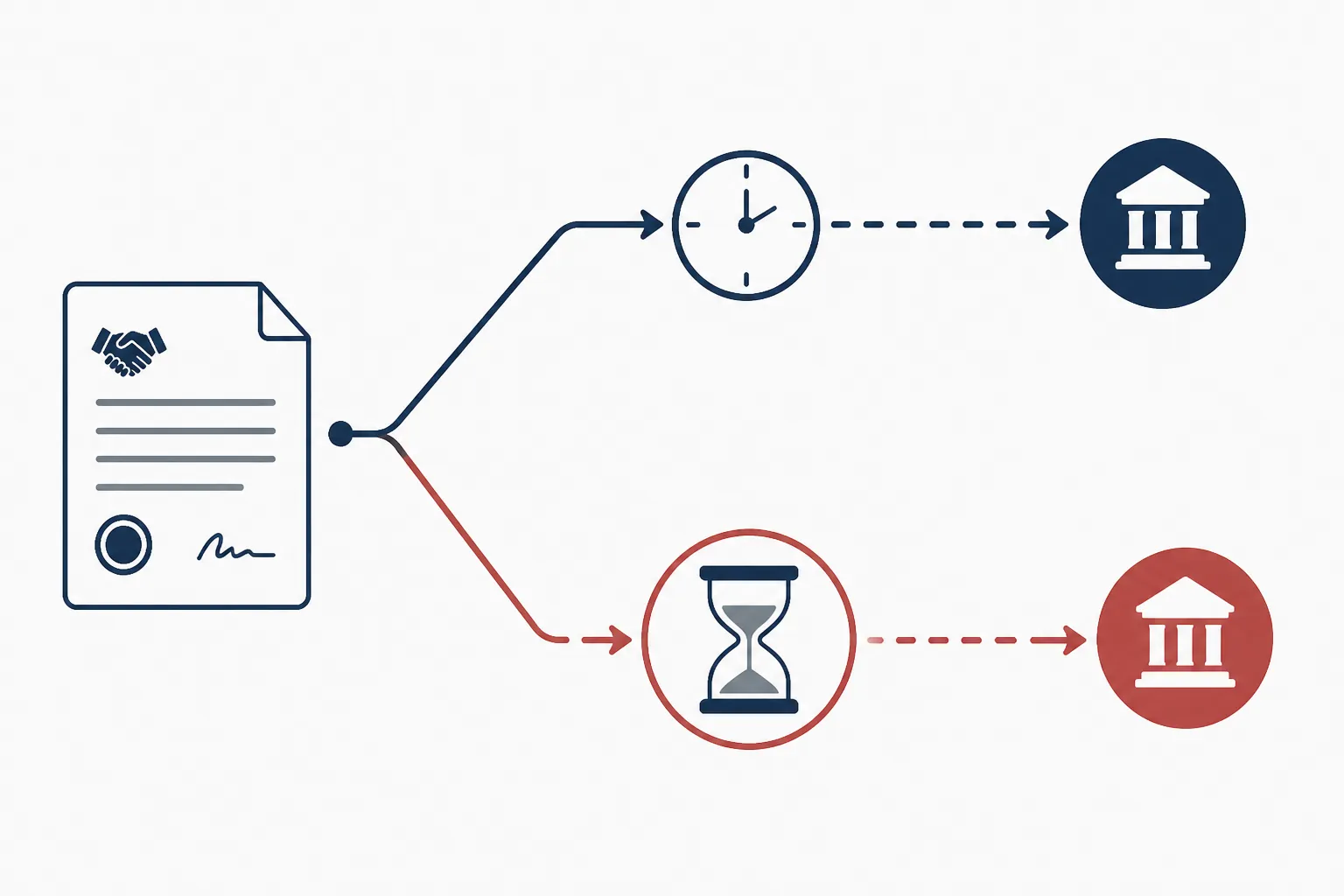
The important jurisdictional point is not that SpaceX received a large launch order. It is that the order is reported as a task order under a FAR-based, firm-fixed-price IDIQ arrangement rather than as an other transaction or an entirely insulated operational decision. That makes the task-order protest statute the first stop.
Procurement-law alerts report that FY2025 NDAA Section 885 raised the DoD task-order protest threshold from $25 million to $35 million under 10 U.S.C. §3406(f)(1)(B). If that threshold and statutory implementation apply to these orders, a $1.6 billion task-order award clears it by a wide margin. [4]
That is only a forum-opening conclusion. It does not supply the protest ground. A disappointed offeror would still need to identify a procurement-law error: an unreasonable evaluation, unequal treatment, a defective solicitation term preserved for challenge, a source-selection rationale unsupported by the record, or some other violation that fits the forum’s review standard. The threshold answers whether the door is locked; it does not say what is on the other side.
The Court of Federal Claims should also remain on the route map. The better same-week advice is not “GAO only” or “COFC only,” but to preserve both analyses while checking the statutory task-order limits, the date on which the protest basis was known or should have been known, and whether the client’s preferred remedy requires speed, record development, or a different tolerance for procedural risk.
Timeliness is the immediate risk
For GAO, the ordinary bid-protest clock is unforgiving: protests generally must be filed within 10 days after the protester knew or should have known the basis of protest, subject to specific debriefing and solicitation-timing rules that have to be checked against the actual procurement record. [5]
That matters here because the public award was already four days old as of this record’s verification date. A company treating the announcement as space-industry news rather than as a protest-triggering procurement event could lose meaningful options before it has finished the business conversation about whether it wants to challenge SpaceX at all.
AlphaSpaces is the useful caution light. GAO dismissed AlphaSpaces’ NSSL Phase 3 Lane 2 protest as untimely in B-423971.3, which is a reminder that even a launch-procurement protest with potentially serious business consequences can end at the filing-date question before GAO reaches the merits. [6]
The practical consequence is simple: the first legal task is not drafting the monopoly narrative. It is reconstructing notice. Who received the award notice? Was there a debriefing right? Was the protest basis apparent from the solicitation, from the July 29 award disclosure, from a later explanation, or from nonpublic information the company already possessed? Those dates drive the filing decision.
The stronger theories would likely be procedural, not atmospheric
The two facts most likely to attract client attention are the compressed acquisition timeline and the concentration of all 18 launches in one provider. They are not self-proving protest grounds. They are pressure points that tell counsel where to look in the record.
Public reporting describes a rapid procurement cycle for these Lane 1 launches, with the ceiling increase announced shortly before the July 29 orders. [3] Speed can be operationally justified in a national-security launch setting, but it also narrows the factual questions a protester will ask: whether all eligible offerors received the same information, whether proposal and evaluation time was consistent with the solicitation, whether the agency documented tradeoffs, and whether any late-stage requirement change effectively favored an incumbent-ready launch provider.
Single-provider concentration has the same double edge. SpaceX receiving 18 Falcon 9 launches from Vandenberg is commercially and operationally significant, but a protest would have to translate that concentration into a legal theory. “Too much SpaceX” is not the same as unequal treatment, unreasonable technical evaluation, improper responsibility judgment, or failure to follow the solicitation’s ordering procedures.
Competitor readiness also cuts both ways. Reuters reported that Blue Origin’s New Glenn remained uncertified after a May 28, 2026 pad explosion, and that ULA’s Vulcan was under a months-long booster-separation investigation. [1] Those facts may help explain why the government viewed SpaceX as the executable option for this package. They may also become record questions if an offeror argues the agency used certification timing, technical risk, or schedule risk in a way not disclosed or not reasonably supported.
Blue Origin’s 2019 win is narrower than it sounds
The best NSSL precedent for a disappointed launch provider is Blue Origin Federation, LLC, B-417839. GAO sustained Blue Origin’s pre-award protest in 2019 because the Air Force’s “when combined” best-value methodology did not provide a reasonable, common basis for comparing proposals. GAO denied Blue Origin’s broader policy-disagreement arguments and its certification-timing challenge. [7]
That distinction is the point. The sustained ground was not that the launch procurement market should be structured differently, or that the agency owed Blue Origin a different industrial-base outcome. The winning theory attacked a concrete evaluation methodology. A 2026 protest against the SpaceX Lane 1 orders would need the same kind of hook: something in the ordering procedures, evaluation method, eligibility screen, risk treatment, or source-selection documentation that can be tested against the solicitation and procurement record.
Blue Origin also warns against overreading certification status. GAO’s 2019 decision did not convert certification timing into an all-purpose lever for reshaping NSSL competition. If a 2026 protester relies on certification or technical readiness, the argument would have to be tied to how the agency stated and applied those requirements in this specific Lane 1 ordering process.
What remains unverified
- No identifiable GAO challenge to the July 29 award had been docketed as of August 2, 2026. That could change quickly, and docket absence should not be treated as a merits assessment.
- The FY2025 NDAA threshold change should be checked against the statutory text and effective-date/application rules before a filing recommendation is made. The available threshold statement in this record comes from procurement-law secondary sources.
- The public record does not disclose every payload, program detail, or evaluation fact. Those gaps should not be filled with assumptions about classified or operationally sensitive missions.
- Competitor technical status is time-sensitive. Reported New Glenn and Vulcan issues matter only to the extent they were part of the procurement record and were evaluated under the applicable criteria.
The restrained answer is therefore the safest one. Legal exposure is real because the reported task-order value appears to clear the DoD protest threshold and because both GAO and Court of Federal Claims routes should be evaluated immediately. It is bounded because no protest had been docketed at last verification, and the most plausible issues are procedural pressure points in a fast Lane 1 ordering process—not the mere fact that SpaceX won a large NSSL task-order package.
References
- SpaceX gets $1.6 billion US Space Force order for 18 Falcon 9 launches, Reuters, July 29, 2026.
- SpaceX wins $1.6 billion in launch orders for military satellite networks, SpaceNews.
- SpaceX wins $1.6B to launch Space Force sensing and targeting sats, Breaking Defense, July 2026.
- FY25 NDAA Update: Potential Costly Changes Ahead for Bid Protests, PilieroMazza.
- Understanding Bid Protest Deadlines: A Practical Guide, Holland & Knight, October 2025.
- AlphaSpaces LLC, U.S. Government Accountability Office.
- Blue Origin Federation, LLC, U.S. Government Accountability Office, November 18, 2019.
Related records
Tool profile
How Meta's AI Spending Reshapes Law Firm ProfitabilityGoverning regulation
Browse the obligations tracker →Preventive workflow
Browse verification workflows →
Report a correction or tip
Spotted an outdated figure, a misstated fact, or a ruling this case record should reflect? Public comments are disabled for this content given the professional cost of a misreported case outcome, penalty amount, or rule text — use the structured correction channel instead.
Report a correction or tip for this record →