
Starbucks AI inventory tool failure as a product-liability case study
The Starbucks Automated Counting failure provides in-house counsel with a concrete scenario to test how product-liability theories apply to enterprise AI systems, identifying the vendor-contract protections, testing protocols, and deployment documentation necessary before scaling any corporate AI tool.
- Jurisdiction
- United States
- Court
- None
- AI tool named
- Automated Counting
- Ruling date
- May 18, 2026
- Source document
- View primary court order ↗
- Last verified
- Jul 30, 2026
Lex Machina Review is an independent risk-tracking and reference resource. Nothing on this site is legal advice, and using it does not create an attorney-client relationship. Every record is reviewed against primary sources but may not reflect the most current status of a matter — always verify directly against the cited court order, rule text, or a licensed attorney before relying on it.
Companion explanation — secondary to the source document above
Starbucks did not merely test an AI inventory counter in a lab or a handful of friendly stores. In September 2025, its Automated Counting tool went into 11,300 company-operated North American stores, where employees were required to use it, compliance was tracked, and non-use reportedly came with disciplinary pressure. By May 18, 2026, after nine months of miscounts, over-ordering, and waste, Starbucks retired the system across North America.[1]
That sequence is why the legal risk for corporations is not limited to a bad procurement story. The reported facts look like the kind of record lawyers later reconstruct: a mass deployment, a specific accuracy representation, known operating failures, mandatory employee use, measurable loss, and a decision to keep the tool in service until a full rollback.
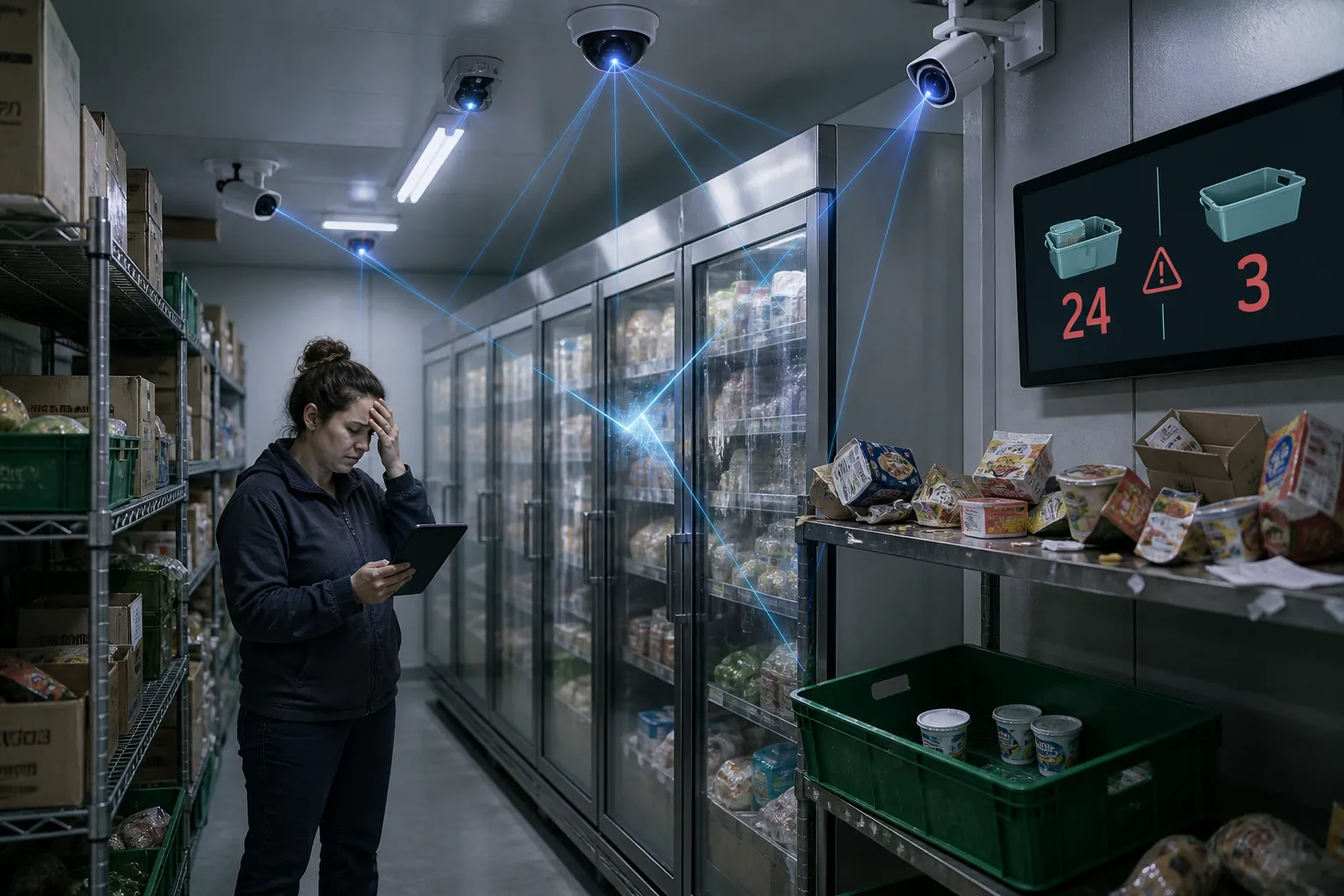
The reported failure modes were not exotic. Refrigerator reflections caused double-counting. Syrup bottles and trash cans were misidentified. Wi-Fi drops could wipe out counts. Stores then had to absorb the operational consequences: bad inventory data, excess orders, cleanup labor, and food disposal.[1][2][3]
One reported store discarded nearly $700 of food in a single day after AI-driven over-ordering. The system itself cost north of $10 million over several years to develop and deploy.[1] The dollar figures matter less as spectacle than as traceable damage. Once a tool’s output directs purchasing behavior at national scale, waste is no longer a vague productivity complaint. It becomes a loss category.
The number that needed conditions attached
NomadGo CEO David Greschler said the tool achieved 99% accuracy in controlled tests. The reported real-world performance was materially lower, although Starbucks and NomadGo did not publish an aggregate real-world error rate.[1][3] That distinction is not a footnote. A controlled-test number without the operating conditions around it leaves the most important questions unanswered: which lighting, packaging, refrigerator-door angle, camera placement, network stability, and employee workflow produced the result?
Accuracy claims do not become legally safer because they are technically true in a narrow setting. They become more dangerous when the buyer, users, or stores are not told what the number does not cover. A procurement file that says “99%” but lacks acceptance criteria for glare, reflections, substitute packaging, crowded coolers, offline mode, and manual override has not captured the risk it is about to distribute.
When an AI service starts to look like a product
No lawsuit has been filed against Starbucks over Automated Counting. The Starbucks-NomadGo contract is not public. The available record supports a risk analysis, not a claim that any court has found liability.
Still, the doctrinal path is no longer difficult to see. K&L Gates’ March 2026 analysis describes AI product-liability litigation as moving toward familiar strict-liability concepts, with Garcia v. Character Technologies and Raine v. OpenAI identified as bellwether cases for efforts to plead mass-marketed AI applications as products.[4] This site has tracked adjacent theories in AI health-advice litigation, including ChatGPT medical advice lawsuit puts AI product liability on trial and ChatGPT medical advice lawsuits test AI liability limits. The Starbucks facts are different because the tool operated inside an enterprise supply-chain workflow, but the pressure on the product-service boundary is similar.
Automated Counting was not a bespoke consulting opinion delivered once and forgotten. Based on the reporting, it was a repeatable system distributed to thousands of stores, marketed around performance, embedded in required work, and used to generate inventory decisions. That is the factual posture that makes product-liability analysis plausible even before any complaint exists.
Design defect: the store was the environment
A design-defect theory would start with the mismatch between the system’s intended use and the environment it had to survive. Starbucks stores were not controlled test chambers. They had reflective refrigerator doors, changing product placement, trash cans, syrup bottles, network interruptions, and employees moving quickly through food counts during live operations.[1][2][3]
The legal question would not be whether computer vision can count inventory in principle. It would be whether this deployed design was reasonably fit for the physical settings where Starbucks required it to operate. A camera system that double-counts reflected items or loses data during ordinary Wi-Fi problems may be usable in a demo and still defective for the workflow it was sold to govern.
This is where the $10 million-plus development and deployment cost sharpens the review. Large spend does not prove defect, but it does undercut any casual assumption that legal review belonged only at the signature page. By the time a tool is expensive enough to scale nationally and operationally important enough to make mandatory, counsel should have a record of what failure modes were tested, what thresholds counted as failure, and who accepted unresolved risk before rollout.
Failure to warn: store employees needed limits, not mythology
A failure-to-warn theory would focus less on whether the tool ever worked and more on what users were told before they had to rely on it. The record available publicly includes a controlled-test accuracy claim, reports of materially lower real-world performance, and no published aggregate error rate from Starbucks or NomadGo.[1][3]
The store-level warning problem is practical. If baristas and managers were expected to use AI counts in ordering decisions, they needed plain limitations: known reflection risks, item categories prone to confusion, when to distrust a count, how to document an override, and what to do after connectivity failures. A warning buried in procurement materials would not help the employee facing a refrigerator count that looks authoritative but is wrong.
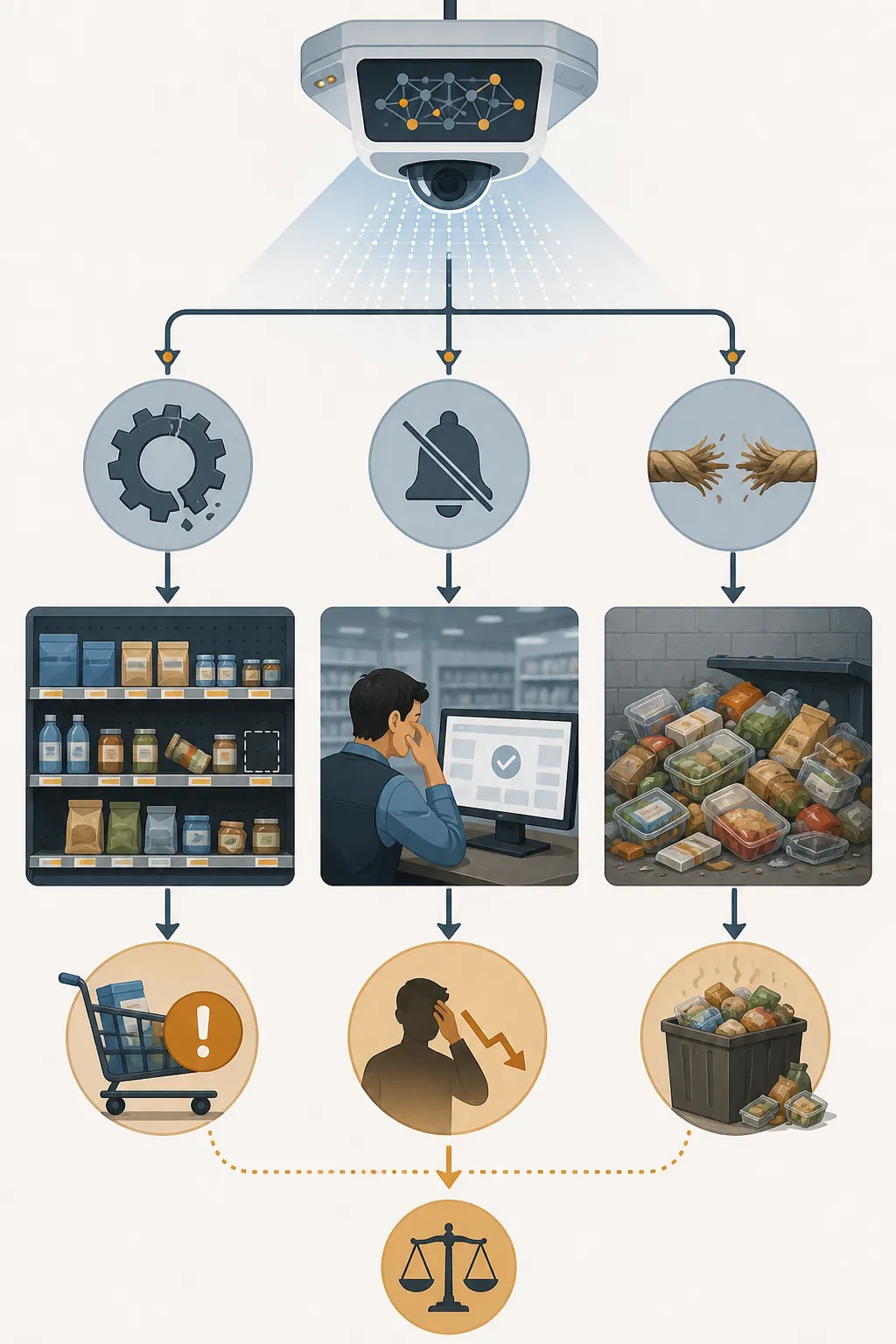
Mandatory use raises the stakes. If compliance is tracked and employees face disciplinary pressure for non-use, the company cannot later treat the tool as merely advisory without showing that employees were given a real, protected path to reject bad outputs. An override that exists only in theory is not much of a safeguard.
Negligence: what should have happened before scale
Negligence analysis would look at the conduct around the product: testing, rollout, monitoring, escalation, and retirement. The public facts do not disclose Starbucks’ internal testing record, acceptance criteria, or escalation process. That uncertainty cuts both ways. It prevents a confident liability conclusion, but it also identifies exactly what in-house counsel would need to defend the deployment.
| Record counsel would want | Why it matters |
|---|---|
| Real-store acceptance tests | Shows whether the tool was evaluated against lighting, reflections, packaging variation, employee pace, and network instability before national use. |
| Known-limitation log | Separates unexpected failure from failure modes the company or vendor already understood. |
| Exception and override records | Shows whether employees could correct bad counts without being penalized for non-compliance. |
| Rollout decision memo | Identifies who approved scale, what risk signals were known, and why deployment continued. |
| Post-deployment incident trail | Connects miscounts, over-ordering, waste, and store reports to the timeline of corrective action. |
The worst litigation record is not simply a failed AI system. It is a failed AI system surrounded by confident launch materials, sparse testing evidence, informal Slack assurances, and store complaints that never made it into a risk register. That record makes ordinary product-development uncertainty look like avoidable disregard.
Supply-chain AI already has a loss vocabulary
Foley & Lardner’s May 2026 analysis of agentic AI in autonomous supply-chain decisions identifies excess inventory, stockouts, unnecessary freight costs, and product damage as key liability risk areas.[5] That list makes the Starbucks episode look less like an odd retail mishap and more like a concrete version of risks counsel should already be screening.
Automated Counting did not need to negotiate supplier contracts or autonomously reroute freight to create exposure. It only needed to feed bad counts into an ordering workflow. If the output causes excess inventory, avoidable waste, or labor spent correcting errors, the legal analysis can move from “the AI was inaccurate” to “the AI caused a foreseeable operational loss.”
That distinction matters for board reporting. Adoption metrics show that a tool was deployed. Effectiveness metrics show whether it performed under real operating conditions. Loss metrics show who paid for the gap. Counsel should insist that all three remain separate.
The contract may be thinner than the loss
The Starbucks-NomadGo contract is not public, so no one outside the parties can say what liability cap, indemnity, warranty, or consequential-damage language governed the relationship. But the standard market concern is clear. Foley notes that AI vendor contracts typically cap liability at fees paid and exclude consequential damages.[5]
That structure may be tolerable for a low-risk internal assistant. It is much harder to justify when a vendor tool can cause enterprise-wide ordering errors. A fee-based cap may not approach the buyer’s downstream waste, labor, reputational harm, or business-interruption costs. A consequential-damages exclusion can be especially important when the most likely harm is not the cost of the software itself, but the operational loss triggered by bad outputs.
Vendor viability also belongs in the legal review, not only in procurement scoring. NomadGo was a 30-person startup and reportedly laid off a large chunk of its workforce after losing the Starbucks account, while continuing to work with other clients including Burger King franchises.[1][3] If the vendor cannot fund a defense, maintain the system, or satisfy indemnity obligations after a major customer exits, the paper allocation of risk may not be worth much.
Separate analyses of AI indemnification gaps and insurance gaps point in the same direction: the liability chain for AI tools can leave buyers exposed when vendor promises, policy language, and actual loss categories do not align.[6][7] For a physical retail deployment, counsel should review the contract and the insurance tower together. The question is not only who promised to indemnify. It is whether the promise survives the exclusion language, cap, insolvency risk, and claim type most likely to arise.
The EU software rule is a warning, not a shortcut
The EU’s revised Product Liability Directive requires member-state transposition by December 2026 and treats software, including AI systems, as products while extending strict-liability concepts across the distribution chain.[4] That matters as persuasive context for global companies, especially those harmonizing product-risk controls across jurisdictions.
It should not be overstated. The directive does not mean a U.S. court has already classified an enterprise inventory-counting system as a defective product. It does mean the direction of travel is visible: software is becoming harder to quarantine as a mere service when it is packaged, distributed, relied on, and capable of causing measurable loss.
What counsel should demand before an AI tool becomes mandatory infrastructure
The Starbucks record points to a practical pre-scale review. It is not enough to ask whether the demo worked or whether a pilot store liked the workflow. Counsel needs a deployment file that can later explain why the company believed the system was safe and fit for its intended use.
- Define acceptance testing in real operating conditions, including bad lighting, reflective surfaces, product substitutions, crowded storage, low staffing, and network interruptions.
- Require the vendor to disclose known limitations, controlled-test assumptions, material failure modes, and any gap between pilot accuracy and expected production accuracy.
- Create store-level warnings and override rules that employees can actually use without discipline when outputs appear wrong.
- Track exceptions, manual corrections, waste events, over-ordering, and user complaints in a form legal, operations, and procurement can review together.
- Negotiate indemnity, liability caps, warranty language, support obligations, audit rights, and insurance requirements around the loss categories the tool can realistically cause.
- Document the decision to continue, pause, narrow, or retire rollout when failure signals appear.
The most important document may be the least glamorous one: the record showing what the company knew after early failures and what it did next. If employees are reporting double-counts, lost data, or avoidable waste, silence in the deployment file will be read against the organization that kept requiring use.
Risk posture after Starbucks
Starbucks is not currently a filed product-liability case over Automated Counting. It is a clean corporate rehearsal for one. A mass-deployed enterprise AI tool made mandatory in physical stores, associated with a controlled-test accuracy claim, and later retired after operational failures and measurable waste gives counsel a fact pattern concrete enough to test design defect, failure to warn, negligence, indemnity, and insurance assumptions before the next rollout begins.
The safer lesson is not to stop buying operational AI. It is to stop treating scaled AI procurement as if the legal work starts after the business owner has already decided the pilot succeeded.
References
- Starbucks bet big on an AI tool at national scale. After 9 months, it scrapped it, Fast Company, https://www.fastcompany.com/91572019/starbucks-bet-big-ai-tool-national-scale-9-months-inventory-automated-counting-nomadgo
- Starbucks scraps AI inventory tool across North America, Reuters, https://www.reuters.com/business/starbucks-scraps-ai-inventory-tool-across-north-america-2026-05-21/
- Report: Starbucks scrapped an AI inventory tool and left a Seattle-area startup blindsided, GeekWire, https://www.geekwire.com/2026/report-starbucks-scrapped-an-ai-inventory-tool-and-left-a-seattle-area-startup-blindsided/
- AI Product Liability: The Next Wave of Litigation, K&L Gates, March 27, 2026, https://www.klgates.com/AI-Product-Liability-The-Next-Wave-of-Litigation-3-27-2026
- Agentic AI Liability in Autonomous Supply Chain Decisions, Foley & Lardner, May 2026, https://www.foley.com/insights/publications/2026/05/agentic-ai-liability-in-autonomous-supply-chain-decisions-identifying-and-preventing-legal-risks/
- AI Indemnification Gap: Liability Chain & Contracts, Tian Pan, May 14, 2026, https://tianpan.co/blog/2026-05-14-ai-indemnification-gap-liability-chain-contracts
- AI Insurance Gap: What It Means for Technology Contracts, Honigman, https://www.honigman.com/the-matrix/ai-insurance-gap-what-it-means-for-technology-contracts
Related records
Tool profile
Browse tool evaluations →Governing regulation
Browse the obligations tracker →Preventive workflow
Browse verification workflows →
Report a correction or tip
Spotted an outdated figure, a misstated fact, or a ruling this case record should reflect? Public comments are disabled for this content given the professional cost of a misreported case outcome, penalty amount, or rule text — use the structured correction channel instead.
Report a correction or tip for this record →