
Why Street Takeover Legal Risks Depend on the State
The exposure from a street takeover now reaches felony-tier consequences, but the penalty ladder varies sharply by state: the same conduct can draw a spectator infraction in one state and vehicle impoundment or felony charges in another. This digest maps confirmed statutes, penalty tiers, and named prosecutions in California, Florida, Texas, and Connecticut so counsel can assess a client's exposure before advising.
- Jurisdiction
- California, Florida, Texas, Connecticut
- Court
- State courts
- AI tool named
- No AI tool implicated
- Ruling date
- Jun 23, 2025
- Source document
- View primary court order ↗
- Last verified
- Aug 2, 2026
Lex Machina Review is an independent risk-tracking and reference resource. Nothing on this site is legal advice, and using it does not create an attorney-client relationship. Every record is reviewed against primary sources but may not reflect the most current status of a matter — always verify directly against the cited court order, rule text, or a licensed attorney before relying on it.
Companion explanation — secondary to the source document above
A street takeover file should not be opened as a generic traffic matter. The first useful questions are narrower: which state, which actor, which statute version, and which remedy the state is actually trying to use. A driver doing donuts, a person accused of coordinating the meet, the registered owner of the vehicle, and a spectator standing near the intersection can sit in very different legal positions even when everyone is described in the same police report as part of a “takeover.”
This is a legal-risk digest, not legal advice and not a national safety-statistics survey. It was last reviewed on August 2, 2026, and uses only the accessible sources listed in the references. Where the record supports only a statutory snapshot or a named prosecution, the discussion stays at that level. Florida’s statute is cited as the published 2024 version; counsel should check later session activity before relying on it in a pleading, charging memo, or opinion letter.
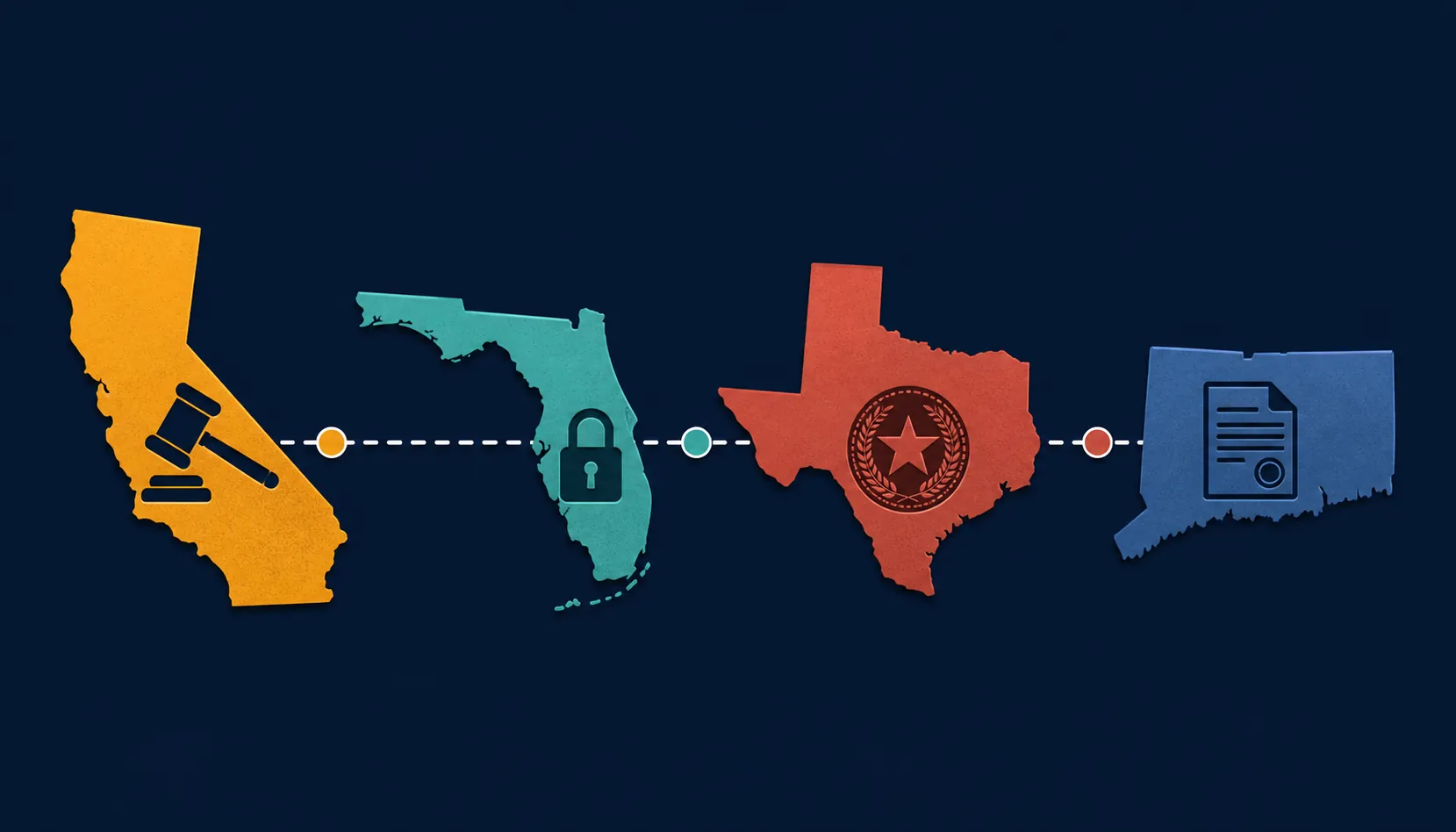
The same takeover can produce different legal exposure by state
California, Florida, Texas, and Connecticut illustrate the point cleanly. Each has moved toward more aggressive treatment of takeover conduct, but the tools are not interchangeable. California’s recent package emphasizes terminology, off-street locations, and impoundment reach. Florida’s statute supplies a detailed ladder for drivers, repeat offenders, coordinated takeovers, spectators, license revocation, and forfeiture. Texas gives enforcement agencies expanded impoundment authority and has paired that with statewide task-force activity. Connecticut’s 2025 law adds license-suspension consequences, municipal ordinance authority, and destruction authority for certain seized vehicles.
| State | Confirmed legal hook in this record | Actor categories the source clearly reaches | Key consequence |
|---|---|---|---|
| California | Four 2024 bills signed September 23, 2024, effective January 1, 2025: AB 1978, AB 2186, AB 2807, and AB 3085 | Drivers, participants in sideshows or street takeovers, and in specified circumstances spectator vehicles | Expanded impoundment, application to off-street parking lots, and statutory treatment of “sideshow” and “street takeover” as synonymous [1][2] |
| Florida | Florida Statutes §316.191, 2024 version | Drivers, repeat offenders, coordinated-street-takeover participants, spectators, and vehicle owners through forfeiture exposure | First-degree misdemeanor for a first offense, third-degree felony for a second offense within one year, felony treatment for coordinated street takeovers, fines, license revocation, spectator infraction, and possible forfeiture [3] |
| Texas | HB 1442 and HB 2899, signed August 2, 2023 | Persons connected to illegal street racing or takeover enforcement where vehicles are subject to impoundment | Impoundment without requiring property damage or injury; task-force enforcement reported more than 50 arrests, more than 590 traffic stops, and more than 390 citations [4] |
| Connecticut | Public Act 25-80, signed June 23, 2025 | Repeat violators, municipalities regulating takeover conduct, and owners or operators of certain seized ATVs and dirt bikes | Two-year license suspension for three or more violations, municipal ordinance authority, and destruction authority for seized ATVs and dirt bikes [5] |
That table is deliberately uneven. Florida can be mapped more tightly because the statute gives charge levels, fine ranges, license consequences, and forfeiture authority in one place. California requires attention to the 2025-effective bill package and how it broadens enforcement settings and impoundment. Texas and Connecticut are still important to an exposure analysis, but the accessible sources in this record support a narrower description.
Florida: the clearest statutory penalty ladder
Florida §316.191 is the cleanest example of why “traffic offense” can be a misleading label. Under the 2024 version, a first violation of the racing and related conduct provisions is a first-degree misdemeanor, with a fine of at least $500 and not more than $2,000, and the court must revoke the person’s driver license for one year. A second violation within one year is a third-degree felony. The statute also separately addresses a “coordinated street takeover,” defined around a threshold of 10 or more vehicles, and attaches felony treatment, a $2,500 to $4,000 fine range, and possible forfeiture under the Florida Contraband Forfeiture Act. Spectating is not treated the same way: the statute makes it a noncriminal traffic infraction punishable by a $400 penalty. [3]

For charging and counseling purposes, those distinctions matter more than the shared scene. A Florida driver accused of active takeover conduct is not in the same position as a bystander cited as a spectator. A person tied to a coordinated event involving the statutory vehicle threshold is not just facing the ordinary first-offense misdemeanor analysis. A registered owner may need immediate advice about seizure and forfeiture exposure, not only about the underlying driving count.
The driver-license consequence is also not a side issue. A one-year revocation on a first offense changes the practical value of a plea even where jail exposure is not the client’s main fear. For a commercial driver, rideshare worker, delivery worker, student commuter, or employee whose job turns on driving, the license result may carry more immediate economic weight than the fine range.
Florida also shows why actor category should be set at intake. “Was the client driving?” is only the first pass. The next pass is whether the state is alleging coordination, whether the event involved enough vehicles to trigger the coordinated-takeover provision, whether the vehicle was seized, and whether the cited person was charged as a participant or as a spectator. Those are not cosmetic differences; they change the available penalty box.
California: 2025-effective changes expand where and what police can reach
California’s recent changes are less a single ladder than a widening of enforcement reach. On September 23, 2024, the governor signed AB 1978, AB 2186, AB 2807, and AB 3085, a bipartisan package addressing sideshows and street takeovers. The governor’s announcement described the bills as expanding vehicle impoundment authority, extending enforcement to off-street parking lots, and making “sideshow” and “street takeover” synonymous in the Vehicle Code. The California Highway Patrol’s 2025 new-laws summary likewise identifies the package as effective January 1, 2025. [1][2]
For a California file, the location question is no longer limited to the intersection that appears in most takeover videos. The 2025-effective package reaches off-street parking lots, which matters for events staged in retail centers, industrial lots, and other private or semi-private spaces. A client may still have Fourth Amendment, identification, ownership, or statutory-interpretation arguments, but the first assumption should not be that off-street conduct falls outside the takeover framework.
Impoundment also requires separate attention. California’s public materials describe expanded impoundment authority, and reporting on the new laws specifically identified measures targeting spectators and their vehicles. That means the vehicle question is not confined to the driver’s car. Counsel should ask who owns the car, who drove it to the scene, whether police claim it was used to block traffic or facilitate the event, and whether the vehicle was connected to spectating rather than stunt driving. [1][6]
California is also where the named prosecution record gives the legal-risk discussion its hardest edge. Dante Chapple Young received a 13-year state-prison sentence for vehicular manslaughter with gross negligence after a Christmas Day 2022 Los Angeles street takeover killed a spectator. The Los Angeles County District Attorney’s Office has cited that case while describing enforcement against street takeovers. [7]
The point is not that every takeover case becomes a manslaughter case. It is that fatality-linked conduct changes the file from nuisance or reckless-driving shorthand into prison-exposure territory. Once a death is tied to the driving, counsel is no longer pricing a citation; counsel is reading homicide statutes, causation proof, video evidence, identification evidence, and any statements tying the accused to the maneuver that caused the death.
Organizer exposure is not the same as driver exposure
The organizer theory is a separate risk channel. Erick Romero Quintana, described in the Los Angeles Times as a street-racing influencer, was charged with 16 conspiracy counts tied to allegations that he used Instagram to organize 16 takeovers; the report states he faced up to 13 years if convicted. He pleaded not guilty, and his defense characterized the prosecution as “overkill.” [8]
That posture matters. Quintana is not a conviction benchmark in this record. He is useful because the charging theory shows how prosecutors may try to move beyond the person behind the wheel. If the state can plead and prove agreement, promotion, coordination, or facilitation, the social-media account and event logistics can become evidence in a conspiracy case rather than background color.
For defense review, that means preserving the line between speech, promotion, attendance, and agreement. A reposted flyer, a group chat, a location pin, a livestream, and a direct instruction to block an intersection are not automatically equivalent. They may all appear in the same discovery packet, but they do different work if the state is trying to prove conspiracy rather than presence.
Texas: impoundment authority and task-force enforcement
Texas entered this record through HB 1442 and HB 2899, signed August 2, 2023. The governor’s office described the laws as part of a crackdown on illegal street racing, including authority to impound vehicles without requiring property damage or injury. The same announcement stated that a statewide task force had reported more than 50 arrests, more than 590 traffic stops, and more than 390 citations. [4]
Those figures are enforcement outputs, not proof of conviction rates or statutory effectiveness. Still, they are relevant to risk assessment because they show that the impoundment power is not merely theoretical in the state’s public enforcement posture. A Texas assessment should treat vehicle custody as an immediate practical issue, not something to be handled after the criminal case resolves.
The available Texas source in this record does not support a full actor-by-actor penalty chart comparable to Florida’s statute. It does support a narrower conclusion: Texas has made impoundment easier in the illegal street-racing and takeover context, and the governor’s office has publicly tied that legal change to statewide enforcement activity.
Connecticut: repeat-violation suspension, local ordinances, and destruction authority
Connecticut’s Public Act 25-80 was signed June 23, 2025. The governor’s office described it as legislation cracking down on street takeovers and identified three pieces especially relevant to exposure review: a two-year license suspension for three or more violations, authority for municipalities to adopt ordinances addressing street takeovers, and authority for the destruction of seized ATVs and dirt bikes. [5]
The municipal-ordinance point deserves notice because it can add a local layer to the state-law analysis. A Connecticut file may require checking both the state statute and the municipality’s code before advising on likely consequences. The seized-vehicle destruction authority also changes the conversation for ATV and dirt-bike matters: the risk is not only a ticket, tow bill, or temporary impound.
As with Texas, the accessible Connecticut material used here does not provide the same granular ladder as Florida §316.191. It does, however, confirm that the state’s 2025 approach reaches beyond ordinary citation practice, especially for repeat violations and certain seized vehicles.
What to separate before estimating exposure
The legal work starts by sorting the person from the event. Police reports and press releases often use group language. Charging documents do not have that luxury. A useful first-pass matrix separates at least four positions:
- Driver: the person accused of racing, drifting, doing donuts, blocking movement through driving conduct, or causing injury or death.
- Organizer or promoter: the person accused of arranging the location, time, participant list, route, online promotion, or coordinated conduct.
- Vehicle owner: the person whose car, ATV, dirt bike, or other vehicle may be towed, impounded, forfeited, or destroyed, even if ownership and operation are disputed.
- Spectator: the person accused of attending, watching, filming, blocking, or otherwise supporting the event without being the stunt driver.
Florida expressly distinguishes spectator treatment from more serious takeover conduct. California’s 2025-effective package and related reporting make spectator vehicles part of the impoundment discussion. Quintana’s pending Los Angeles prosecution shows how organizer allegations can be charged separately from stunt driving. Chapple Young’s sentence shows why a death at the scene changes the scale of exposure. Those are not four versions of the same risk.
The second separation is between criminal punishment and property consequences. A client may focus on the misdemeanor or felony label while the state moves first on the vehicle. In some cases, the most urgent deadline may involve retrieving, contesting, or preserving a car, ATV, or dirt bike, not negotiating the final criminal disposition.
The third separation is between adoption and outcomes. A statute authorizing impoundment or forfeiture does not prove how often prosecutors obtain forfeiture. A task-force arrest count does not establish conviction rates. A pending conspiracy prosecution does not establish guilt. The confirmed point is still significant: legislatures and prosecutors have tools that did not fit the older assumption that takeover conduct would be handled as a minor traffic episode.
What is not included in this map
Several states and proposals appear in public discussion of street takeovers, including Virginia, New York, North Carolina, and Missouri. They are not treated here as current-law comparators because the relevant statutory details were not verified from accessible primary sources in this record. Legislative claims repeated through inaccessible or secondary pages should not be converted into penalty advice.
This article also does not rely on broad crash, death, arrest, or firearm compilations that were not part of the verified penalty-map record. Street takeovers are plainly dangerous in the ordinary sense, and the Chapple Young prosecution supplies a concrete fatality-linked anchor. But a legal-risk digest should not mix statutory exposure with harm statistics unless the data source and methodology are separately evaluated.
The practical legal read
The answer to “why street takeovers are dangerous legal and safety risks” is no longer limited to reckless driving. In the verified materials here, a takeover can produce misdemeanor exposure, felony exposure, license revocation or suspension, vehicle impoundment, forfeiture, destruction of certain seized vehicles, and conspiracy charges aimed at alleged organizers. A fatality can move the file into gross-negligence vehicular manslaughter and state-prison sentencing.
But none of that should be advised from a national street-racing assumption. The state controls the ladder. The actor category controls the rung. The statute version controls the remedy. Before estimating risk, counsel needs the jurisdiction, the filed or likely charge, the client’s role, the vehicle status, and the enforcement record that actually applies.
References
- Governor Newsom signs bipartisan bills to address sideshows and street takeovers, Office of Governor of California, September 23, 2024
- CHP Highlights New Laws for 2025, California Highway Patrol
- Florida Statutes 316.191, Florida Senate, 2024
- Governor Abbott Signs Laws Cracking Down On Illegal Street Racing, Office of the Texas Governor, August 2, 2023
- Governor Lamont Signs Legislation Cracking Down on Street Takeovers, Connecticut Governor’s Office, June 23, 2025
- New CA laws target street takeover spectators and their vehicles, ABC7 Los Angeles
- District Attorney Hochman Works with Law Enforcement to Crack Down on Street Takeovers, Los Angeles County District Attorney’s Office
- L.A. street racing influencer charged with organizing takeovers, Los Angeles Times, June 5, 2025
Related records
Tool profile
How Meta's AI Spending Reshapes Law Firm ProfitabilityGoverning regulation
Browse the obligations tracker →Preventive workflow
Browse verification workflows →
Report a correction or tip
Spotted an outdated figure, a misstated fact, or a ruling this case record should reflect? Public comments are disabled for this content given the professional cost of a misreported case outcome, penalty amount, or rule text — use the structured correction channel instead.
Report a correction or tip for this record →