
The Suttles Arrest Exposes NIL Collective Governance Gaps
The July 2026 arrest of a Yea Alabama director on solicitation charges highlights a systemic regulatory vacuum: no mandated background checks or board-oversight standards exist for NIL entity personnel. This article analyzes the specific D&O, tax-status, and reputational risks this gap creates for universities, collective boards, and insurers.
- Jurisdiction
- US-Alabama
- Court
- Shelby County (AL) District Court
- AI tool named
- No AI tool
- Ruling date
- Jul 23, 2026
- Source document
- View primary court order ↗
- Last verified
- Jul 26, 2026
Lex Machina Review is an independent risk-tracking and reference resource. Nothing on this site is legal advice, and using it does not create an attorney-client relationship. Every record is reviewed against primary sources but may not reflect the most current status of a matter — always verify directly against the cited court order, rule text, or a licensed attorney before relying on it.
Companion explanation — secondary to the source document above
The legal significance of Aaron Suttles’ arrest begins with a narrow record, not with a conclusion about guilt. Suttles, identified as Yea Alabama’s Director of Content, was arrested on July 23, 2026, during a Shelby County human-trafficking operation, charged with soliciting prostitution, and released on a $1,000 bond; Yea Alabama suspended him the same day, according to local reporting.[1] Yahoo Sports also reported the arrest and described Suttles as a former sportswriter working for Alabama’s NIL operation.[2] That distinction matters for any legal analysis of the arrest’s impact on college NIL collectives: this is an arrest-based risk assessment, not an assertion that Suttles committed the charged offense or that any regulator has already acted against Alabama, Yea Alabama, or affiliated nonprofit structures.
The same-day suspension is not a throwaway fact. It shows the entity had at least one line it could enforce after the event. The harder question is whether that line had an owner before the event: who screened the person, who approved the role, who understood the access attached to it, who reported concerns upward, and who had board-level visibility into personnel risk.

The separateness problem is practical, not semantic
The University of Alabama’s own public description of Yea Alabama makes the governance question difficult to dismiss as an outside-fan problem. When Yea Alabama was announced in 2023, Alabama described it as the “official University of Alabama NIL entity” and explained that it would include subscribers, tax-deductible contributions through the Walk of Champions nonprofit, and sponsors.[3] That is a sophisticated public-facing structure. It solicits money, associates itself with the athletics brand, and presents a sanctioned channel for supporters who want to participate in Alabama NIL.
At the same time, WBRC reported that the university said Suttles “is not a University of Alabama employee.”[1] That statement may be accurate and legally important. It also does not answer the operational question that matters most after a personnel incident at an officially approved NIL entity. If the person was not inside university HR, whose HR system applied? If the NIL entity was close enough to carry official approval, who required a documented personnel-vetting process before the role existed?
This is where clean organizational charts tend to underperform. A university can be separate from an NIL entity for employment-law purposes and still face reputational, compliance, insurance, and donor-relations consequences when that entity’s personnel are publicly understood as part of the school’s NIL infrastructure. Separateness may answer one legal question. It does not, by itself, prove that the risk was assigned, reviewed, insured, and escalated.
The missing control category: personnel governance
NIL compliance has developed around transactions: whether a deal is genuine, whether an athlete performed services, whether a payment is disguised pay-for-play, whether a donor or associated entity is too close to the institution. Those are real questions. They are not the same question as whether the people operating NIL entities have been vetted, supervised, and made accountable to a board.
A D&O insurance analysis published by PLUS identifies the gap plainly: NIL collectives operate without mandated background checks, director-fitness standards, board-composition rules, or clear governance requirements, even as NIL entities have become large financial and operational actors in college sports.[4] The same analysis flags management-liability concerns around fiduciary duty, supervision, nonprofit compliance, and policy exclusions for criminal conduct.[4] That is the architecture problem exposed by the Suttles arrest. The arrest did not create the governance gap; it made the gap visible in a way that a board, insurer, or university counsel can no longer treat as theoretical.
| Control question | Why it matters after the Suttles arrest |
|---|---|
| Was a background check required for NIL entity staff or directors? | Current materials identify no general NIL-specific mandate requiring one. |
| Who approved access to athletes, donors, brand channels, or official NIL communications? | Official affiliation can create institutional reliance even where employment status remains separate. |
| Did the board receive personnel-risk reporting? | D&O exposure often turns on whether oversight duties were defined and documented. |
| Did insurance underwriting contemplate personnel misconduct at a NIL entity? | Criminal-conduct exclusions and supervision allegations can point in different directions. |
| Did nonprofit-linked fundraising policies address staff conduct and escalation? | Tax-exempt credibility depends on governance discipline, not only charitable wording. |
None of those questions assumes wrongdoing by Alabama or Yea Alabama. They are the questions a functioning control environment should be able to answer without improvising after an arrest. If the answer is “we are separate,” the follow-up is not hostile. It is basic: separate under whose governance documents, with what vetting standard, reported to which board committee, and disclosed to which insurer?
Why transaction-focused NIL reforms do not solve this
Several newer NIL guardrails are meaningful. The problem is that they mostly regulate conduct around deals, agents, and financial arrangements. They do not create a general personnel-vetting regime for the people who manage NIL entities.
Louisiana’s agent-registration law is a useful example of a real but narrow intervention. The law requires criminal background checks for athlete agents, according to Fennemore’s analysis of NIL agent regulation.[5] That helps where the person is acting as an athlete agent within the law’s scope. It does not broadly answer whether an NIL collective employee, content director, fundraiser, board member, sponsor-relations lead, or operations contractor must undergo screening before receiving access to NIL infrastructure.
The College Sports Commission’s NIL Go process and January 2026 guidance also work in a different lane. NIL Revolution reported that CSC guidance emphasizes “substance over form” and expects NIL arrangements, including arrangements involving associated entities, to contain reasonable specificity of activation.[6] That is a deal-review discipline. It can test whether a transaction is dressed up as something it is not. It does not test whether the person running content, donor outreach, sponsorship activation, or athlete coordination has a criminal-history screen, conflict review, conduct policy, or board-approved role description.
The April 2026 Executive Order likewise focuses on improper financial conduct. Baker Donelson summarized the order as tying federal grants and contracts to compliance with governing-body rules and defining improper financial activities to include collectives facilitating pay-for-play, with suspension and debarment among the possible consequences.[7] That is a serious federal-funding lever. It still is not a standalone HR code for NIL entity directors, officers, contractors, or staff.
The negative space is the point. NIL governance is becoming more formal where money changes hands, where athletes perform activations, and where institutions are charged with knowledge of associated-entity activity. The person-level controls around who operates those structures remain far less developed.
The exposure is not one lawsuit-shaped risk
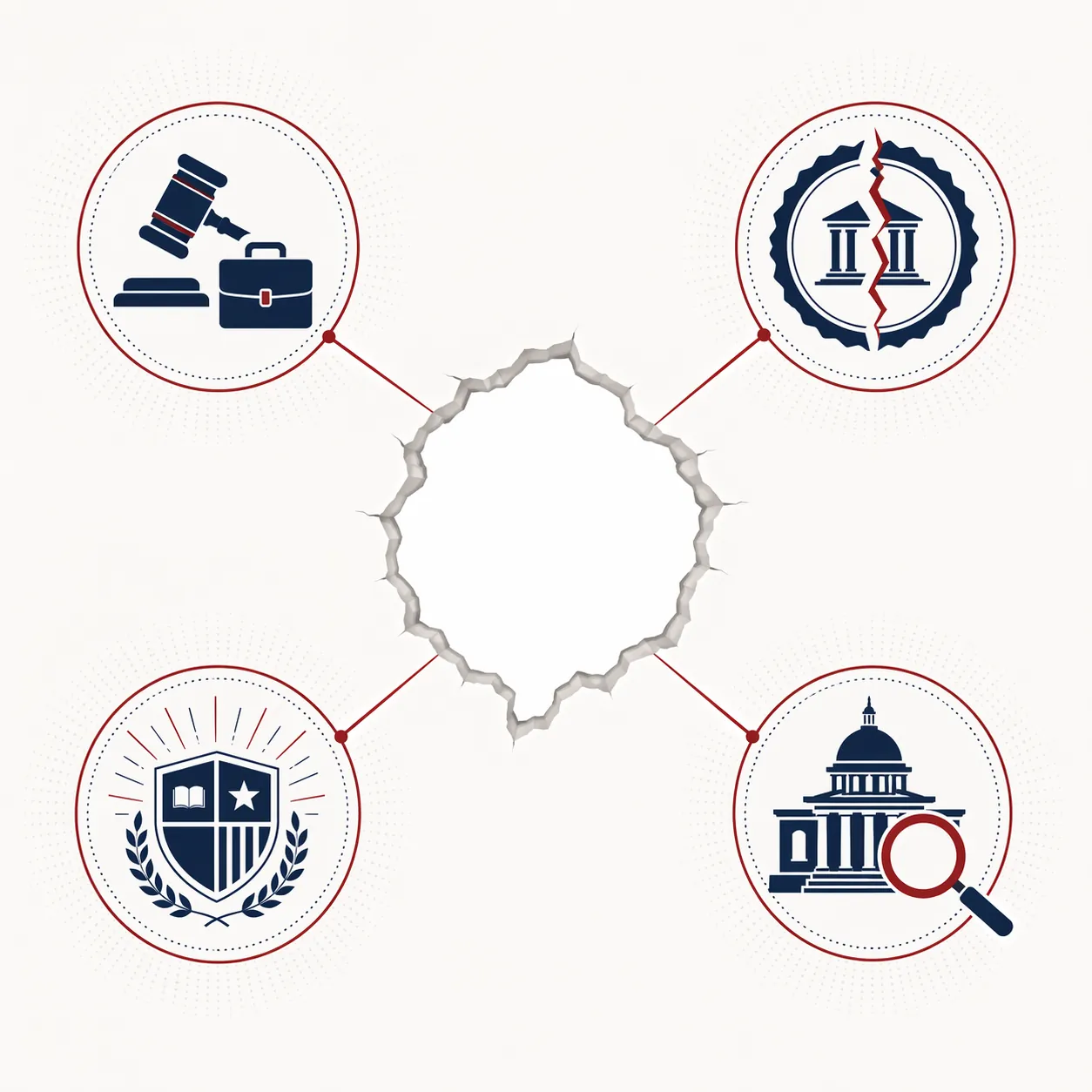
A personnel-vetting gap at an NIL entity does not point to one automatic consequence. It creates several different pressure points, each with a different burden of proof and a different audience. That is why boards and insurers should avoid treating the Suttles matter as only an embarrassing personnel headline.
D&O exposure turns on supervision, not the underlying charge alone
The most direct governance risk is a management-liability theory: directors and officers failed to implement reasonable controls over personnel who represented or operated the NIL entity. PLUS identifies breach of fiduciary duty for failure to supervise as a D&O risk vector for NIL collectives, along with the complications created by criminal-conduct exclusions.[4]
That does not mean a D&O claim is inevitable here. The available record does not establish that a board ignored warning signs, that a policy existed and was violated, or that an insurer has reserved rights. The lesson is more basic and more useful: if a claim were made after a personnel incident, the board would want to show that staff roles were defined, vetting was required, access was limited by role, misconduct reports had a path upward, and suspension authority was not invented in the middle of a news cycle.
Tax-exempt risk is a governance credibility problem
Yea Alabama’s announced funding model included tax-deductible contributions through the Walk of Champions nonprofit.[3] That does not mean the Suttles arrest jeopardizes any entity’s tax status. No source in the current record reports IRS action, a tax inquiry, or revocation proceedings. The risk is conditional: where NIL operations rely on nonprofit-linked fundraising, personnel misconduct can become relevant to whether governance systems are strong enough to protect charitable purpose and donor trust.
PLUS separately identifies 501(c)(3) compliance as a concern for NIL collectives.[4] In practical terms, that makes personnel controls part of tax-risk hygiene. A nonprofit does not protect itself only by describing a charitable mission. It protects itself by showing that people with authority over funds, athletes, donors, public communications, and affiliated programming are selected and supervised through documented processes.
NCAA knowledge rules make reputational contagion harder to cabin
The NCAA-facing risk is not that an arrest for solicitation is itself an NIL violation. The more relevant development is the expansion of institutional-knowledge obligations. Butler Snow’s 2026 NIL analysis explains that October 2025 NCAA Division I Board amendments impose affirmative compliance duties when athletics staff, donors, or boosters are aware of NIL activity at booster collectives or other associated entities.[8]
Those amendments do not convert every NIL entity personnel problem into an NCAA case. They do, however, make it less comfortable for an institution to rely on an after-the-fact statement that a person was not a university employee when the entity itself was officially approved, publicly connected to the athletics brand, and used by supporters as a sanctioned NIL channel. Once knowledge obligations expand around associated entities, universities need a way to show what they knew, what they were required to know, and how concerns moved between athletics, compliance, counsel, and the NIL entity.
Federal-funding pressure may attach to weak NIL controls even without a personnel rule
The April 2026 Executive Order does not create a background-check mandate for NIL entity personnel. Its relevance is indirect. By tying federal grants and contracts to compliance with governing-body rules and targeting improper NIL financial activities, the order gives federal actors a compliance hook where NIL structures appear to facilitate fraud, pay-for-play, or other improper financial conduct.[7]
A solicitation arrest is not the same thing as improper NIL financial activity. It should not be described as though it were. But weak personnel governance can become part of an investigative picture if an NIL entity already faces questions about finances, activation, donor influence, or associated-entity arrangements. In that setting, an inability to identify who approved roles, access, and oversight can make the whole compliance environment look unmanaged.
What a defensible NIL personnel file would need to show
The governance answer does not need to be elaborate. It needs to be assigned. NIL entities that handle subscriptions, sponsorships, donor money, athlete relationships, content, and institutional brand proximity should be able to produce a personnel-control record before a crisis forces the issue.
- Role definition: a written description of duties, authority, athlete contact, donor contact, brand access, and communications privileges.
- Vetting standard: a documented background-check and conflict-review process calibrated to the person’s access and authority.
- Board oversight: minutes or committee materials showing that personnel-risk policies were approved, reviewed, and periodically updated.
- Escalation path: a clear route for misconduct reports from NIL staff, athletes, university contacts, sponsors, or donors to the right decision-maker.
- Insurance alignment: D&O and related policies reviewed against supervision claims, criminal-conduct exclusions, nonprofit exposures, and affiliated-entity ambiguity.
- University interface: written rules for what athletics compliance, university counsel, and NIL entity leadership share with one another without collapsing legal separateness.
That last point is often the most sensitive. Universities do not want to become the employer, controller, or guarantor of every NIL entity employee. But a university that approves an official NIL channel cannot prudently treat personnel governance as someone else’s informal problem. The safer design is not to blur the entities. It is to document where the boundary sits and what information must cross it when risk appears.
The narrower conclusion
The Suttles arrest does not prove that Yea Alabama’s board failed, that Alabama violated NCAA rules, that a nonprofit tax problem exists, or that federal authorities will investigate. The current public record does not support those claims. It supports a narrower and more durable conclusion: NIL entities can be sophisticated enough to raise money through subscriptions, sponsors, and tax-deductible channels while still operating in a personnel-governance environment with no general mandated background checks, no director-fitness standards, and no NIL-specific board-oversight regime.
That gap now has a concrete fact pattern attached to it. For university counsel, athletics compliance officers, collective boards, and D&O underwriters, the useful response is not to predict enforcement. It is to stop treating NIL personnel governance as informal infrastructure. The file should show who was vetted, who had access, who supervised, who reported, who insured the risk, and who had authority to act before the suspension became necessary.
References
- University of Alabama NIL Content Director arrested in human trafficking operation, WBRC, July 24, 2026
- Alabama NIL director, former sportswriter arrested in human trafficking operation, Yahoo Sports
- Yea Alabama Unveiled as Official University of Alabama NIL Entity, RollTide.com, February 2, 2023
- Challenges of Insuring an NIL Collective, PLUS
- NIL Agents: The Good, The Bad, and The Unregulated, Fennemore Law
- Enforcement on the Horizon? CSC Issues NIL Guidance, NIL Revolution, January 2026
- Executive Order Targets College Athletics Compliance, NIL Practices, and Federal Funding, Baker Donelson
- NIL After House: What Name, Image and Likeness Means for Colleges and Higher Education Institutions in 2026, Butler Snow
Related records
Tool profile
How Meta's AI Spending Reshapes Law Firm ProfitabilityGoverning regulation
Browse the obligations tracker →Preventive workflow
Browse verification workflows →
Report a correction or tip
Spotted an outdated figure, a misstated fact, or a ruling this case record should reflect? Public comments are disabled for this content given the professional cost of a misreported case outcome, penalty amount, or rule text — use the structured correction channel instead.
Report a correction or tip for this record →