
Taco Bell Cyclospora Lawsuits Test Strict Product Liability
The article outlines the legal theories, defendants, and settlement benchmarks in the 2026 Taco Bell cyclospora outbreak, providing litigators and defense counsel with a framework for evaluating potential claims and supply-chain liability allocation.
- Jurisdiction
- US Federal
- Court
- Northern District of Ohio
- AI tool named
- No AI tool
- Ruling date
- Jul 16, 2026
- Source document
- View primary court order ↗
- Last verified
- Jul 25, 2026
Lex Machina Review is an independent risk-tracking and reference resource. Nothing on this site is legal advice, and using it does not create an attorney-client relationship. Every record is reviewed against primary sources but may not reflect the most current status of a matter — always verify directly against the cited court order, rule text, or a licensed attorney before relying on it.
Companion explanation — secondary to the source document above
The Taco Bell cyclospora outbreak lawsuits begin in an awkward evidentiary posture: the public-health record is large enough to support immediate litigation, but the traceback record is not finished in the way defendants will want it finished. As of July 24, 2026, CDC and FDA materials tied the outbreak investigation to 1,947 confirmed outbreak-linked illnesses across 9 states, at least 98 hospitalizations, and no deaths; Michigan separately reported 8,176 total cases, a much broader figure that should not be treated as the Taco Bell-linked case count without qualification.[1][2]
That distinction matters for the food-safety litigation record because strict product liability can reduce the plaintiff’s need to prove how a defendant behaved, but it does not erase the need to prove what food caused the illness. A plaintiff who can show a dated Taco Bell meal, a compatible incubation period, laboratory-confirmed cyclosporiasis, medical treatment, and economic loss is in a different legal position from someone relying on regional case counts and a brand name.

The first lawsuits arrived quickly. The first reported suit, Ayyad v. Pacific Bells, was filed July 16 in the Northern District of Ohio against a Taco Bell operator.[3] Restaurant Dive’s early inventory also identified Parrish v. Taco Bell Corp. and Taylor Farms in the Eastern District of Michigan, Null v. Taylor Farms as a California economic-loss class action, and Granados v. Taylor Farms in California.[4] Seven suits within a week of the CDC/FDA announcement is not proof of liability. It is proof that plaintiffs’ counsel already view the outbreak as actionable.
The Lawsuits Are Moving Faster Than The Traceback Record
Early foodborne-illness dockets often look more settled than they are. Complaints name the restaurant, the supplier, sometimes the franchisor, sometimes unknown growers, and then plead the legal theories broad enough to preserve claims while epidemiologists and regulators continue their work. Reuters identified the theories appearing in the post-outbreak litigation as including strict product liability, breach of implied warranty, negligence, and state consumer protection claims.[5]
Those theories do different work. Negligence asks what a defendant failed to do. Warranty asks what the sale implicitly promised. Consumer protection claims may focus on unfair or deceptive conduct, depending on state law. Strict product liability is the cleaner route for many illness plaintiffs because it can attach to a defective food product sold into the stream of commerce without requiring the plaintiff to prove the restaurant, distributor, processor, or grower was careless in a conventional sense.
But strict liability is not causation-free liability. The plaintiff still has to connect the meal to the pathogen, the pathogen to the illness, and the illness to the claimed damages. In this outbreak, that proof will likely depend heavily on exposure timing, purchase records, medical testing, public-health interviews, and the strength of the supply-chain traceback.
| Issue | What It Does In Early Case Assessment |
|---|---|
| Confirmed outbreak-linked case count | Shows the public-health investigation has identified a defined cluster, not merely isolated complaints. |
| Michigan total case count | Signals broader regional severity, but should not be treated as the Taco Bell-linked count without separation. |
| No confirmed positive product test | Gives defendants a concrete causation challenge, even if it does not end the case. |
| Multiple suits in multiple courts | Shows plaintiffs are moving toward coordinated litigation pressure before the full record is public. |
Why Strict Product Liability Changes The Defendant Map
The most important litigation question is not whether one defendant can be blamed in a press release. It is how risk moves through the chain once contaminated lettuce is alleged to have reached a customer through a franchise restaurant system. That is where strict product liability has teeth.
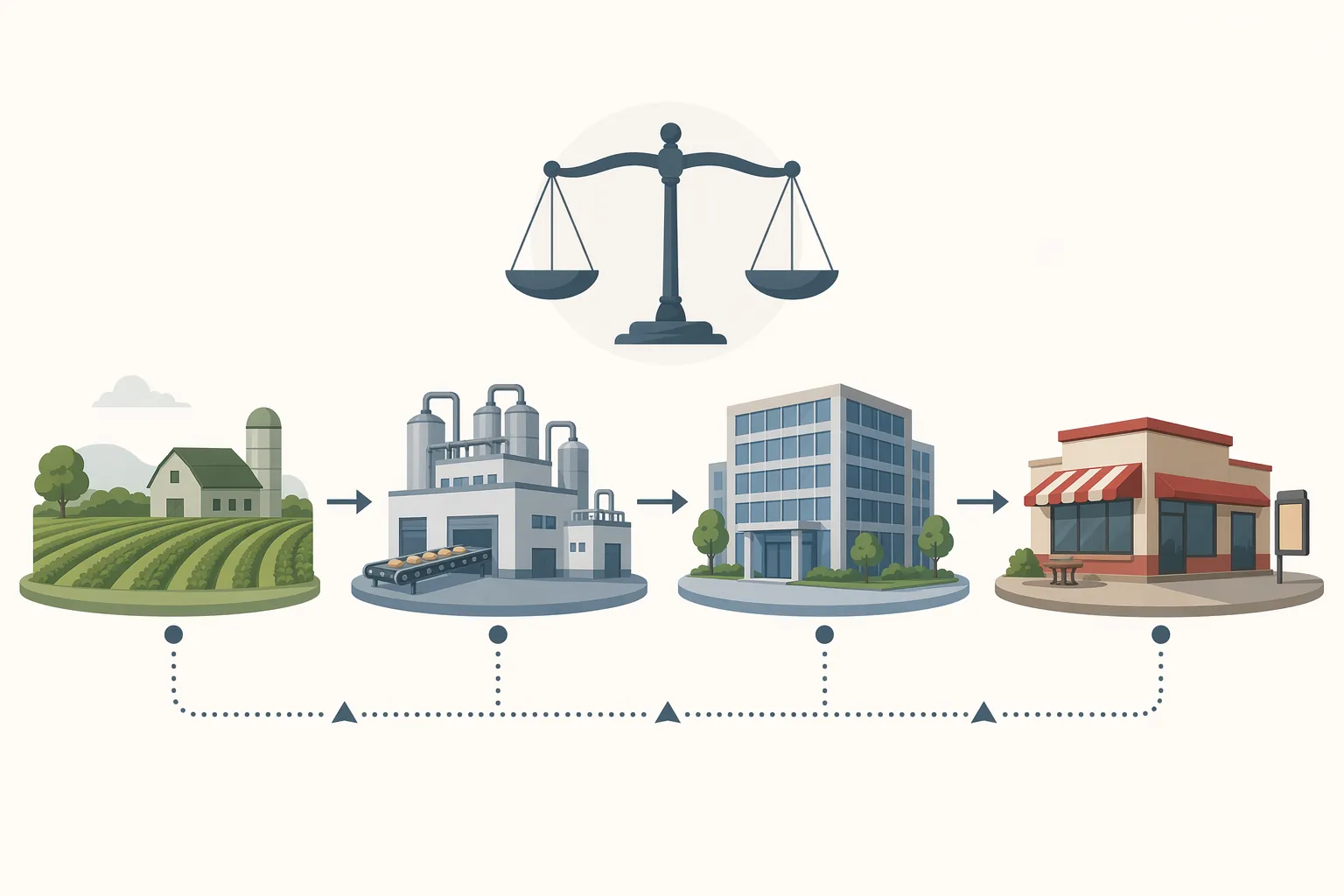
A franchisee such as Pacific Bells is an obvious target when the alleged meal was bought at one of its restaurants. The claim does not need to start with an unsafe kitchen practice. If the restaurant sold food that was defective because it carried cyclospora, the local operator can be pulled into the case as the seller closest to the consumer.
The franchisor position is more contested but still foreseeable. Taco Bell Corp. may be named because plaintiffs will want discovery into menu specifications, approved suppliers, food-safety protocols, supply-chain control, and the degree of operational authority exercised over franchise locations. The legal fight is likely to turn less on brand ownership in the abstract and more on control, specification, distribution decisions, and the franchisor’s role in the chain that delivered the lettuce.
Supplier entities such as Taylor Farms and Taylor Fresh Foods sit in a different position. If the lettuce moved through their processing, packing, distribution, or contracting systems, plaintiffs can frame them not as distant business partners but as participants in placing the allegedly defective ingredient into commerce. That does not establish contamination at their facilities. It does explain why they are central defendants rather than peripheral witnesses.
Unnamed growers, pleaded as John Doe defendants in some foodborne cases, preserve the possibility that the source traces further upstream. That is not just a pleading habit. In a produce outbreak, the legally important act may have occurred before restaurant handling and before processing, especially if the contaminant entered through agricultural water, field conditions, harvesting, or raw-product commingling. The present record does not establish which of those pathways occurred here.
The Missing Product-Positive Test Is A Real Gap, Not A Defense Verdict
Defense counsel will not ignore the absence of a confirmed positive product sample. The FDA had not confirmed a single positive cyclospora test on a product sample in the available investigation record.[2] AP also reported the same practical problem in narrower scientific terms: cyclospora cannot be cultured in labs, and whole-genome sequencing is not available for it in the way lawyers may expect from bacterial outbreak litigation.[6]
That matters because whole-genome sequencing can make some foodborne cases feel almost mechanical: clinical isolates match food or environmental isolates, and the fight shifts to damages and allocation. Cyclospora cases often do not give counsel that kind of evidentiary comfort. The proof tends to sit in epidemiology, traceback, exposure windows, menu commonalities, and the exclusion of competing sources.
Plaintiffs can still proceed without a product-positive test. Foodborne cases have long been built on epidemiological proof when direct testing is unavailable, untimely, or scientifically limited. The mistake would be to treat the missing test as legally irrelevant. It is the gap defendants will use to challenge general causation, specific causation, and the scope of any proposed class or coordinated proceeding.
The broad Michigan number illustrates the danger. A very large state-level count may make the outbreak feel overwhelming, but a claim does not become Taco Bell-linked simply because it arose in the same season or state. For individual injury cases, the useful record is narrower: where the person ate, what they ate, when symptoms began, whether a clinician ordered appropriate testing, whether the diagnosis was confirmed, and whether public-health investigators tied the exposure to the cluster.
Class Framing Has A Causation Problem Individual Cases May Not
Economic-loss class actions can appear quickly in outbreak litigation because they do not require every putative class member to prove hospitalization or severe illness. Null v. Taylor Farms, identified in Restaurant Dive’s inventory as a California economic-loss class action, fits that early pattern.[4] The theory may be easier to plead at scale than personal injury causation, but it is not automatically easier to certify or value.
A personal injury plaintiff with a dated receipt, a lab-confirmed cyclospora diagnosis, documented treatment, and missed work may have a fact pattern that is smaller but stronger. A broad class theory may have cleaner numerosity and messier exposure proof. Courts and defendants will look for differences in where food was purchased, what product was consumed, whether the consumer became ill, and whether the alleged loss is tied to a defective product rather than generalized concern after the announcement.
That is why lawsuit counts are a crude signal. They show speed and pressure. They do not show which claims will survive motion practice, which plaintiffs can prove medical causation, or how fault will be allocated among restaurant operator, franchisor, supplier, and growers.
Valuation Starts With Severity, Not The Brand Name
The only settlement benchmark in the available record is not from this outbreak. Reuters quoted Bill Marler as saying his firm’s prior cyclospora cases have resolved in a range from $25,000 to more than $1 million, depending on illness severity.[5] That is useful, but only if treated as a benchmark rather than a forecast.
The lower end of that benchmark is not a default offer for every person who ate at Taco Bell during the relevant period. The higher end is not unlocked by the size of the outbreak alone. The practical valuation questions are familiar: Was the illness laboratory-confirmed? Did the person require hospitalization? How long did symptoms persist? Were there relapses or complications? What medical expenses were documented? What wages were lost? Are there alternative exposures that a defendant can plausibly develop?
Hospitalization will matter, but it will not be the only divider. A non-hospitalized plaintiff with strong testing, a clear purchase record, prolonged symptoms, and documented wage loss may present a more coherent damages file than a medically thin claim that leans on the outbreak headline. Conversely, a severe case with weak exposure proof may face a discount not because the illness was minor, but because causation remains contestable.
No settlements in the current outbreak were identified in the available sources. That should restrain both sides. Prior cyclospora settlements can help intake teams screen claims and help defendants reserve for categories of severity, but the present docket still depends on the evidence developed from this specific lettuce supply chain and this specific outbreak investigation.
Collateral Regulatory Facts Should Stay In Their Lane
The available record notes a separate OSHA fine against Taylor Farms involving safety violations at a Colorado plant. That kind of fact may color the public narrative around a supplier, but it should not be used as proof that cyclospora entered lettuce through the conduct alleged in these lawsuits. Workplace-safety violations and produce-contamination causation are different records unless discovery connects them.
The same caution applies to comparison outbreaks. A prior large cyclospora outbreak involving restaurant salad products can show that cyclospora litigation may proceed even when the ultimate source remains difficult to identify. It should not be used to assume the same defendants, the same proof problems, or the same settlement posture here.
The Assessment Frame Before The Docket Hardens
The legal force of this outbreak comes from the combination of a concentrated food-service supply chain and strict product liability theories that do not require plaintiffs to prove negligence at every link. That makes the franchisee, franchisor, supplier entities, and unnamed growers all plausible litigation targets depending on what each did with the lettuce and how much control each exercised over the product path.
The limiting force is proof. Plaintiffs still need medical confirmation, purchase evidence, timing, and damages documentation before assuming benchmark-level value. Defendants still need to model exposure beyond the first named entity, because allocation may move across the franchise-supplier-grower chain even if no product sample ever tests positive.
At this stage, the outbreak is legally potent but not self-valuing. Its strongest cases will be built less on the Taco Bell name than on a disciplined file: confirmed illness, traceable exposure, documented severity, and a supply-chain record that remains persuasive when tested without the comfort of a product-positive sample.
References
- Investigation of Cyclospora Outbreak: July 2026 — CDC — https://www.cdc.gov/cyclosporiasis/outbreaks/07-26/investigation.html
- Investigation of 9-State Outbreak of Cyclospora Illnesses: Iceberg Lettuce, July 2026 — FDA — https://www.fda.gov/food/outbreaks-foodborne-illness/investigation-9-state-outbreak-cyclospora-illnesses-iceberg-lettuce-july-2026
- First Lawsuit in 2026 Multistate Cyclospora Outbreak Filed Against Taco Bell Operator in Ohio Federal Court — Marler Clark — https://marlerclark.com/news_events/first-lawsuit-in-2026-multistate-cyclospora-outbreak-filed-against-taco-bell-operator-in-ohio-federal-court
- Taco Bell, Taylor Farms, franchisee sued over cyclosporiasis outbreak — Restaurant Dive — https://www.restaurantdive.com/news/taco-bell-taylor-farms-franchisee-sued-cyclosporiasis/825998/
- Food poisoning cases mount as lawsuits follow — Reuters — July 20, 2026 — https://www.reuters.com/legal/litigation/food-poisoning-cases-mount-lawsuits-follow-2026-07-20/
- Cyclospora lettuce Taco Bell CDC FDA — AP News — https://apnews.com/article/cyclospora-lettuce-taco-bell-cdc-fda-77f2b6db56fbeddcae045a03ccf122c4
Related records
Tool profile
How Meta's AI Spending Reshapes Law Firm ProfitabilityGoverning regulation
Browse the obligations tracker →Preventive workflow
Browse verification workflows →
Report a correction or tip
Spotted an outdated figure, a misstated fact, or a ruling this case record should reflect? Public comments are disabled for this content given the professional cost of a misreported case outcome, penalty amount, or rule text — use the structured correction channel instead.
Report a correction or tip for this record →