
Three Court Tracks Now Decide Texas THC Ban's Fate
As of Aug. 4, 2026, the Texas THC ban is an agency reclassification whose fate now turns on three unfinished court fights rather than a legislative vote. This record maps the current enforcement posture and separates verified rulings from the unverified 'gift to the cartels' claim.
- Jurisdiction
- Texas, U.S.
- Court
- Texas Supreme Court
- Judge
- Evan Young
- AI tool named
- No AI tool implicated
- Ruling date
- May 28, 2026
- Source document
- View primary court order ↗
- Last verified
- Aug 4, 2026
Lex Machina Review is an independent risk-tracking and reference resource. Nothing on this site is legal advice, and using it does not create an attorney-client relationship. Every record is reviewed against primary sources but may not reflect the most current status of a matter — always verify directly against the cited court order, rule text, or a licensed attorney before relying on it.
Companion explanation — secondary to the source document above
Last verified: Aug. 4, 2026, 00:00 UTC. This is a legal-status record, not legal advice. Any filing, charging, licensing, lending, leasing, insurance, or retail decision should be checked against the live docket, the current Texas Department of State Health Services rule text, and the enforcement posture of the relevant county or agency.
As of Aug. 4, 2026, the Texas THC ban’s fate is not waiting on another legislative vote. The operative pressure point is an agency reclassification that is now being tested through three unfinished court tracks: the Texas Supreme Court delta-8 track, the Travis County smokeable-hemp injunction track, and a new federal suit filed Aug. 3 in the Southern District of Texas.

| Track | What it controls | Current posture as of Aug. 4, 2026 | Counseling consequence |
|---|---|---|---|
| Texas Supreme Court — DSHS v. Sky Marketing Corp., No. 23-0887 | Whether DSHS may place delta-8 and similar hemp-derived substances on Schedule I while the merits continue | Texas Supreme Court issued its opinion May 1, 2026; the injunction was dissolved May 28, 2026, allowing the agency position to operate while litigation continues.[1][2] | Do not advise as though the prior delta-8 injunction still protects inventory. |
| Travis County smokeable-hemp litigation | Whether smokeable delta-9 hemp products remain protected while the total-THC rule is litigated | Judge Daniella DeSeta Lyttle issued a May 1, 2026 temporary injunction after an April sequence in which the 15th Court of Appeals reinstated and then re-paused the ban within days.[3] | Smokeable-hemp advice requires separate treatment from delta-8 advice. |
| Southern District of Texas federal suit filed Aug. 3, 2026 | Whether the reinstated definitions are preempted by federal hemp law, erase the hemp/marijuana line, or impermissibly burden interstate commerce | Two retailers and a distributor sued DSHS, Attorney General Ken Paxton, and Galveston County officials, with TRO and preliminary-injunction motions pending.[4] | Federal relief is requested but not yet granted on the available sources. |
The operative ban is an agency rule posture, not a new statute
The first mistake is treating “Texas THC ban” as shorthand for a bill that passed. Senate Bill 3 was vetoed on June 22, 2025, and the second special session ended Sept. 3, 2025 without producing a replacement ban. Separate legislation, SB 2024, dealt with certain vape restrictions effective Sept. 1, 2025, but it is not the source of the present delta-8, delta-10, THCP, and THCA flower fight.[5]
The present exposure comes from DSHS rulemaking and classification. The rules were effective March 31, 2026, and the reinstated definitions took effect July 31, 2026, according to the reporting available in the record.[6] That matters because a legislator’s next speech, or even a failed special-session bill, does not itself answer whether a retailer can be charged, fined, or ordered to pull product today.
For a client holding inventory, the practical question is narrower: which court order, if any, presently blocks enforcement against this product category in this county, under this license, on this date? The answer is not uniform across the three tracks.
Track one: DSHS v. Sky Marketing changed the delta-8 floor
The Texas Supreme Court track is the one most likely to be flattened in press summaries, but it deserves careful handling. In DSHS v. Sky Marketing Corp., No. 23-0887, the court’s May 1, 2026 opinion addressed the agency’s authority in the delta-8 classification dispute; the opinion was issued by Justice Evan Young.[1] The reported consequence was immediate enough for business counseling: DSHS could criminalize delta-8 “for now,” as the contemporaneous public-radio coverage put it, but that phrase does not mean every related hemp issue was finally resolved on the merits.
The later docket event is just as important. On May 28, 2026, the injunction that had protected delta-8 sales was dissolved.[2] For a retailer or distributor, that date is not an academic procedural footnote. It is the point at which counsel should stop relying on the old injunction as a live shield unless a new order, stay, or product-specific exception applies.
This track does not, by itself, answer the smokeable delta-9 hemp question. It also does not dispose of the new federal preemption and commerce claims filed Aug. 3. It does set the baseline for DSHS authority in the delta-8 reclassification fight, and that baseline is materially less favorable to sellers than it was while the prior injunction remained in place.
Track two: the Travis County smokeable-hemp order is a different injunction
The Travis County proceeding concerns smokeable hemp and the total-THC rule, not simply the delta-8 posture from Sky Marketing. The sequence reported in April 2026 was unusually easy to misstate: the 15th Court of Appeals reinstated the ban and then re-paused it within days, before Judge Daniella DeSeta Lyttle issued a May 1 temporary injunction keeping smokeable delta-9 hemp on shelves while the total-THC rule is litigated.[3]
That creates a narrower counseling lane. A shop selling smokeable delta-9 hemp may point to a different order than a shop selling delta-8 gummies or THCA flower. A landlord or lender reviewing tenant or borrower risk should not treat “hemp products” as a single litigation bucket. The product form, cannabinoid, testing theory, and license posture all matter before the injunction analysis even begins.
The Travis County order also should not be overread as a final merits ruling on the entire Texas THC regime. It is interim relief in a specific fight over smokeable hemp and total THC. It may affect inventory decisions immediately, but it does not erase felony exposure tied to products outside that protected lane.
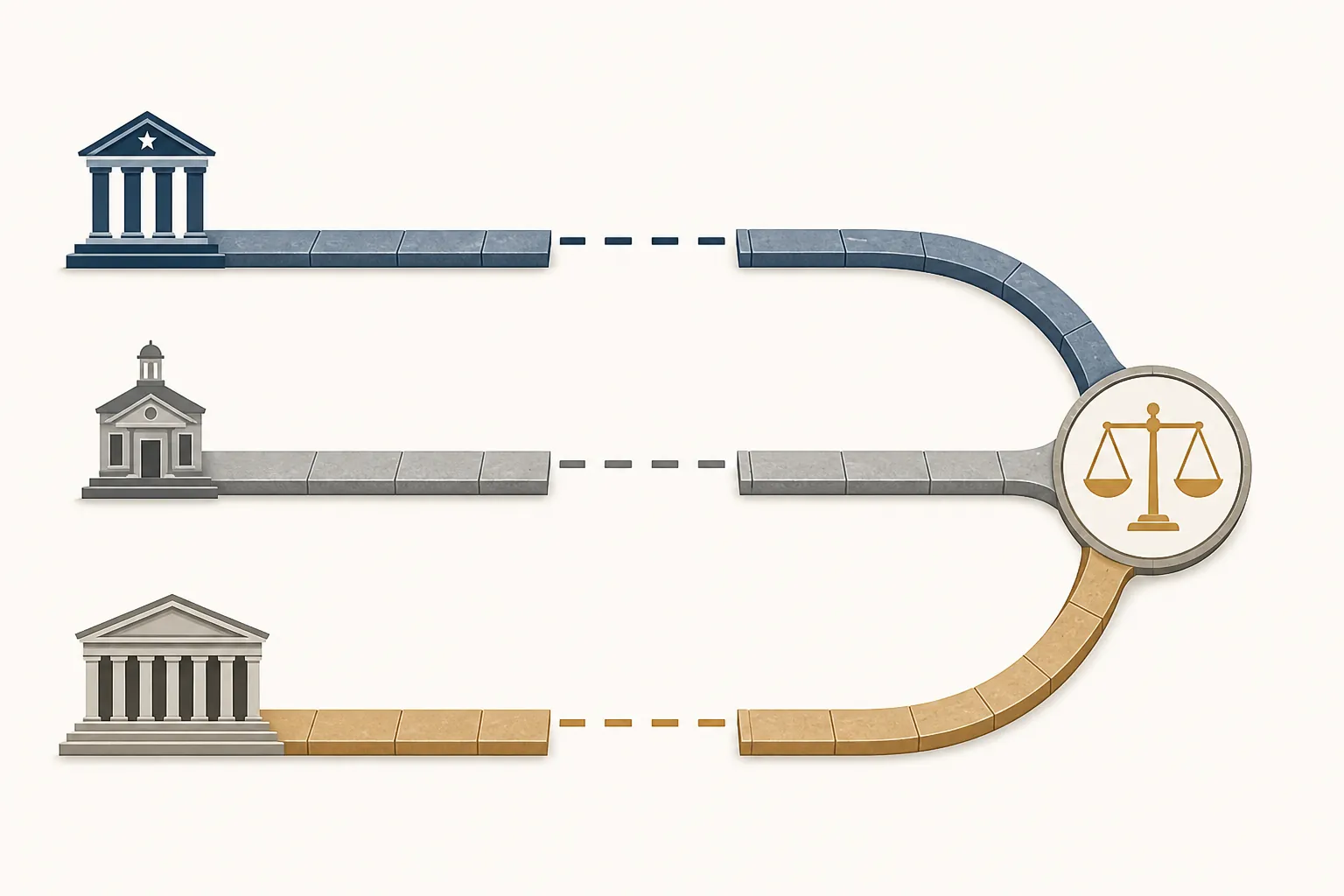
Track three: the Aug. 3 federal complaint opens a new front, but not yet a safe harbor
The newest track is the Southern District of Texas complaint filed Aug. 3, 2026. Two retailers and a distributor sued DSHS, Attorney General Ken Paxton, and Galveston County’s district attorney and sheriff. The plaintiffs, represented by lead counsel Andrea Steel, also filed motions for a temporary restraining order and preliminary injunction.[4]
The federal complaint attacks the reinstated definitions on several fronts. As reported, the plaintiffs allege that the definitions erase the line between lawful hemp and marijuana, are preempted by the 2018 Farm Bill, and burden interstate commerce.[4] Those are serious claims, especially for distributors and out-of-state supply chains, but the existence of a complaint is not the same thing as relief. Until a TRO, preliminary injunction, or other order issues, the filing is a live challenge rather than a live restraint on enforcement.
For Galveston County actors, the named local defendants make the case immediately relevant. For statewide businesses, the safer phrasing is that a federal challenge is pending and may affect enforcement if relief is granted. That distinction is tedious only until a client asks whether to reopen sales tomorrow morning.
The penalty numbers make this more than a labeling dispute
The reclassification matters because Schedule I treatment carries criminal and regulatory consequences. Reported penalty ranges include state-jail-felony exposure for possession, with 180 days to two years and a fine up to $10,000, escalating to up to life imprisonment and a $50,000 fine above 400 grams.[6] Retailers also face license revocation and reported fines of up to $10,000 per day.[6]
There is also a small but briefing-relevant conflict in the fee reporting. KLTV reported retail registration and manufacturing figures as $150 and $250, while Texas Tribune reporting described them as $155 and $258.[6][7] That discrepancy is not central to the constitutional fight, but it is exactly the sort of detail that should be verified against the current agency schedule before it appears in a client memo.
The counseling consequence is straightforward: civil compliance, inventory removal, lease default, banking covenants, insurance exclusions, and prosecutorial discretion all begin to overlap once a product category is treated as Schedule I. A retailer’s risk is not limited to whether an officer walks through the door; it can also surface when a landlord asks for proof of lawful use, a lender reviews collateral, or an insurer evaluates a claim.
What the cartel argument does, and does not, prove
The “texas thc ban cartels legislation response” framing comes from politics as much as law. On Aug. 2, 2026, Democratic Senate candidate James Talarico posted that the ban could benefit cartels, and the issue was quickly covered as part of the 2026 Senate-race exchange involving Attorney General Ken Paxton.[8][9]
That claim is politically material because it is being used to attack the policy response. It is not, on the sources available as of Aug. 4, 2026, a verified outcome. The record contains no post-July 31 enforcement, seizure, trafficking, or cartel-activity data showing that the reclassification has in fact shifted sales to cartel-controlled channels.
There is a legitimate policy argument that banning or sharply restricting a previously visible retail market can push some demand into illicit channels. But for litigation and compliance purposes, that is a risk theory, not a docket fact. It may help explain why legislators, candidates, and industry plaintiffs are responding; it should not be written as proof that cartels have already gained market share from the July 31 reinstated definitions.
Federal law is also moving, but on a later clock
The federal-law backdrop is not static. Available sources note a federal hemp redefinition date of Nov. 12, 2026 under H.R. 5371, while some coverage describes the change more loosely as arriving in 2027.[10] For current Texas counseling, the date should be treated as an open verification item rather than folded casually into today’s enforcement answer.
The Aug. 3 federal complaint already puts federal preemption and interstate-commerce theories before a district court. A later federal definitional change may alter that landscape, but it does not presently replace the need to read the Texas rules, the Texas Supreme Court posture, the Travis County injunction, and any new federal order entered after the complaint.
Open items to verify before relying on this record
- Any TRO or preliminary-injunction ruling in the Southern District of Texas case filed Aug. 3, 2026.
- Any stay, modification, appeal, or merits ruling affecting the Travis County smokeable-hemp injunction.
- Any further Texas Supreme Court or remand activity in DSHS v. Sky Marketing Corp., No. 23-0887.
- The current DSHS fee schedule, because reported fee figures conflict across sources.
- County-level enforcement guidance, charging decisions, seizures, or notices issued after July 31, 2026.
- Any reliable post-July 31 data on illicit-market or cartel effects; none was identified in the available sources as of Aug. 4, 2026.
The record therefore stops in an uncomfortable but manageable place. The Legislature did not enact the current ban after SB 3 was vetoed. DSHS moved through classification and definitions. The Texas Supreme Court track changed the delta-8 posture, Travis County preserved a smokeable-hemp lane for now, and the new federal case asks a district court to intervene. The cartel argument remains a reported political claim and policy-risk theory, not a verified post-July 31 result.
References
- DSHS v. Sky Marketing Corp., No. 23-0887, Supreme Court of Texas, May 1, 2026.
- Austin delta-8 cannabis sales can be criminalized again after injunction dissolved, KUT, May 28, 2026.
- Texas hemp businesses win temporary reprieve from ban on smokeable hemp products, Texas Tribune, April 8, 2026.
- Texas hemp businesses sue over THC ban, arguing new rules could make them felons, Texas Tribune, Aug. 3, 2026.
- Update on Texas Hemp Regulation, Buchanan Ingersoll & Rooney, September 2025.
- Texas THC cannabis ban: What to know about new hemp rules, Texas Tribune, July 30, 2026.
- Texas hemp regulations tighten, banning most THC products, raising fees, KLTV, July 30, 2026.
- THC ban becomes issue in Texas Senate race as Talarico criticizes Paxton, Houston Public Media, Aug. 3, 2026.
- Texas ban on THC: Talarico warns cartels could benefit, USA Today, Aug. 3, 2026.
- Is THC Legal in Texas?, McCarty-Larson.
Related records
Tool profile
How Meta's AI Spending Reshapes Law Firm ProfitabilityGoverning regulation
Browse the obligations tracker →Preventive workflow
Browse verification workflows →
Report a correction or tip
Spotted an outdated figure, a misstated fact, or a ruling this case record should reflect? Public comments are disabled for this content given the professional cost of a misreported case outcome, penalty amount, or rule text — use the structured correction channel instead.
Report a correction or tip for this record →