
Tristan Thompson's Amari case shows conservatorship risk for wealthy
This article analyzes the distinct financial-oversight and reform-driven risks that a limited conservatorship under California law poses for high-net-worth petitioners, using Tristan Thompson's April 2026 filing for brother Amari as a case study. Readers will learn the specific statutory limitations and post-#FreeBritney scrutiny that affect wealth management and abuse prevention in these arrangements.
- Jurisdiction
- California, US
- Court
- California Superior Court (county not specified)
- AI tool named
- No AI tool implicated
- Ruling date
- Apr 27, 2026
- Source document
- View primary court order ↗
- Last verified
- Jul 30, 2026
Lex Machina Review is an independent risk-tracking and reference resource. Nothing on this site is legal advice, and using it does not create an attorney-client relationship. Every record is reviewed against primary sources but may not reflect the most current status of a matter — always verify directly against the cited court order, rule text, or a licensed attorney before relying on it.
Companion explanation — secondary to the source document above
The first risk in the Tristan Thompson conservatorship Amari legal case is not celebrity exposure. It is scope. Thompson reportedly filed on April 27, 2026, seeking a limited conservatorship of the person for his 19-year-old brother, Amari, with news reports quoting the filing as saying Amari “does not object” and “does not wish to contest.” The reported petition is not a general conservatorship, and it is not an estate conservatorship. As of July 30, 2026, no official public docket or case number is available in the materials reviewed, and the matter remains pending rather than decided.[1][2]
That narrow fact pattern matters more than the familiar headline shape. A limited conservatorship of the person may help a family member obtain lawful authority over personal-care decisions for an adult with a developmental disability. It does not, by itself, solve the financial architecture around that adult. For a high-net-worth petitioner, the gap between care authority and financial authority is where the advisory risk begins.

The Filing Described Is Narrower Than Many Clients Assume
California’s limited conservatorship structure is designed for adults with developmental disabilities and is supposed to be tailored to the powers the court finds necessary. The California Courts Self-Help Guide states that a judge may appoint a limited conservator only after clear and convincing evidence shows that the adult needs help in the requested areas.[3]
That standard is easy to flatten in public coverage. A petition can be described as uncontested and still require the court to decide whether the requested powers are justified. Consent or lack of objection may reduce the visible conflict in a family case, but it does not convert a petition into a private appointment. The court still has to protect the proposed conservatee’s retained rights.
The reported Thompson petition also appears to request personal authority rather than estate authority. That distinction is not a technical footnote. It determines whether the petitioner is asking to make decisions about care, residence, education, medical consent, social contacts, or similar personal matters, rather than asking to collect income, manage property, invest assets, settle claims, or account for an estate.
For counsel advising a wealthy athlete, entertainer, founder, or family office client, this is the first correction to make in the room: a limited conservatorship of the person is not a wealth-management tool. If the client expects one court order to create both a care plan and financial control, the client is already misunderstanding the instrument.
What The Person Conservatorship Does Not Carry With It
Disability Rights California’s guidance is blunt on the point that tends to surprise families: a limited conservator cannot control the limited conservatee’s wages or salary. The same guidance also notes that a limited conservator cannot force medication, agree to sterilization, or agree to electroconvulsive therapy.[4]
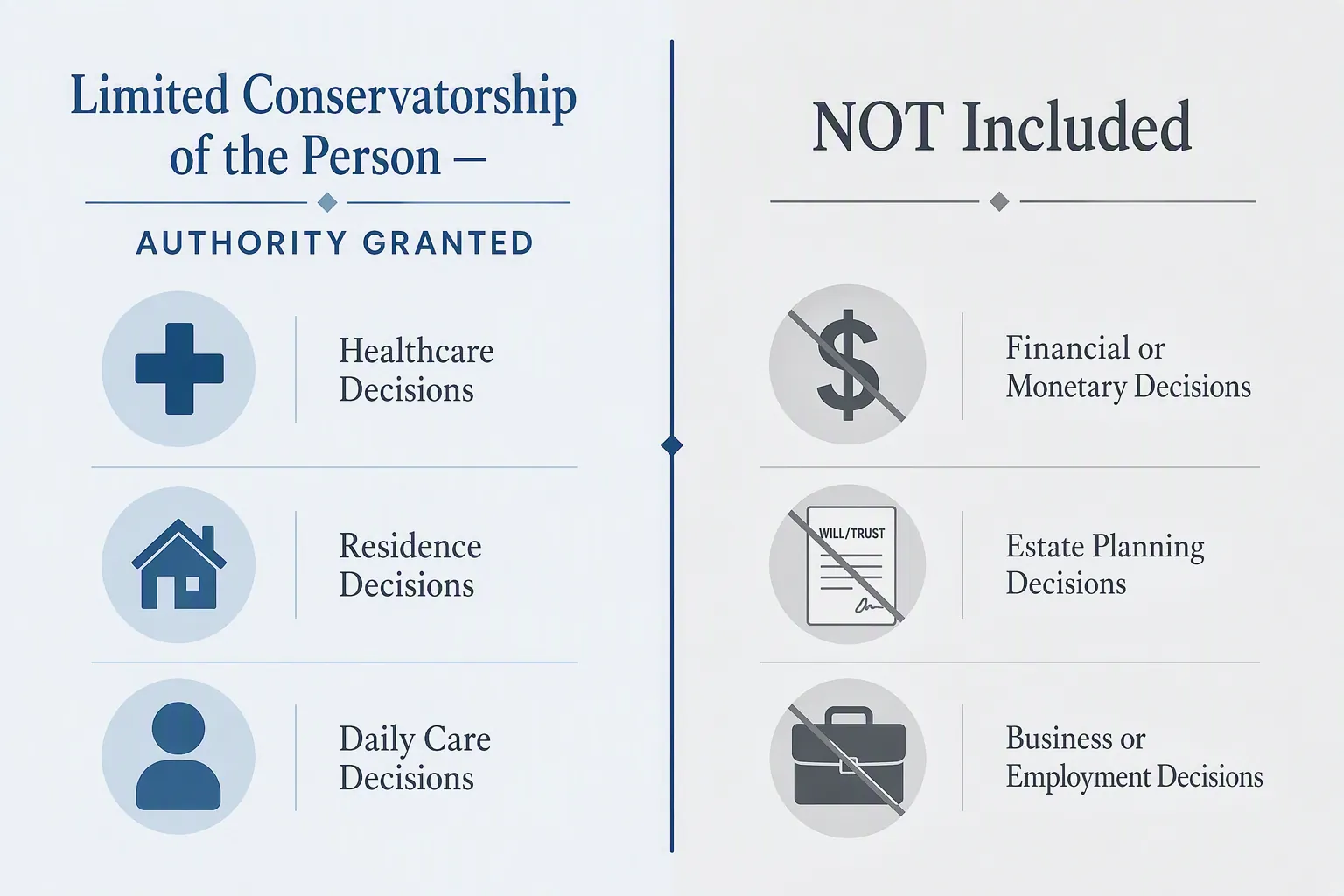
The wage limitation is not a marginal point in a high-net-worth family. A disabled adult may have a benefits profile, a trust interest, inheritance rights, a small job, image-related income, settlement proceeds, insurance proceeds, or a future claim. Some of those possibilities may be remote in any individual case. The problem is that the public materials on the Thompson filing do not answer them. They do not establish whether Amari has a special needs trust, whether any estate petition is contemplated, what assets he may hold, or whether future inheritance questions remain open after the death of Thompson and Amari’s mother.
A petitioner can therefore end up in an awkward posture: responsible in the eyes of the family for building a lawful care structure, publicly associated with the adult’s protection, but without the financial authority outsiders may assume exists. If bills, benefits, private caregivers, housing costs, or trust distributions are not mapped before filing, the conservator of the person may be left explaining that the order did not reach the money.
Estate authority also brings its own supervision. California probate materials identify annual accountings and possible bond requirements in estate conservatorship settings. Those protections matter because they create a paper trail for money. But they also confirm the mismatch: if the petition is only for the person, the case may create personal authority without creating the estate-accounting framework that a family office, lender, agent, insurer, or relative might mistakenly expect.
| Client Assumption | Risk Correction |
|---|---|
| The conservator will control all decisions. | A limited conservatorship grants only powers the court approves. |
| Care authority includes control over income. | A limited conservator cannot control the conservatee’s wages or salary. |
| The filing protects estate assets. | A person-only petition does not create estate-management authority. |
| No objection means low scrutiny. | The court still applies statutory standards and protects retained rights. |
The Unanswered Asset Questions Are The Risk File
The available reporting does not justify speculation about Amari Thompson’s assets, benefits, or family financial arrangements. It does justify a more disciplined question: what would counsel need to know before letting a wealthy petitioner believe a limited conservatorship of the person has solved the family’s financial exposure?
At minimum, the advisory file should separate four categories before any petition is treated as operationally complete: personal-care decisions, public benefits, private assets, and third-party payment obligations. Those categories do not all belong in the same court request. Some may require no conservatorship power at all. Some may require representative payee arrangements, trustee action, benefits planning, powers authorized by another court order, or an estate conservatorship if the legal standard is met.
This is where wealthy families can create avoidable confusion. A sibling with substantial resources may be paying expenses voluntarily. A parent may have left an estate plan. A disabled adult may qualify for benefits that depend on asset structure. A settlement or insurance issue may sit outside the immediate caregiving story. None of those facts can be assumed from the Thompson reports. In a private file, however, failing to ask about them before filing can leave the petitioner with a court title that does less than the family expects and exposes more than counsel has documented.
The cleaner practice is not to inflate the conservatorship petition. It is to make the petition’s limits explicit, then build a parallel asset map. Who receives funds? Who has signing authority? Who is trustee? Who pays caregivers? Who must account? Which resources belong to the disabled adult, and which are voluntary support from relatives? A limited conservatorship can coexist with those answers, but it should not be used as a substitute for them.
Post-#FreeBritney Scrutiny Is Procedural, Not Decorative
The Britney Spears conservatorship still shapes how lawyers, judges, reporters, and families hear the word “conservatorship.” The useful lesson is not that every family petition resembles that case. It is that courts and lawmakers now operate with a sharper institutional memory of how broad authority, weak monitoring, and professional fees can accumulate around a vulnerable adult.
The South Carolina Law Review’s discussion of the Spears matter describes a 13-year conservatorship, more than $600,000 in termination legal fees, and oversight failures that became part of the reform conversation.[5] Those facts do not prove anything about Thompson’s petition. They explain why current petitioners should expect procedural safeguards to be taken seriously, especially when a family member seeks authority over an adult who may not be positioned to litigate every retained right.
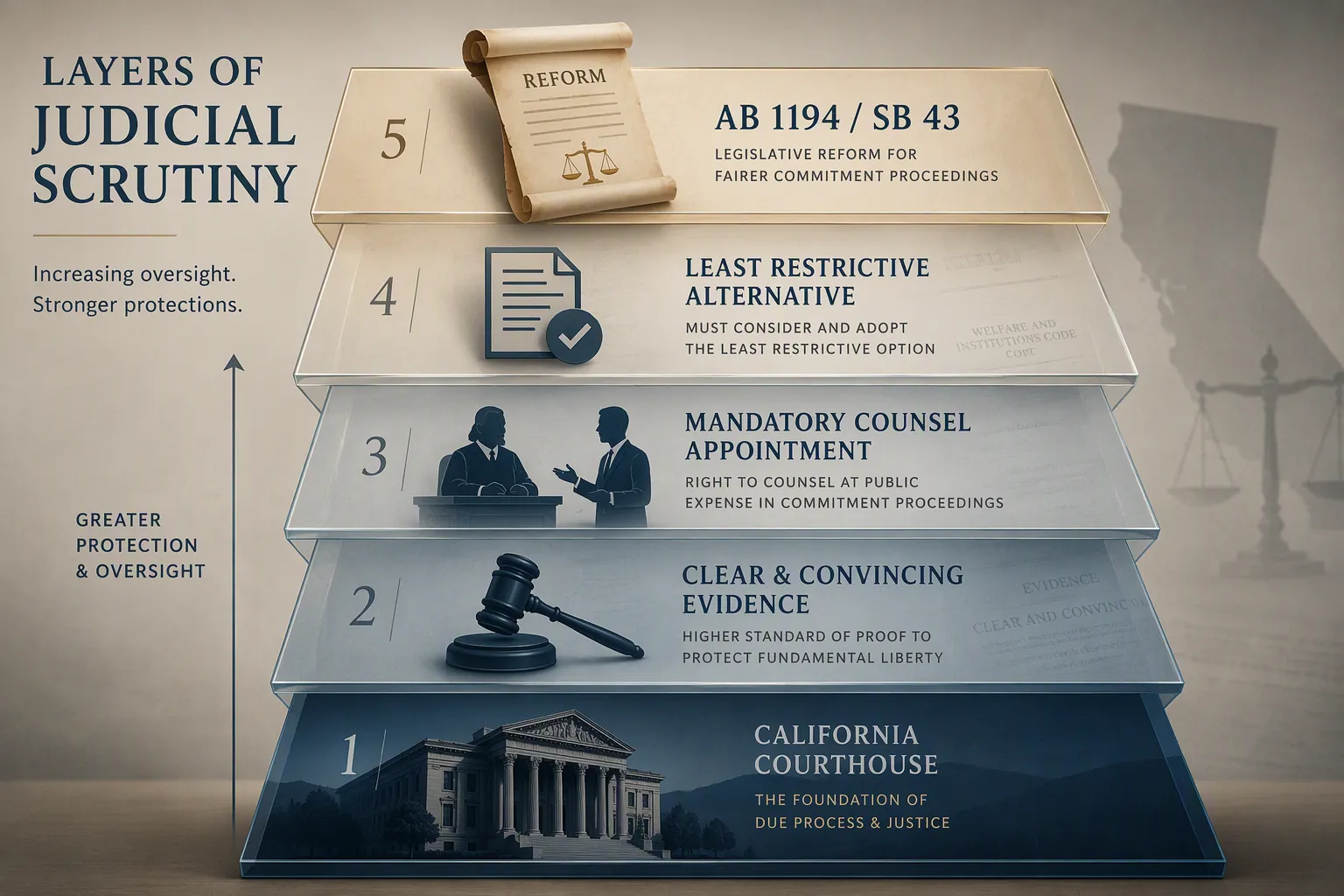
California’s reform environment reinforces that point. Disability Rights California states that, effective January 1, 2023, if a conservatee tells the court or court investigator that they want to end a conservatorship, the court must appoint an attorney and hold a hearing.[6] That is a practical litigation fact, not a public-relations footnote. A family member who expects a quiet, durable arrangement has to understand that the conservatee’s later objection can trigger counsel and a hearing process.
California AB 1194 belongs in the same reform atmosphere because it tightened attention on least-restrictive alternatives and conservatorship oversight. SB 43, which updated California’s Lanterman-Petris-Short Act framework, is a different statutory track from a developmental-disability limited conservatorship, but it still reflects the state’s broader movement toward recalibrating when and how personal liberty may be restricted through court-supervised arrangements.[7]
The result for a high-net-worth petitioner is not that courts presume bad faith. The risk is subtler. A petitioner who arrives with a vague “family care” explanation may encounter a court system now trained to ask whether the requested powers are necessary, whether alternatives were considered, whether the adult’s preferences are being heard, and whether the arrangement can be narrowed.
National Numbers Explain The Sensitivity, With A Caveat
National guardianship and conservatorship figures are often invoked too loosely, but they help explain why courts and reformers treat these cases as a financial-risk domain. Raber Law Offices, citing National Center for State Courts data from 2017-2018, states that about 1.3 million U.S. adults were under guardianship or conservatorship and that roughly $50 billion in assets were court-controlled.[8]
The vintage matters. Those figures are not a current 2026 census, and they should not be used to imply a present growth rate or to measure the Thompson case. Their value is narrower: they show why a family petition that looks private to the petitioner enters a legal category associated with large-scale asset control, judicial monitoring, and documented abuse-prevention concerns.
How Counsel Should Read The Thompson Filing
The reported Thompson petition is useful because it keeps the hard issue visible. If the request is limited to the person, then the central risk for a wealthy petitioner is not that the court is secretly granting sweeping financial control. It is the opposite: the petitioner may receive less authority than the family, advisers, agents, and service providers assume.
That reading changes the preparation. Counsel should not begin with a generic conservatorship explainer. The better first memo is a scope memo: requested powers, excluded powers, retained rights, known assets, unknown assets, benefits consequences, alternatives considered, and the evidence needed to satisfy the statutory standard. If the petitioner is famous or wealthy, the memo should also assume that public reporting may describe the filing more broadly than the petition does.
- Confirm whether the requested appointment is for the person, the estate, or both.
- Identify wages, benefits, trusts, inheritances, settlements, and recurring family support before filing.
- Document why each requested personal power is necessary and why a less restrictive alternative is insufficient.
- Prepare the petitioner for court investigation, attorney involvement, and later termination procedures.
- Separate voluntary family payments from funds legally belonging to the proposed conservatee.
The same discipline protects the disabled adult. A limited conservatorship is not supposed to erase capacity wholesale. It should preserve rights unless the court has a reason to remove them. When financial questions are left blurry, the adult can lose practical autonomy even without a formal estate order, because everyone around the arrangement starts treating the conservator as the only decision-maker.
The Pending Case Should Not Be Treated As A Verdict
Nothing in the available public materials supports a conclusion that Thompson’s petition is abusive, unnecessary, or certain to be granted. The posture is more limited: news outlets have reported a pending April 2026 request for a limited conservatorship of the person, described as uncontested by Amari in the quoted filing language, with no official public docket available for independent review in the materials considered.[1][2]
That uncertainty should restrain the analysis rather than weaken it. The legal lesson does not depend on predicting the outcome. A person-only limited conservatorship can be the right instrument for some families, but it is narrower, more scrutinized, and less financially comprehensive than many high-net-worth clients expect. Before filing, counsel has to map assets, authority, alternatives, retained rights, and court oversight with enough precision that the family-care plan does not become a remedial file later.
References
- Tristan Thompson Files for Conservatorship of 19-Year-Old Brother Amari, People
- Tristan Thompson files for conservatorship over 19-year-old brother Amari, Page Six
- Limited Conservatorships, California Courts Self-Help Guide
- Limited Conservatorships & Alternatives, Disability Rights California
- Britney Spears and Systemic Reform: Embracing Vulnerability in Conservatorship Laws, South Carolina Law Review
- Principles: Conservatorship of Persons with Disabilities, Disability Rights California
- SB 43: Updating California’s Conservatorship Law, LLU Institute for Health Policy and Leadership
- High-Profile Guardianship Battle Cases Reveal Important Legal Lessons, Raber Law Offices
Related records
Tool profile
How Meta's AI Spending Reshapes Law Firm ProfitabilityGoverning regulation
Browse the obligations tracker →Preventive workflow
Browse verification workflows →
Report a correction or tip
Spotted an outdated figure, a misstated fact, or a ruling this case record should reflect? Public comments are disabled for this content given the professional cost of a misreported case outcome, penalty amount, or rule text — use the structured correction channel instead.
Report a correction or tip for this record →