
Trump Faces Two-Sided Legal Exposure Over AI-Generated Images
Donald Trump's AI-generated image posts and the deepfakes targeting him expose a legal patchwork: the TAKE IT DOWN Act does not cover political content, state election-deepfake laws face First Amendment challenges, and defamation claims confront high constitutional bars. This analysis maps the frameworks that apply to both the publisher and the subject, helping counsel assess exposure for their clients.
- Jurisdiction
- United States (California)
- Court
- California state court
- AI tool named
- Generative AI (unspecified)
- Ruling date
- Aug 1, 2025
- Source document
- View primary court order ↗
- Last verified
- Jul 29, 2026
Lex Machina Review is an independent risk-tracking and reference resource. Nothing on this site is legal advice, and using it does not create an attorney-client relationship. Every record is reviewed against primary sources but may not reflect the most current status of a matter — always verify directly against the cited court order, rule text, or a licensed attorney before relying on it.
Companion explanation — secondary to the source document above
Donald Trump is a useful stress test for political deepfake law because he sits on both sides of the caption. He has been identified in public timelines as a repeat publisher of AI-generated political imagery on Truth Social, including posts described as a Jesus-as-doctor image, an Obama-as-apes video, “Chipocalypse Now,” a Gaza AI video, and a protest feces video between February 2025 and April 2026; at least two of those posts were reportedly removed after backlash, though the timeline should be treated cautiously because it relies in part on a secondary page carrying its own update warnings.[1] He has also been the subject of synthetic attacks, most visibly when the DeSantis campaign shared apparent AI-generated images of Trump embracing Anthony Fauci in June 2023.[2]
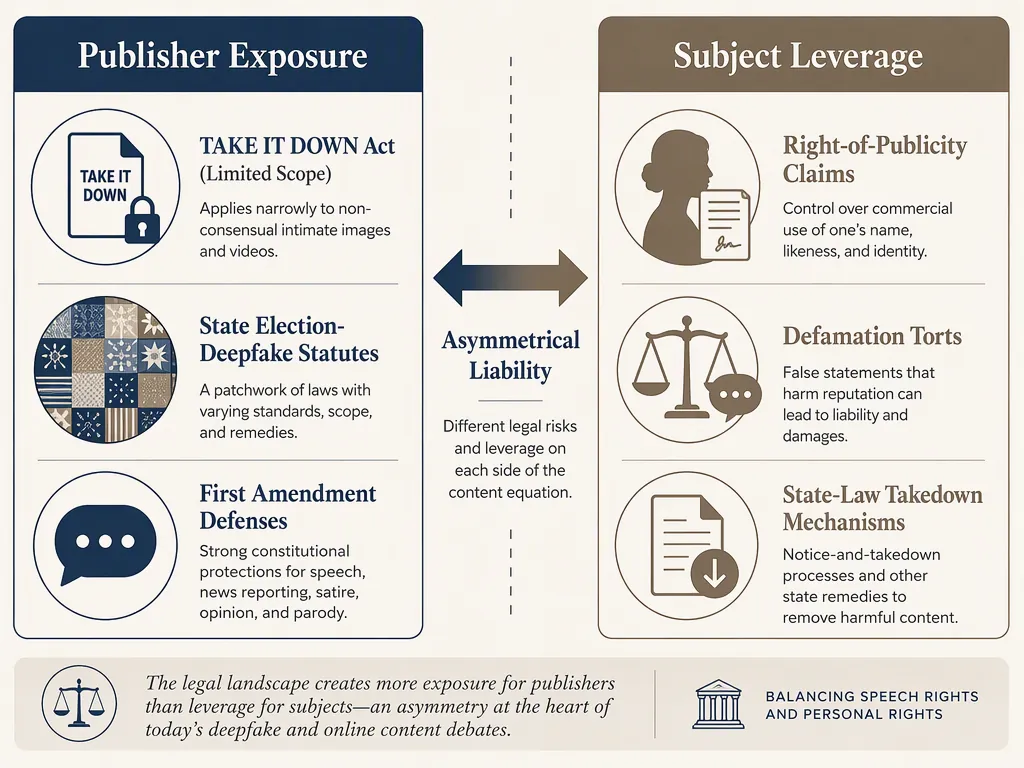
That dual posture matters more than the usual “are deepfakes legal?” framing. If the client published the image, counsel starts with election-statute coverage, platform rules, disclaimer duties, defamation exposure, and First Amendment defenses. If the client is depicted in the image, the same facts become a search for leverage: takedown demands, statutory private rights, defamation theories, false-light claims where available, and increasingly right-of-publicity claims. The legal question raised by Trump AI-generated images is not one rule. It is a switchboard.
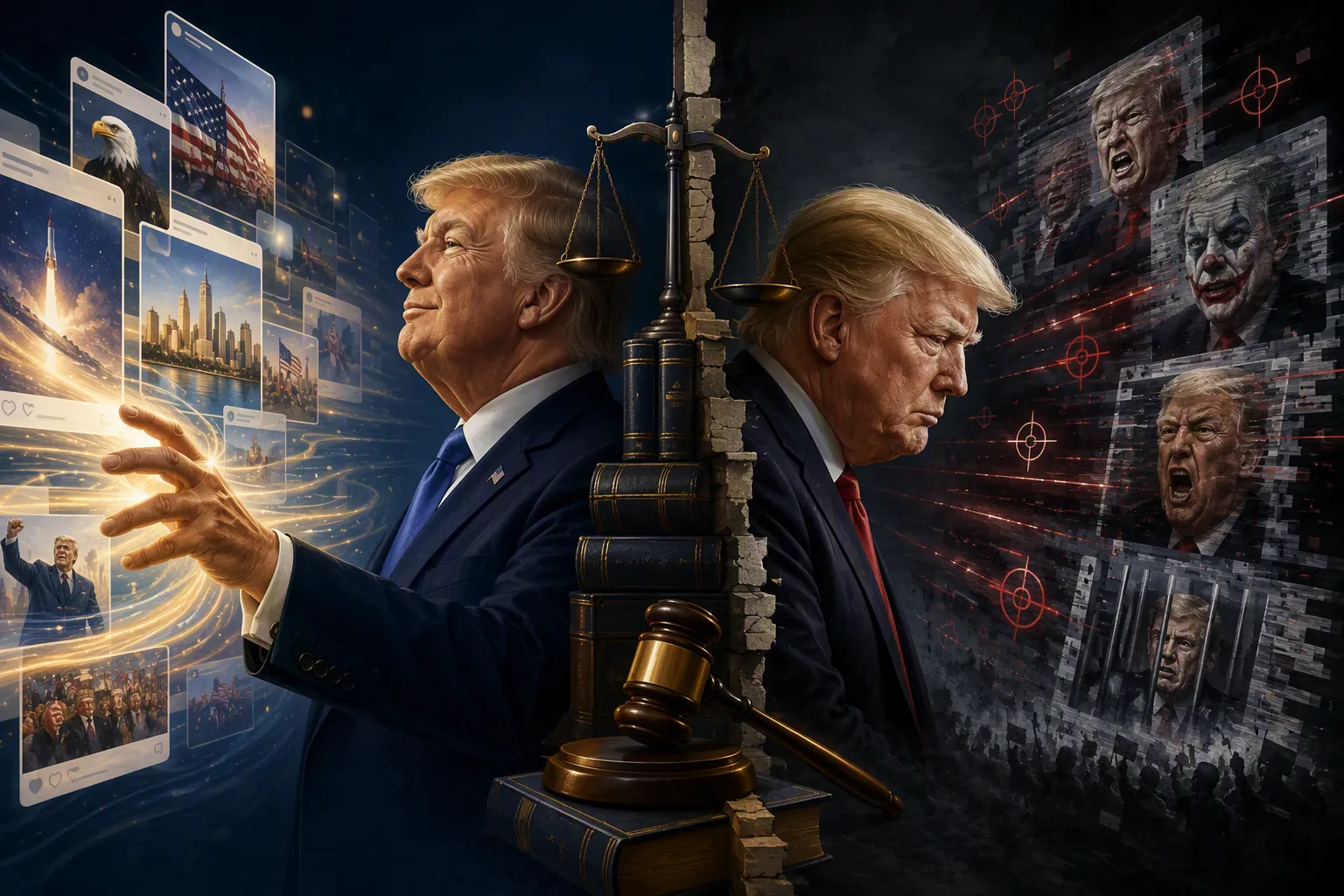
The Same Image Changes Character With the Client
A campaign lawyer looking at the DeSantis Trump-Fauci images in 2023 would have asked a different question from the lawyer looking at a Trump-posted AI image in 2026. The first file is a subject-side problem: can Trump say the images falsely portray him as physically affectionate or politically aligned with Fauci, and is that enough to sue? The second is a publisher-side problem: did Trump, his campaign, or an affiliated account distribute synthetic political content in a jurisdiction that regulates materially deceptive election media?
The DeSantis episode generated extensive press coverage but no civil lawsuit.[2] That absence should not be overread. No lawsuit is not the same as no claim; it may mean the target calculated that litigation would amplify the image, that the claim would face constitutional problems, or that the campaign calendar made relief impractical. Still, the non-filing is operationally important. It shows the gap between a plausible legal theory and a plaintiff willing to test it.
| Client posture | First legal questions | Most likely pressure points |
|---|---|---|
| Publisher of AI-generated political image | Is the content election-related, materially deceptive, distributed inside a regulated time window, or missing a required disclosure? | State election-deepfake laws, platform policies, defamation risk, campaign compliance review |
| Depicted subject of AI-generated political image | Does the image falsely state or imply a fact, appropriate a likeness, cause measurable harm, or trigger a statutory takedown right? | Right of publicity, defamation or false light, state private rights of action, platform notice channels |
| Platform hosting the image | Is the material intimate, election-related, unlawful under state law, or covered by a notice-and-removal duty? | TAKE IT DOWN obligations for NCII, state-law notice rules, trust-and-safety escalation |
This is why a clean legal memo on Trump AI-generated images cannot treat “deepfake law” as a coherent field. Federal law, state election law, tort law, publicity law, and platform compliance each answer a narrower question. They do not line up neatly, and they do not become broader just because the image is ugly or obviously synthetic.
The TAKE IT DOWN Act Is Narrower Than Its Name Sounds
The federal statute readers are most likely to overestimate is the TAKE IT DOWN Act. President Trump signed it in May 2025, and commentary at the time correctly focused on its expansion of platform duties around nonconsensual intimate imagery and AI-generated intimate deepfakes.[3] The Federal Trade Commission began enforcement in May 2026, emphasizing that covered platforms must maintain notice-and-removal processes for unlawful intimate images and deepfakes.[4]
That matters for victims of intimate-image abuse. It does much less for a political figure depicted in non-intimate synthetic campaign material. The Act targets nonconsensual intimate imagery, including AI-generated versions, and imposes platform removal obligations; it is not a general federal ban on fake political images, manipulated campaign videos, or synthetic attacks on candidates.[3][4][5]
For Trump as publisher, the Act is mostly a boundary marker. A non-intimate AI image in a political post is not converted into federal criminal exposure simply because it is synthetic. For Trump as subject, the same boundary is frustrating: the broadest-sounding federal deepfake statute leaves the ordinary political attack image outside its direct reach.
There is an indirect effect. Platform counsel operating under TAKE IT DOWN processes may build faster escalation channels for all synthetic-content complaints, and those channels can spill over into political-content review. But that is institutional behavior, not statutory coverage. A takedown request routed through a platform’s internal synthetic-media queue should not be mistaken for a TAKE IT DOWN claim unless the image is within the Act’s intimate-image scope.
State Election-Deepfake Laws Create the Immediate Publisher Problem
The more immediate publisher-side risk sits in state election-deepfake statutes. MultiState reported that more than 30 states had active election-deepfake laws or rules positioned for the 2026 midterms, with approaches ranging from disclaimer requirements to bans on materially deceptive synthetic media.[6] Wiley’s political-ad guidance similarly describes a growing set of state restrictions on AI-generated political ads, including disclosure duties and prohibitions that vary by state and medium.[7]
Those statutes do not ask only whether the image is AI-generated. The harder questions are usually narrower: Is the image about a candidate or ballot measure? Was it distributed within a regulated pre-election window? Would a reasonable viewer understand it as parody or satire? Does the law require actual malice, knowledge, or intent to deceive? Is the remedy a disclaimer, injunctive relief, civil penalty, private action, or criminal prohibition?
- Disclosure models, such as laws described for states including New Mexico and Mississippi, generally try to preserve distribution while requiring a label or disclaimer.[6][7]
- Prohibition models, including examples described in Maryland and Texas, create higher publisher risk because the compliance question is not only whether to label the content but whether to publish it at all.[6][7]
- Likeness-oriented or quasi-property models, including statutes discussed in Montana, Virginia, and Tennessee, can look less like campaign-finance regulation and more like a consent rule for synthetic uses of a person’s identity.[6]
That patchwork is where a Trump AI-image post becomes a compliance problem even if federal law does not reach it. A post made from a personal account, amplified by campaign channels, targeted to voters, or repurposed into paid advertising can move across legal categories quickly. The lawyer reviewing it is not giving a national yes-or-no answer. The answer changes with where the content is shown, when it is shown, and whether the state treats synthetic political media as a disclosure problem or a deception problem.
This is also where the “removed after backlash” fact has legal texture. Removal does not prove unlawfulness. It can mean reputational damage, platform concern, campaign discipline, or simple embarrassment. But when synthetic political content comes down after public criticism, counsel should assume future plaintiffs or regulators may characterize removal as evidence that the publisher recognized a problem. That is not always a winning argument; it is the argument that gets quoted in the demand letter.
First Amendment Challenges Keep the Patchwork Unstable
The state-law map is not only uneven; it is under constitutional stress. MultiState’s 2026 survey reports that California’s AB 2839 was partially struck down in August 2025 as too broad and content-discriminatory, while Hawaii’s law was overturned after failing to include sufficient satire protections.[6] The same survey identifies Minnesota’s HF 1370 as under challenge.[6]
Those developments are not technical footnotes. They change what a publisher can rationally risk. A narrow disclaimer statute with a clear satire exception occupies a different litigation posture from a broad ban on deceptive political media close to an election. Counsel may still advise compliance with a statute that is being challenged, especially during a campaign cycle, but the memo should say the statute is contested rather than settled.
The federalism fight adds another layer. A proposed 10-year moratorium on state AI regulation failed in the Senate by a 99-1 vote in July 2025, and Trump issued a December 2025 executive order directing agencies to challenge certain state AI laws, according to MultiState’s account.[6] That does not preempt the state election-deepfake statutes by itself. It does explain why state-law advice in 2026 has to include a procedural-status check, not just a statutory citation.
Defamation Helps Less Than Many Targets Expect
When a political figure is the subject of a fake image, defamation is usually the first tort people name and one of the hardest to make work. Trump is a public figure. A claim over political attack imagery therefore runs into the constitutional requirement that he show, at minimum, a false statement of fact made with actual malice. The more obviously absurd or stylized the image, the easier it is for the publisher to argue that viewers understood it as commentary, parody, or visual rhetoric rather than a factual assertion.
The DeSantis Trump-Fauci images show the problem. The alleged implication was political: Trump was too close to Fauci. If the images were realistic enough to suggest an actual physical encounter, the target-side claim becomes more plausible. If the images functioned as an exaggerated visual shorthand for a political argument, the publisher’s First Amendment defense strengthens. The fact that no lawsuit followed leaves that line untested in that incident.[2]
Early commentary on deepfake litigation suggests courts are not automatically treating realistic synthetic media as protected satire merely because it was generated by AI, but the available materials do not support a broad rule that political deepfake defamation claims are easy to win.[8] The safer classification is narrower: realism can make a synthetic image more dangerous for the publisher, especially if it asserts a verifiable event, but public-figure defamation remains a high-bar claim.
For Trump as publisher, defamation exposure depends on whether the image communicates a factual assertion about someone else. A grotesque or surreal image of a political opponent may be protected as opinion or parody. A realistic image showing a person doing something they did not do, in a context where viewers may believe the event occurred, is a different file. Counsel should spend less time asking whether the image is “AI” and more time asking what fact the image asks the viewer to believe.
Right of Publicity Gives the Depicted Subject a Cleaner Handle
Right-of-publicity law deserves more attention in political deepfake analysis because it does not always require the plaintiff to prove that the image made a false factual claim. It asks a different question: did the publisher use the person’s name, image, voice, or likeness without permission in a way the law recognizes as actionable? For a public figure depicted in synthetic media, that can be a more administrable theory than stretching defamation to cover every false visual association.
The state landscape is still fragmented. MultiState identifies Tennessee’s ELVIS Act model and other likeness-oriented frameworks as part of the 2026 state deepfake environment, while AI Vortex’s guide describes courts and litigants in Tennessee, California, and New York as applying or testing publicity-style claims against AI-generated likeness uses.[6][8] That is not the same as a uniform national remedy. It is, however, a more concrete civil route for a depicted subject than waiting for a court to decide whether a political image crossed from satire into defamatory fact.
The theory is strongest when the synthetic image trades on recognizability. A fake image of Trump is valuable because it is Trump; the same is true for other politicians, celebrities, or public officials used in political ads and fundraising materials. That matters even outside campaign law. The issue is not only voter deception. It is unauthorized identity use.
There are limits. Political speech receives constitutional protection, and many publicity statutes contain newsworthiness, public-affairs, parody, or expressive-work defenses. A campaign meme and a commercial endorsement are not the same use. Readers who need the advertising-side version of this problem should separate it from candidate-speech disputes; the liability stack for AI celebrity ads is more commercial and more FTC-facing than the Trump political-image scenario.
Even with those defenses, publicity law gives the depicted subject something defamation may not: a claim focused on control of identity rather than proof of reputational falsehood. For Trump as subject, that is likely the strongest civil path when a synthetic image is realistic, identity-driven, and not comfortably inside parody or news commentary. For Trump as publisher, it is the claim most likely to matter when an AI post uses another recognizable person’s likeness as the payload of the message.
What Counsel Actually Has to Classify
The first classification is subject matter. Intimate-image abuse moves toward the TAKE IT DOWN Act and platform notice-and-removal duties. Non-intimate political imagery usually does not. Election-related synthetic media moves toward state statutes. Ordinary insult, parody, and political exaggeration may remain mostly in First Amendment territory unless the image asserts a believable false fact or appropriates a likeness in a regulated way.
The second classification is distribution. A private joke, an organic social post, a campaign account post, a paid ad, and a platform-amplified video can trigger different rules. Some state laws focus on election timing. Others focus on paid communications or candidate depictions. A post that looks low-risk in isolation may become higher-risk when a campaign committee reposts it into a targeted ad buy.
The third classification is procedural posture. Has the relevant statute survived a First Amendment challenge? Is there a satire exception? Is enforcement public, private, or platform-mediated? Has the state attorney general issued guidance? Is the plaintiff seeking damages, an injunction, a correction, or removal? In synthetic political-media disputes, the remedy often matters as much as the theory. An emergency injunction before Election Day is a different fight from damages after the votes are counted.
- For a publisher, the urgent question is whether the image falls inside a state election-deepfake rule and whether a disclosure, removal, or litigation hold is needed.
- For a depicted subject, the urgent question is whether the image is intimate, election-related, defamatory, or an actionable likeness use.
- For a platform, the urgent question is whether the complaint invokes a statutory removal duty or only a policy-based synthetic-media review.
- For all three, the unstable fact is jurisdiction: the same AI image can be lawful, labelable, enjoinable, or litigable depending on where and when it appears.
The result is asymmetrical but not incoherent. Trump as publisher faces real exposure, especially under state election-deepfake statutes, but no single federal political-deepfake prohibition answers the question. Trump as subject has plausible leverage, especially through right-of-publicity claims, but defamation remains difficult for a public figure and the TAKE IT DOWN Act usually will not reach non-intimate political imagery. The practical legal map is narrower than the outrage and messier than the headlines.
References
- AI-generated content in American politics — Wikipedia
- DeSantis campaign shares apparent AI-generated images of Trump — NPR
- President Trump Signs AI Deepfake Act into Law — Mintz, 2025-05-22
- Take It Down Act enforcement starts now — FTC, 2026-05
- Take It Down Act Requires Online Platforms To Remove Unauthorized Intimate Images and Deepfakes — Skadden, 2025-06
- State Deepfake Laws in 2026: What's Changed and What's Next — MultiState, 2026-02-12
- AI Restrictions in Political Ads — Wiley Law
- Deepfake Laws 2026 — US Federal Legislation & State Rules — AI Vortex
Related records
Tool profile
How Meta's AI Spending Reshapes Law Firm ProfitabilityGoverning regulation
Browse the obligations tracker →Preventive workflow
Browse verification workflows →
Report a correction or tip
Spotted an outdated figure, a misstated fact, or a ruling this case record should reflect? Public comments are disabled for this content given the professional cost of a misreported case outcome, penalty amount, or rule text — use the structured correction channel instead.
Report a correction or tip for this record →