
How Pleading $10B in Damages Opened Trump's Financial Records to BBC
Examines the July 2026 ruling in Trump v. BBC where the court compelled Trump's financial records after he pleaded $10B in damages while producing minimal discovery. Litigators learn how a plaintiff's damages claim can be turned into a discovery obligation under Rule 26(b)(1), regardless of later attempts to reframe the harm as purely reputational.
- Jurisdiction
- US Federal - Southern District of Florida
- Court
- U.S. District Court for the Southern District of Florida
- Judge
- Enjoliqué Aytch Lett
- AI tool named
- No AI tool implicated
- Ruling date
- Jul 21, 2026
- Source document
- View primary court order ↗
- Last verified
- Jul 29, 2026
Lex Machina Review is an independent risk-tracking and reference resource. Nothing on this site is legal advice, and using it does not create an attorney-client relationship. Every record is reviewed against primary sources but may not reflect the most current status of a matter — always verify directly against the cited court order, rule text, or a licensed attorney before relying on it.
Companion explanation — secondary to the source document above
The useful part of the Trump-BBC Panorama defamation lawsuit is not the familiar argument over the broadcast edit. It is the discovery backfire: Donald Trump pleaded a $10 billion case alleging injury to his brand, properties, and business, then faced an order requiring financial records from the Donald J. Trump Revocable Trust dating from January 1, 2023 forward.[1]
This is a Risk Digest entry because it is a procedural-risk case study, not because it is an AI hallucination matter, a sanctions order, or a final merits ruling. The ruling was issued by Magistrate Judge Enjoliqué Aytch Lett in the Southern District of Florida on July 21, 2026, according to press reports describing the order; the written order itself could not be independently retrieved for this article because of PACER access barriers. District Judge Roy K. Altman has set a February 15, 2027 trial date, while the BBC’s motion to dismiss for lack of personal jurisdiction remains pending.[1][2][3]
The Damages Pleading Did the Work
A plaintiff does not get to plead business injury at massive scale and then treat business records as a side issue. Under Rule 26(b)(1), the relevance question is tied to the claims and defenses actually in the case, subject to proportionality. If the complaint says the defendant’s publication injured the plaintiff’s business interests, the defendant has an obvious reason to test whether the claimed injury appears in the books.
That is the lane the BBC drove through. The case arose from BBC Panorama’s October 28, 2024 program, “Trump: A Second Chance?,” which edited excerpts of Trump’s January 6 speech; the BBC later apologized in November 2025. Trump filed suit in December 2025 in Florida federal court, seeking $10 billion across defamation and unfair trade practices theories.[1]

The financial-records fight followed from that pleading choice. The BBC sought materials that could bear on whether the alleged publication caused measurable business harm. Judge Lett granted the motion to compel as to records from the Donald J. Trump Revocable Trust beginning January 1, 2023, while narrowing the broader time period the BBC had requested.[1]
That narrowing matters. The court did not give the BBC an unlimited license to rummage through every financial file connected to Trump. It ordered production from a defined trust, over a defined period, tied to the damages theory Trump himself had placed in dispute. As reported, the remedy matched the defect: compel the records needed to test the pleaded injury, rather than punish the production gap with monetary sanctions.
The Production Gap Made the Motion Hard to Ignore
The asymmetry is the fact no discovery lawyer would want to explain from the wrong side of the lectern. The BBC had produced about 87,000 pages. Trump had produced 735 pages, described in reports as consisting of internet articles.[1]
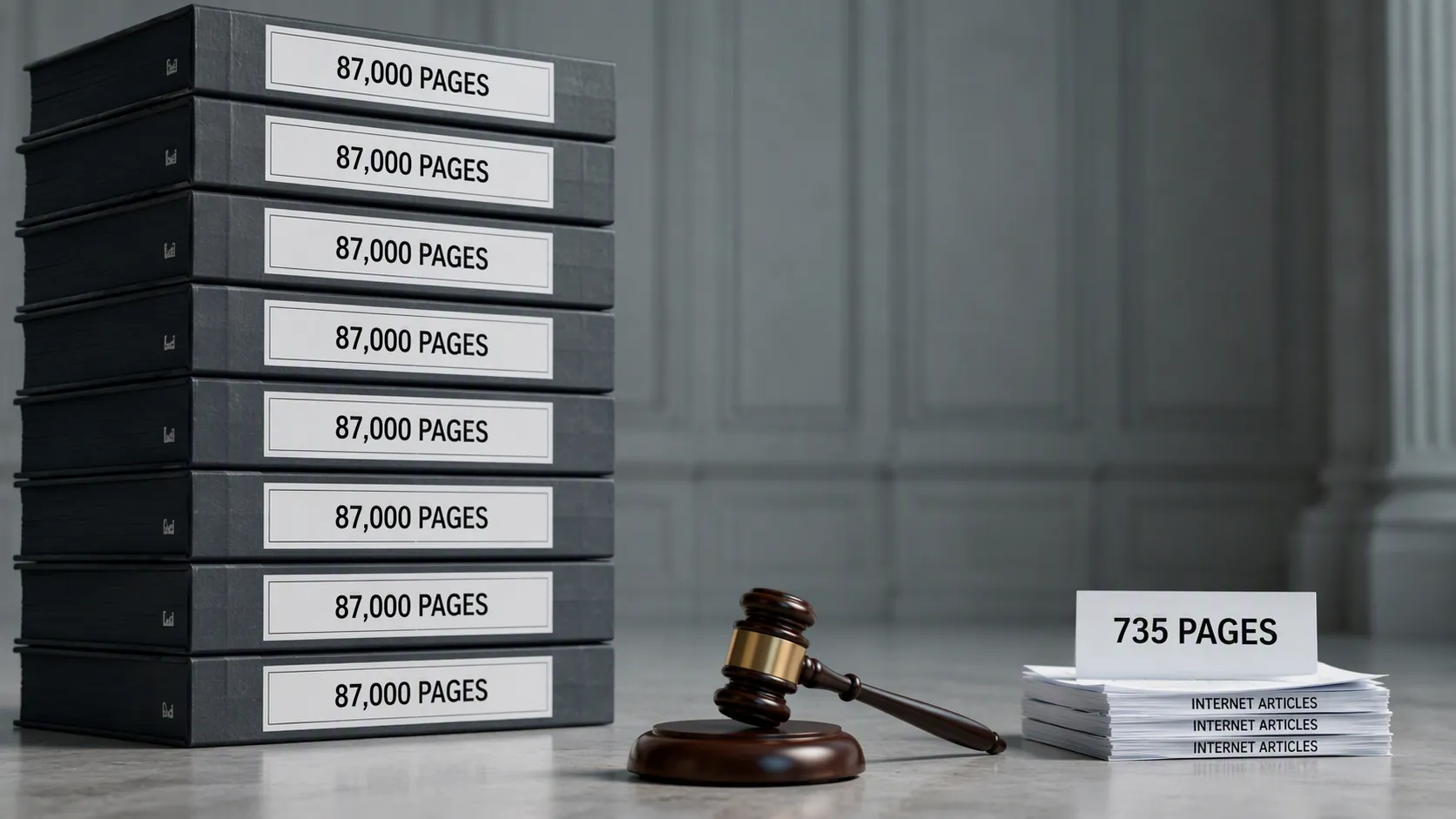
That was not the first production problem reported in the case. Earlier coverage said Trump had produced zero documents by June 2026 despite serving 503 discovery requests of his own.[4]
BBC counsel Charles Tobin gave the imbalance the phrase that will travel: he called Trump’s production a “sham production” of material “pulled from the internet” and argued that discovery had become “entirely one-sided.”[4] Advocacy labels are not findings, and the available press reports do not show a Rule 37 sanctions award or a bad-faith finding carrying monetary consequences. Still, the phrase landed because the numbers already made the point.
| Discovery Fact | Why It Mattered |
|---|---|
| $10 billion damages demand | Made the claimed scale of injury central to proportionality and relevance. |
| Business, brand, and property injury alleged | Opened the door to records capable of proving or disproving business harm. |
| BBC produced about 87,000 pages | Showed the defendant had been producing at substantial volume. |
| Trump produced 735 pages | Created the asymmetry that made a compulsion motion predictable. |
| Earlier report of zero documents despite 503 requests | Undercut any posture that aggressive discovery could flow only one way. |
The order’s practical lesson is not that a low page count alone loses a discovery motion. A party can produce few documents because few responsive documents exist, because requests are overbroad, or because objections are valid. The problem here, as reported, was the combination of a sweeping damages theory, aggressive requests served on the defense, and a plaintiff-side production that did not supply the financial evidence needed to test the pleaded harm.
The Reputational-Harm Pivot Came Too Late
Trump’s counsel Alejandro Brito reportedly argued at the July hearing that the damages theory had “evolved” to focus on reputational harm rather than business loss.[5] That is a common instinct once financial discovery becomes intrusive: recharacterize the injury as intangible, keep the headline damages demand, and try to move the accounting records out of bounds.
But discovery follows the operative pleadings. If the complaint still alleges that the publication harmed the plaintiff’s brand, properties, and business, then the defendant can ask for records bearing on those allegations. A hearing argument that the theory has become more reputational does not erase the pleading that made financial condition, revenue effects, licensing value, or property-related business performance discoverable in the first place.
That is why the $10 billion figure is not just atmosphere. Large pleaded damages expand the zone of proportional discovery. They invite the defendant to ask what the plaintiff’s business looked like before and after the alleged defamation, what other events might explain movement in the numbers, and whether the claimed injury has any non-speculative measure. Once those questions are in the case, the plaintiff’s own records become evidence, not private background.
Constitutional law scholar Sonja J. West put the broader point bluntly: “lawsuits can come back to bite you once they hit the discovery stage.”[5] The sentence is useful because it does not depend on Trump, the BBC, or the politics of the broadcast. It describes the civil-litigation bargain. A complaint buys access to the defendant’s files; it also exposes the plaintiff’s theory to testing.
The Surrounding Pressure Stayed Procedural
The July discovery fight did not occur in a quiet case. A few days before the ruling, Trump voluntarily dismissed BBC Studios Productions and BBC Studios Distribution from the lawsuit after the BBC argued those commercial entities had no role in the Panorama documentary.[6] That narrowed the party lineup, but it did not end the main case against the BBC.
At the same hearing, Judge Lett reportedly allowed the BBC to serve 47 subpoenas on members of Trump’s family and inner circle, including Donald Trump Jr., Ivanka Trump, Jared Kushner, Steve Bannon, Stephen Miller, and Michael Flynn.[7] Bloomberg Law also reported that Trump had previously tried to remove Judge Lett from the case in May 2026.[8]
Those facts show pressure around the discovery ruling, not a final adjudication of the defamation claim. The merits question—whether the Panorama edit was actionable—remains distinct from the discovery question. For litigators, the narrower lesson is enough: when a plaintiff alleges financial consequences, discovery will move toward the documents that can verify or contradict those consequences.
There is also a jurisdictional overhang. The BBC has argued lack of personal jurisdiction, and the trial date currently sits in February 2027 before Judge Altman.[2][3] If the court grants the jurisdictional motion, the discovery ruling may lose practical force in this case. That possibility does not erase the pleading lesson; it only limits how much anyone should treat this interim order as a final case outcome.
The Litigation Risk Is Pleaded Before It Is Compelled
The safest time to control this risk is before the complaint is filed. If a client wants to plead that a publication harmed brand value, real estate interests, licensing economics, or broader business performance, counsel should assume the defendant will seek financial records that test causation and amount. That assumption should hold even in a media-defamation case where reputational injury feels like the natural center of gravity.
A narrower damages theory may preserve more privacy, but it may also reduce leverage. A broader theory may support a larger demand, but it creates discoverable terrain. In this dispute, the $10 billion pleading helped define the battlefield, and the production gap gave the BBC a direct route to compel.
High-dollar damages allegations are not free leverage. They are invitations to discovery. Before pleading business harm at massive scale, the client should understand that the price may include financial records the client would rather keep out of the case.
References
- Judge rules Trump must hand over records sought by BBC in defamation case — BBC News
- Trump's lawsuit against the BBC will go to trial in 2027, U.S. judge says — PBS NewsHour
- Trial date set for Trump's legal case against BBC — BBC News
- Trump lawyers refuse to reveal financial information to BBC in defamation case — The Guardian
- Trump must divulge financial details about businesses in $10bn BBC lawsuit — The Guardian
- Trump drops BBC's commercial arm from Panorama lawsuit, but main case remains — BBC News
- Trump's Family, Inner Circle Face Subpoenas After Judge Ruling — Newsweek
- Trump's Inner Circle Subpoenaed by BBC in US Libel Lawsuit — Bloomberg Law
Related records
Tool profile
How Meta's AI Spending Reshapes Law Firm ProfitabilityGoverning regulation
Browse the obligations tracker →Preventive workflow
Browse verification workflows →
Report a correction or tip
Spotted an outdated figure, a misstated fact, or a ruling this case record should reflect? Public comments are disabled for this content given the professional cost of a misreported case outcome, penalty amount, or rule text — use the structured correction channel instead.
Report a correction or tip for this record →