
Fact Checking the Trump DOJ Election Interference Speech
A verified, source-linked record examining each election-interference claim from the July 16, 2026 Trump White House declassification speech against the primary intelligence and court documents they purport to reveal.
- Jurisdiction
- US federal
- Court
- D.D.C.
- AI tool named
- No AI tool implicated
- Ruling date
- Nov 25, 2024
- Source document
- View primary court order ↗
- Last verified
- Aug 4, 2026
Lex Machina Review is an independent risk-tracking and reference resource. Nothing on this site is legal advice, and using it does not create an attorney-client relationship. Every record is reviewed against primary sources but may not reflect the most current status of a matter — always verify directly against the cited court order, rule text, or a licensed attorney before relying on it.
Companion explanation — secondary to the source document above
Reviewed by Elena Cross, legal risk editor and former campaign-season litigation associate. This record is for source verification and editorial risk review only; it is not legal advice. Last verified: August 4, 2026, 00:00 UTC. The purpose is narrow: check the election-interference claims from the July 16, 2026 Trump White House/DOJ declassification speech against primary intelligence, election-administration, immigration-status, FBI, and court records.
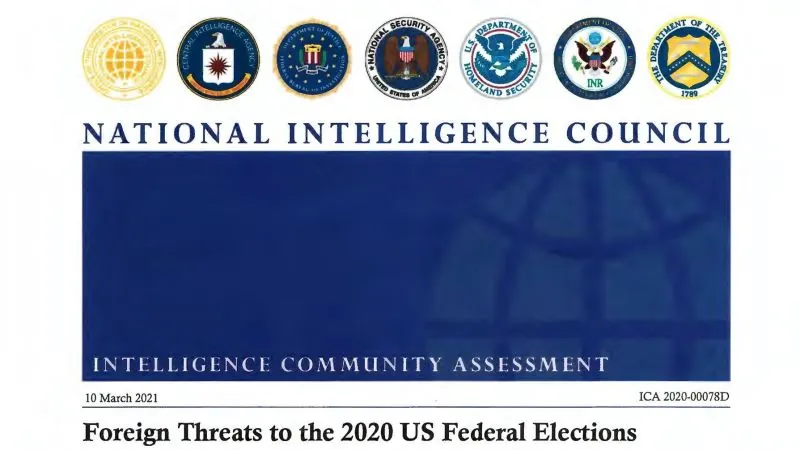
The controlling distinction is simple enough to state and easy enough to blur. A document may discuss foreign influence activity, attempted access, voter-file exposure, registration-system issues, investigative leads, or administrative-data anomalies. None of those verbs is the same as proving that ballots were changed, vote totals were altered, or a voting system changed the result. The March 2021 Intelligence Community assessment addresses that narrower question directly: it found “no indications that any foreign actor attempted to alter any technical aspect of the voting process in the 2020 US elections.” [1]

Status key used in this record
- Confirmed: the cited primary record says the claim, or the operative part of the claim, in substance.
- Misleading: the claim uses a real document or event but changes the legal or factual load-bearing verb, usually by turning access, inquiry, or concern into vote alteration.
- Unproven: the public record reviewed here does not establish the claim.
- Context-only: the fact is real and relevant to the political or legal setting, but it does not prove the election-manipulation claim being made.
For litigation, client-alert, or newsroom use, the status flag should be read with the source sentence, not apart from it. A claim can be politically significant and still be evidentiary dead weight if the cited record does not say the thing being asserted.
Claim ledger
| Claim checked | Status | Primary-source resolution | Last verified |
|---|---|---|---|
| The declassified March 2021 intelligence assessment proves foreign actors manipulated 2020 votes. | Misleading / unproven | The assessment discusses foreign influence activity, but its technical finding cuts the other way: it reported no indications that any foreign actor attempted to alter voter registration, ballot casting, vote tabulation, or result reporting. [1] | Aug. 4, 2026 |
| Access to election-related data is proof that votes were changed. | Misleading | Access, targeting, or possession of data is not the same evidentiary category as alteration of ballots or tabulation. CISA and election-infrastructure officials said after the election that there was no evidence any voting system deleted, lost, or changed votes, or was otherwise compromised. [2] | Aug. 4, 2026 |
| Voter-file or registration-data issues prove illegal ballots were counted or totals were altered. | Unproven | Election-administration records can show registration maintenance, provisional-ballot handling, turnout reporting, and related administrative measures. They do not, by themselves, establish that an ineligible person cast a counted ballot or that a vote total was changed. [3] | Aug. 4, 2026 |
| SAVE program records prove noncitizen votes changed the 2020 result. | Unproven | SAVE is a status-verification program used to check immigration or naturalized/acquired citizenship status for authorized agencies. A SAVE query or record is not, without a matched ballot and lawful-voter analysis, proof that a noncitizen cast a counted vote or affected a certified result. [4] | Aug. 4, 2026 |
| A January 2020 intelligence memo proves later 2020 vote manipulation. | Context-only / unproven | A pre-election intelligence warning or lead can explain what officials were watching before the election. It does not prove that votes were later altered unless it contains or is paired with post-election technical findings showing alteration. No such vote-alteration finding is established in the source set reviewed here. | Aug. 4, 2026 |
| The Michigan-related FBI closing record proves vote manipulation was buried. | Unproven | A closing record can matter if it identifies the issue investigated and the reason for closure. On the reviewed record, the Michigan matter is not a public finding that ballots were changed, vote totals were altered, or a voting system changed the election result. | Aug. 4, 2026 |
| The dismissal of United States v. Trump proves the federal election-interference prosecution failed on the merits. | Misleading | The federal case was dismissed without prejudice on Nov. 25, 2024, after the 2024 election and under DOJ policy concerning prosecution of a sitting president. That docket event is not an acquittal, a trial verdict, or a judicial finding that the indictment’s factual allegations were false. [5] | Aug. 4, 2026 |
| United States v. Trump proves Trump was criminally convicted of election interference. | Misleading | The case did not go to trial and produced no conviction. Special Counsel Jack Smith’s Volume 1 report stated that the admissible evidence was sufficient to obtain and sustain a conviction, but that is a prosecutorial assessment, not an adjudicated verdict. [6] | Aug. 4, 2026 |
Where the vote-alteration claim fails
The March 2021 Intelligence Community assessment is the first document to pull from the stack because it answers the technical question directly. It did not merely fail to endorse a theory of changed votes. It affirmatively reported no indications that a foreign actor attempted to alter the technical voting process, including registration, ballot casting, tabulation, and result reporting. [1]
That does not mean every foreign-activity concern was imaginary. The assessment addressed influence operations and foreign preferences. Those topics can be serious without doing the work the July 16 speech assigned to them. Influence activity concerns persuasion, disinformation, pressure, or perception. Vote alteration concerns the machinery and legal count: registration records changed in a way that affects eligibility, ballots cast or discarded unlawfully, tabulation altered, or results reporting manipulated. A sentence about the first category cannot be quoted as proof of the second.
The same boundary appears in the post-election statement from CISA and the Election Infrastructure Government Coordinating Council and Sector Coordinating Executive Committees. Their Nov. 12, 2020 statement said the election was “the most secure in American history” and that there was no evidence that any voting system deleted or lost votes, changed votes, or was compromised. [2] That statement is not a universal audit of every rumor, witness statement, or administrative problem. It is, however, a primary-source obstacle to any speech claim that treats access, concern, or investigation as established vote manipulation.
Why access is not enough
The recurring move in the speech is evidentiary compression. A record suggesting data access, system probing, foreign interest, or administrative vulnerability is treated as if it completed the chain to altered votes. For a legal-risk reader, that chain has missing links: what system was accessed, what authority or authentication was used, whether the accessed system was connected to voting or counting, whether any record was changed, whether the change affected eligibility or tabulation, and whether the change survived certification or audit controls.
A hypothetical example shows the difference without pretending to describe a real case. If an actor obtained a county voter-registration export, that could be a serious data-security incident. It would not prove that a ballot was added, removed, or switched. To make the vote-alteration claim, the record would need to show a changed registration status, a resulting ballot event, a tabulation consequence, and some way to connect the action to the certified vote count. The July 16 speech’s cited categories do not bridge that gap on the public record reviewed here.
This is also why voter-file data should be handled carefully. The Election Assistance Commission’s 2020 Election Administration and Voting Survey is useful for administrative measures: registration totals, voting methods, provisional-ballot handling, rejected ballots, and election-office reporting. [3] Those are not trivial records. They are just not a shortcut to the conclusion that unlawful votes were counted or lawful votes were changed. A registration file can contain corrections, duplicates to be resolved, inactive voters, or ordinary list-maintenance issues without proving a changed election result.
SAVE records cannot carry the noncitizen-vote claim by themselves
The same source-control problem applies to claims built on SAVE, the federal Systematic Alien Verification for Entitlements program. USCIS describes SAVE as a service that allows authorized agencies to verify immigration status or naturalized/acquired US citizenship status. [4] That makes it a verification tool, not a ballot ledger.
A defensible noncitizen-voting claim would need more than a SAVE record or a mismatch. It would need a legally reliable identity match, the relevant status at the legally relevant time, proof of registration or ballot activity, proof the ballot was counted, and a theory connecting those ballots to a race outcome if the claim is outcome-changing manipulation. Without those steps, the claim remains in the category of administrative lead or possible eligibility inquiry. It does not become proof that votes were changed.
The criminal docket cuts both ways, and neither side gets to overclaim it
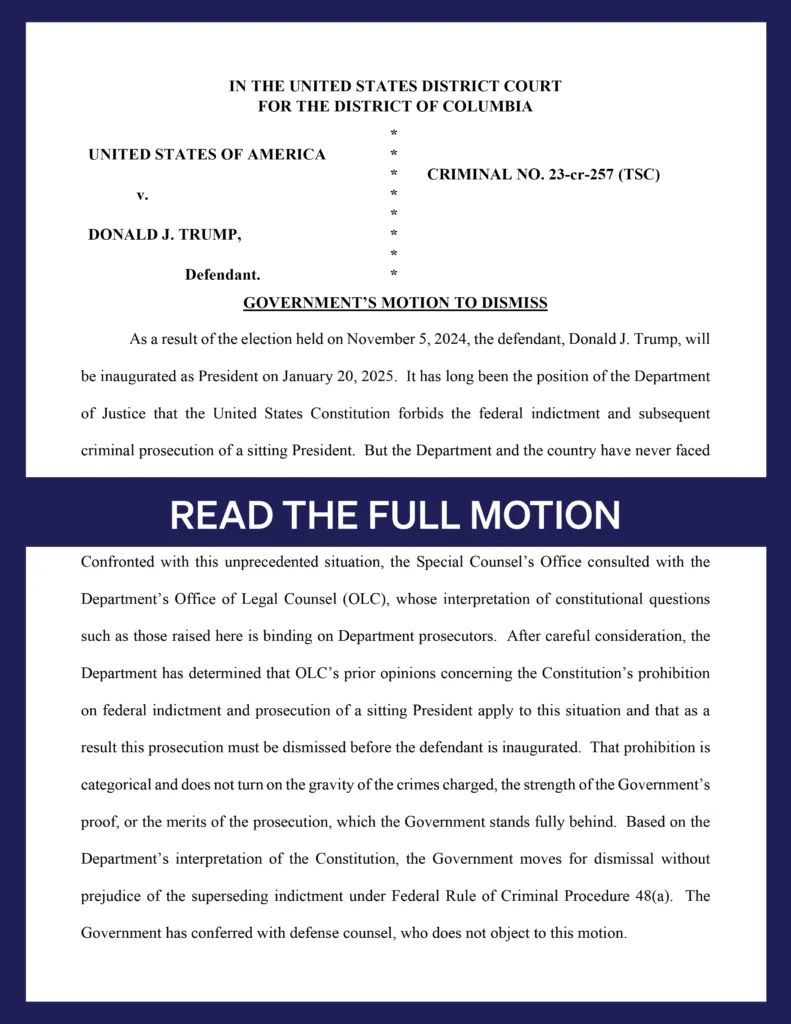
The federal election-interference prosecution belongs in this record because the July 16 speech used the same political terrain, and because clients often ask whether the dismissal changed the legal assessment. It changed the procedural status. It did not adjudicate the facts.
United States v. Trump was dismissed without prejudice on Nov. 25, 2024, after the 2024 presidential election and in light of DOJ policy concerning prosecution of a sitting president. [5] “Without prejudice” matters. It means the dismissal was not a merits determination equivalent to an acquittal. The dismissal also does not prove that election-interference allegations were true. It means the case ended before trial under the stated procedural and institutional constraints.
Smith’s Volume 1 report, released Jan. 14, 2025, stated that the admissible evidence was sufficient to obtain and sustain a conviction. [6] That sentence is an official prosecutorial assessment and it can be cited as such. It is not a jury verdict. It is not a conviction. It does not establish, for purposes of this July 2026 declassification claim, that foreign actors changed votes or that the underlying intelligence documents prove vote manipulation.
What can be said safely
A careful formulation would be: the July 16, 2026 speech cited declassified and official records concerning election security, foreign influence, voter-file or administrative data, and legal proceedings, but the cited public record does not establish that votes were altered in the 2020 election. That sentence is narrower than most political summaries, and it is the safer one.
A riskier formulation would be: the documents prove the 2020 vote was manipulated. The primary sources reviewed here do not support that sentence. The March 2021 intelligence assessment and the CISA/election-infrastructure statement point the other way on technical vote alteration, and the federal criminal docket supplies procedural and prosecutorial context rather than an adjudicated finding.
The defensible conclusion is therefore limited but firm: the July 16, 2026 Trump DOJ election-interference speech does not prove vote manipulation through the documents cited. Its central move depends on treating data access, administrative records, investigative leads, and unresolved legal context as if they established altered votes. The underlying intelligence assessments and court records do not support that conversion.
References
- Intelligence Community Assessment: Foreign Threats to the 2020 US Federal Elections, Office of the Director of National Intelligence, March 10, 2021.
- Joint Statement from Elections Infrastructure Government Coordinating Council & the Election Infrastructure Sector Coordinating Executive Committees, Cybersecurity and Infrastructure Security Agency, November 12, 2020.
- Election Administration and Voting Survey 2020 Comprehensive Report, U.S. Election Assistance Commission, 2021.
- Systematic Alien Verification for Entitlements (SAVE), U.S. Citizenship and Immigration Services.
- United States v. Trump, No. 1:23-cr-00257 (D.D.C.) docket, CourtListener, November 25, 2024.
- Final Report of the Special Counsel, Volume One, U.S. Department of Justice, January 14, 2025.
Related records
Tool profile
How Meta's AI Spending Reshapes Law Firm ProfitabilityGoverning regulation
Browse the obligations tracker →Preventive workflow
Browse verification workflows →
Report a correction or tip
Spotted an outdated figure, a misstated fact, or a ruling this case record should reflect? Public comments are disabled for this content given the professional cost of a misreported case outcome, penalty amount, or rule text — use the structured correction channel instead.
Report a correction or tip for this record →