
Trump Epstein Award Suit Faces Anti-SLAPP Motion
A procedural record of Trump's $10B defamation suit against The Wall Street Journal over Epstein reporting, which survived initial dismissal but now faces an anti-SLAPP motion to dismiss with prejudice and fee exposure, following the same reporting's receipt of the Katherine Graham Award for Courage and Accountability. This collision illustrates the high actual-malice bar for public-figure plaintiffs and the strategic leverage of Florida's anti-SLAPP statute.
- Jurisdiction
- US-FL-Southern District
- Court
- U.S. District Court for the Southern District of Florida
- Judge
- Darrin P. Gayles
- AI tool named
- No AI tool implicated
- Ruling date
- Apr 13, 2026
- Source document
- View primary court order ↗
- Last verified
- Jul 27, 2026
Lex Machina Review is an independent risk-tracking and reference resource. Nothing on this site is legal advice, and using it does not create an attorney-client relationship. Every record is reviewed against primary sources but may not reflect the most current status of a matter — always verify directly against the cited court order, rule text, or a licensed attorney before relying on it.
Companion explanation — secondary to the source document above
As of July 27, 2026, Donald Trump’s $10 billion defamation suit against The Wall Street Journal is alive only in the procedural sense that he filed an amended complaint after an initial dismissal. The operative pleading is now facing the Journal’s June 10 anti-SLAPP motion, which asks Judge Darrin P. Gayles of the Southern District of Florida to dismiss the amended complaint with prejudice and award attorney fees. That motion remains pending before the court.
That status matters because the case is easy to misdescribe from either direction. The April dismissal did not end the action. The amended complaint did not cure the case as a matter of law. And the White House Correspondents’ Dinner award given to the same reporting on July 24 is not a judicial finding that the reporting was accurate, protected, or published without actual malice. It is reputationally striking, not dispositive.
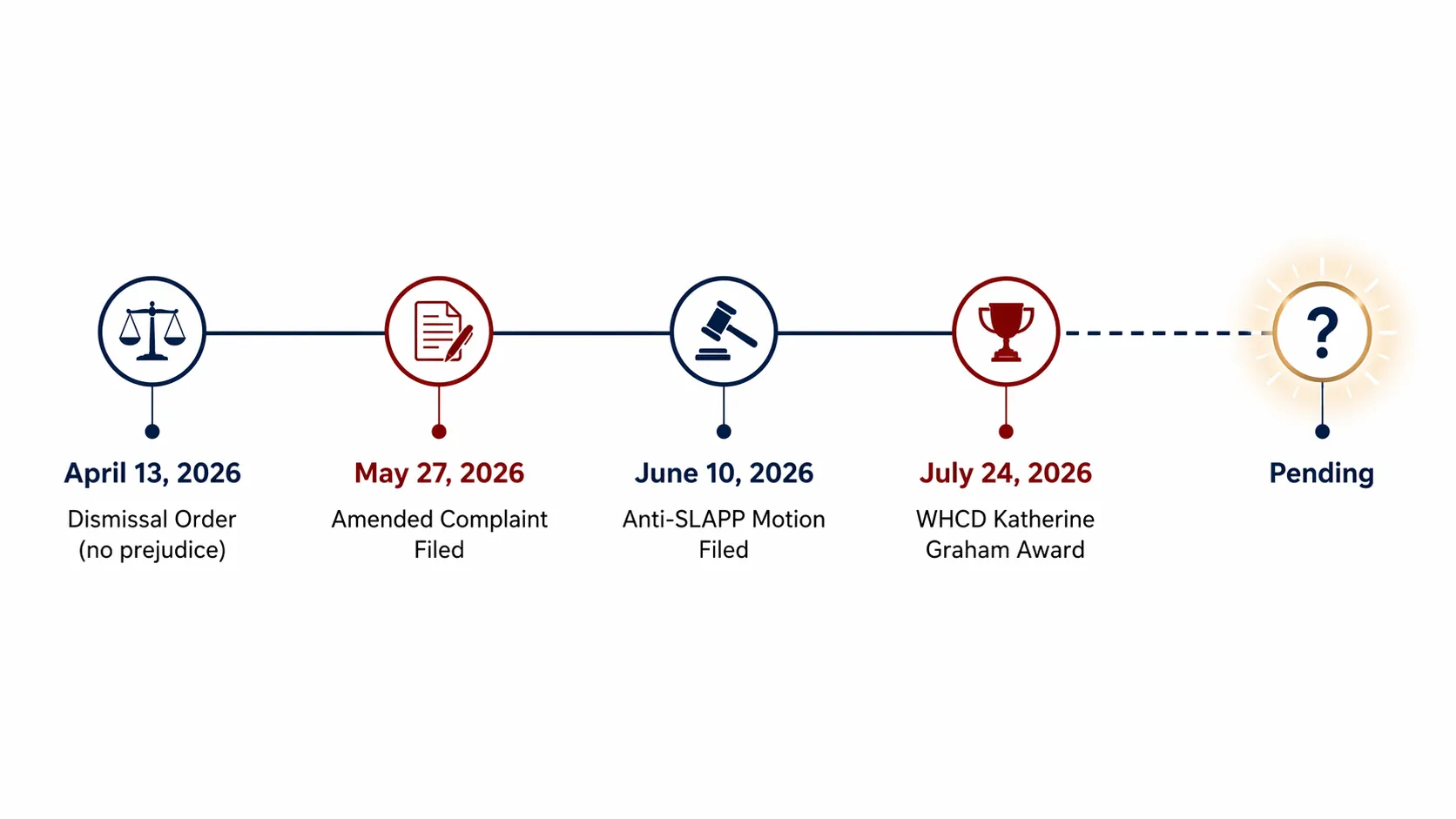
The live posture is an amended complaint under anti-SLAPP pressure
The current procedural sequence is short but loaded. On April 13, 2026, Judge Gayles dismissed Trump’s defamation complaint, with reporting on the order emphasizing the court’s conclusion that Trump was “nowhere close” to pleading actual malice, the constitutional fault standard that public-figure defamation plaintiffs must satisfy. Trump then filed an amended complaint on May 27. On June 10, The Wall Street Journal moved again to dismiss, this time invoking Florida’s anti-SLAPP statute and seeking dismissal with prejudice plus attorney fees. The amended complaint and the anti-SLAPP motion are both still pending as of July 27, 2026.[1][2][3][4]
| Date | Event | Why it matters now |
|---|---|---|
| April 13, 2026 | Judge Gayles dismisses Trump’s complaint | The order identifies a pleading failure on actual malice; it does not finally terminate the dispute. |
| May 27, 2026 | Trump files an amended complaint | The case continues on a new pleading, including additional allegations reported as involving Rupert Murdoch and Ghislaine Maxwell. |
| June 10, 2026 | The Wall Street Journal files an anti-SLAPP motion | The defense seeks dismissal with prejudice and attorney fees, creating the live fee-shifting issue. |
| July 24, 2026 | The reporting receives the WHCD Katherine Graham Award | The award intensifies the public contrast but does not decide the legal sufficiency of the amended complaint. |
| July 27, 2026 | No ruling reported on the amended complaint or anti-SLAPP motion | The case remains pending before the court. |
What the April dismissal did — and did not — decide
The April 13 order is the reason the case cannot be treated as an ordinary open pleading dispute. Judge Gayles did not merely ask for cleaner drafting. The reported language that Trump was “nowhere close” to alleging actual malice goes to the central liability bottleneck in a public-figure defamation case: whether the plaintiff plausibly alleges that the publisher knew the challenged statement was false or acted with reckless disregard for whether it was false.[1][2]
That is different from deciding the factual truth of the Journal’s reporting. A dismissal at the pleading stage tests whether the complaint alleges enough facts to move forward under the applicable legal standard. The practical effect, however, is still significant. Once a court has said the original complaint fell “nowhere close” on actual malice, the amended complaint has to do more than repeat injury, outrage, or reputational consequences. It has to supply allegations that address the defect the court identified.
That is why “survived initial dismissal” needs careful wording here. The claim survived only because Trump repleaded after dismissal. It has not survived the Journal’s renewed attack on the amended pleading.
The amended complaint changed the posture, not the burden
Trump’s May 27 amended complaint kept the lawsuit moving and added allegations reported as involving Rupert Murdoch and Ghislaine Maxwell. The underlying dispute remains the Journal’s reporting about an alleged Trump letter to Jeffrey Epstein’s birthday book. Those additions matter procedurally because they are the plaintiff’s attempt to answer the April order’s pleading concerns, but they do not lower the actual-malice threshold.[3]
For risk readers, the amended pleading is best treated as a reset of the motion practice, not as a merits win. A plaintiff can keep a case alive by amending after a dismissal without establishing that the new allegations are legally sufficient. The relevant question becomes narrower: did the amended complaint add facts that plausibly support actual malice, or did it simply add more allegation-heavy context around the same core publication?
That question is now teed up by the defense motion. Until Judge Gayles rules, neither side has the ruling it wants: Trump has an operative amended complaint, and the Journal has a pending motion asking the court to end it with prejudice.
The anti-SLAPP motion is the live strategic lever
The June 10 filing is the pressure point because the Journal is not just asking for another dismissal. It is asking for dismissal with prejudice under Florida’s anti-SLAPP statute and for attorney fees. If the court grants that request, the amended complaint would not merely be found deficient again; the case would be terminated at the district-court level in a posture that also creates fee exposure for Trump.[4]
That is the procedural leverage anti-SLAPP practice can create in media litigation. A standard motion to dismiss may narrow or end claims. An anti-SLAPP motion, where applicable and successful, also changes the economics of the case by putting the plaintiff at risk for the defendant’s fees. In a celebrity-scale defamation suit seeking $10 billion, the fee issue is not the headline number, but it is the real litigation-management number: it affects settlement posture, appeal calculations, and the cost of continuing to press a deficient pleading.
The limitation is just as important. The Journal’s anti-SLAPP argument has not been accepted by the court. “Moved to dismiss with prejudice” is not the same as “dismissed with prejudice.” The motion is pending before the court, and any useful legal update has to stop there.

The award makes the optics awkward, not legally settled
The reputational collision arrived on July 24, when the White House Correspondents’ Association gave the Journal reporting at issue the Katherine Graham Award for Courage and Accountability. The same event also produced the odd public overlap that has made the lawsuit newly searchable: Trump publicly congratulated the Journal reporters while he was simultaneously suing over the reporting they had done.[5][6][7][8]
That is a memorable scene, but it should not be made to carry more legal weight than it has. A journalism award can reinforce the public and professional standing of a story. It can also sharpen the contrast between the newsroom’s reception and the plaintiff’s litigation position. It does not answer whether the amended complaint pleads actual malice, whether Florida’s anti-SLAPP statute applies, whether dismissal should be with prejudice, or whether fees should be awarded.
For the court, the relevant materials are the pleadings, the challenged publication, the applicable defamation standard, the anti-SLAPP statute, and the motion record. For the public, the award supplies the dramatic fact pattern: a president congratulating reporters for work that remains the target of his $10 billion complaint. Those two tracks now run beside each other, but they do not merge into a merits ruling.
Risk posture as of July 27, 2026
For counsel or knowledge-management teams tracking the matter, the clean version is this: the first complaint was dismissed after the court found the actual-malice allegations badly deficient; Trump repleaded; the Journal responded with an anti-SLAPP motion seeking dismissal with prejudice and fees; and no ruling on that motion has issued as of July 27, 2026.
- Plaintiff-side status: Trump has an amended complaint on file, so the case is not over.
- Defense-side status: The Journal has a pending anti-SLAPP motion that, if granted as requested, would end the case with prejudice and support a fee request.
- Actual-malice status: The April order’s “nowhere close” language remains the key warning sign for the amended pleading.
- Award status: The WHCD recognition is reputationally relevant and publicly awkward, but it is not evidence that resolves the legal standard.
The case therefore sits in a narrow but consequential procedural window. It is not finished, and the award does not decide it. But the current posture shows how a public-figure defamation plaintiff can keep a case alive by amending while still facing a steep actual-malice burden and the added economic pressure of an anti-SLAPP fee-shifting request.
References
- Judge Gayles’ April 13, 2026 dismissal order reporting on Trump’s Wall Street Journal defamation suit, PBS News, April 13, 2026
- Coverage of dismissal order finding Trump “nowhere close” to alleging actual malice, CNBC, April 13, 2026
- Coverage of Trump’s May 27, 2026 amended complaint against The Wall Street Journal, Courthouse News Service, May 27, 2026
- Coverage of The Wall Street Journal’s June 10, 2026 anti-SLAPP motion to dismiss with prejudice and seek attorney fees, Courthouse News Service, June 10, 2026
- Coverage of the WHCD Katherine Graham Award and Trump’s congratulation of Wall Street Journal reporters, The Independent, July 24, 2026
- Coverage of the Wall Street Journal reporting receiving the Katherine Graham Award, Forbes, July 24, 2026
- Coverage of Trump congratulating Wall Street Journal reporters amid the lawsuit, New York Post, July 24, 2026
- Coverage of the White House Correspondents’ Dinner awards ceremony, NPR, July 24, 2026
Related records
Tool profile
How Meta's AI Spending Reshapes Law Firm ProfitabilityGoverning regulation
Browse the obligations tracker →Preventive workflow
Browse verification workflows →
Report a correction or tip
Spotted an outdated figure, a misstated fact, or a ruling this case record should reflect? Public comments are disabled for this content given the professional cost of a misreported case outcome, penalty amount, or rule text — use the structured correction channel instead.
Report a correction or tip for this record →