
Where the Trump immunity case stands after the 2025 remand
A verified docket record of the Trump immunity case in 2025: the Supreme Court's July 2024 holding, the dismissed federal election case, and the November 6, 2025 Second Circuit remand in the New York conviction. The record keeps the three strands separate so no citation to 'the immunity appeal' collapses the holding into the live removal fight.
- Jurisdiction
- US federal, New York
- Court
- Supreme Court of the United States, U.S. Court of Appeals for the Second Circuit
- Judge
- Alvin Hellerstein; Tanya Chutkan
- AI tool named
- No AI tool named
- Ruling date
- Jul 1, 2024
- Source document
- View primary court order ↗
- Last verified
- Aug 4, 2026
Lex Machina Review is an independent risk-tracking and reference resource. Nothing on this site is legal advice, and using it does not create an attorney-client relationship. Every record is reviewed against primary sources but may not reflect the most current status of a matter — always verify directly against the cited court order, rule text, or a licensed attorney before relying on it.
Companion explanation — secondary to the source document above
| Field | Record |
|---|---|
| Category slug | risk-digest |
| Use note | Docket-status verification record only. Not legal advice; do not use as filing, client-advice, or publication authority without independent review. |
| Licensed-counsel review line | Publication should carry the site’s licensed-counsel review line before release; this record is not individualized legal advice. |
| Last verified | 2026-08-04 (UTC). |
| Source status | Supreme Court holding checked against the official opinion PDF [1] and SCOTUSblog procedural page [2]. Federal election-case dismissal checked against NPR’s dismissal report [3] and the DOJ Special Counsel report released in January 2025 [4]. The November 6, 2025 Second Circuit remand is treated here as reported by Courthouse News [5] and Lyle Denniston [6] because the Second Circuit opinion PDF was not directly crawled for this record. |
| Relevant proceedings | Trump v. United States, No. 23-939, 603 U.S. 593; United States v. Trump federal election-interference case before Judge Tanya Chutkan; New York conviction removal fight remanded to Judge Alvin Hellerstein. |
| Bottom-line status | By the end of 2025, “the Trump immunity appeal” was not one live procedural object: the Supreme Court holding remained controlling precedent, the federal election-interference prosecution had been dismissed without prejudice, and the live 2025 litigation was the Second Circuit remand in the New York removal fight. |
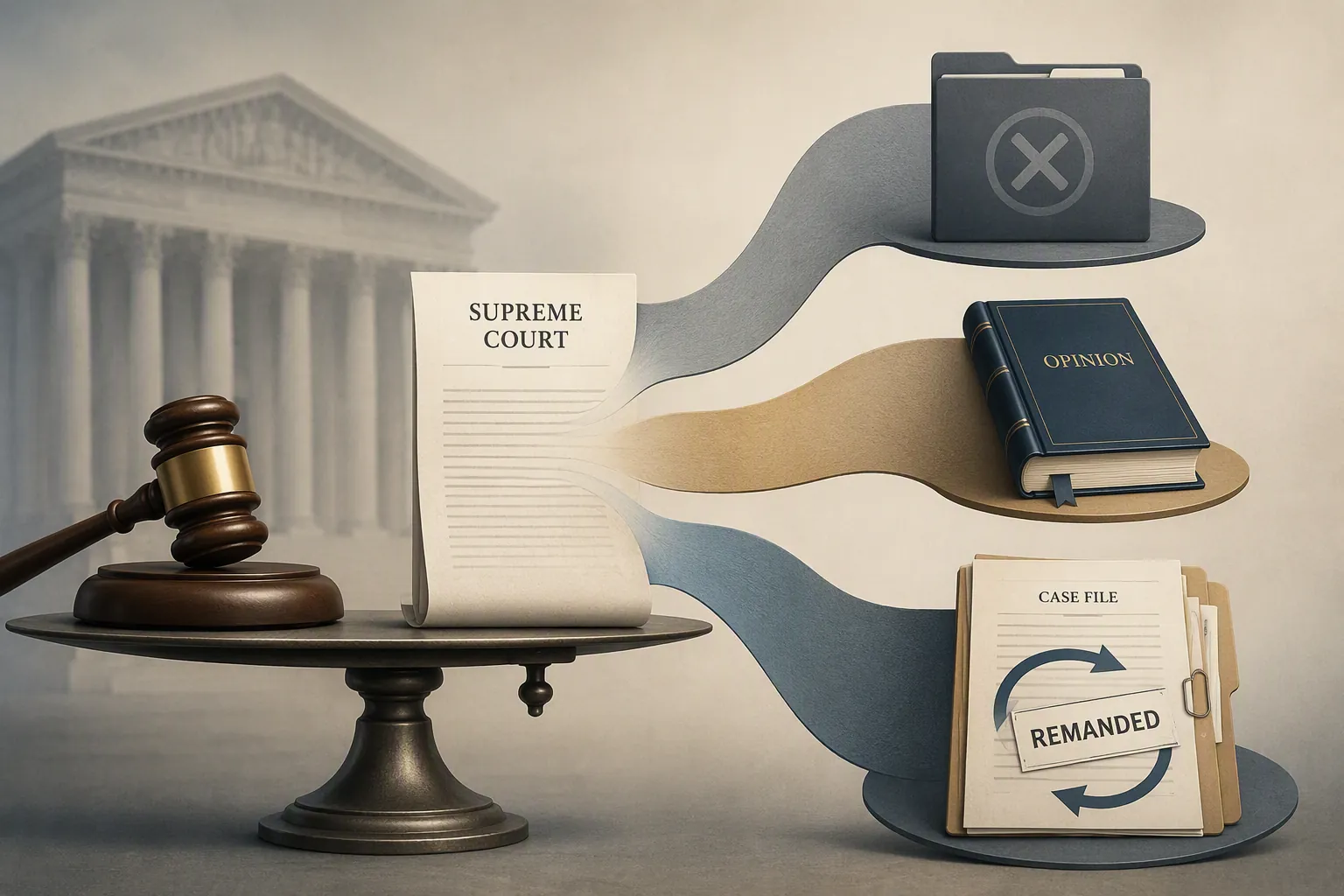
Status correction: there is no single 2025 “immunity appeal”
For anyone checking the 2025 Trump immunity record, the first correction is procedural rather than ideological. A cite to “the immunity appeal” is too blunt unless it identifies which of three records it means: the Supreme Court’s July 1, 2024 presidential-immunity holding, the federal election-interference prosecution that was dismissed without prejudice in November 2024, or the New York conviction removal fight that the Second Circuit remanded on November 6, 2025.
Those are not interchangeable. One is a Supreme Court merits decision. One is a dismissed federal criminal case. One is a live remand over whether the New York case should be reconsidered for federal-officer removal. Treating them as one appellate posture creates the exact kind of citation error that looks harmless in a headline and becomes expensive in a brief.
| Strand | Verified status | Citation consequence |
|---|---|---|
| Supreme Court immunity holding | Trump v. United States, No. 23-939, decided July 1, 2024; the Court recognized absolute immunity for core constitutional acts, at least presumptive immunity for official acts, and no immunity for unofficial acts [1]. | Do not summarize as blanket criminal immunity. The official/unofficial line is part of the holding. |
| Federal election-interference prosecution | Judge Tanya Chutkan granted dismissal without prejudice on November 25, 2024 after Special Counsel Jack Smith moved to dismiss under DOJ policy [3]. Smith’s Volume 1 final report was released in January 2025 [4]. | Do not describe this as the live 2025 immunity appeal. The prosecution was dismissed without prejudice. |
| New York conviction removal fight | As reported, a Second Circuit panel of Judges Raymond Lohier, Susan Carney, and Myrna Perez remanded to Judge Alvin Hellerstein on November 6, 2025 for reconsideration of Trump’s removal request under the 1815 federal-officer statute, while expressing no view on the merits [5]. | This is the live 2025 strand, but it is a removal/remand posture, not a reopened Supreme Court immunity appeal. |
What the Supreme Court actually held
The Supreme Court’s July 2024 decision in Trump v. United States did not announce that a former president is immune from all criminal prosecution. The opinion divided presidential conduct into categories. For actions within the president’s “conclusive and preclusive” constitutional authority, the Court recognized absolute immunity. For other official acts, the Court recognized at least presumptive immunity. For unofficial acts, the Court said there is no immunity [1].
That category structure is not a decorative caveat. It is the holding lawyers have to carry forward. A description that says only “Trump won immunity” leaves out the operative limitation. A description that says “blanket immunity” is worse: it contradicts the explicit no-immunity rule for unofficial acts.
The procedural page maintained by SCOTUSblog is useful for tracking the case’s path and disposition, but the load-bearing source for the rule is the Supreme Court PDF itself [1][2]. When the issue is the content of the immunity holding, cite the opinion before citing a summary. That is not pedantry; it is the difference between quoting a rule and paraphrasing a headline.
The decision also matters because it did not itself decide every downstream application. It supplied a constitutional framework for distinguishing official from unofficial conduct. Later proceedings could then argue about how particular allegations or evidence fit that framework. That is why collapsing the Supreme Court holding into a later 2025 remand produces a false procedural picture.
The federal election case was dismissed without prejudice
The federal election-interference prosecution before Judge Tanya Chutkan is not the live 2025 appeal. On November 25, 2024, Judge Chutkan granted Special Counsel Jack Smith’s request to dismiss the case without prejudice after Smith moved to dismiss under Justice Department policy concerning the prosecution of a sitting president [3].
“Without prejudice” is a status word, not a merits ruling on the immunity question. It means this strand should not be cited as though an appellate court in 2025 was still actively deciding Trump’s immunity in that prosecution. Smith’s Volume 1 final report was then released by the Justice Department in January 2025, which belongs to the record of the completed special-counsel work, not to a live immunity appeal in Judge Chutkan’s case [4].
That is the entire point needed for citation hygiene. The case’s factual and political background may be relevant elsewhere. It is not necessary to restage it to answer the docket-status question.
The live 2025 strand was the New York removal remand
The 2025 development that must not be folded into the dismissed federal case is the Second Circuit’s November 6, 2025 remand in the New York conviction removal fight. Courthouse News reported that a three-judge panel—Judges Raymond Lohier, Susan Carney, and Myrna Perez—sent the matter back to Judge Alvin Hellerstein because he had not adequately considered “important issues relevant” to Trump’s request to remove the case under the 1815 federal-officer statute [5].
The remand was not a ruling that Trump’s New York conviction must be thrown out. It was also not a merits ruling rejecting his position. Courthouse News reported that the panel expressed no view on the merits [5]. That phrase belongs in any accurate short account of the remand, because it prevents the remand from being misread as an appellate victory on the ultimate removal question.
Lyle Denniston’s coverage reported three evidence items the panel identified for renewed consideration: a possible Federal Election Commission investigation, a White House Oval Office conversation with Hope Hicks, and a presidential social-media post [6]. Because the Second Circuit PDF was not directly crawled for this record, those details should be cited as reported by Courthouse News and Denniston unless the downstream writer independently retrieves and verifies the opinion.
That source-status note is not optional. A reported description of an appellate opinion is useful; it is not the same thing as having the opinion in hand. If a filing, client memo, or published story needs the panel’s exact language, the next step is to pull the Second Circuit opinion and check the quotation, the statutory framing, and the scope of the remand against the court document itself.
Do not use one shorthand for three records
The common drafting failure is small: “the Trump immunity appeal.” The damage is that the phrase no longer tells the reader which docket, which court, or which disposition is being invoked.
- If the sentence is about the constitutional rule, cite Trump v. United States and preserve the distinction among core constitutional acts, official acts, and unofficial acts [1].
- If the sentence is about the federal election-interference prosecution, say it was dismissed without prejudice on November 25, 2024, after Smith moved to dismiss under DOJ policy [3].
- If the sentence is about the 2025 appellate activity, say the Second Circuit remanded the New York removal fight to Judge Hellerstein on November 6, 2025, and—unless independently verified—attribute panel composition and evidence-item details to the reporting that supplied them [5][6].
The phrase “immunity appeal” may still be tolerable as loose search language. It is not tolerable as a legal citation unless the writer immediately specifies the proceeding. By late 2025, the federal prosecution and the New York removal fight were in different procedural postures, and the Supreme Court decision was a separate precedent governing categories of conduct.
Citation-verification risk
This record does not document an AI hallucination involving Trump v. United States. It does identify a posture that AI-assisted research, rushed legal drafting, and general-news compression can easily oversimplify: one Supreme Court holding, one dismissed federal prosecution, and one live state-conviction removal remand all traveling under the same public shorthand.
For verification workflows, the fix is not complicated. Check the holding against the Supreme Court opinion. Check the federal election-case status against the dismissal record and the special-counsel report. Check the New York remand against the Second Circuit opinion itself if the exact appellate language matters. Related Risk Digest records on prompt-injection legal risk and legal AI selloff risk address verification duties in AI-assisted legal work; this docket presents the same practical lesson in miniature.
By the end of 2025, “the Trump immunity appeal” was no longer one thing. Any citation that treats it as one thing is unreliable.
References
- Trump v. United States, 23-939, Supreme Court of the United States, July 1, 2024.
- Trump v. United States, SCOTUSblog.
- Judge grants dismissal of Jan. 6 case against Trump, NPR, Nov. 25, 2024.
- Report of Special Counsel Smith Volume 1, U.S. Department of Justice, January 2025.
- Second Circuit gives Trump another stab at bucking hush money conviction, Courthouse News, Nov. 6, 2025.
- Trump helped again on immunity, Lyle Denniston Law News, Nov. 6, 2025.
Related records
Tool profile
How Meta's AI Spending Reshapes Law Firm ProfitabilityGoverning regulation
Browse the obligations tracker →Preventive workflow
Browse verification workflows →
Report a correction or tip
Spotted an outdated figure, a misstated fact, or a ruling this case record should reflect? Public comments are disabled for this content given the professional cost of a misreported case outcome, penalty amount, or rule text — use the structured correction channel instead.
Report a correction or tip for this record →