
Why Trump's IRS audit immunity was never lawful
The May 2026 arrangement barring IRS examination of President Trump's past returns was invalid on statutory grounds before any court acted: § 7122 did not give the acting attorney general that settlement power, and § 7217 separately criminalizes presidential audit interference. The July 13 bad-faith ruling stripped the deal of judicial cover, but gaps remain — no confirmed IRS chief counsel, an undefined personal scope, and a surviving private settlement.
- Jurisdiction
- U.S. Federal
- Court
- U.S. District Court
- AI tool named
- No AI tool implicated
- Ruling date
- Jul 13, 2026
- Source document
- View primary court order ↗
- Last verified
- Aug 4, 2026
Lex Machina Review is an independent risk-tracking and reference resource. Nothing on this site is legal advice, and using it does not create an attorney-client relationship. Every record is reviewed against primary sources but may not reflect the most current status of a matter — always verify directly against the cited court order, rule text, or a licensed attorney before relying on it.
Companion explanation — secondary to the source document above
Last verified: Aug. 4, 2026. This article is legal information, not legal advice. It was reviewed for statutory background and source consistency; it does not assess any reader’s tax position or litigation strategy.
The operative document in the Trump IRS audit-immunity dispute is not long. On May 19, 2026, Acting Attorney General Todd Blanche signed a one-page order purporting to make the Internal Revenue Service “forever barred and precluded” from examining, reexamining, auditing, or investigating President Trump’s past returns and certain related persons or entities. The order’s reach was at once sweeping and oddly narrow: it targeted past returns, left future tax years outside its express terms, and used “related or affiliated individuals” language whose boundaries were not self-defining. That is enough to make the statutory question unavoidable before any constitutional argument begins: who had authority to sign a permanent tax-audit release of that kind? [1]

The central legal implication is straightforward: the arrangement lacked statutory authority before the July 13 ruling. The later ruling mattered because it stripped the order of judicial cover, but it did not create the defect. The defect was already embedded in the attempted shortcut around the tax code’s settlement rules, closing-agreement channel, and audit-interference prohibition.
The settlement statute did not make DOJ the IRS
The first statutory mismatch is § 7122. The provision divides compromise authority by procedural posture. The Secretary of the Treasury may compromise tax cases before referral to the Department of Justice. Once a case has been referred to DOJ for prosecution or defense, the Attorney General or a delegate may compromise the referred matter. That is a real settlement power, but it is not a general power to settle tax liabilities that were never referred to DOJ. [2]
That distinction is doing most of the work. DOJ can settle litigation in which the United States is a party. It does not follow that DOJ can issue a permanent administrative release covering IRS examination of tax years and liabilities not properly before it. The Tax Law Center at NYU Law made that point before the court’s July ruling: a settlement of claims in the lawsuit could not, by itself, compromise unrelated federal tax liabilities outside the referred case. [3]
That is why the wording of the May 19 order matters. “Forever barred and precluded” is not just emphatic drafting. It purports to change what IRS exam personnel may do with an audit file. If the underlying tax matters were not referred to DOJ, § 7122 did not supply the Acting Attorney General with the authority to impose that result. The problem is not that the order used strong language; it is that the statute did not attach legal force to that language for non-referred tax matters.
The missing § 7121 closing-agreement channel
If the government wanted a binding resolution of tax liability rather than merely a settlement of litigation claims, the tax code has a separate instrument: a closing agreement under § 7121. That provision authorizes the Secretary, or a properly authorized delegate, to enter written agreements with taxpayers on tax liability. Once validly made, those agreements are final and conclusive except on grounds such as fraud, malfeasance, or misrepresentation of material fact. [4]
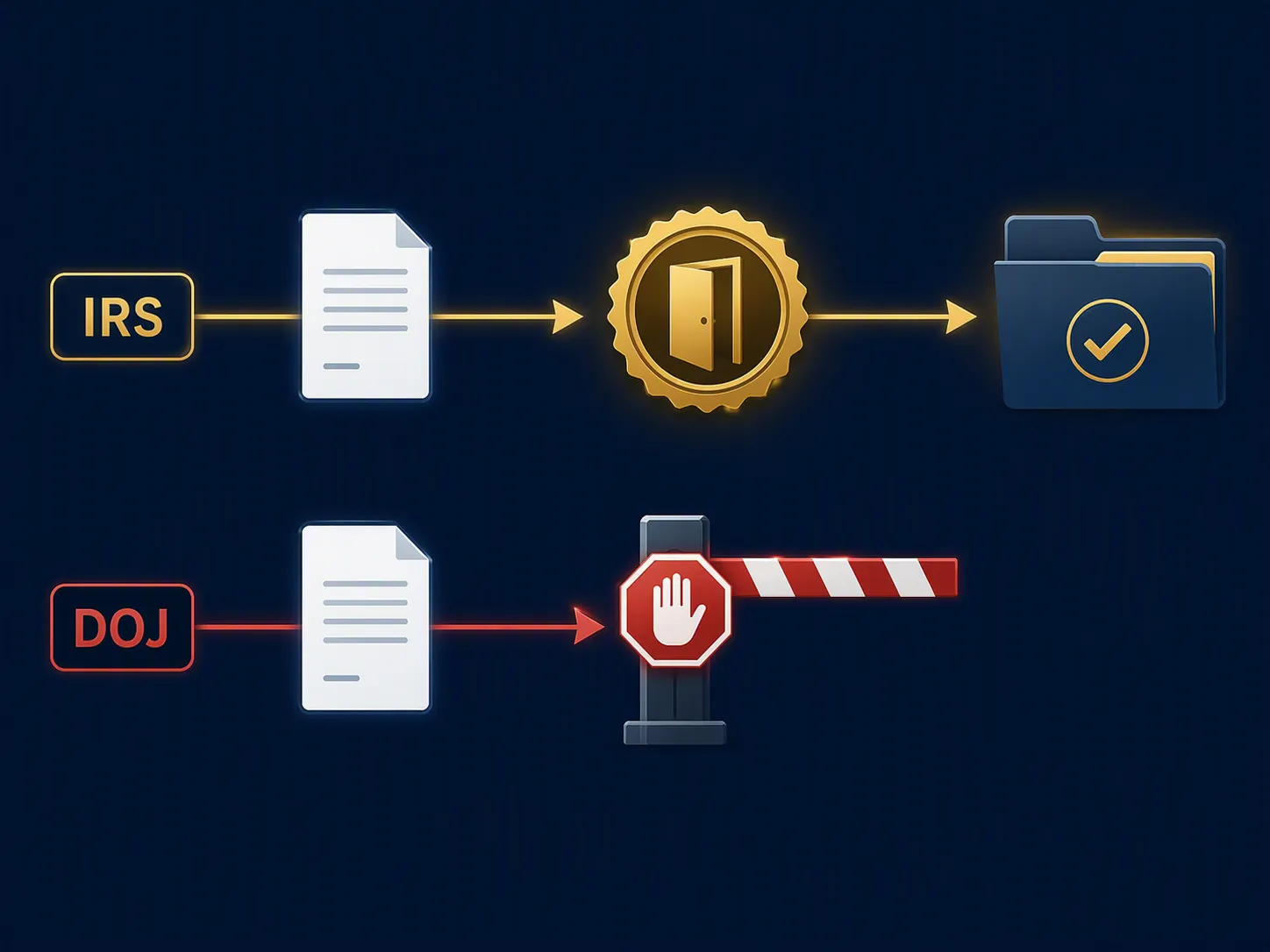
A closing agreement is not a decorative formality. It identifies the channel, the authorized signer, and the consequence of finality. That is exactly what the May 19 order tried to bypass. A tax-liability resolution that belongs in the IRS closing-agreement channel cannot be converted into a DOJ release simply by attaching it to a litigation settlement. The signer matters because the tax code makes finality depend on delegated tax authority, not on the prestige of the government official holding the pen.
The Tax Law Center’s May 13 statement framed the issue in those terms: resolving tax liabilities not at issue in the complaint would require valid IRS closing agreements, not a DOJ-only settlement. That analysis also explains why the one-page order left later government lawyers in a difficult position. If IRS personnel were told the audit file was permanently closed, the next question was not political preference; it was whether there was a valid § 7121 instrument or a referred matter within § 7122. [3][4]
Audit interference is a separate problem, not just a settlement defect
The second statutory problem is more serious than an unauthorized compromise. Section 7217 makes it unlawful for the President, the Vice President, and employees of the Executive Office of the President to request, directly or indirectly, that an IRS officer or employee conduct or terminate an audit or investigation of a particular taxpayer, except through specified lawful channels. The point of the statute is to keep individual audit decisions out of presidential pressure. [5]

That prohibition changes the character of the Trump IRS audit-immunity arrangement. The issue is not merely whether the government gave away too much in a civil settlement. A request to terminate a particular taxpayer’s audit sits inside a criminal prohibition Congress wrote for presidential audit interference. Just Security’s June 2 analysis treated § 7217 as central for that reason, and also discussed § 7212 as a possible obstruction provision in the narrower circumstances recognized by Marinello. [6]
Section 7212 should not be inflated beyond its post-Marinello scope. The obstruction provision criminalizes corrupt interference with tax administration, but Marinello narrowed its application to interference connected to a particular proceeding, such as a known or reasonably foreseeable investigation or audit. That matters here because the strongest statutory implication does not require making § 7212 do all the work. Section 7217 is already aimed at the presidential-audit-interference fact pattern. [7][8]
Nothing in the cited materials establishes that any person has been charged under § 7217 or § 7212 in connection with the arrangement. The narrower, supportable conclusion is that the request to end a particular taxpayer’s audit triggered a statutory prohibition separate from the question whether DOJ had settlement authority.
The July 13 ruling removed cover from an already defective order
By the time the court ruled on July 13, the statutory architecture was already visible. The ruling mattered because it eliminated the supposed judicial footing for the arrangement. The court held that “there was never adverseness between the Parties; there was never a case or controversy,” which goes to Article III power and to the legitimacy of using a court order to bless the deal. [9]
That is not the same as saying the July 13 ruling made the audit immunity unlawful. If DOJ lacked § 7122 authority for non-referred liabilities, and if no valid § 7121 closing agreement existed, the legal problem did not wait for a judge to name it.
The Warren and Wyden July 16 release is useful only for a narrower proposition. It characterized the addendum as directly contravening § 7217 and demanded follow-up from Treasury Secretary Scott Bessent and IRS Commissioner Billy Bisignano by July 22, 2026. That release does not itself decide liability or enforcement. It does show that congressional scrutiny had moved from general outrage to the statutory mechanics of who requested what from whom. [10]
Why the presidential-audit norm matters
The mandatory presidential-audit policy is not the source of DOJ’s settlement authority, and it is not a substitute for § 7121. It matters for a different reason. After Watergate, Congress and the IRS built guardrails to prevent the tax system from being used as a presidential weapon or shield. Mandatory review of presidential and vice-presidential returns is one of those administrative guardrails. [11]
That background explains why a purported release of past presidential returns is not an ordinary audit-management decision. Reported stakes included a potential exposure exceeding $100 million tied to Chicago-loss issues and a separate $72.9 million refund dispute associated with “The Apprentice.” Those figures are reported stakes, not judicial findings in the May 19 or July 13 orders. They matter because they show why an audit file’s procedural status has consequences; they do not prove the amount of any final tax liability. [12][13]
The Tax Law Center’s July 28 statement tied the audit-immunity issue to the Blanche confirmation fight, but the legal point does not depend on confirmation politics. If an official asserts power to end IRS scrutiny of a particular taxpayer’s past returns, the tax code asks a sequence of administrative questions: Was the matter referred to DOJ? Was there a valid closing agreement? Was the signer authorized? Did the request itself fall within § 7217? [14]
What remains unresolved
The July 13 ruling did not automatically rebuild the audit machinery. It removed judicial cover, but it did not by itself answer who inside the IRS would reopen, reassign, or supervise any affected file. That matters because the materials identify the absence of a confirmed IRS chief counsel as an unresolved governance gap. A defective release still has to be unwound through officials with authority to act.
The personal scope also remains unsettled. The May 19 order’s reference to related or affiliated individuals created uncertainty about who was supposedly protected. A tax administration system cannot treat that phrase as self-executing without deciding whether it covers family members, business entities, trusts, counterparties, or some narrower category. The broader the asserted coverage, the harder it is to square with a one-page order unsupported by a tax-code closing instrument.
Future § 7121 agreements are also not foreclosed as a category. The point is not that the IRS can never settle tax liabilities with President Trump or related taxpayers. The point is that a valid tax settlement must move through the correct statutory channel and be signed by an authorized official. If the government later enters proper closing agreements, those instruments would need to be judged on their own terms, not treated as cured versions of the May 19 order.
Finally, the private settlement survives as a separate complication. The July 13 ruling stripped the arrangement of judicial cover; it did not automatically void every private undertaking the parties may have made around it. That leaves the government with a practical enforcement problem: an invalid public order may be easier to disregard than a web of private promises, releases, and litigation positions that still have to be parsed.
The boundary is therefore precise. The court’s ruling took away the premise that a friendly lawsuit could generate a binding anti-audit order. It did not supply a valid § 7121 agreement, expand § 7122, define the covered persons, appoint the missing tax officials, or decide every enforcement question. The legal defect was not a later judicial discovery; it was present from the moment a one-page DOJ order tried to do the work of the tax code’s settlement, closing-agreement, and audit-interference rules.
References
- Trump v. Internal Revenue Service, U.S. Department of Justice, May 19, 2026.
- 26 U.S.C. § 7122 — Compromises, Legal Information Institute.
- Tax Law Center Statement on Trump v. IRS Settlement, Tax Law Center at NYU Law, May 13, 2026.
- 26 U.S.C. § 7121 — Closing agreements, Legal Information Institute.
- 26 U.S.C. § 7217 — Prohibition on executive branch influence over taxpayer audits and other investigations, Legal Information Institute.
- The Trump-IRS Settlement: Legal Issues and Congressional Oversight Options, Just Security, June 2, 2026.
- 26 U.S.C. § 7212 — Attempts to interfere with administration of internal revenue laws, Legal Information Institute.
- Marinello v. United States, Supreme Court of the United States.
- Trump v. Internal Revenue Service, July 13, 2026.
- Warren, Wyden Demand Answers from Treasury, IRS Following Court Ruling on Trump IRS Deal, Office of Senator Elizabeth Warren, July 16, 2026.
- Internal Revenue Manual 4.8.4.2.5 — Mandatory Review of the President and Vice President’s Tax Returns, Internal Revenue Service.
- I.R.S. Audit of Trump Could Cost Former President More Than $100 Million, The New York Times, May 11, 2024.
- The President’s Taxes: Long-Concealed Records Show Trump’s Chronic Losses and Years of Tax Avoidance, The New York Times, Sept. 27, 2020.
- Tax Law Center Statement on Trump Audit Immunity and the Blanche Confirmation, Tax Law Center at NYU Law, July 28, 2026.
Related records
Tool profile
How Meta's AI Spending Reshapes Law Firm ProfitabilityGoverning regulation
Browse the obligations tracker →Preventive workflow
Browse verification workflows →
Report a correction or tip
Spotted an outdated figure, a misstated fact, or a ruling this case record should reflect? Public comments are disabled for this content given the professional cost of a misreported case outcome, penalty amount, or rule text — use the structured correction channel instead.
Report a correction or tip for this record →