
Trump targets inaccurate Smithsonian exhibits via sidewalk signs
President Trump's July 24 executive order cannot compel the Smithsonian to change its exhibits, but it can require disclaimers on NPS-maintained sidewalks outside its museums. This analysis examines the separation-of-powers limits and the government speech questions raised by the strategy.
- Jurisdiction
- US Federal
- Court
- D.C. Circuit
- AI tool named
- No AI tool
- Ruling date
- Jul 24, 2026
- Source document
- View primary court order ↗
- Last verified
- Jul 25, 2026
Lex Machina Review is an independent risk-tracking and reference resource. Nothing on this site is legal advice, and using it does not create an attorney-client relationship. Every record is reviewed against primary sources but may not reflect the most current status of a matter — always verify directly against the cited court order, rule text, or a licensed attorney before relying on it.
Companion explanation — secondary to the source document above
The legally interesting object in President Trump's July 24 order is not inside a gallery. It is the sign outside: a posted disclaimer, placed on federal land administered by the National Park Service, warning visitors about what the order calls "inaccurate" Smithsonian content before they enter the museum. That placement is doing most of the legal work.
Sections 2 and 3 of the executive order direct the Secretary of the Interior, not the Smithsonian Secretary, to identify and post notices on federal land administered by the National Park Service near Smithsonian museums. The order is styled as a response to allegedly inaccurate or ideologically distorted exhibits, but its operative route runs through Interior-controlled land rather than through curatorial offices or museum display cases.[1]
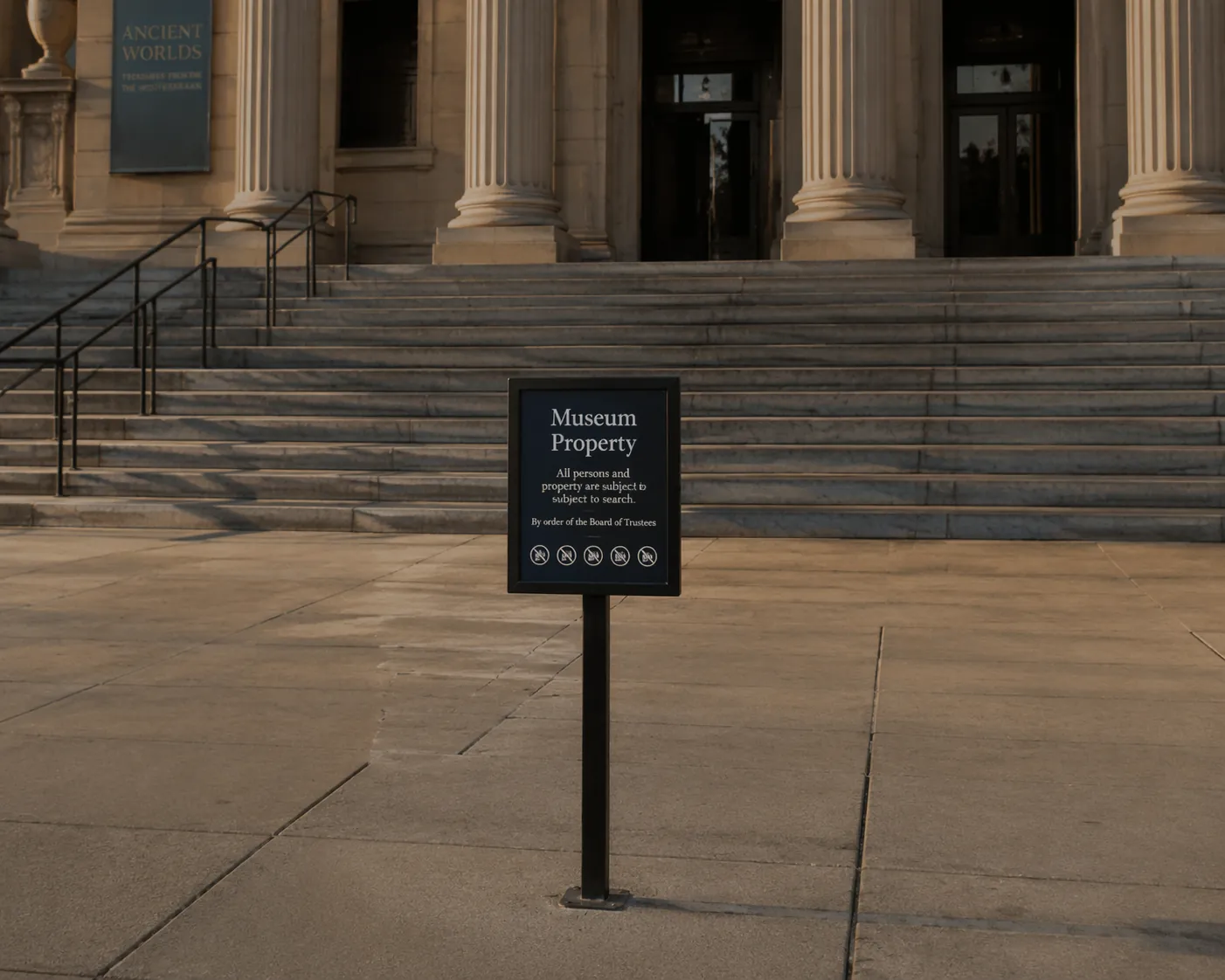
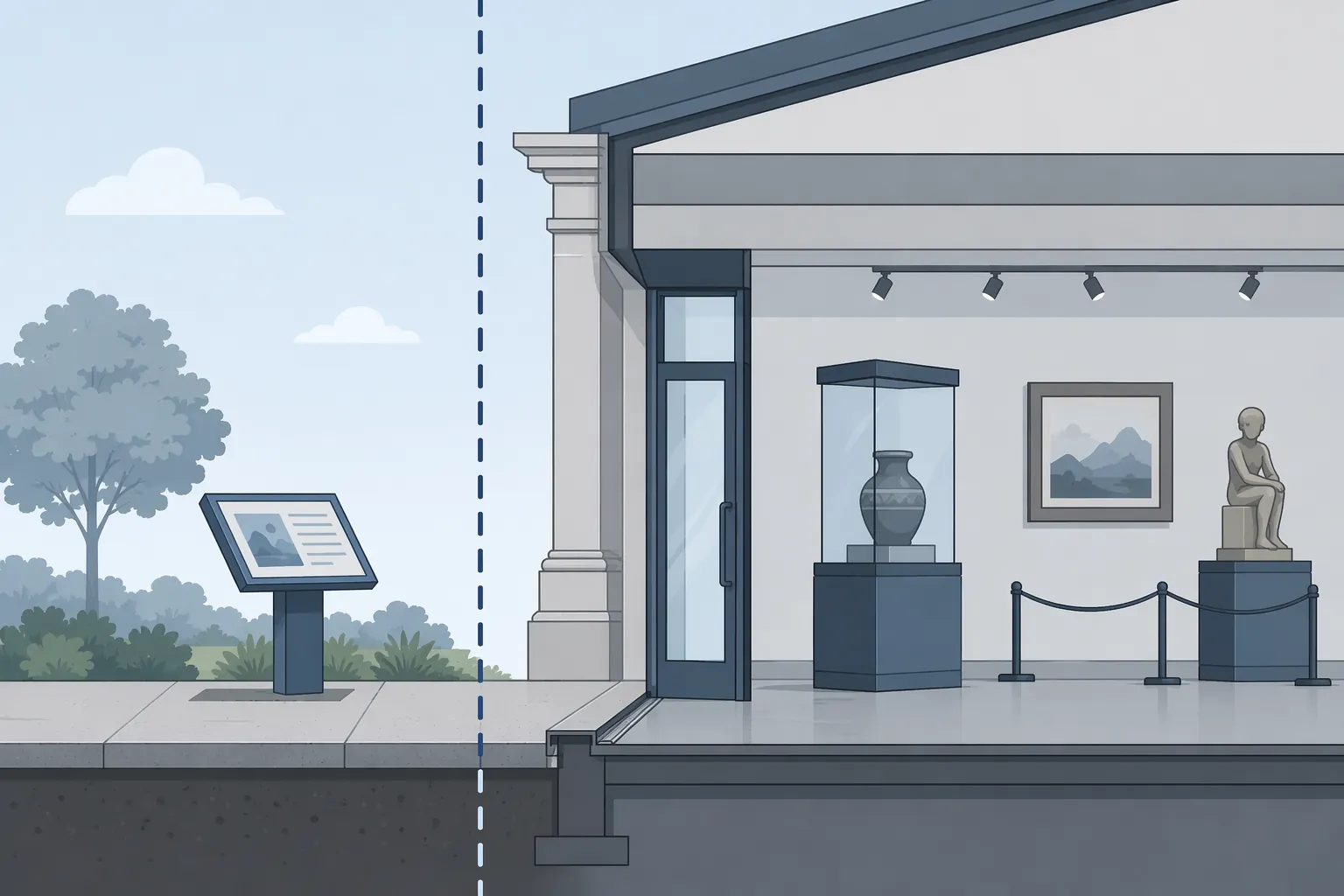
That distinction matters because the President's authority is not the same on each side of the threshold. A directive to the Interior Department about federal sidewalks and grounds is one kind of legal act. A command to the Smithsonian to rewrite exhibits would be another. The controversy is easy to overstate if those two acts are collapsed into one general claim about "the government" controlling museum speech.
Why the Smithsonian Is Not Just Another Executive Agency
The Smithsonian's legal status is the reason the order takes the sidewalk route. The D.C. Circuit has described the Smithsonian as a trust instrumentality rather than an ordinary executive agency, and that classification has practical consequences for presidential control.[2] Earlier D.C. Circuit precedent likewise treated the Smithsonian as having an independent legal identity rather than simply operating as a standard department within the Executive Branch.[3]
The statutory design reinforces that point. The Smithsonian is governed by a 17-member Board of Regents that includes the Vice President, the Chief Justice of the United States, three members of the Senate, three members of the House, and nine citizen regents.[4] That is not the familiar chain of command in which the President appoints, supervises, and removes agency leadership as a matter of ordinary Article II control.
The Chief Justice's role is not decorative for this analysis. It signals a structure deliberately removed from single-branch ownership. The Smithsonian's own legal history emphasizes its origin in James Smithson's bequest and Congress's creation of an institution to administer that trust.[5] However one describes the Smithsonian in other contexts, its museum directors are not cabinet subordinates waiting for presidential exhibit instructions.
That is why broad formulations such as "Trump can force the Smithsonian to change its exhibits" reach too far. The President may criticize the institution, condition some future executive-branch interactions where lawful, or direct agencies under his control. But the materials here do not support a direct presidential power to remove the Smithsonian Secretary, displace the Board of Regents, or order curators to revise exhibit text.
The same point has been made in recent academic analysis of the Smithsonian's structure. A Yale Law Journal essay published in April 2026 identified the trust-instrumentality arrangement as the central limit on executive efforts to control Smithsonian exhibits, while also noting that the structure is not immune from political pressure or adjacent forms of federal leverage.[6] The essay is not binding authority, but it correctly starts where the legal analysis has to start: with the institution's charter and governance, not with the political temperature around a particular exhibit.
The Kennedy Center comparison sharpens rather than weakens the point. In that setting, Congress gave the President specific statutory appointment authority over board members.[7] Whether one thinks the resulting governance fight was wise or destabilizing, the legal lever was materially different. Appointment power supplied a route to institutional control. The Smithsonian's Board of Regents does not give the President the same handle.
The Order's Workaround Runs Through Interior
The July 24 order appears to recognize that problem. It does not, at least in its sidewalk-signage provisions, purport to send instructions to the Smithsonian Secretary. It directs the Secretary of the Interior to act on land administered by the National Park Service.[1] That is a jurisdictional pivot, not a drafting accident.
| Location | Likely controlling actor | Legal significance |
|---|---|---|
| NPS-administered sidewalk or exterior grounds | Interior Department / National Park Service | Presidential direction is strongest because the sign is placed on executive-branch-administered federal land |
| Museum entrance threshold and interior galleries | Smithsonian governance structure | Direct exhibit-control arguments become vulnerable because the Smithsonian is not an ordinary executive agency |
| Curatorial text, object labels, exhibit design | Smithsonian officials and Regents framework | A presidential command to change content would raise the separation-of-powers issue the sidewalk strategy avoids |
The White House fact sheet released the same day describes the order as part of an effort to restore trust in the Smithsonian and address exhibits the administration views as distorted or inaccurate.[8] The Domestic Policy Council report, "Saving America's Story," supplies the administration's broader rationale and ambition.[9] Those documents matter as evidence of purpose and political framing. They do not by themselves expand the President's legal authority over a trust instrumentality.
The result is a narrow but serious move. Interior can be told to speak on land it administers. The administration can use that speech to warn, criticize, contextualize, or dispute. What it cannot do by labeling the same project "signage" is smuggle a curatorial command into an entity it does not directly control.
Government Speech Helps the Sign, But Not Every Version of the Sign
If the sign is government speech on federal land, the administration starts from a favorable position. Government speech doctrine generally permits the government to choose its own message without being subject to the same viewpoint-neutrality rules that would govern restrictions on private speakers. Pleasant Grove City v. Summum and Walker v. Texas Division are the usual markers: permanent monuments in a public park in one, specialty license plates in the other.[10]
Those cases do not decide this dispute, but they explain why the sidewalk strategy is not frivolous. A sign selected, worded, paid for, and placed by the federal government on NPS-administered land looks much more like the government speaking for itself than like the government opening a forum for private messages. If a visitor sees the sign as an Interior Department statement, the First Amendment objection becomes harder to frame as censorship.
The harder question is the sign's target. The contemplated message does not merely celebrate a federal program or describe a monument. It characterizes the content of a separate legal entity's museum exhibits as inaccurate. Existing government-speech doctrine gives the government room to speak; it has not clearly answered whether federal officials may use that room to place an official disclaimer at the doorway of a trust instrumentality and brand its independent curatorial judgments unreliable.
That distinction does not make the order obviously unlawful. Governments criticize other institutions all the time. Agencies issue reports, warnings, advisories, and public statements that disagree with outside actors. But a sign stationed at the museum threshold has a different practical force from a press release. It intercepts the visitor at the point of entry and uses federal property control to frame another institution's content before the visitor encounters it.
The sign's wording will matter. A notice saying the Department of the Interior disputes certain historical interpretations would present a different case from one declaring that Smithsonian exhibits contain falsehoods in a way that appears to speak with supervisory authority over the museum. The first looks like federal counter-speech. The second begins to resemble an official attempt to discipline an institution that Congress did not place under ordinary presidential command.
The Philadelphia President's House Case Is Close Enough to Be Useful, Not Close Enough to Control
The nearest recent public-history dispute is the Third Circuit's June 2026 President's House ruling, which arose from a slavery exhibit in Philadelphia. A unanimous panel ruled that a federal contract required Philadelphia to remove the exhibit.[11] The surface similarities are obvious: contested historical interpretation, government leverage, and a fight over what visitors may see at a public-facing historical site.
The limits are just as important. The Third Circuit case turned on contract interpretation. It involved city land. It did not resolve a government-speech question about federal signs on federal sidewalks, and it did not decide whether the President can pressure or reframe the speech of a congressionally chartered trust instrumentality.[11]
The case is therefore a caution against lazy analogies in both directions. It does not prove that public-history content is insulated from government leverage. It also does not give the administration a general license to treat every museum-content dispute as a contract or property-management problem. Its usefulness is diagnostic: courts will look for the actual legal hook. In Philadelphia, that hook was a contract. For the Smithsonian signs, it would be federal property control and government speech.
What Would Cross the Line
The most vulnerable version of implementation would be the one that treats the exterior-signage order as a first step toward compelled internal changes. If Interior officials, White House staff, or other executive actors used the order to demand edits to exhibit labels, removal of objects, reassignment of curators, or approval rights over new displays, the legal analysis would shift quickly away from government speech and toward institutional control.
At that point, the Smithsonian's structure would no longer be background. It would be the core defense. The Board of Regents, the trust history, and the D.C. Circuit's trust-instrumentality language would supply the argument that the President is attempting to exercise authority Congress did not give him.[2][3][4][5]
A less dramatic but still important boundary problem would arise if the signs were designed to look as though the Smithsonian itself had conceded error. A federal disclaimer that clearly identifies the Department of the Interior as the speaker is one thing. A placard that borrows Smithsonian trade dress, appears at the museum entrance, and blurs the identity of the speaker would create avoidable litigation risk. In a dispute about institutional authority, speaker identity is not a cosmetic issue.
Standing May Be the Practical Brake
Even if the theory is contestable, getting it into court may be difficult. A sidewalk sign that does not block entry, change admission terms, remove exhibits, or require visitors to speak creates a standing problem for ordinary museumgoers. Offense at a government message is rarely enough by itself.
The Smithsonian would have the more concrete injury theory: reputational harm, interference with trust administration, or impairment of institutional independence. But that lawsuit would come with strategic costs. It would put the institution in direct litigation against the White House over contested historical interpretation, and it would require the Smithsonian to decide whether the sign is harmful enough to justify that confrontation.
Other possible plaintiffs would need to identify a legal injury beyond disagreement. Curators might object to reputational effects or professional interference, but if their exhibit text remains unchanged and their employment status is untouched, the injury theory narrows. Advocacy groups could challenge the message politically, but political disagreement is not jurisdiction.
The Order Is Strongest at the Boundary
As of July 25, 2026, the order is too new for litigation to have clarified the outer limits. The cleanest legal description is also the narrowest: the President likely has more room to direct Interior-controlled signage on NPS-administered land than to command Smithsonian exhibit content. The first act fits within familiar property-control and government-speech concepts. The second would run into the Smithsonian's trust-instrumentality status.
The unresolved middle is the point worth watching. A federal sign can speak. It can criticize. It can frame. What no court has yet settled is whether government speech on federal sidewalks may be used to characterize a separate congressionally structured institution's independent museum content as "inaccurate" without creating a new constitutional or structural injury. The order is stronger as a boundary-conscious workaround than as a mechanism for museum control; the government-speech extension remains untested.
References
- Executive Order, "Restoring Trust in the Smithsonian Institution," whitehouse.gov, July 24, 2026
- Dong v. Smithsonian Institution, 125 F.3d 877, D.C. Cir. 1997
- Expeditions Unlimited Aquatic Enterprises v. Smithsonian Institution, 500 F.2d 808, D.C. Cir. 1974
- 20 U.S.C. § 42
- Smithsonian Institution Office of General Counsel, Legal History, si.edu/ogc/legalhistory
- Ononye, Fight at the Museum, Yale Law Journal, Apr. 2026
- 20 U.S.C. § 76k
- White House, Fact Sheet, whitehouse.gov, July 24, 2026
- Domestic Policy Council, Saving America's Story
- First Amendment Encyclopedia, Control of Smithsonian Institution Exhibits, MTSU
- Spotlight PA/AP, Philadelphia President's House ruling, June 2026
Related records
Tool profile
How Meta's AI Spending Reshapes Law Firm ProfitabilityGoverning regulation
Browse the obligations tracker →Preventive workflow
Browse verification workflows →
Report a correction or tip
Spotted an outdated figure, a misstated fact, or a ruling this case record should reflect? Public comments are disabled for this content given the professional cost of a misreported case outcome, penalty amount, or rule text — use the structured correction channel instead.
Report a correction or tip for this record →