
Supreme Court’s Mail-In Voting Stay in Trump v. California
The Supreme Court’s Aug 24, 2026 action in Trump v. California is an emergency stay that lets the administration implement challenged USPS mail-in ballot restrictions before the November 2026 midterms, despite the D. Mass. injunction against them. It is not a merits ruling and leaves the lawfulness of the restrictions undecided.
- Jurisdiction
- US Federal
- Court
- Supreme Court of the United States
- AI tool named
- No AI tool implicated
- Ruling date
- Aug 24, 2026
- Source document
- View primary court order ↗
- Last verified
- Aug 30, 2026
Lex Machina Review is an independent risk-tracking and reference resource. Nothing on this site is legal advice, and using it does not create an attorney-client relationship. Every record is reviewed against primary sources but may not reflect the most current status of a matter — always verify directly against the cited court order, rule text, or a licensed attorney before relying on it.
Companion explanation — secondary to the source document above
The Supreme Court’s August 24, 2026 action in Trump v. California, docket No. 26A124, was a per curiam order issued “on application for stay.” It temporarily removed the blocking effect of a lower-court preliminary injunction, allowing the Trump administration to move forward with challenged restrictions involving USPS handling of mail-in ballots before the November 3 midterms. It was not a decision on the merits of those restrictions.[1]
That procedural description should come before any claim that the Court “halted” or “allowed” mail voting. Anyone citing the case should first check the LII slip text and the Supreme Court’s docket page for 26A124 rather than treating a headline as the disposition.[2]
| Verification field | What the record supports |
|---|---|
| Case | Trump v. California |
| Docket | 26A124 |
| Date | August 24, 2026 |
| Posture | On application for stay |
| Order type | Per curiam emergency order |
| Immediate effect | The challenged restrictions may move forward despite the preliminary injunction while the appeal continues |
| What remains unresolved | Whether the restrictions are lawful |
How the dispute reached the Supreme Court
The challenged policy arose from Executive Order 14399, “Ensuring Citizenship Verification and Integrity in Federal Elections.” The supplied record places its signing in March 2026 but does not establish an exact signing day. As described by the National Constitution Center, the order required USPS to send mail-in ballots only to voters appearing on a federal list.[3]
A challenge was brought by 23 states led by California, together with the District of Columbia. Judge Indira Talwani of the U.S. District Court for the District of Massachusetts issued a preliminary injunction prohibiting implementation of the challenged restrictions on or before November 3, 2026. Claims concerning implementation after that date were considered unripe.[4]
The administration then sought emergency relief from the Supreme Court. Its application to stay the District of Massachusetts injunction was dated July 27, 2026 and docketed as 26A124.[1][3] The distinction between a stay application and an ordinary merits appeal matters: the immediate request concerned whether the injunction would continue operating during the appeal, not the final legal validity of the executive action.
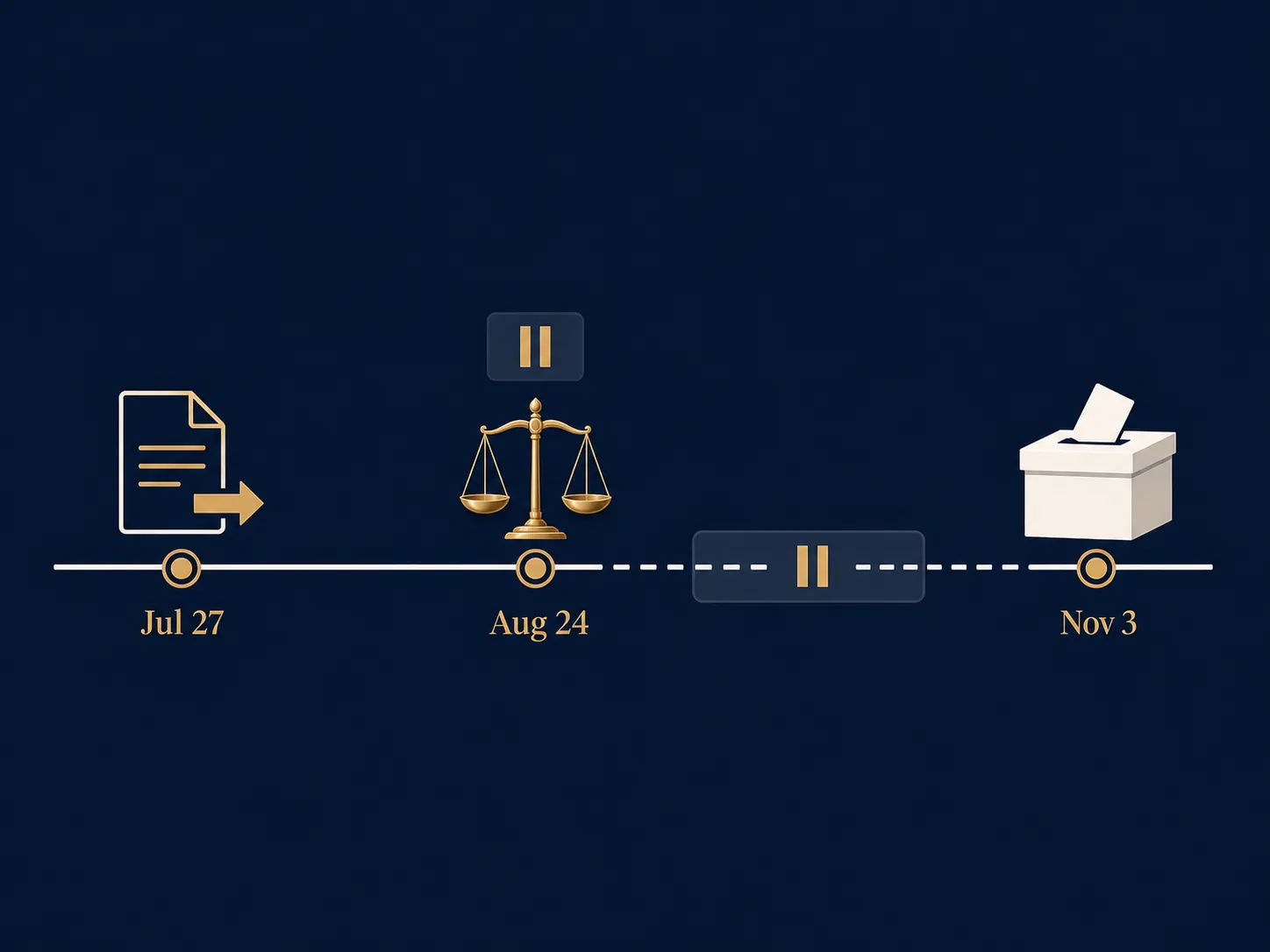
On August 24, the Supreme Court granted emergency relief that allowed the administration to move forward despite the injunction.[1][4] Operationally, that changes which court directive controls before November 3: the district court’s prohibition no longer blocks implementation during the stay. Legally, the underlying claims continue through the appellate process.
Why apparently conflicting headlines can both describe the stay
NPR described the Supreme Court as halting a ruling that had blocked the administration’s mail-voting order.[6] AP and SCOTUSblog emphasized the opposite-facing consequence: the administration could move forward with the restrictions.[4][7] Those formulations describe different sides of the same procedural act.
- Viewed from the lower court: the Supreme Court stayed the preliminary injunction, suspending its blocking effect.
- Viewed from the administration: the stay removed the immediate judicial barrier to implementation.
- Viewed from the merits litigation: the legality of the restrictions remains undecided.
“The Court halted the injunction” and “the Court allowed implementation to proceed” are therefore compatible descriptions, provided each is tied to the stay posture. “The Court upheld the restrictions” is materially different. It implies a merits judgment that the August 24 order did not supply.
The dissent reinforces that boundary. It characterized the Court’s action as one that “merely postpones adjudication” and said the action did not address the lawfulness of the administration’s attempts to interfere with the November 2026 elections.[1] Whatever view a reader takes of that characterization, it accurately directs attention to what was absent: a final adjudication of the legal claims.
What the order permits—and what it does not establish
The materials support several narrower conclusions:
- The Supreme Court acted on an emergency stay application rather than issuing a merits opinion.
- The stay changes the force of the lower-court injunction during the appeal.
- The challenged restrictions may move forward before November 3 despite that injunction.
- The order does not finally decide whether the executive action or resulting USPS restrictions are lawful.
- The record supplied here does not establish how many voters will be affected or predict any electoral result.
The last point is especially important for election-risk reporting. A court order can alter the legal conditions under which officials operate without establishing that a particular voter missed a ballot, that a state changed a deadline or that an election outcome will change. Those downstream claims require their own evidence.
Vote reporting and the companion caption require caution
SCOTUSblog’s case page reports a 6–3 vote, identifying Chief Justice Roberts and Justices Thomas, Alito, Gorsuch, Kavanaugh and Barrett in the majority, with Justices Sotomayor, Kagan and Jackson dissenting.[5] That tally is secondary reporting, not a primary vote confirmation in the supplied materials.
There is also a detail that should prevent casual transcription. The LII slip text includes a dissent under the companion caption No. 26A139, Alabama et al. v. California et al., and identifies “Justice Sotomayor, with whom Justice Kagan joins, dissenting.”[1] The supplied primary material does not confirm Justice Jackson’s status as a third dissenter, nor does it establish whether 26A139 was formally consolidated with 26A124 or simply addressed in the same slip text.
A summary that needs the vote should label 6–3 as reported by SCOTUSblog and verify it independently against the docket record. A summary that does not need the tally is more reliable if it omits it. The posture, date and effect of the stay are the load-bearing facts; an uncertain vote attribution should not be allowed to weaken them.
Unverified details should remain unverified
The available record contains no post-August 24 statement from the California Secretary of State or a Massachusetts election authority confirming that a state ballot deadline changed because of the order. The stay may affect implementation of the challenged restrictions, but it should not be cited as evidence that any particular state deadline was revised.
A Federal Register item titled “Ballot Mail for Federal Elections” was published on August 26, two days after the Supreme Court action.[8] It is a related regulatory artifact. Without the operative text and an established connection in the supplied record, its timing does not prove the scope, meaning or implementation details of the August 24 stay.
For a memo, filing or case tracker, the defensible formulation is precise: on August 24, 2026, the Supreme Court issued a per curiam emergency stay in Trump v. California, No. 26A124, allowing the administration to move forward with the challenged USPS mail-ballot restrictions despite the District of Massachusetts preliminary injunction while the appeal continues. The Court did not resolve the restrictions’ lawfulness.[1][4]
References
- TRUMP v. CALIFORNIA — Legal Information Institute, August 24, 2026
- Docket for 26A124 — Supreme Court of the United States
- Trump mail voting executive order on Supreme Court’s radar — National Constitution Center, August 12, 2026
- Supreme Court allows Trump administration to move forward with order imposing restrictions on mail-in voting — SCOTUSblog, August 24, 2026
- Trump v. California — SCOTUSblog
- Supreme Court halts ruling that blocked Trump’s mail voting order — NPR, August 24, 2026
- Supreme Court sides with Trump administration in dispute over mail voting restrictions — AP, August 24, 2026
- Ballot Mail for Federal Elections — Federal Register, August 26, 2026
Related records
Tool profile
How Meta's AI Spending Reshapes Law Firm ProfitabilityGoverning regulation
Browse the obligations tracker →Preventive workflow
Browse verification workflows →
Report a correction or tip
Spotted an outdated figure, a misstated fact, or a ruling this case record should reflect? Public comments are disabled for this content given the professional cost of a misreported case outcome, penalty amount, or rule text — use the structured correction channel instead.
Report a correction or tip for this record →