
Uber, AI Layoffs, and the NY WARN Act Checkbox No One Is Using
Uber's July 2026 AI-driven customer-service layoff highlights a compliance gap in New York's WARN Act: despite a mandatory AI-disclosure checkbox, zero out of 160+ notices filed in the first year used it. This analysis examines the enforcement risk, proposed penalties, and what in-house counsel should watch for.
- Jurisdiction
- US-New York
- Court
- New York Department of Labor
- AI tool named
- AI
- Ruling date
- Jul 23, 2026
- Source document
- View primary court order ↗
- Last verified
- Jul 25, 2026
Lex Machina Review is an independent risk-tracking and reference resource. Nothing on this site is legal advice, and using it does not create an attorney-client relationship. Every record is reviewed against primary sources but may not reflect the most current status of a matter — always verify directly against the cited court order, rule text, or a licensed attorney before relying on it.
Companion explanation — secondary to the source document above
Uber’s July 23, 2026 customer-service layoff is legally interesting for a narrow reason: the company reportedly tied the reduction to AI, while New York’s WARN filing system now asks employers whether a covered layoff is caused by AI or automation. Business Insider reported that Uber cut 10% of its customer-service workforce and expressly identified AI as the reason for the reduction, describing it as the first Uber layoff round publicly attributed to AI. [1]
That does not, by itself, establish a New York WARN violation. The available reporting does not confirm that affected employees were New York-based, that New York WARN thresholds were met, or that Uber filed a New York WARN notice for this particular round. The legal question is conditional but still practical: if New York employees were included in an AI-attributed layoff that required a NY WARN filing, the state portal had a field designed for exactly that fact pattern.
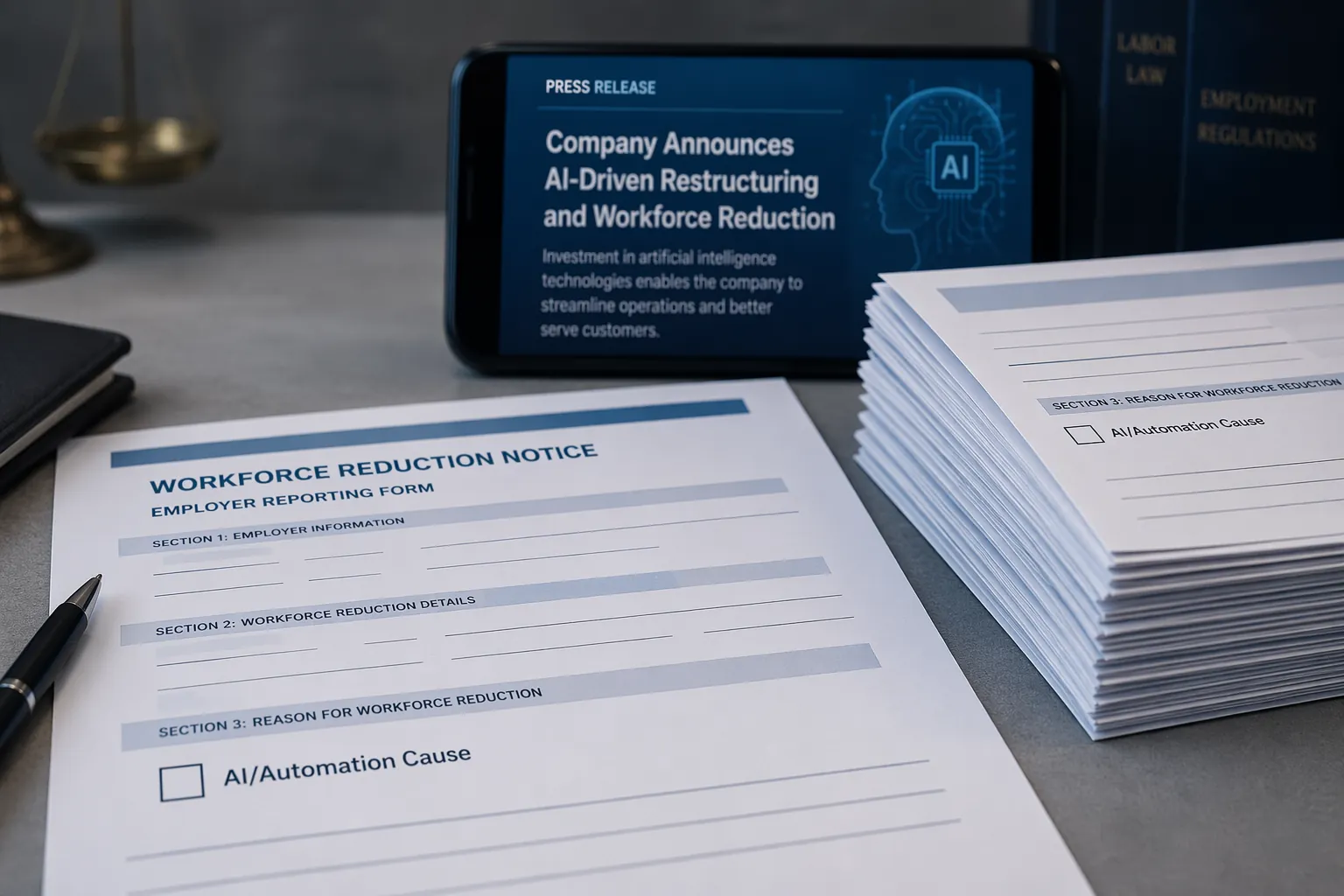
The mismatch matters because it is no longer unusual for companies to describe AI efficiency to investors, employees, and the press. What remains unusual, at least in New York’s WARN records, is an employer saying the same thing in the government notice workflow. Hunton Andrews Kurth reviewed more than 160 New York WARN notices filed during the first year of the AI-disclosure requirement and found that none checked the AI/automation box. [2]
The Checkbox Is Small, but the Record It Creates Is Not
New York’s AI-disclosure requirement did not arrive as a clean statutory rewrite. Kaufman Dolowich explained in August 2025 that the state added a mandatory AI-related question to the online WARN portal, even though the underlying WARN statute itself was not formally amended. That makes enforceability less tidy than a conventional statutory duty, but it does not make the field irrelevant for counsel preparing a filing. [3]
In-house teams should separate three things that often get compressed in conversation. First, the statute still determines whether a WARN notice is required. Second, the portal controls what the state asks a filer to answer when that notice is submitted. Third, the company’s public explanation may create a record that later makes a bland WARN description look incomplete, even if enforcement of the portal field remains unsettled.
That is why the Hunton finding is more troubling than a single missed checkbox would be. Zero checked boxes across more than 160 notices does not prove that every employer made the wrong filing decision. It does suggest that the profession has not yet built a reliable habit around AI-causation review. Some notices may have had no AI connection at all. But if public-company layoffs increasingly cite automation, generative AI, support tooling, or workflow replacement, a universal zero begins to look less like coincidence and more like a control failure. [2]
How Uber Fits—and How It Does Not
Uber is a useful test case precisely because the public record contains two recent layoff explanations with different AI content. On June 3, 2026, CNBC reported that Uber cut 23% of its HR and People division and said that round was not AI-related. [4] Less than two months later, the customer-service reduction was reported as AI-driven. [1]
That contrast matters more than a generic “AI is taking jobs” frame. Same company, same year, different stated cause. If a WARN preparer had both rounds on the desk, the June HR reduction would not automatically call for an AI-causation disclosure just because Uber is an AI-adopting company. The July customer-service reduction would demand a different review because the employer’s reported explanation tied the job cuts to AI.
The compliance analysis should start with ordinary WARN questions, not the press headline. Were affected employees located in New York? Did the number of employment losses, timing, and site analysis trigger New York WARN? Was there a filing obligation at all? Only after those threshold questions are answered does the portal question become operative.
| Question for the filing team | Why it matters |
|---|---|
| Were any affected employees New York-based? | Without New York-covered employees, the New York portal issue may never arise. |
| Did the event meet New York WARN thresholds? | The AI checkbox matters inside a required NY WARN filing, not as a free-standing public disclosure rule. |
| Did board materials, HR scripts, investor language, or press statements identify AI as a cause? | Those records may make a non-AI WARN explanation harder to defend later. |
| Was AI the cause, a contributing cause, or merely a tool used during restructuring? | The portal field asks for causation; adoption of AI is not the same as AI-caused displacement. |
| Who approved the final WARN narrative? | Employment counsel, communications, finance, and legal operations may each hold part of the factual record. |
A careful filer would not check an AI box merely because the company uses AI software somewhere in the business. The more difficult case is the one Uber’s July announcement appears to present: public language saying that AI drove the reduction. If that same reduction included New York employees and required notice, omitting the AI/automation disclosure would create a discrepancy that is easy for a regulator, plaintiff, union, journalist, or investor to understand.
Portal Practice Is Not the Same Thing as Settled Law
The awkwardness for counsel is that New York’s AI field sits between administrative practice and litigated obligation. Kaufman Dolowich’s account of the change is important because it notes the mandatory portal question while also flagging that the statute was not formally amended. [3] That distinction leaves room for arguments about whether a missed checkbox carries the same consequences as a statutory notice defect.
But ambiguity is not the same as safety. A required field in a state filing system is still part of the official submission workflow. If an employer can tell analysts that AI is reducing labor needs, it should be able to decide whether that same fact belongs in a WARN portal field. Treating the question as clerical clutter may be tempting when enforcement history is thin. It is also how a company ends up with a government record that does not match its own public explanation.
The harder internal conversation is usually not about doctrine. It is about ownership. Communications may draft the investor-facing account. HR may own employee messaging. Outside counsel may prepare the WARN filing from a spreadsheet. Legal operations may be the only function that sees the portal question at the moment of submission. If those workstreams do not reconcile causation language before filing, the checkbox decision can be made by the person with the least context and the least time.
Pending Penalties Change the Practical Risk Calculation
The proposed New York Automation Displacement Protection Act would make this analysis harder to dismiss as a portal-management issue. Available summaries of the 2026 legislative session materials describe a proposal that would require transition wages or retraining for 90 days, vendor identification, penalties of up to $10,000 per day, and a five-year loss of state eligibility for willful violations. The bill is pending; those penalties are not current law.
That pending status matters. Counsel should not advise the business as though the proposed penalty schedule already applies. But pending legislation can still change risk judgment before enactment, because it tells employers where lawmakers are looking and what kind of record may be unattractive later. A company that has already chosen not to disclose AI causation in a state portal will not improve its position if a stricter regime later asks why its public statements and WARN notices diverged.
The practical move is not to over-file or over-admit. It is to document the causation decision before the WARN notice is submitted. If AI increased call resolution capacity, reduced the need for human support roles, or replaced a workflow previously performed by the affected group, that belongs in the legal review. If AI was only part of a broader cost-cutting story, counsel should decide whether it is still a cause within the meaning of the portal question and preserve the rationale.
The Stock Drop Is a Signal, Not Proof
There is also a market-facing reason this issue will not stay buried in employment paperwork. FXLeaders reported that Uber stock slipped 1.7% to about $70.33 on July 23, 2026, with analysts citing execution risk and regulatory scrutiny in connection with the AI job cuts and a Delivery Hero transaction. [5]
That stock movement should be handled carefully. A one-day trading report does not prove legal exposure, and it certainly does not prove a WARN violation. It does show why the same layoff rationale may now travel through several audiences at once: employees, regulators, shareholders, analysts, and plaintiffs’ lawyers. Once AI displacement is part of the investor story, the employment-law filing can become part of the securities and governance record, even if the underlying WARN question remains technical.
Multi-State Employers Do Not Get One AI-Layoff Script
New York is not the only state complicating the WARN analysis. California’s Cal-WARN amendments became effective in January 2026 and added separate disclosure and notice requirements, creating a patchwork for employers with distributed workforces. The available materials do not support a full state-by-state comparison here, but they do support the operational point: a company like Uber cannot assume that one layoff narrative will satisfy federal WARN, New York WARN portal practice, and California’s amended regime.
This is where legal operations earns its keep. The company needs a single factual causation record and state-specific filing outputs. Those are different things. A common internal memo may say what actually drove the reduction; the final notices may then adapt that record to each jurisdiction’s thresholds, fields, timing rules, and disclosure format.
For New York, that means the WARN preparer should not be the first person to learn that AI was mentioned in a press statement. Before submission, someone should compare the proposed notice against the layoff approval memo, board materials, employee FAQs, public announcement, investor talking points, and any vendor or automation documentation that explains why the roles are being eliminated. The point is not to make every reduction an AI layoff. The point is to avoid accidentally making two records: one candid enough for the market, one sanitized enough for the portal.
The Filing Habit Has to Change Before Enforcement Does
The safest current position is modest but concrete. When a layoff is publicly linked to AI, counsel should treat New York’s AI/automation checkbox as a live control point if a NY WARN notice is required. That does not mean conceding that every portal-level field carries statutory penalties. It means recognizing that the filing is part of the company’s evidentiary record.
Uber’s July 2026 customer-service layoff shows why this matters. The known facts do not establish that Uber owed New York an AI-disclosure notice. They do show how quickly a public AI-efficiency story can collide with a state filing system that asks employers to identify automation-caused displacement. Against Hunton Andrews Kurth’s zero-out-of-160-plus finding, the larger issue is not whether one company checked one box. It is whether employers have built any defensible process for deciding when the box should be checked at all. [1][2]
AI-linked layoff language now needs to be reconciled across press statements, board materials, WARN notices, and state-specific disclosure fields. The cheapest risk to prevent is not necessarily today’s enforcement action. It is tomorrow’s record that makes the company look evasive after regulators, penalties, or plaintiffs catch up.
References
- Uber layoffs AI prompts cuts to customer service jobs, Business Insider, July 23, 2026.
- New York WARN Act: No AI-Related Layoffs Reported in First Year of Adding AI-Related Disclosure to the System, Hunton Andrews Kurth, May 2026.
- New York Amends WARN Act to Require Disclosure of AI-Related Layoffs, Kaufman Dolowich, August 2025.
- Uber layoffs people division AI, CNBC, June 3, 2026.
- Uber Stock Slips 1.7% as AI Job Cuts and $14.8 Billion Delivery Hero Deal Raise Execution Risks, FXLeaders, July 23, 2026.
Related records
Tool profile
How Meta's AI Spending Reshapes Law Firm ProfitabilityGoverning regulation
Browse the obligations tracker →Preventive workflow
Browse verification workflows →
Report a correction or tip
Spotted an outdated figure, a misstated fact, or a ruling this case record should reflect? Public comments are disabled for this content given the professional cost of a misreported case outcome, penalty amount, or rule text — use the structured correction channel instead.
Report a correction or tip for this record →