
UBS fined a record $125 million for money laundering
FinCEN's $125 million penalty against UBS Financial Services Inc. is the largest Bank Secrecy Act fine ever imposed on a broker-dealer. This verified record lays out the joint SEC-FINRA-CFTC resolution, the admitted AML and SAR failures, and the remediation terms compliance teams should benchmark against.
- Jurisdiction
- US federal
- Court
- FinCEN (administrative proceeding)
- AI tool named
- Automated AML monitoring tool (unnamed)
- Ruling date
- Aug 3, 2026
- Source document
- View primary court order ↗
- Last verified
- Aug 4, 2026
Lex Machina Review is an independent risk-tracking and reference resource. Nothing on this site is legal advice, and using it does not create an attorney-client relationship. Every record is reviewed against primary sources but may not reflect the most current status of a matter — always verify directly against the cited court order, rule text, or a licensed attorney before relying on it.
Companion explanation — secondary to the source document above
Verified enforcement record
| Record item | Verified entry |
|---|---|
| Issuer and authority | Financial Crimes Enforcement Network assessed a civil money penalty under the Bank Secrecy Act against UBS Financial Services Inc. [1][2][3] |
| Respondent | UBS Financial Services Inc., a U.S. broker-dealer and futures commission merchant affiliate within UBS’s wealth-management business. [1] |
| Action date | Aug. 3, 2026. [1][2] |
| Case label | In the Matter of UBS Financial Services Inc., Case 2026-02. [2][3] |
| Core penalty | FinCEN assessed $125,000,000. FinCEN describes it as the largest Bank Secrecy Act penalty ever imposed on a broker-dealer. [1] |
| Joint resolution accounting | The broader multi-agency resolution is $173,000,000 assessed: FinCEN $125,000,000; SEC $20,000,000; FINRA $20,000,000; and a CFTC component reported as $8,000,000. [1][4][5][6][7][8] |
| Treasury payment mechanics | FinCEN credited $48,000,000 for payments to other agencies, leaving $77,000,000 owed to Treasury; ThinkAdvisor reports that at least $110,000,000 is cash across the four agencies and $62,000,000 cash to Treasury after a potential $15,000,000 waiver tied to satisfactory completion of the independent AML review. [9] |
| Last verified | Aug. 3–4, 2026, against the cited agency pages and available source links. |
| Use note | This is an enforcement-record summary for obligations tracking, not legal advice. Direct order language should be checked against the primary PDFs before reuse in a board memo, pleading, or client alert. |
For source checking, start with FinCEN’s press release, the FinCEN enforcement action page, and Consent Order Number 2026-02. The parallel agency files are the SEC’s Release 34-106026, FINRA’s news release and AWC, and CFTC Press Release 9277-26.
The phrase “UBS $125 million money laundering fine” is serviceable shorthand, but it is imprecise unless the accounting is kept separate. The $125 million figure is FinCEN’s BSA assessment. The $173 million figure is the assessed multi-agency resolution. The cash-payment figures reported by ThinkAdvisor are different again because they account for credits and a possible waiver tied to future review performance. Treating those numbers as interchangeable makes the record less useful for anyone trying to brief a board, compare precedent, or track remediation obligations.
What FinCEN says UBSFS admitted
FinCEN says UBSFS admitted willfully violating the Bank Secrecy Act by failing to maintain an effective anti-money-laundering program and failing to file suspicious activity reports. The agency’s public release frames the 2026 action around repeated failures after UBSFS had already been subject to a December 2018 FinCEN consent order for BSA deficiencies. [1][3]
That matters more than the record label. A large penalty for a first-time systems failure tells one kind of supervision story. A large penalty after a prior order tells another: the regulator is not just pricing the underlying alerting and reporting breakdowns, but also the institution’s failure to prove that promised remediation actually closed the control gap.
FinCEN’s release describes the affected activity as more than 50,000 foreign-currency wires with an aggregate value of more than $10 billion. [1] The order language reported by American Banker gives a different, more exact figure: it quotes the consent order as referring to more than 61,500 wires totaling more than $10.5 billion. [11] FINRA, in its own release, describes more than 60,000 transactions totaling more than $10 billion. [5] Those are not three figures to average or reconcile from the outside. They are three sourced descriptions from three record streams.
| Source stream | Monitoring-volume wording to preserve |
|---|---|
| FinCEN press release | Over 50,000 foreign-currency wires; more than $10 billion aggregate. [1] |
| American Banker report quoting Consent Order 2026-02 | More than 61,500 wires; more than $10.5 billion. Direct order wording should be checked against the PDF before reuse. [11] |
| FINRA release | More than 60,000 transactions; more than $10 billion. [5] |
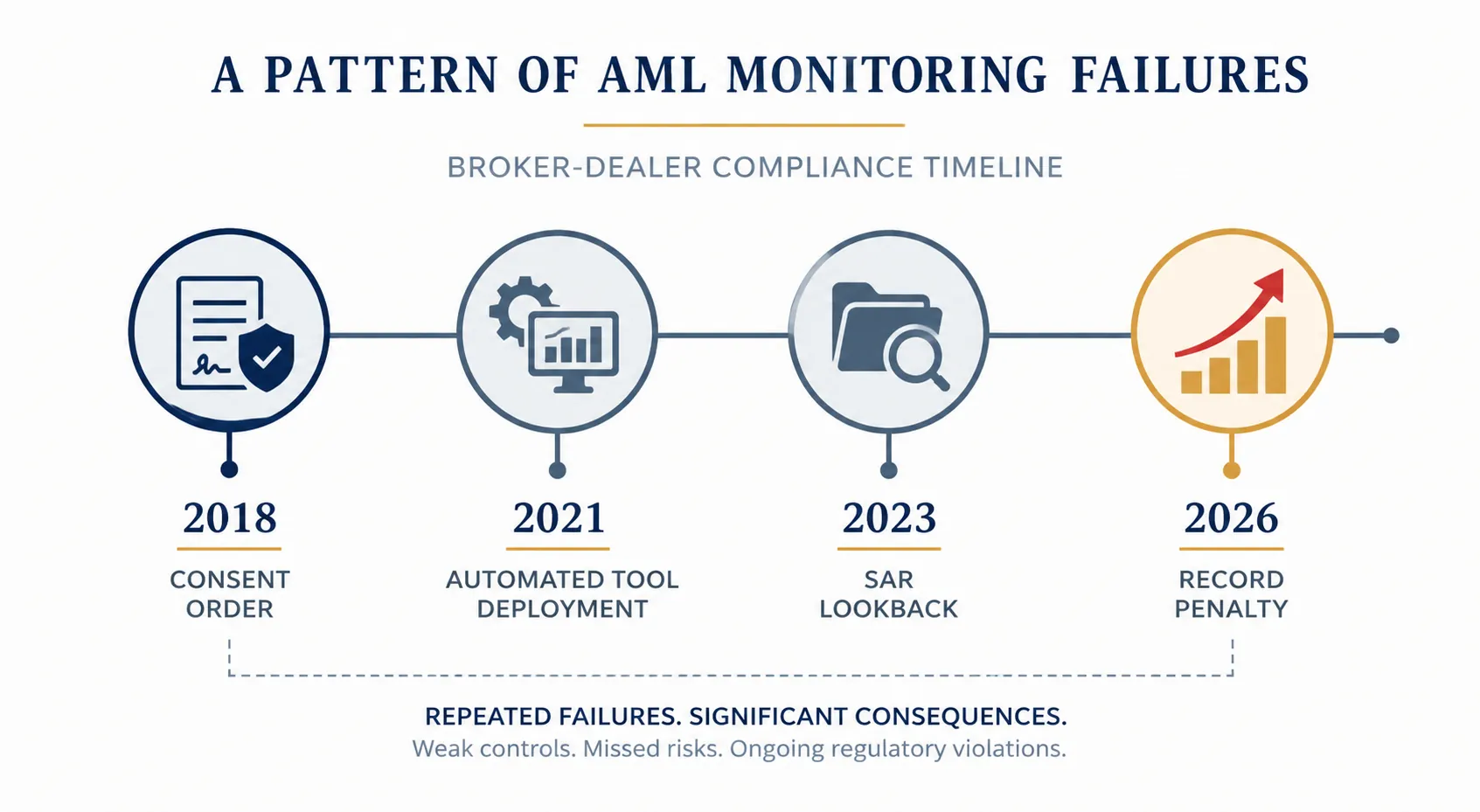
The control failure runs from the 2018 order to the 2023 lookback
The useful part of this record is the timeline. In December 2018, FinCEN assessed $14.5 million against UBSFS for BSA violations, and the 2026 materials tie the later case back to the same compliance terrain: AML monitoring, customer due diligence, and SAR reporting. [10] FINRA’s 2026 release also places its $20 million sanction against the backdrop of repeated AML deficiencies. [5]
After the 2018 order, UBSFS was expected to improve transaction monitoring for foreign-currency wires. The later enforcement record says that, instead of timely delivering the promised automated monitoring, the firm continued to rely on a legacy quarterly manual process through January 2021. The automated tool was then deployed in February or March 2021, nearly two years after the mid-2019 timing reflected in the remediation history described in the current record. [1][3][11]
Deployment did not equal coverage. The record says the automated process still omitted roughly one third of retail foreign-exchange wires. For a compliance officer, that is the part that will survive the headline cycle: a firm can point to modernization work, budget, and a new tool, while an examiner asks for the population map showing what the tool did and did not ingest.
The SAR consequence appears most clearly in the SEC action. The SEC says UBSFS filed lookback SARs from October 2023 onward that were late and covered thousands of transactions totaling approximately $250 million. [4] That is not merely a late-paperwork finding. It shows how a monitoring omission becomes a reporting backlog, and how a reporting backlog becomes a multi-regulator case.
- December 2018: FinCEN consent order imposes a $14.5 million penalty for BSA deficiencies. [10]
- January 2019 through June 2023: the later record treats this as the repeat-failure window for AML monitoring and SAR-related violations. [1][3]
- Through January 2021: UBSFS continued using a quarterly manual review process for the relevant wires. [1][3]
- February/March 2021: UBSFS deployed the automated tool, but the record says the deployment was late and still did not capture the full relevant wire population. [1][3][11]
- October 2023 onward: UBSFS filed lookback SARs that the SEC says were late and covered thousands of transactions totaling approximately $250 million. [4]
- Aug. 3, 2026: FinCEN, SEC, FINRA, and CFTC announce the resolved enforcement actions. [1][4][5][7]
Regulator-by-regulator resolution
FinCEN: BSA program and SAR failures
FinCEN’s $125 million assessment is the central action. It rests on admitted willful BSA violations, including the failure to maintain an effective AML program and the failure to file SARs. [1][3] The agency also built the penalty around recurrence after the 2018 order, which is why this case is a benchmark for firms that have already promised supervisors a monitoring fix.
SEC: late SARs
The SEC imposed a $20 million penalty for late SAR filings. Its order is the cleanest place in the public record for the SAR timing consequence: lookback filings beginning in October 2023, thousands of transactions, and approximately $250 million in total transaction value. [4] For adjacent SAR-obligation context, readers tracking FinCEN notices can compare this enforcement posture with the site’s record on FinCEN’s World Cup trafficking notice.
FINRA: AML violations at the broker-dealer
FINRA fined UBS Financial Services $20 million for AML violations. Its public release uses the more than 60,000 transactions / more than $10 billion formulation and should be kept separate from FinCEN’s and American Banker’s reported formulations. [5] The FINRA AWC is a primary file to check before quoting undertaking language or admissions from the FINRA side. [6]
CFTC: the $8 million component needs a sourcing note
The CFTC participated in the joint resolution through Press Release 9277-26. [7] The $8 million figure for the CFTC component is reported in The GRC Report’s four-regulator breakdown; because the CFTC source was only partially available in the source set, that figure should be treated as supported by the breakdown and CFTC case reference, not as independently rederived here from the full CFTC order. [8]
Why the record label is accurate, and where it stops
FinCEN’s “largest broker-dealer BSA penalty” description is supported by the agency’s own release. [1] It also follows closely after FinCEN’s March 6, 2026, $80 million penalty against Canaccord Genuity LLC, which had set the broker-dealer BSA benchmark earlier in the year. [12] That comparison is the proper one.
It is not the proper comparison to say, loosely, that this is FinCEN’s largest penalty. The broker-dealer qualifier does real work; TD Bank’s $1.3 billion remains the larger overall FinCEN benchmark described in the available record. The distinction is not pedantry. It keeps the UBSFS action in the right supervisory lane: broker-dealer AML remediation after prior findings, not the full universe of bank BSA enforcement.
That same caution applies to the site’s 2026 enforcement map. The UBSFS action is a counter-signal to any easy assumption that technical BSA failures are being deprioritized. The useful comparison point is not broad AML rhetoric but where federal money-laundering enforcement is actually concentrating; the site’s 2026 federal money-laundering enforcement concentration map should be read with this record added to the broker-dealer side of the ledger.
Customer-risk findings should not become the whole story
The customer-risk facts matter because they show why monitoring coverage and due diligence are not abstract controls. Reuters reported that the enforcement record included detail involving a Russian oligarch customer. [13] That detail belongs in the customer due diligence and illicit-finance-risk discussion, not as a substitute for the actual violation theory.
FinCEN’s remediation terms point to priority illicit-finance risks including the U.S. Southwest border, cartels and narcotics trafficking, Iran, Russia, and Venezuela. [3] The lesson for other firms is not that every broker-dealer now has a new category of customer prohibition. It is that a firm with prior BSA findings needs to be able to show which higher-risk populations were included in its monitoring rules, which were excluded, who approved any exclusion, and how the SAR decisioning record was preserved.
Remediation obligations to benchmark
The order is most useful for compliance teams as a remediation benchmark. The terms described in the cited materials include a third-party lookback, an independent AML-program review focused on priority illicit-finance risks, and six-year document retention. [3] Those are not decorative undertakings. They are the paper trail by which UBSFS will have to show that the prior monitoring and SAR failures were remediated rather than renamed.
- Population completeness: document which wires, products, accounts, and customer types the monitoring tool ingests, and which it does not.
- Remediation timing: preserve the original promised date, the actual deployment date, interim compensating controls, and approval records for any delay.
- Manual-to-automated transition: show how manual review queues were retired, validated, or carried over when a new system went live.
- SAR lookback governance: identify who scoped the lookback, who reviewed escalations, how late filings were measured, and how the institution prevented the same omission from recurring.
- Independent review readiness: maintain evidence in a form a third party can test without rebuilding the firm’s control history from interviews.
- Retention discipline: if a six-year retention term applies, confirm that system logs, alert exports, SAR decision files, model-change documentation, and population-mapping evidence are all covered.
The enforcement action does not create a new rule for every broker-dealer. It does, however, give supervisors and counterparties a current benchmark for firms with prior BSA findings, especially where automated monitoring, customer due diligence coverage, SAR timeliness, and documented remediation history remain exposed. Use this record as a source-linked enforcement benchmark, not legal advice; before relying on quoted order language, check the primary PDFs and the Aug. 3–4, 2026 last-verified stamp against the current agency files.
References
- FinCEN Assesses Historic $125 Million Penalty Against UBS Financial Services Inc. for Recidivist BSA Violations — FinCEN, Aug. 3, 2026
- In the Matter of UBS Financial Services Inc. — FinCEN
- Consent Order Number 2026-02 — FinCEN
- 34-106026-s — SEC
- FINRA Fines UBS Financial $20 Million for Anti-Money Laundering Violations — FINRA
- UBS Financial AWC and CAS 2021069426901 — FINRA
- CFTC Press Release 9277-26 — CFTC
- FinCEN Hits UBS with Record $125 Million Penalty Over Repeat AML Failures — The GRC Report
- UBS to Pay $125M Over Anti-Money Laundering Failures — ThinkAdvisor, Aug. 3, 2026
- UBS Assessment 12.17.2018 FINAL 508 Revised — FinCEN, Dec. 17, 2018
- Fincen fines UBS $125M for money-laundering recidivism — American Banker
- FinCEN Assesses Historic $80 Million Penalty Against Canaccord Genuity LLC — FinCEN, Mar. 6, 2026
- US Treasury fines UBS Financial Services $125 million for secrecy violations — Reuters, Aug. 3, 2026
Related records
Tool profile
Browse tool evaluations →Governing regulation
Browse the obligations tracker →Preventive workflow
Browse verification workflows →
Report a correction or tip
Spotted an outdated figure, a misstated fact, or a ruling this case record should reflect? Public comments are disabled for this content given the professional cost of a misreported case outcome, penalty amount, or rule text — use the structured correction channel instead.
Report a correction or tip for this record →