
What Happened in the Underwood Teacher Malicious Punishment Case
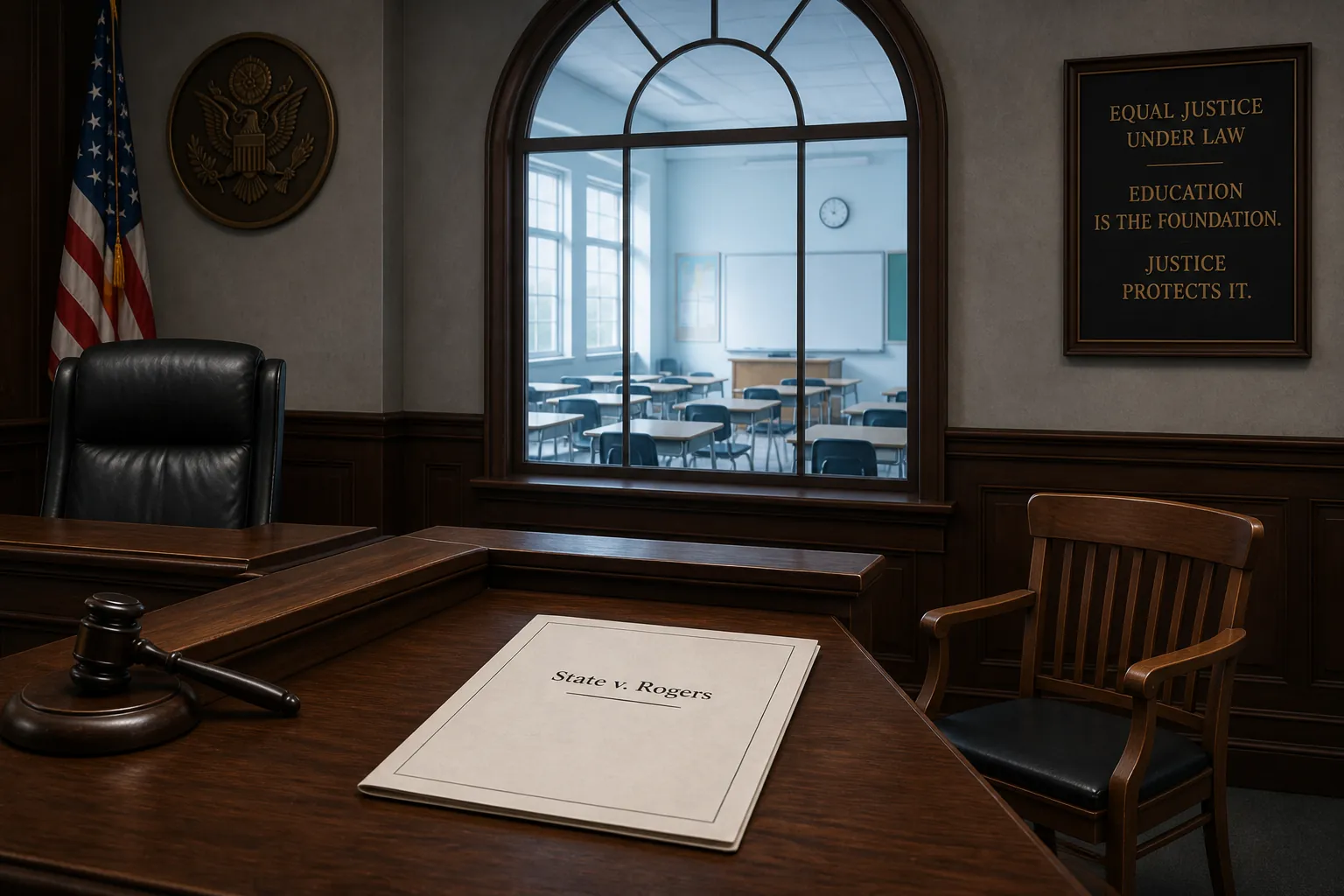
This record documents the State v. Jason Rogers malicious punishment prosecution in Otter Tail County, including the incident facts, charges under Minn. Stat. § 609.377, and the July 2026 sentence imposing a stay of adjudication with multi-state teaching license surrender.
- Jurisdiction
- Minnesota, United States
- Court
- Otter Tail County District Court
- AI tool named
- No AI tool implicated
- Ruling date
- Jul 30, 2026
- Source document
- View primary court order ↗
- Last verified
- Jul 31, 2026
Lex Machina Review is an independent risk-tracking and reference resource. Nothing on this site is legal advice, and using it does not create an attorney-client relationship. Every record is reviewed against primary sources but may not reflect the most current status of a matter — always verify directly against the cited court order, rule text, or a licensed attorney before relying on it.
Companion explanation — secondary to the source document above
Jason Lowell Rogers, the former Underwood School teacher charged in Otter Tail County after a February 2025 lockdown drill, received a stay of adjudication on three gross-misdemeanor malicious-punishment counts on July 30, 2026. The sentence placed him on two years of probation, required him to surrender any teaching license in any state, complete an anger-management assessment, perform 90 hours of community service, write apology letters to the victims, and pay $2,250 in fines and fees. If he completes probation, no conviction is entered; if he violates it, the court can adjudicate the counts. [1]
That is the narrow but important answer in the Underwood teacher punishment case: the case did not end in a conventional conviction, yet it still ended Rogers’s ability to keep teaching. The legal weight sits in the space between the classroom facts, Minnesota’s malicious-punishment statute, and a sentencing structure that used probation conditions to do what an ordinary licensing case might have taken longer to accomplish.
The Drill Facts That Made This a Criminal Case
The reported incident began during a lockdown drill at Underwood School in February 2025. Students were lying face-down on the floor when Rogers allegedly stepped on three students. One student told authorities Rogers stood on his back “like a stepping stool” and that he cried from pain. Rogers was reported to weigh more than 350 pounds. [1][2]
The student was later treated at Lake Region Hospital, and the Otter Tail County Sheriff’s Office investigated. The early charging reports matter because they connect the classroom conduct to physical injury and law-enforcement review, rather than leaving it in the category of internal school discipline. [3]
Rogers reportedly admitted that he acted because the class was not taking the drill seriously. That fact is central. A teacher responding to an active emergency may have a different legal argument than a teacher imposing pain or pressure to make children comply during a drill. The reported admission gave prosecutors a punitive theory: the force was not merely incidental to safety management; it was used to punish or correct students who were not behaving as Rogers thought they should.
The record available through news reports does not show every classroom angle, every witness statement, or the full district file. It does show enough to explain why the charging theory moved out of the language of poor judgment and into Minnesota’s child-punishment statute: prone sixth-graders, substantial adult body weight, pain and crying, hospital treatment, and a stated corrective purpose.
Why Prosecutors Used Minn. Stat. § 609.377
Minnesota’s malicious-punishment statute applies when a parent, legal guardian, or caretaker, by an intentional act or series of intentional acts with respect to a child, evidences unreasonable force or cruel discipline that is excessive under the circumstances. The gross-misdemeanor provision carries a maximum of 364 days of imprisonment or a $3,000 fine, or both. [4]
Rogers was charged with three counts, one for each student identified in the reports. At the statutory ceiling, three gross-misdemeanor counts could expose a defendant to far more than the $2,250 in fines and fees ultimately imposed. The sentence therefore should not be read as a maximum-punishment result; it was a negotiated or court-approved disposition using probationary conditions to control the professional risk.
The important statutory word is “caretaker.” The available reports show that prosecutors charged a classroom teacher under § 609.377, and Minnesota courts have treated teachers as standing in a caretaker-like role in school settings. But the available materials do not provide an appellate ruling in this case, and they do not establish a new bright-line rule resolving the full outer boundary of “caretaker” for every teacher in every circumstance.
That distinction is not academic. School discipline can be wrongful without being criminal. A corporal-punishment violation can trigger employment or licensing consequences without necessarily producing a malicious-punishment prosecution. Here, the charged theory depended on the alleged use of intentional, unreasonable force against children by an adult exercising school authority.
The Classroom Boundary: Corporal Punishment and Reasonable Force
Minnesota has prohibited corporal punishment in schools since 1989. Section 121A.58 defines corporal punishment to include conduct involving unreasonable physical force that causes bodily harm or substantial emotional harm, and the statute also addresses prone restraint in the school setting. [5]
Minnesota law separately preserves a reasonable-force exception for school personnel in limited circumstances, including force that is reasonable and necessary to restrain a student or prevent bodily harm or death. That exception is not a general permission slip for pain compliance, punishment, or humiliation. It exists for safety, not for making a point. [6]
On the reported facts, the reasonable-force argument would have had an obvious problem: this was a drill, the students were already on the floor, and Rogers reportedly said he acted because the class was not taking the drill seriously. Those facts point away from immediate physical necessity and toward correction through force.
The distinction matters for school lawyers. A teacher can physically intervene when a student is about to run into traffic, strike another child, or harm themselves. But when the same adult uses force after the safety need has passed, or uses it to punish noncompliance, the legal analysis changes. The Rogers prosecution sits on that line and then crosses it on the facts reported: face-down children, body weight applied from above, pain, and a stated disciplinary reason.
What a Stay of Adjudication Did Here
A stay of adjudication is easy to understate because it sounds procedurally mild. In Rogers’s case, the court did not enter a conviction on the three malicious-punishment counts. The case remains conditional: complete two years of probation and the adjudication is stayed; violate probation and the court may enter the convictions. [1]
But the sentence was not mild in professional terms. The probation conditions required Rogers to surrender his teaching license in any state. They also required an anger-management assessment, 90 hours of community service, apology letters to the student victims, and payment of $2,250 in fines and fees. [1]
| Disposition Element | Practical Effect |
|---|---|
| Stay of adjudication | No conviction entered if probation is successfully completed |
| Two years probation | Court supervision remains active during the probation period |
| License surrender in any state | Teaching is functionally removed from Rogers’s available occupations |
| Anger-management assessment and community service | Behavioral and restorative conditions become part of the criminal disposition |
| Apology letters and $2,250 in fines and fees | Victim-facing and financial consequences attach despite the absence of an entered conviction |
That architecture is the point. A conviction is not the only way a criminal case can end a licensed profession. Probation can carry conditions that make continued practice impossible or impermissible, especially when the defendant accepts those conditions to avoid adjudication.
Why License Surrender Matters More Than the Label
Minnesota’s teacher-license statute authorizes suspension or revocation for specified grounds, including immoral conduct and certain child-abuse convictions. A conventional licensing pathway can therefore turn on a board process, a conviction, or both. [7]
Rogers’s sentence took a different route. Because adjudication was stayed, the case did not generate an entered conviction at sentencing. The court nevertheless made license surrender a condition of probation. That condition preempted the practical licensing question: whether or not a revocation order would have followed through the ordinary board route, Rogers had to give up the license to receive and keep the deferred disposition.
For counsel, that is the risk lesson. The professional consequence does not wait for the cleanest administrative record. A defendant may avoid a conviction and still accept conditions that produce the same occupational result a conviction would have made likely.
What the Record Does Not Show
The available news reports do not publish a docket number for State v. Jason Rogers. Anyone needing the primary court order, plea record, sentencing transcript, or probation-condition language should search Minnesota Trial Court Public Access or obtain the district-court file directly.
The available materials also do not show a civil lawsuit filed by the students’ families against the Underwood School District as of July 31, 2026. Civil exposure is an obvious question after a criminal teacher-force case, but it remains a prospective risk assessment on this record, not a reported pending claim.
Nor does this case, on the present materials, create a new published appellate rule about § 609.377. It is a trial-level prosecution and sentencing outcome reconstructed from public reporting and statutes. That is still useful for risk analysis, but it should not be cited as if it were a precedential appellate opinion.
A Note on Search Confusion
This Minnesota case is separate from reports involving Cole Underwood in Perryton, Texas. The Rogers matter concerns an Underwood, Minnesota school teacher, a lockdown drill, and malicious-punishment charges under Minnesota law. The Texas matter involves different people, a different state, and different allegations.
The Practical Legal Takeaway
State v. Jason Rogers does not prove that every teacher use-of-force incident in Minnesota will become a malicious-punishment prosecution. It does show that when a teacher uses punitive physical force against children in a state that bans corporal punishment, prosecutors can charge the conduct under § 609.377 rather than leave it to school discipline alone.
It also shows how a deferred criminal disposition can carry consequences that look final outside the courtroom. Rogers may avoid an entered conviction if he completes probation, but the teaching-license surrender condition makes the sentence function as a de facto teaching ban. On the verified record available as of July 31, 2026, that is the case’s real significance.
References
- Underwood teacher gets probation, loses teaching license after stepping on students during lockdown drill, Valley News Live, July 30, 2026
- Teacher weighing more than 350 pounds sentenced for stepping on students' backs during lockdown drill, KFVS12, July 30, 2026
- Underwood teacher charged with malicious punishment of child, Valley News Live, March 25, 2025
- Sec. 609.377 MN Statutes — Malicious Punishment of Child, Minnesota Revisor of Statutes
- Sec. 121A.58 MN Statutes — Corporal Punishment; Prone Restraint, Minnesota Revisor of Statutes
- Sec. 121A.582 MN Statutes — Student Discipline; Reasonable Force, Minnesota Revisor of Statutes
- Sec. 122A.20 MN Statutes — Suspension or Revocation of Licenses, Minnesota Revisor of Statutes
Related records
Tool profile
How Meta's AI Spending Reshapes Law Firm ProfitabilityGoverning regulation
Browse the obligations tracker →Preventive workflow
Browse verification workflows →
Report a correction or tip
Spotted an outdated figure, a misstated fact, or a ruling this case record should reflect? Public comments are disabled for this content given the professional cost of a misreported case outcome, penalty amount, or rule text — use the structured correction channel instead.
Report a correction or tip for this record →