
No US law requires cash compensation for flight delays
A primary-source US-law status check on flight delay and cancellation compensation as of August 2026: no federal rule requires cash payouts, and the enforceable baseline is automatic refunds, denied-boarding caps, and tarmac care — while two late-2025 DOT actions reset the rulemaking and refund-enforcement landscape. Readers get a dated, verifiable baseline that supersedes pre-2026 explainers and AI summaries with older training cutoffs.
- Jurisdiction
- US federal
- Court
- U.S. Department of Transportation
- AI tool named
- AI chatbot
- Ruling date
- Nov 17, 2025
- Source document
- View primary court order ↗
- Last verified
- Aug 4, 2026
Lex Machina Review is an independent risk-tracking and reference resource. Nothing on this site is legal advice, and using it does not create an attorney-client relationship. Every record is reviewed against primary sources but may not reflect the most current status of a matter — always verify directly against the cited court order, rule text, or a licensed attorney before relying on it.
Companion explanation — secondary to the source document above
Last verified: August 4, 2026. This is a US federal-law status record, not legal advice; it is placed here because the reliance risk is a stale or AI-generated legal summary that sounds current after the governing source chain has moved. No US statute or DOT rule currently requires airlines to pay cash compensation for domestic flight delays or cancellations, and DOT’s archived passenger-rights guide states that airlines are not required to compensate passengers whose flights are delayed or canceled.[1]
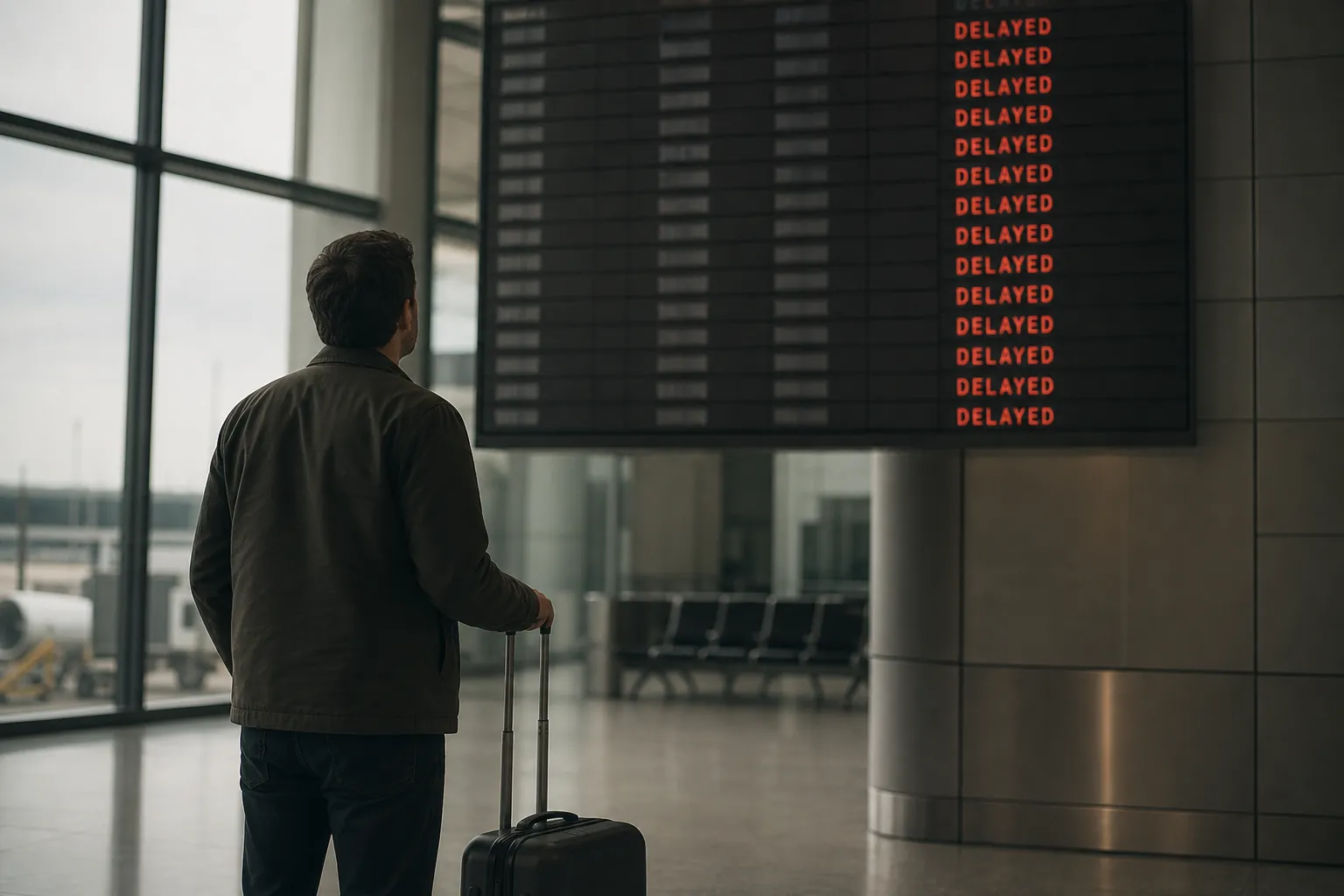
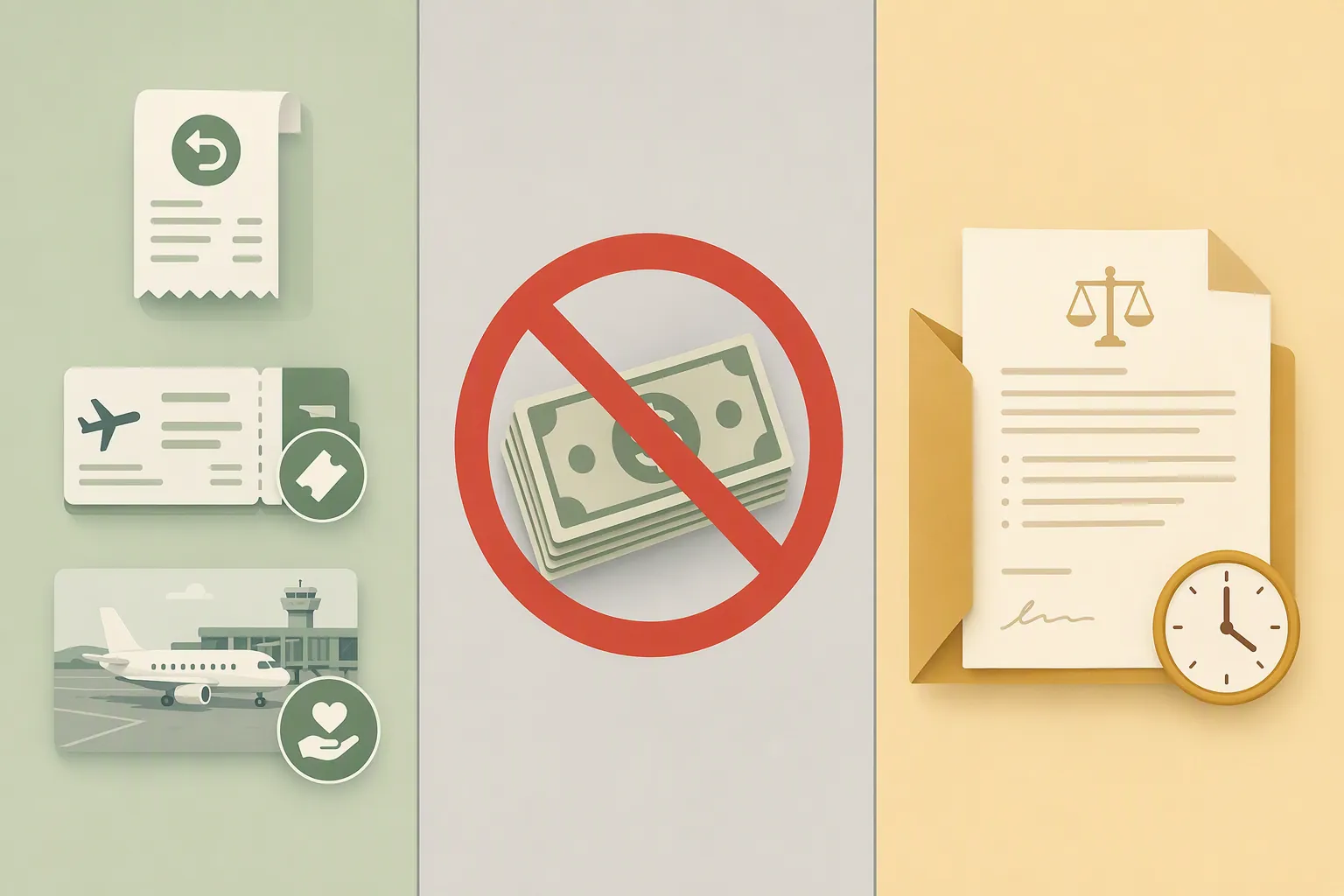
That answer is narrower than many consumer-facing explainers make it sound, but it is not the same as saying passengers have no enforceable rights. The enforceable federal baseline is built around refunds for qualifying cancellations or significant changes, denied-boarding compensation when a passenger is involuntarily bumped from an oversold flight, and tarmac-delay obligations. Those are different legal categories, and mixing them together is how a refund claim turns into an unsupported demand for delay damages.
| Current federal right | What it covers | What it does not create |
|---|---|---|
| Automatic refund for qualifying cancellation or significant change | A refund of money paid when the passenger is owed a refund under DOT’s refund rule, including listed significant changes such as 3+ hours for domestic itineraries and 6+ hours for international itineraries, airport changes, added connections, and downgrades.[2][3] | A separate cash payment for inconvenience, lost time, missed events, hotel costs, or stress. |
| Denied-boarding compensation | Cash compensation for covered involuntary bumping from an oversold flight, with DOT compensation caps identified in the passenger-rights materials as $1,075 and $2,150 depending on the delay and fare conditions.[1] | A general delay or cancellation payment when the passenger was not involuntarily denied boarding. |
| Tarmac-delay care and deplaning rules | Care obligations during covered tarmac delays, including food and water after roughly two hours and an opportunity to deplane before roughly three hours on domestic tarmac delays, subject to safety, security, and air-traffic exceptions.[1] | A statutory cash-compensation right for the delay itself. |
Refund is not compensation
The most useful passenger right in many cancellation and long-schedule-change situations is a refund, not a damages award. DOT’s current refunds page says passengers are entitled to a refund when an airline cancels a flight or makes a significant change and the passenger does not accept alternative transportation or travel credits.[2] The April 2024 final rule placed that automatic-refund framework into the federal consumer-protection rules rather than leaving passengers to guess whether they had to ask, wait, or accept a voucher.[3]
For this purpose, DOT identifies a significant change as including a domestic itinerary moved by three hours or more, an international itinerary moved by six hours or more, a change to the departure or arrival airport, an added connection, or a downgrade to a lower class of service.[2] Those thresholds matter because they are not a sliding scale of inconvenience. A domestic itinerary moved by three hours or more can trigger the refund rule if the other conditions are met; it does not, by itself, create a federal right to an extra $300, $600, or any other cash amount for the delay.
The payment windows are also refund windows, not compensation deadlines. DOT states that covered refunds must be issued within seven business days for credit-card purchases and within 20 calendar days for other payment methods.[2] A passenger, paralegal, or intake attorney who turns that rule into “the airline owes cash compensation within seven days” has changed both the noun and the legal consequence.
The late-2025 reset that makes older summaries unsafe
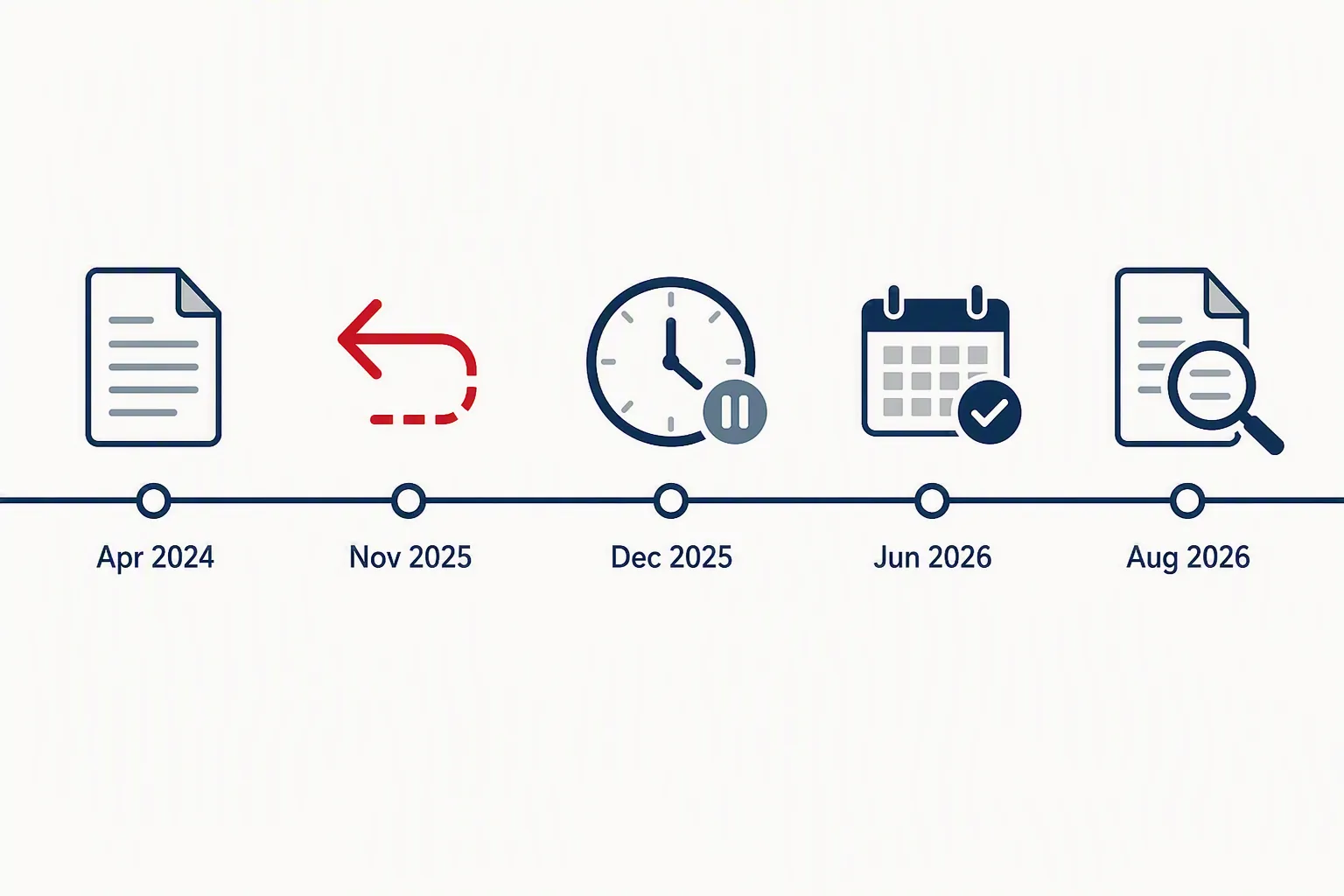
The date problem is not cosmetic. On November 17, 2025, DOT published a Federal Register notice withdrawing the Airline Passenger Rights advance notice of proposed rulemaking. The withdrawal notice said the rulemaking was not based on the best reading of DOT’s statutory authority, and it recorded that Airlines for America and the International Air Transport Association had estimated annual costs of $5 billion or more.[4]
Use the Federal Register date for that event. Secondary summaries have not been perfectly consistent about timing, and some discussions of the withdrawn rulemaking have treated reported compensation ranges as if they were almost-law. They were not governing law. A withdrawn rulemaking is a poor foundation for a demand letter unless the demand letter is accurately describing history rather than asserting a present entitlement.
A separate DOT action followed on December 5, 2025. DOT published an enforcement-discretion notice stating that its Office of Aviation Consumer Protection would not pursue certain refund-rule enforcement actions involving renumbered flights through June 30, 2026, while DOT reconsidered the definition of “cancelled flight.”[5] That notice did not create a cash-compensation right either. It affected the enforcement posture around a particular refund-rule problem: when an airline changes a flight number and the question becomes whether the original flight was cancelled for refund purposes.
Those two late-2025 moves are enough to make a confident pre-2026 explainer suspect. A summary may have been careful when written and still be wrong for a 2026 reader if it assumes a pending compensation rule survived, or if it treats every renumbered flight as a settled cancellation issue without checking later DOT and Federal Register materials.
Pending bills are not passenger rights
There is a pending legislative proposal, and it matters because it is easy to misread as current law. In December 2025, Senators Mark Kelly, Richard Blumenthal, and Edward Markey announced the Flight Delay and Cancellation Compensation Act, describing proposed baseline compensation of at least $300 for delays of three hours or more and $600 for delays of six hours or more.[6] That press release is evidence of proposed legislation. It is not a DOT rule, not an enacted statute, and not an enforceable federal compensation right as of this verification date.
That distinction is not pedantry when someone is drafting an email to an airline, advising a client, or screening a small claim. A proposed $300 baseline may explain where lawmakers wanted the law to go. It does not prove what the airline must pay today.
Voluntary offers, foreign regimes, and baggage caps sit outside this answer
Airlines may voluntarily offer meal vouchers, hotel rooms, mileage credits, rebooking help, or travel credits in situations where federal law does not require cash compensation. Those offers may be practically valuable, and a passenger stuck overnight may care more about a hotel room than about the doctrinal label. But a voluntary commitment is not the same thing as a federal statutory compensation right.
Foreign passenger-rights regimes can also change the answer on a route-by-route basis. EU 261, Canadian rules, and other non-US frameworks are not analyzed here because the keyword question is US airline flight delay compensation rights law under the US federal baseline. A route-based comparison belongs in a separate record; importing foreign compensation assumptions into a domestic-US answer is another way to overclaim.
Baggage liability is also a different subject. It has its own federal rules and dollar limits, but it does not supply a general answer to whether a passenger gets cash because a flight arrived late. The fact that one aviation-consumer rule has a dollar cap does not mean another inconvenience has a mandatory payout.
Why this is an AI-reliance problem
This is the kind of legal issue where an AI answer can sound useful because the vocabulary is familiar: refund, compensation, cancellation, significant delay, voucher, entitlement. The hard part is not writing a sympathetic paragraph for a stranded passenger. The hard part is checking whether the sentence “you are entitled to compensation” is attached to a rule that exists today.
For lawyers and legal staff, this is the same verification problem that shows up in broader AI-legal-output failures. A model, chatbot, or reused explainer may preserve an old rulemaking posture after DOT has withdrawn it, or it may collapse a refund right into a compensation right because both involve money from an airline. The professional-risk version of that problem is covered in our AI hallucinations and attorney ethics record and in the 2026 discussion of AI compliance duties for attorneys. The travel-rights version is more ordinary, but the reliance mechanism is the same.
A verification workflow does not need to be elaborate to catch the problem. Before advising, filing, or sending a demand that relies on US flight-delay compensation law, check the current DOT refunds page and passenger-rights materials, then check the Federal Register source chain for any rulemaking or enforcement-discretion changes. For firms building that into intake or knowledge-management systems, the same logic applies as in an AI compliance framework for law firms: the output is only as current as the authority it was checked against.
The dated baseline
As of August 4, 2026, the US federal baseline is still narrow: no mandatory cash compensation for domestic flight delays or cancellations; automatic refunds for qualifying cancellations and significant changes; denied-boarding compensation for covered involuntary bumping; and tarmac-delay care obligations. Anything broader should be tied to a current statute, a current DOT rule, an airline’s voluntary commitment, a contract term, or a route-specific foreign regime before anyone treats it as enforceable.
References
- Fly Rights, U.S. Department of Transportation, https://www.transportation.gov/airconsumer/fly-rights
- Refunds, U.S. Department of Transportation, November 7, 2025, https://www.transportation.gov/individuals/aviation-consumer-protection/refunds
- Refunds and Other Consumer Protections, Federal Register, April 26, 2024, https://www.federalregister.gov/documents/2024/04/26/2024-07177/refunds-and-other-consumer-protections
- Airline Passenger Rights; Withdrawal, Federal Register, November 17, 2025, https://www.federalregister.gov/documents/2025/11/17/2025-20042/airline-passenger-rights-withdrawal
- Airline Refunds and Other Consumer Protections, Federal Register, December 5, 2025, https://www.federalregister.gov/documents/2025/12/05/2025-22140/airline-refunds-and-other-consumer-protections
- Kelly, Blumenthal, Markey Introduce Legislation to Protect Airline Passengers from Flight Cancellations and Delays, Senator Mark Kelly, December 2025, https://www.kelly.senate.gov/newsroom/press-releases/kelly-blumenthal-markey-introduce-legislation-to-protect-airline-passengers-from-flight-cancellations-and-delays/
Related records
Tool profile
How Meta's AI Spending Reshapes Law Firm ProfitabilityGoverning regulation
Browse the obligations tracker →Preventive workflow
Browse verification workflows →
Report a correction or tip
Spotted an outdated figure, a misstated fact, or a ruling this case record should reflect? Public comments are disabled for this content given the professional cost of a misreported case outcome, penalty amount, or rule text — use the structured correction channel instead.
Report a correction or tip for this record →