
USPS Mail Carrier Charged With Mail Theft? What Happens Next
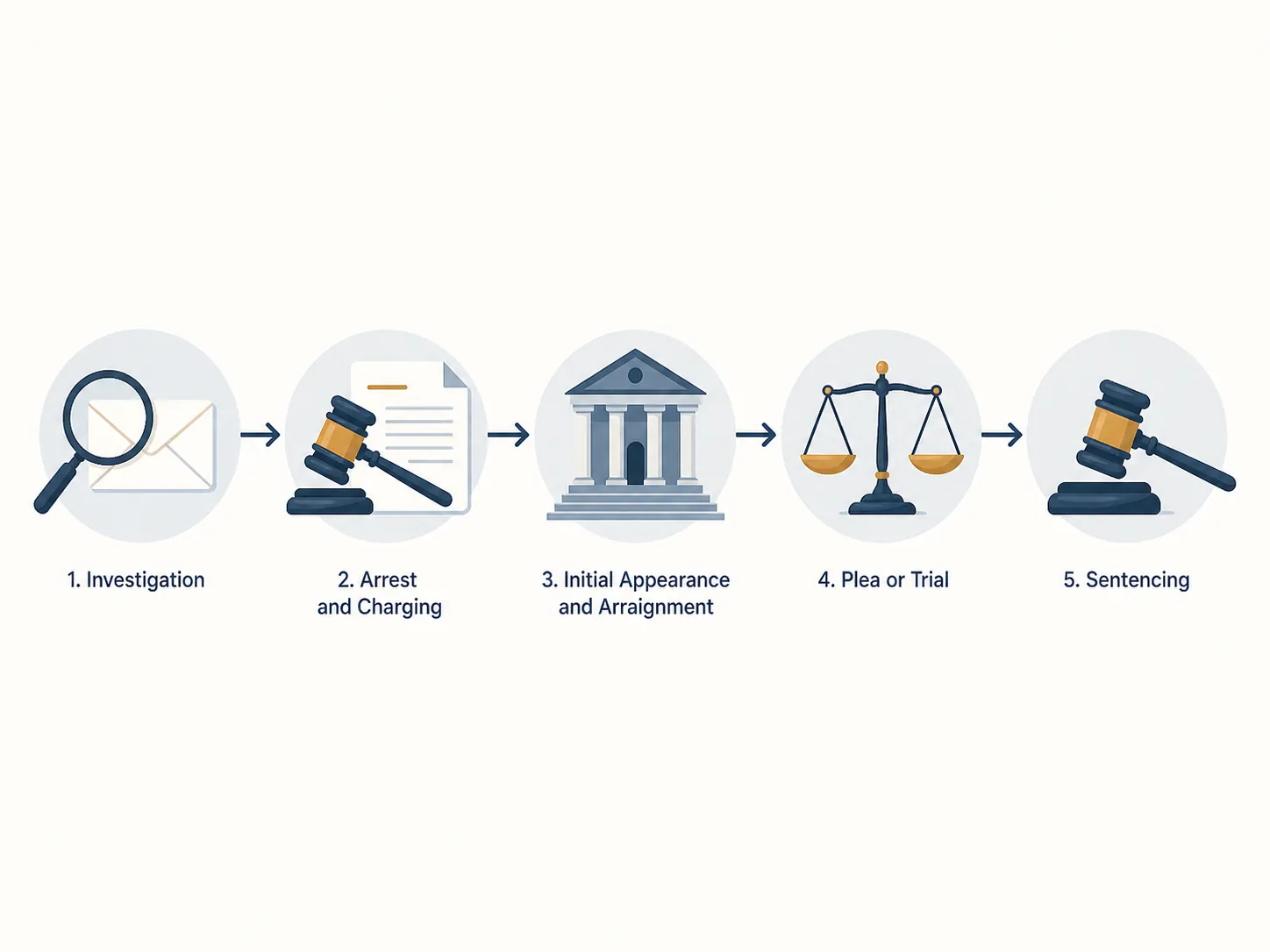
A USPS mail carrier charged with mail theft enters a defined federal pipeline: OIG and Postal Inspection Service investigation, arrest, indictment, arraignment, plea or trial, and sentencing. Each stage is tied to 18 U.S.C. §§ 1708–1709 and 2025–2026 case records, showing that loss amount, add-on charges, and the sentencing guidelines — not the five-year statutory maximum — determine the penalty.
- Jurisdiction
- US federal
- Court
- U.S. District Courts (SDNY, EDNY)
- AI tool named
- No AI tool implicated
- Ruling date
- Jul 1, 2026
- Source document
- View primary court order ↗
- Last verified
- Aug 25, 2026
Lex Machina Review is an independent risk-tracking and reference resource. Nothing on this site is legal advice, and using it does not create an attorney-client relationship. Every record is reviewed against primary sources but may not reflect the most current status of a matter — always verify directly against the cited court order, rule text, or a licensed attorney before relying on it.
Companion explanation — secondary to the source document above
A USPS mail carrier charged with mail theft is usually inside a federal criminal pipeline, not merely facing a headline penalty. The case may start with USPS Office of Inspector General or Postal Inspection Service work, move to arrest or a charging document, then to an initial appearance, indictment or information, arraignment, plea negotiations or trial, and sentencing. The five-year maximum under 18 U.S.C. § 1709 matters because it marks the statutory ceiling for theft of mail by a Postal Service officer or employee, and § 1708 supplies a related general mail-theft statute, but the practical consequences turn on the charging instrument, alleged loss, fraud or identity-theft add-ons, restitution, forfeiture, and the sentencing-guidelines record that reaches the judge later. [1][2][3]
This is legal-process information, not legal advice. It is also a source-status record: the analysis below relies first on statutory text, a federal-process source, a model jury instruction, USPS OIG enforcement reporting, and named agency or court-adjacent case records. Some 2025–2026 case pages require live re-checking before litigation use or publication in a news story, and no individual sentence below is treated as a “typical” sentence.
The first question is where the case is, not how bad the headline sounds
An arrest is not a conviction, and a charge is not a sentence. That distinction is not a comfort phrase; it changes what can be known from the docket. At the investigation stage, the public record may show very little. At the complaint stage, the record may show an agent’s probable-cause narrative. At indictment, the government has formalized counts. At arraignment, the defendant enters a plea and release or detention conditions may be set. At sentencing, the court is no longer working from the press-release version of the case; it is working from the conviction counts, presentence materials, objections, loss figures, restitution positions, guideline calculations, and statutory limits.
DOJ’s public federal-criminal-process map is useful here precisely because it does not pretend every case has the same tempo. It identifies the broad sequence — investigation, charging, initial hearing or arraignment, discovery, plea bargaining, pretrial motions, trial, sentencing, and appeal — while leaving room for the obvious variations: a complaint before indictment, an information after waiver, a guilty plea before trial, or a sentencing record that narrows issues the charging document made look larger. [3]
The enforcement backdrop is substantial but not case-specific proof. In its Fall 2025 Semiannual Report to Congress, USPS OIG reported 1,348 investigations, 498 arrests, 476 convictions, and more than $186 million in fines, restitution, and recoveries. Those figures show the scale of postal-integrity enforcement during the reporting period; they do not tell a defendant, victim, family member, or reporter what any one carrier’s sentence will be. [4]
How a route problem becomes a federal case
The public often first sees the case after arrest. By then, the important transition has already happened: a workplace or customer-delivery problem has been converted into a federal investigation. The records that make that transition visible tend to be concrete. Customers report missing checks, gift cards, money orders, Treasury payments, or packages. Investigators compare complaints against a route or facility assignment. They may use surveillance, controlled mail pieces, bait items, GPS data, or coordination between USPS OIG, the Postal Inspection Service, and local law enforcement.
The Victor, New York sting is a useful methodology example, though it is older and should not be mistaken for a universal template. In that investigation, missing-mail complaints were mapped to one carrier route, investigators placed a GPS tracker on the postal truck, sent two $25 bait gift cards, and used a hidden camera that captured the carrier opening envelopes. The value of the example is not the dollar amount; it is the sequence: complaint pattern, route attribution, controlled test, surveillance, then arrest. [6]
A Postal Inspection Service record from a Christmas Eve overnight surveillance operation shows the same broader point from a different angle. Surveillance and interagency coordination can precede the arrest record that later appears simple from the outside. A short arrest notice may compress hours, weeks, or months of investigative work into a few lines. [7]
This matters because the early defense, reporting, or family question is often phrased as if the case begins when the carrier is taken into custody. Procedurally, the government may already have route analysis, controlled-mail evidence, bank or check-cashing records, phone records, customer statements, surveillance, or admissions. Or it may have less. The point is not to assume strength or weakness from the label “mail theft.” The point is to read the charging record as the first public window into what investigators say they can prove.
Charging changes the question from suspicion to counts
Once the case is charged, the useful question becomes narrower: what document is in front of the court? A criminal complaint can support an arrest and initial appearance, but it is not the same as an indictment. An indictment reflects grand-jury charges. An information may appear where the defendant waives indictment. The exact path matters because it determines what the defendant must answer to at arraignment and what counts will later drive plea discussions, trial risk, and sentencing exposure.
In a clean, single-count § 1709 case, the statutory story may look straightforward: postal employee, mail entrusted to or possessed by that employee for conveyance, and embezzlement or theft. But many real mail-carrier cases do not stay that clean. Stolen Treasury checks can lead to bank-fraud, wire-fraud, aggravated-identity-theft, or conspiracy allegations depending on the alleged conduct and proof. Money orders can create a different restitution record. A route-based gift-card case can look very different from a facility-based Treasury-check scheme.
The first appearance and arraignment are therefore not sentencing hearings in miniature. They are where the defendant is brought before the court, advised of charges and rights, has release or detention addressed, and enters the litigation track that may later end in plea, trial, dismissal of some counts, or sentencing. A family member who hears “arraignment” and expects the judge to announce punishment is watching the wrong event.
What § 1709 requires the government to prove
For a Postal Service employee charged under § 1709, the Ninth Circuit’s model criminal instruction states the elements in a way that is more useful than a press-release paraphrase. The government must prove that the defendant was an officer or employee of the Postal Service; that a letter, postal card, package, bag, or mail was entrusted to the defendant or came into the defendant’s possession and was intended to be conveyed by mail or carried or delivered by a mail carrier; and that the defendant embezzled that mail. The instruction’s comment cites United States v. Monday for the point that the government need not prove a specific intent to permanently deprive. [5]
That formulation keeps two common confusions out of the way. First, § 1709 is employee-specific; it is aimed at mail theft or embezzlement by a Postal Service officer or employee. Second, the absence of a permanent-deprivation requirement under the cited Ninth Circuit authority does not mean the government has no mental-state burden at all. It means the element should not be rewritten into a property-theft standard that the model instruction does not use. [1][5]
Section 1708 remains relevant because not every postal-theft prosecution is framed only as employee embezzlement. It covers theft, taking, abstracting, or possession of stolen mail matter more generally, with its own statutory language and maximum. In a carrier case, the charging instrument will show whether prosecutors chose § 1709, § 1708, both, or additional fraud-related counts. [2]
The five-year maximum is the outer wall, not the sentencing answer
A sentence is not calculated by reading “up to five years” and guessing downward. The maximum caps the sentence on that count. It does not resolve the guideline range, the loss amount, the number of victims, the presence of fraud counts, identity-theft counts, conspiracy counts, acceptance of responsibility, criminal history, restitution, forfeiture, or whether multiple counts are grouped or consecutive. In mail-carrier theft cases, those later details do the real work.
| Record | What the record shows | Why it does not create a typical sentence |
|---|---|---|
| Babulal, SDNY mail-carrier record | Reported 39-month sentence for mail theft and fraud scheme; the DOJ SDNY page and Lohud coverage should be live-checked before reuse because the agency page was not fully readable in this preparation. [8][9] | It is a mail-theft-and-fraud sentencing record, not proof that 39 months is the normal result for a carrier theft case. |
| Wellington and Straker, EDNY/JFK Treasury-check scheme | Wellington received 60 months plus $100,000 forfeiture; Straker received 12 months plus $57,945.56 forfeiture; both were tied to $405,696.98 restitution in a Treasury-check scheme involving checks valued at more than $4 million. [10] | The different sentences in the same broader record show why role, counts, proof, and sentencing findings matter more than the shared mail-theft label. |
| Chicago-area employee ring | USPS reported 27 defendants sentenced to a combined 36 years and $6 million restitution after 35 USPS employees exploited more than 10,300 victims across more than 200 ZIP codes. [11] | A combined-sentence figure should not be divided into an average and applied to a single carrier; it reflects a large ring record. |
| Pennsylvania money-order carrier | USPS reported a carrier who stole 300 money orders was sentenced to 1.5 years and ordered to pay $123,000 restitution to the Postal Service. [12] | The case turns on money orders, restitution to USPS, and its own sentencing record; it is not a ceiling, floor, or median. |
The comparison is deliberately uneven because the cases are uneven. Babulal is described as mail theft plus fraud. Wellington and Straker are tied to a Treasury-check scheme at the JFK mail facility and show very different imprisonment terms even within a related sentencing announcement. The Chicago-area record is a ring case with many defendants, many victims, and a combined restitution figure. The Pennsylvania case centers on stolen money orders and restitution to the Postal Service. These are useful sentencing records, but only if they are kept in their lanes.
The practical consequence for a charged carrier is that the next meaningful number may not be the statutory maximum. It may be the alleged loss in the complaint, the intended or actual loss position in plea papers, the restitution amount in the presentence report, a forfeiture figure, or the guideline range argued at sentencing. A press release may lead with imprisonment. The docket may turn on money.
Restitution and forfeiture are not side issues
For victims, the harm is concrete: missing Treasury checks, benefit payments, money orders, gift cards, or personal mail can disrupt rent, food, medical care, and basic identity security. For sentencing, however, victim impact does not become reliable legal analysis unless it is tied to a record the court can use. Restitution and forfeiture figures are part of that record. They identify amounts the judgment may require the defendant to pay or surrender, and they may sit alongside imprisonment and supervised release.
The EDNY Treasury-check record illustrates the distinction. The release refers to checks valued at more than $4 million, restitution of $405,696.98, and separate forfeiture amounts for Wellington and Straker. Those numbers are not interchangeable. Check face value, actual loss, restitution, and forfeiture can answer different questions, and using one as if it were the other is how sentencing folklore gets built. [10]
The same caution applies to large group cases. USPS’s Chicago-area employee-ring account reports more than 10,300 victims, more than 200 ZIP codes, 27 defendants sentenced, a combined 36 years of imprisonment, and $6 million restitution. Those are important scale markers. They do not tell the reader what a newly charged individual carrier will receive, and they should not be converted into a casual average. [11]
What to read in the docket before drawing consequences
A reliable process reading starts with the current stage. If the only document is a complaint, the case is early and the government’s account may be a probable-cause narrative rather than a final charging set. If an indictment has been returned, the counts are clearer. If a plea agreement exists, the factual admissions and agreed or disputed guideline positions become more important than the arrest announcement. If sentencing memoranda are filed, the fight has usually moved to loss, role, criminal history, acceptance, restitution, forfeiture, and variance arguments.
- Identify the charging instrument: complaint, indictment, superseding indictment, or information.
- Separate § 1709 or § 1708 mail-theft counts from fraud, identity-theft, conspiracy, or financial-institution counts.
- Look for the alleged loss, proven loss, restitution request, and forfeiture request as separate numbers.
- Do not treat a route-based bait-mail case, a money-order case, a Treasury-check facility case, and a multi-defendant ring as interchangeable comparators.
- Wait for the plea agreement, presentence report positions, and sentencing memoranda before describing likely punishment with confidence.
That discipline may feel unsatisfying when the search query is urgent. It is still the only way to avoid overstating the case. Once a USPS mail carrier is charged with mail theft, the responsible question is not simply whether the statute can carry five years. It is what stage the case is in, what counts were charged, what loss is alleged or proven, what restitution or forfeiture is in play, and which sentencing record is actually comparable.
References
- 18 U.S. Code § 1709 - Theft of mail matter by officer or employee, Cornell Law School
- 18 U.S. Code § 1708 - Theft or receipt of stolen mail matter generally, Cornell Law School
- Steps in the Federal Criminal Process, U.S. Department of Justice
- Fall 2025 Semiannual Report to Congress, USPS Office of Inspector General
- 23.13 Embezzlement of Mail by Postal Employee (18 U.S.C. § 1709), Ninth Circuit Court of Appeals
- Investigators: Sting operation leads to postal employee's arrest, 13WHAM
- Joint Overnight Surveillance Operation on Christmas Eve Leads to Arrest of Repeat Offender, U.S. Postal Inspection Service
- Former USPS Mail Carrier Sentenced To 39 Months In Prison For Mail Theft And Fraud Scheme, U.S. Attorney’s Office for the Southern District of New York
- Mail carrier sentenced to federal prison for lengthy mail theft scheme, Lohud, July 1, 2026
- Two Former Postal Workers Sentenced for Theft of U.S. Treasury Checks Valued at More Than $4 Million, U.S. Secret Service, April 14, 2026
- USPS employees who stole mail are now doing time, USPS Employee News, April 23, 2026
- Employee goes to prison for stealing money orders and mail, USPS Employee News, January 14, 2026
Related records
Tool profile
How Meta's AI Spending Reshapes Law Firm ProfitabilityGoverning regulation
Browse the obligations tracker →Preventive workflow
Browse verification workflows →
Report a correction or tip
Spotted an outdated figure, a misstated fact, or a ruling this case record should reflect? Public comments are disabled for this content given the professional cost of a misreported case outcome, penalty amount, or rule text — use the structured correction channel instead.
Report a correction or tip for this record →