
Verify AI Answers for Virginia Wrongful Death Standing
AI legal research tools frequently misstate who can file a wrongful death claim in Virginia. This article provides a structured verification workflow tied to the primary statute, 2026 amendments, and documented hallucination patterns to help lawyers catch errors before filing.
- Jurisdiction
- US-Virginia
- Court
- Eastern District of Virginia
- AI tool named
- Lexis+ AI
- Ruling date
- Jan 1, 2025
- Source document
- View primary court order ↗
- Last verified
- Jul 30, 2026
Lex Machina Review is an independent risk-tracking and reference resource. Nothing on this site is legal advice, and using it does not create an attorney-client relationship. Every record is reviewed against primary sources but may not reflect the most current status of a matter — always verify directly against the cited court order, rule text, or a licensed attorney before relying on it.
Companion explanation — secondary to the source document above
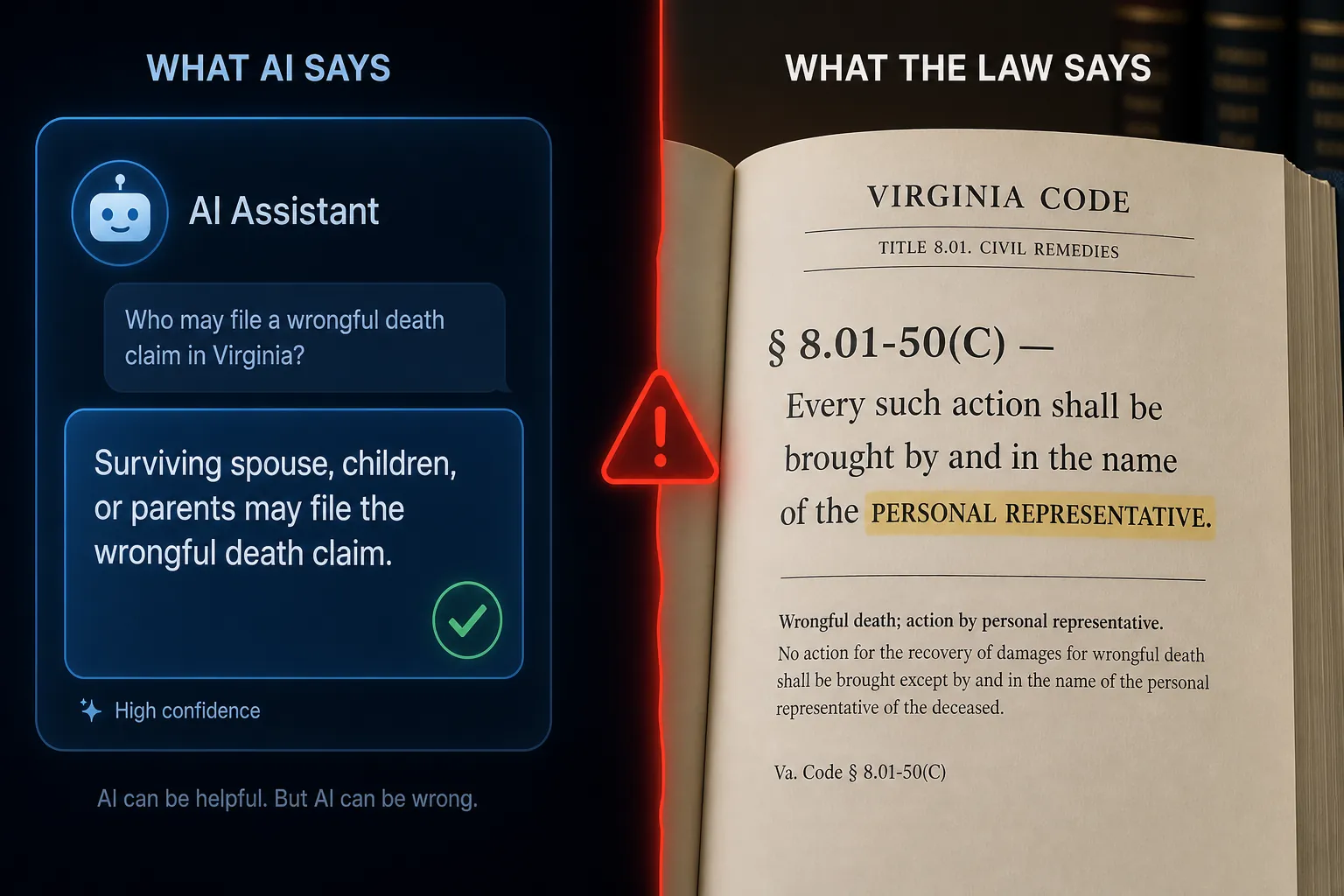
The unsafe AI answer usually looks ordinary: a surviving spouse can file a Virginia wrongful death claim; if there is no spouse, the children can file; if there are no children, the parents can file. That answer borrows language from the beneficiary side of wrongful death practice and turns it into a plaintiff-standing rule. For the filing question in ordinary Virginia wrongful death litigation, that is the wrong move.
The starting point is Va. Code § 8.01-50(C): “Every such action under this section shall be brought by and in the name of the personal representative of such deceased person.” The same section also contains a separate fetal-death provision in subsection B, which allows an action by the natural mother for the death of a fetus at any gestation.[1] A verification workflow has to keep both propositions in view at the same time: the ordinary plaintiff rule is personal representative; the statutory exception is not optional background.
This article is a verification procedure, not legal advice about any particular death claim, estate appointment, limitation period, settlement approval, damages allocation, or court filing. The question here is narrower: before relying on an AI-generated answer to who can file a wrongful death claim in Virginia in 2026, what should a Virginia reviewer check so the caption and standing analysis survive contact with the statute?
Start By Pinning Down The Question The Tool Actually Answered
Many bad outputs are not nonsense. They are answers to a neighboring question. An AI tool may answer who may recover, who may receive damages, who may approve a settlement, who may qualify to administer an estate, or who has a family relationship to the decedent. Those are not the same as who brings the wrongful death action in court.
Before checking citations, isolate the noun the AI used for the filer. If the output says “spouse,” “children,” “parents,” “statutory beneficiaries,” “heirs,” or “family members” may file directly, mark the answer as unverified. It may later be salvageable as a discussion of beneficiaries, but it should not be copied into a complaint, petition, demand package, or client-facing standing memo as the plaintiff rule.
| AI Wording | Verification Treatment |
|---|---|
| “The surviving spouse may file a wrongful death claim.” | Check against § 8.01-50(C); ordinary action must be brought by and in the name of the personal representative. |
| “Children or parents have standing to sue.” | Do not treat beneficiary status as filing authority without a statutory or appointment basis. |
| “The natural mother may bring a claim for fetal death.” | Check subsection B separately; this is the statutory exception the tool may either omit or overgeneralize. |
| “Virginia law allows the heirs to file under Code section ___.” | Inspect the cited section for existence, current text, and relevance before using the sentence. |
The Six-Check Workflow
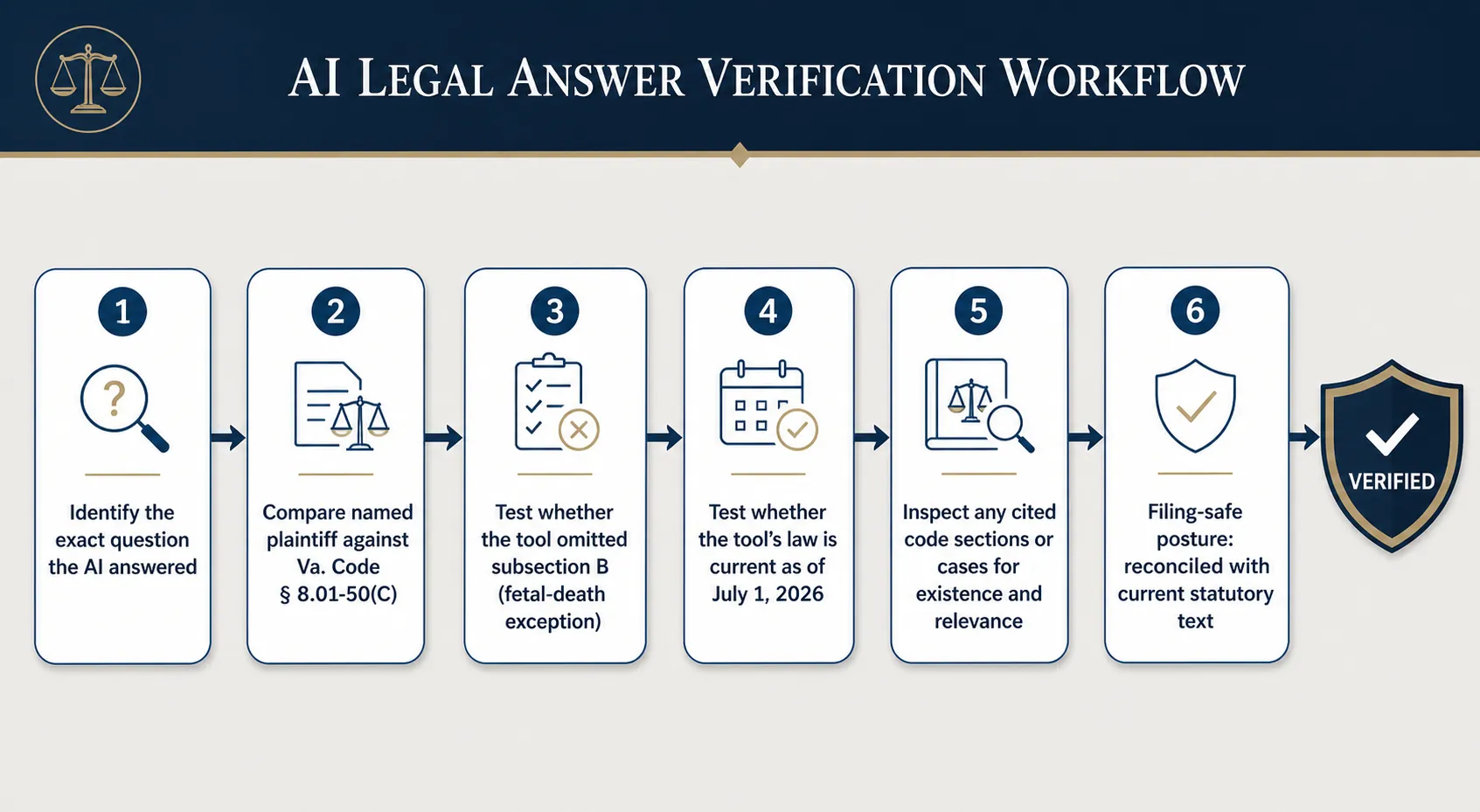
- Identify the exact question the AI answered: filer, beneficiary, damages recipient, estate representative, or settlement approval.
- Compare the named plaintiff against Va. Code § 8.01-50(C), using the current statutory text.
- Test whether the answer omitted subsection B’s fetal-death pathway or blurred it into the ordinary wrongful death rule.
- Check whether the tool’s law is current as of July 1, 2026, especially for HB 528 and other 2026 wrongful-death-related changes.
- Inspect every cited Virginia Code section, case, and quotation for existence, version, and relevance.
- Preserve a source trail that shows the statute version checked and the reason the named plaintiff is filing.
The order matters. A tool that fails the plaintiff comparison under subsection C should not get rehabilitated because it later gives a plausible damages summary. A tool that states the ordinary personal-representative rule but ignores subsection B has not answered the full statutory question. A tool that cites code provisions without current text has produced a research lead, not a filing-safe conclusion.
Check One: Personal Representative Means Personal Representative
For an ordinary wrongful death action under § 8.01-50, the caption should be tested against the statutory phrase “by and in the name of the personal representative of such deceased person.”[1] That is the language an AI answer has to reconcile. If the tool names a spouse, child, parent, or family member as the direct filer without explaining the personal-representative requirement, the answer has collapsed two different concepts.
The practical review is simple and unforgiving. Put the proposed plaintiff name next to the statute. Then ask what status that person is being given in the pleading. “Surviving spouse” may matter to recovery. “Personal representative” matters to bringing the action. If the same individual occupies both roles, the filing still needs the representative capacity to be right; the family relationship alone does not do the work.
This is where AI phrasing creates real risk. “The spouse may file” sounds close enough to survive a tired review if the decedent was married and the spouse is the person pressing the claim. But the filing question is not asking who is most interested, who suffered the loss, or who will receive proceeds. It is asking whose name the statute permits on the action.
A Quick Redline Test
Take the AI sentence and replace the family label with “personal representative.” If the sentence loses a necessary distinction, the answer was too loose. For example, a hypothetical AI output saying “the decedent’s children can sue because they are beneficiaries” should be rewritten into a research question, not a filing conclusion: who is the personal representative, and how do the children’s beneficiary interests affect recovery rather than filing authority?
Check Two: Do Not Let Subsection B Disappear
A correct ordinary-rule answer can still be incomplete. Va. Code § 8.01-50(B) addresses fetal death and states that an action may be brought by the natural mother for the death of a fetus at any gestation.[1] That exception needs its own line in the verification notes because it changes the filer analysis for that category of claim.
The failure pattern runs both ways. Some AI outputs omit subsection B entirely and present the personal-representative rule as if it covers every possible § 8.01-50 filing. Others notice the natural-mother language and overextend it into ordinary death claims. Either error is avoidable if the reviewer forces the tool’s answer through a two-column check: ordinary wrongful death under subsection C, fetal death under subsection B.
| Claim Type Being Reviewed | Statutory Filing Check |
|---|---|
| Ordinary wrongful death of a deceased person | Action brought by and in the name of the personal representative under § 8.01-50(C). |
| Death of a fetus at any gestation | Check subsection B’s natural-mother language before applying the ordinary personal-representative formulation. |
This is not a long research project. It is a control point. If the facts involve pregnancy or fetal death, subsection B must be opened and read. If they do not, the reviewer should still note that subsection B was considered and found not to drive the filer question. That note is the kind of small source trail that prevents later confusion.
Check Three: Treat July 1, 2026 As A Boundary, Not A Footnote
The standing sentence in § 8.01-50(C) is the immediate issue, but the 2026 version check cannot stop there. HB 528 amended Va. Code § 8.01-55, effective July 1, 2026, concerning settlement approval without a hearing.[2] Virginia also added a punitive-damages remedy for certain felony hit-and-run conduct, with the reported change taking effect July 1, 2026.[3] Those changes do not convert beneficiaries into direct filers under § 8.01-50(C), but they do create a date-sensitive environment in which pre-2026 AI output may be incomplete.
The update check should be mechanical. Open the current Virginia Code page. Confirm the effective version being consulted. Then separate three questions that AI tools often blend together: who files, how settlement approval proceeds, and what damages theories may be available. A 2026 amendment to settlement procedure or punitive damages may matter to the case, but it does not silently rewrite the plaintiff requirement in subsection C.
- If the AI answer was generated from a model or database that may not include July 1, 2026 updates, rerun the research in an updated primary-law source.
- If the answer cites § 8.01-55, check whether it is discussing settlement approval rather than who may file the action.
- If the answer mentions punitive damages for hit-and-run conduct, verify that the discussion is tied to the current statutory change and not being used to support standing.
- If the answer gives a confident 2026 statement without an effective-date trail, treat the date as unverified.
Court interpretation of new 2026 provisions may still be developing. That is another reason to keep the workflow modest. The reviewer is not trying to predict every downstream issue; the immediate task is to prevent an outdated or mixed-version answer from being used as if it were current Virginia filing law.
Check Four: Make Every Citation Prove It Exists
An AI-generated code citation should not be trusted because it looks like a Virginia citation. Wrong section numbers, obsolete language, and invented subsections are particularly dangerous in procedural questions because they can sound familiar enough to pass a fast read. The verification step is not to ask the tool whether it is sure. It is to open the cited authority outside the AI interface and compare the sentence being used against the source.
For each cited authority, record four things: the source opened, the text actually found, the date or version checked, and the reason the authority supports the filing statement. If a cited case cannot be found, if a quoted passage does not appear, or if the cited statute addresses a different procedural topic, remove the sentence from the draft until it is rebuilt from real authority.
Virginia has already seen fabricated AI legal material reach court. In Powhatan County School Board v. Skinger, reported in 2025, a pro se filing in the Eastern District of Virginia contained 42 fabricated citations.[4] That matter involved a pro se litigant and general-purpose AI, so it should not be treated as a benchmark for every legal research platform. Its narrower lesson is enough: fabricated legal support can arrive in a Virginia filing, and a citation that looks legal is not a source.
Why This Workflow Is Necessary, Not Merely Cautious
The published benchmark literature does not prove that a particular AI platform will miss § 8.01-50(C) today. It does show why state-specific procedural answers deserve verification before filing. Stanford RegLab and HAI reported that, in testing May 2024 versions of leading legal research AI tools, Lexis+ AI hallucinated 17% of the time and Westlaw AI-Assisted Research hallucinated 34% of the time on legal queries, with state-specific questions among the highest-error categories.[5]
Those figures should be used carefully. They are not a July 2026 audit of the exact Virginia wrongful death standing query. Tool versions, retrieval systems, and product guardrails change. But the benchmark is still useful for workflow design because it identifies the type of answer that needs checking: a legal query where the correct response depends on jurisdiction-specific text rather than general legal vocabulary.
The local-law risk is even clearer in the Place Matters study, which reported hallucination rates of 45% to 61% for place-based legal queries and up to 100% for specific local statutory provisions.[6] The study did not test Virginia wrongful death standing specifically. Its relevance is narrower: when a query asks for the law of a place, especially a statutory provision, the reviewer should expect the model to drift unless the output is anchored to current primary law.
The AI Law Librarians synthesis, published in February 2026, describes recurring hallucination patterns in legal research that match this problem: nonexistent authorities, misstatements of real law, and jurisdictional or temporal mismatches.[7] A Virginia wrongful death standing query can trigger all three. The tool can invent a code path, misstate the personal-representative rule, or answer from an outdated or non-Virginia template.
Damien Charlotin’s database tracked 1,811 hallucination cases globally as of July 29, 2026, including 1,252 in the United States, with tort listed as the third-largest category at 158 cases.[8] That database is not a denominator-based frequency study; it does not tell a lawyer the odds that any one AI answer is wrong. It does show that fabricated legal material is no longer a hypothetical problem kept outside court systems.
A Filing-Safe Review Note
A useful final work product is not a paragraph saying “AI was checked.” It is a short note that makes the filing basis auditable. For a straightforward ordinary wrongful death action, the note should identify § 8.01-50(C), state that the action is brought by and in the name of the personal representative, and explain that family members listed by the AI were treated as potential beneficiaries or interested persons rather than direct filers unless a separate verified basis exists.
If subsection B was potentially relevant, the note should say how it was handled. If 2026 changes appeared in the AI output, the note should state which current source was checked and whether the change affected filing, settlement approval, damages, or none of those. If the tool supplied code sections or cases, the note should preserve the authorities that were actually opened and discard the ones that did not check out.
AI can still be useful at intake. It can surface § 8.01-50, flag related settlement provisions, generate an issue list, or remind a reviewer to ask whether fetal death is involved. It cannot be the last word on who files. For this Virginia standing question, the defensible answer is the one reconciled with the current statutory text, the fetal-death exception, and the July 1, 2026 effective-date boundary. Until an AI-generated plaintiff list or code citation survives that workflow, it is only a reason to look.
References
- § 8.01-50. Action for death by wrongful act; how and when to be brought, Virginia Law, https://law.lis.virginia.gov/vacode/title8.01/chapter3/section8.01-50/
- HB528, BillTrack50, https://www.billtrack50.com/billdetail/1927906
- Punitive Damages in Virginia: A New Change for Hit-and-Run Cases, Curcio Law, June 8, 2026, https://www.curciolaw.com/2026/06/08/punitive-damages-in-virginia-a-new-change-for-hit-and-run-cases/
- 025-3-236 Powhatan County School Board v. Skinger, Virginia Lawyers Weekly, June 16, 2025, https://valawyersweekly.com/2025/06/16/025-3-236-powhatan-county-school-board-v-skinger/
- Hallucination-Free? Assessing the Reliability of Leading AI Legal Research Tools, Stanford Law School, https://law.stanford.edu/publications/hallucination-free-assessing-the-reliability-of-leading-ai-legal-research-tools/
- Place Matters, arXiv, 2025, https://arxiv.org/abs/2511.06700
- What the Science Says About Hallucinations in Legal Research, AI Law Librarians, February 19, 2026, https://www.ailawlibrarians.com/2026/02/19/what-the-science-says-about-hallucinations-in-legal-research/
- AI Hallucination Cases, Damien Charlotin, https://www.damiencharlotin.com/hallucinations/
Related records
Tool profile
Generation Beta Inherits a Legal AI Reliability RecordGoverning regulation
Browse the obligations tracker →Preventive workflow
Browse verification workflows →
Report a correction or tip
Spotted an outdated figure, a misstated fact, or a ruling this case record should reflect? Public comments are disabled for this content given the professional cost of a misreported case outcome, penalty amount, or rule text — use the structured correction channel instead.
Report a correction or tip for this record →