
Verifying the Brij Bhushan Sharan Singh acquittal timeline
AI-generated case timelines routinely split on verifiable dates, and in the Brij Bhushan Sharan Singh matter two separate proceedings are often merged into one story. This workflow shows how to check an AI chronology against primary records, resolve each disputed fact, and flag the remainder as reported rather than confirmed.
- Jurisdiction
- India
- Court
- Rouse Avenue Court, Delhi
- Judge
- ACJM Ashwini Panwar; ACMM Priyanka Rajpoot
- AI tool named
- AI chronology generator
- Ruling date
- Aug 3, 2026
- Source document
- View primary court order ↗
- Last verified
- Aug 3, 2026
Lex Machina Review is an independent risk-tracking and reference resource. Nothing on this site is legal advice, and using it does not create an attorney-client relationship. Every record is reviewed against primary sources but may not reflect the most current status of a matter — always verify directly against the cited court order, rule text, or a licensed attorney before relying on it.
Companion explanation — secondary to the source document above

The failure point in a Brij Bhushan Sharan Singh acquittal case timeline is not hard to describe: a May 2025 report saying he was “cleared” can be carried forward as if it disposed of the adult complainants’ case that ended at Rouse Avenue Court on Aug. 3, 2026. That is the kind of mistake an AI chronology can make while still looking tidy, sourced, and professionally usable.
For a verification workflow, the first status frame is therefore narrow. The Aug. 3, 2026 acquittal belongs to the adult six-complainant proceeding at Rouse Avenue Court. The separate POCSO track had already been closed earlier, with the closure reported on May 26, 2025 after the minor complainant’s father retracted his allegation on Jun. 7, 2023.[1] Treating those as one continuous prosecution story is the error to catch before any chronology is polished.
Start by splitting the matter before arranging the dates
A timeline sorted only by date invites the wrong kind of confidence. In this matter, several entries look adjacent because they share people, police station context, press coverage, and court geography. They do not all share the same procedural track.
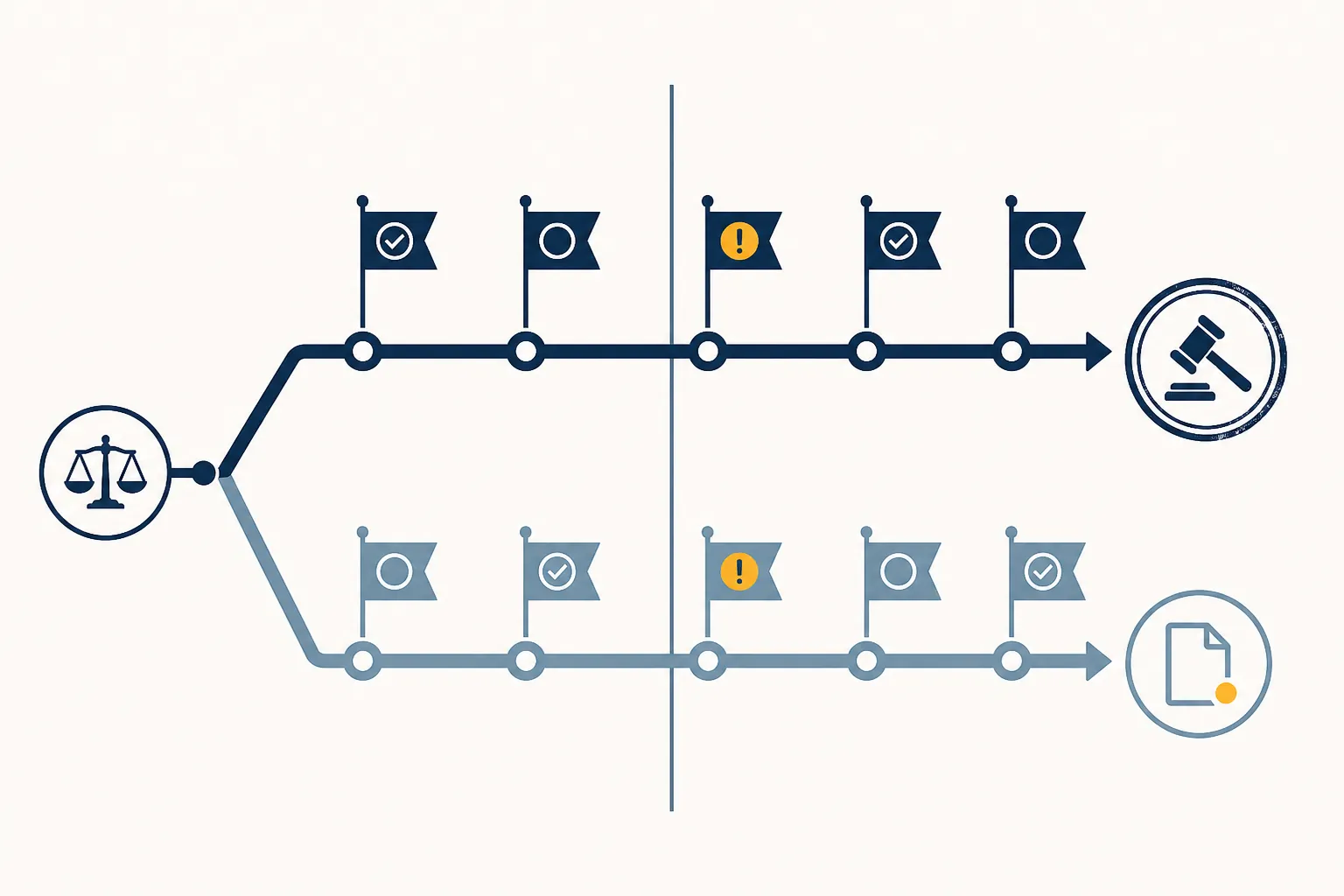
The adult case concerns six complainants and the IPC chargesheet filed in June 2023. The POCSO track concerns the allegation involving a minor complainant and the later closure of that proceeding. An AI-generated answer that says “the case was closed in May 2025” may be accurate only for the POCSO lane. An answer that says “the case ended in acquittal on Aug. 3, 2026” may be accurate only for the adult lane. The professional risk is the unmarked merge.
| Track | What it covers | Status point that matters | Verification treatment |
|---|---|---|---|
| Adult complainants’ case | Six adult complainants; IPC chargesheet and trial at Rouse Avenue Court | Acquittal pronounced on Aug. 3, 2026 | Keep as the adult-case endpoint; do not backfill the May 2025 “cleared” report into this lane |
| POCSO proceeding | Allegation involving a minor complainant | Closure reported on May 26, 2025 after the father’s Jun. 7, 2023 retraction | Keep as a separate closed track; do not describe it as the Aug. 2026 acquittal |
This split comes before the full chronology because it controls every later judgment. A date cannot be “confirmed” in the abstract. It is confirmed for a track, a stage, and a procedural proposition.
The working flow for checking an AI chronology
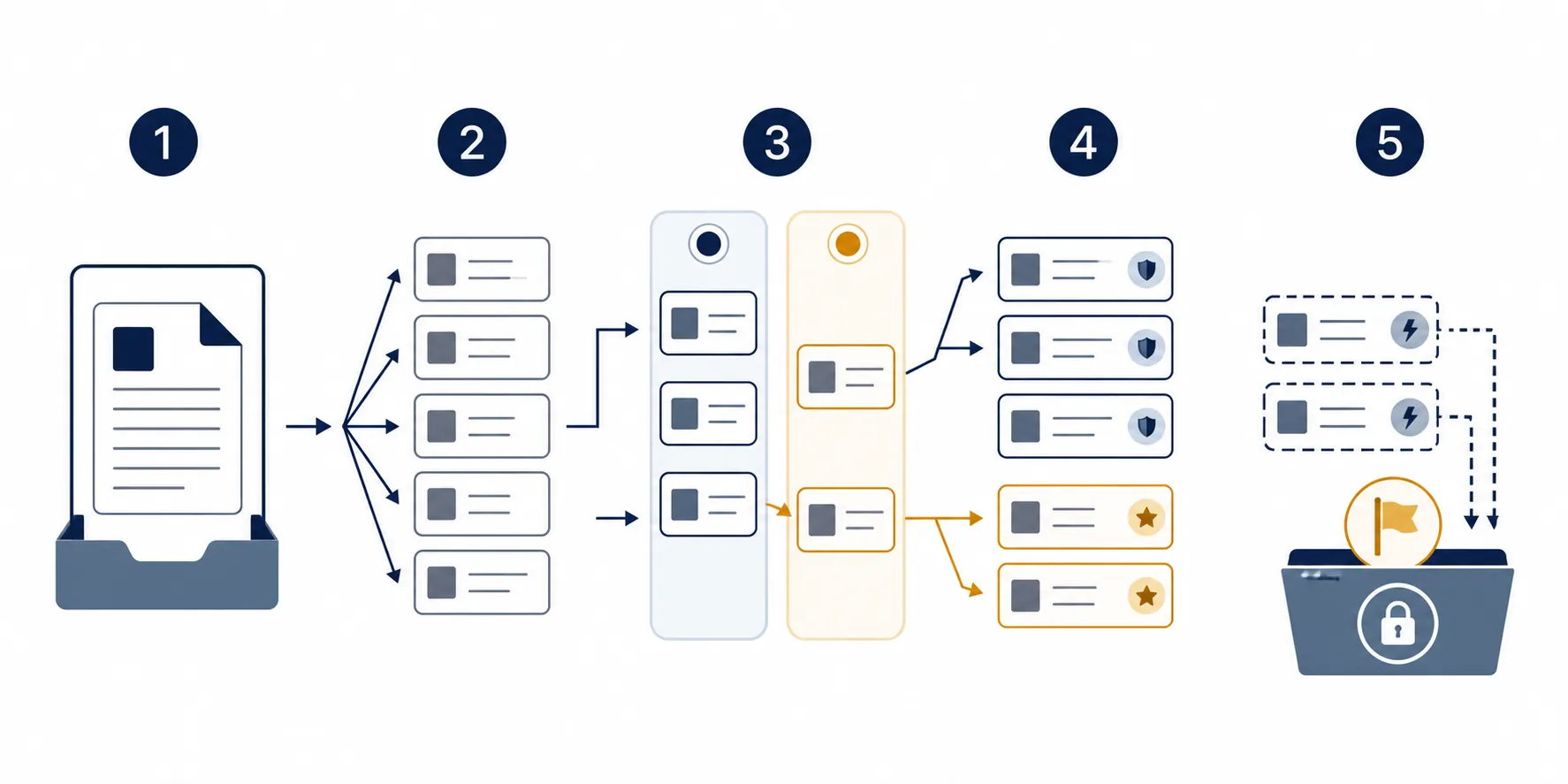
The useful workflow is modest. It does not ask the reviewer to decide whether every press report is right or wrong. It asks the reviewer to make each claim small enough that it can be assigned, sourced, and labeled.
- Collect the AI chronology exactly as generated, including vague phrases such as “later cleared” or “charges were framed in May 2024.”
- Split the chronology into atomic claims: date, actor, court, procedural act, complainant group, and source basis.
- Assign each claim to the adult track, the POCSO track, both tracks, or neither until clarified.
- Attach the best available source: court order, docket entry, original-publisher legal report, or secondary press report.
- Mark conflicts rather than smoothing them: confirmed, reported, disputed, unresolved, or wrong-track.
That last label, wrong-track, earns its place. A May 2025 “cleared” item is not necessarily false. It becomes dangerous when it is used to close the adult case that was still alive until the Aug. 3, 2026 acquittal.
Build the claim table before writing the narrative
For professional use, the claim table is more important than the first prose draft. It shows what the chronology actually rests on and where a later user must avoid overstatement.
| Claim to check | Track | Best current status | Why the flag matters |
|---|---|---|---|
| Supreme Court notice preceded FIR registration | Both-origin context | Reported | The notice is part of the public sequence, but the later tracks must still be separated |
| FIRs were registered at Connaught Place police station on Apr. 28, 2023 | Both-origin context | Reported | Useful origin point, not proof that all later outcomes belong to one case lane |
| Chargesheet filed on Jun. 15, 2023 under IPC 354, 354A, 354D, 506(1), with 34 and 109 for Tomar | Adult case | Reported | This is the adult-case prosecution track that later reaches the 2026 acquittal |
| Minor complainant’s father retracted allegation on Jun. 7, 2023 | POCSO track | Reported | Explains later closure of the POCSO proceeding; does not close the adult case |
| Charges were framed in May 2024 for five complainants, with discharge as to one | Adult case | Disputed date | Reputable reports split between May 10 and May 21, 2024 |
| Trial was in-camera from Jun. 1, 2024 | Adult case | Reported | Useful stage marker, but should not be inflated into a full public record of testimony |
| There were 32 prosecution witnesses | Adult case | Reported | A count to retain only if tied to the trial reporting or record used |
| POCSO case was closed on May 26, 2025 | POCSO track | Reported | This is the source of the common “cleared” misread |
| Verdict was reserved on Jul. 2, 2026 | Adult case | Reported | Confirms the adult case remained pending after the POCSO closure |
| Acquittal was pronounced on Aug. 3, 2026 by ACJM Ashwini Panwar | Adult case | Confirmed for workflow purposes if matched to the court record or original report | This is the adult-case endpoint, not a restatement of the 2025 POCSO closure |
The labels are deliberately conservative. “Reported” does not mean unreliable. It means the article, memo, or AI evaluation has not yet tied that item to the trial-court record or another primary source. That distinction matters when the same date is later reused by another team as if it had been judicially verified.
The May 2025 “cleared” item belongs in only one lane
The BBC’s May 2025 “cleared” formulation is a good stress test because it is not an obscure source and not an obviously absurd claim. The problem is narrower: the item refers to the POCSO closure, not the adult six-complainant case that continued to verdict in 2026.[1]
A reviewer should not rewrite that item as “false.” The safer correction is: “reported as cleared in the POCSO proceeding; not the adult complainants’ case.” This preserves the source’s procedural meaning while preventing the AI timeline from using it as a global endpoint.
The downstream consequence is easy to miss. If an in-house briefing says Singh was cleared in May 2025 and then separately acquitted in August 2026 without explaining the two tracks, the reader is left to infer either duplication, appeal activity, or inconsistent reporting. The actual fix is not more prose. It is a track label.
Resolve the charge-framing conflict without pretending it is settled

The charge-framing date is where a neat timeline usually overreaches. Bar and Bench and Telegraph India date the framing of charges to May 10, 2024.[2][3] Times of India and Hindustan Times date it to May 21, 2024.[4][5] Those are reputable-publisher conflicts, not fringe noise.
| Issue | Reported version A | Reported version B | Safe timeline treatment |
|---|---|---|---|
| Charge-framing date | May 10, 2024, as reported by Bar and Bench and Telegraph India | May 21, 2024, as reported by Times of India and Hindustan Times | Mark as disputed until checked against the trial-court order or docket |
| Procedural substance | Charges framed for five complainants and discharge as to one | Same broad stage described in later timelines | Separate the date conflict from the procedural proposition |
| Judge at this stage | ACMM Priyanka Rajpoot | Not the same judge who later pronounced acquittal | Keep stage and judge together to avoid merged-court summaries |
The important drafting move is to avoid choosing a date just because it appears more often or looks cleaner in a chronology. The status line can say: “Charges were reportedly framed in May 2024; reports conflict on whether the operative date was May 10 or May 21; verify against the trial-court record before publication.”
That wording is less elegant than a single date. It is also the difference between a working legal chronology and a copy-forward error.
Do not let the alleged-incident window harden into an unsupported fact
The alleged-incident window has a different kind of conflict. Wikipedia states 2012–2022.[6] Lawbeat and The Quint state 2016–2019.[7][8] A chronology that quietly selects one of those ranges without attribution gives the reader a false sense that the period is settled across sources.
Here the label should be even more careful than with the charge-framing date. A court order or chargesheet may resolve what the prosecution alleged for the adult case, but a secondary timeline range may be summarizing a broader public controversy, a subset of allegations, or a specific pleading posture. Unless the source basis is visible, the entry should remain attributed: “reported alleged-incident window varies by source.”
This is one of the places where an AI assistant’s fluency can be actively unhelpful. It will often prefer a single clean range. The reviewer’s job is to preserve the unresolved boundary until the underlying record supplies one.
Keep the judge and stage together
The judge-stage distinction is another small detail that prevents a large misstatement. ACMM Priyanka Rajpoot is associated with the May 2024 charge-framing stage. ACJM Ashwini Panwar pronounced the Aug. 3, 2026 acquittal. If those names are detached from their procedural stages, a summary can wrongly imply that one judge handled the entire relevant sequence or that the charge-framing and acquittal entries describe the same court action.
| Court stage | Judge name to keep with that stage | Timeline risk if merged |
|---|---|---|
| Charge framing in May 2024 | ACMM Priyanka Rajpoot | The charge order may be confused with the final trial outcome |
| Acquittal on Aug. 3, 2026 | ACJM Ashwini Panwar | The verdict may be described as if it were the same procedural act as charge framing |
For an AI-evaluation file, this is a useful scoring point. A model that gets the final date right but attaches it to the wrong stage, wrong judge, or wrong case lane has not produced a safe professional chronology.
A restrained working chronology
Only after the two-track distinction is in place does the chronological view become useful. The point is not to retell the case. It is to show how each entry should travel with a status flag.
| Date or period | Entry | Track | Status |
|---|---|---|---|
| Apr. 25, 2023 | Supreme Court notice reported before FIR registration | Origin context | Reported |
| Apr. 28, 2023 | FIRs registered at Connaught Place police station | Origin context | Reported |
| Jun. 7, 2023 | Minor complainant’s father retracted allegation | POCSO track | Reported |
| Jun. 15, 2023 | Chargesheet filed under IPC 354, 354A, 354D, 506(1), with 34 and 109 for Tomar | Adult case | Reported |
| May 2024 | Charges framed for five complainants; discharge as to one | Adult case | Reported, date disputed |
| May 10 or May 21, 2024 | Conflicting reported charge-framing date | Adult case | Disputed |
| Jun. 1, 2024 | In-camera trial reported to begin | Adult case | Reported |
| May 26, 2025 | POCSO proceeding reported closed | POCSO track | Reported |
| Jul. 2, 2026 | Verdict reserved | Adult case | Reported |
| Aug. 3, 2026 | Acquittal pronounced at Rouse Avenue Court | Adult case | Confirmed for the case-status frame |
The table deliberately leaves some entries short. A verification memo does not need a mini news recap for every procedural step. It needs enough structure to stop the wrong claim from crossing lanes.
How to mark the AI output
When the AI chronology is reviewed, each line should receive a disposition. The most useful dispositions are not moral judgments about the model. They are editing instructions for the next person who might rely on the file.
| Flag | Use it when | Example in this matter |
|---|---|---|
| Confirmed | The claim is tied to a court record, docket entry, or sufficiently identified original report used as the controlling source | Adult-case acquittal on Aug. 3, 2026, if matched to the court record or original legal report |
| Reported | The claim appears in a named press or legal report but has not been independently matched to the primary record | FIR registration, chargesheet details, in-camera trial, witness count, or verdict reservation if used from press reporting |
| Disputed | Named sources conflict on a date, range, or procedural description | May 10 versus May 21, 2024 for charge framing |
| Wrong-track | The source item may be accurate but is being used for the wrong proceeding | May 2025 POCSO “cleared” item used as if it ended the adult case |
| Unresolved | The available material does not let the reviewer choose safely | Alleged-incident window where secondary sources differ |
This is also where legal-tech buyers can make the test harder. Do not ask only whether the system names the final acquittal date. Ask whether it keeps the adult proceeding separate from the POCSO closure, preserves the charge-framing conflict, and attaches judge names to the correct stages.
Where the verified record should stop
A defensible Brij Bhushan Sharan Singh acquittal case timeline can say that the adult six-complainant proceeding ended in acquittal at Rouse Avenue Court on Aug. 3, 2026, while the POCSO proceeding had been closed earlier. It can also say that the May 2025 “cleared” item belongs to the POCSO lane, not the adult-case endpoint.
It should not, on the materials available here, pretend that every date conflict has been solved. The charge-framing date remains disputed between May 10 and May 21, 2024 unless checked against the trial-court record. The alleged-incident window should remain attributed because secondary sources differ. Judge names should stay attached to their procedural stages.
Any AI timeline that collapses those distinctions may still look coherent. It is not safe for professional use until the tracks are separated, the conflicts are flagged, and the unresolved dates are labeled as reported rather than confirmed.
References
- BBC report on May 2025 POCSO closure, BBC, May 2025, link
- Bar and Bench report on charge framing, Bar and Bench, May 2024, link
- Telegraph India report on charge framing, Telegraph India, May 2024, link
- Times of India report on charge framing, Times of India, May 2024, link
- Hindustan Times report on charge framing, Hindustan Times, May 2024, link
- Wikipedia timeline entry on alleged-incident window, Wikipedia, link
- Lawbeat report on alleged-incident window, Lawbeat, link
- The Quint report on alleged-incident window, The Quint, link
Related records
Tool profile
How Meta's AI Spending Reshapes Law Firm ProfitabilityGoverning regulation
Browse the obligations tracker →Preventive workflow
Browse verification workflows →
Report a correction or tip
Spotted an outdated figure, a misstated fact, or a ruling this case record should reflect? Public comments are disabled for this content given the professional cost of a misreported case outcome, penalty amount, or rule text — use the structured correction channel instead.
Report a correction or tip for this record →