
Vietnam Factory Tariff Inspections Signal Escalated Enforcement Risk
CBP's on-site factory inspections in Vietnam mark a shift from document-based audits to physical verification of manufacturing substance. This article outlines the legal obligations, penalty exposure, and five-document framework importers and manufacturers need to prepare for under the new enforcement regime.
- Jurisdiction
- US Federal
- Court
- U.S. Customs and Border Protection
- AI tool named
- None
- Ruling date
- Jul 28, 2026
- Source document
- View primary court order ↗
- Last verified
- Jul 29, 2026
Lex Machina Review is an independent risk-tracking and reference resource. Nothing on this site is legal advice, and using it does not create an attorney-client relationship. Every record is reviewed against primary sources but may not reflect the most current status of a matter — always verify directly against the cited court order, rule text, or a licensed attorney before relying on it.
Companion explanation — secondary to the source document above
The important detail in the July 28 report was not simply that US Customs and Border Protection personnel had gone into factories in Vietnam. It was what they were reportedly looking at once they were inside: raw material sourcing, production processes, value-add calculation, and software IP at China-linked facilities.[1] That list moves the inquiry away from a file review built around entry packets and supplier declarations. It asks whether the factory floor, the purchasing trail, the production records, and the origin claim all describe the same commercial reality.

For importers selling “Vietnam origin” treatment to customers, this is the uncomfortable version of legal compliance that teams planning for tariff inspections at Vietnam factories now have to face. A clean customs form can be the beginning of the conversation, not the end of it. If an inspector can stand next to a production line and ask where the inputs came from, how much work happened in Vietnam, how value was calculated, and whether embedded software or IP changes the analysis, the importer needs more than a broker file.
The available account should be handled with care. The detailed inspection description comes through ChosunBiz, and the Bloomberg and Reuters materials referenced in the research file were not independently reviewed here because they were not accessible. Even with that caveat, the categories reportedly examined are exactly the ones a regulator would use to test manufacturing substance rather than paperwork consistency alone.[1]
Why the factory visit matters after the July 2025 tariff framework
The inspection reports sit against the July 2025 US-Vietnam trade framework, under which goods from Vietnam face a 20% tariff while transshipment is subject to a 40% penalty tariff.[2] The hard part is that “transshipment” remains undefined in the materials reviewed here.[2] That uncertainty does not make the issue optional. It makes the evidentiary record more important.
In an ordinary commercial discussion, “transshipment” may be used loosely to mean goods merely passing through a country. In an enforcement file, that looseness becomes dangerous. If the operative term is not defined, businesses should not assume that any Vietnam-based processing step is enough. They should assume that officials may test whether the Vietnamese operation can be substantiated through inputs, production activity, inventory movement, value-add, and internal controls.
That is a different risk posture from asking a customs broker to classify an entry and retain the documents the importer supplied. Brokers do not run the plant. They do not reconcile raw material ledgers against work orders. They cannot make a factory manager explain why the bill of materials says one thing while the storage area, purchase orders, or production routing show another. When enforcement moves inside the facility, the legal risk follows the facts upstream.
The broader US enforcement backdrop is already visible in tariff and trade-fraud priorities. Readers tracking adjacent import risk can compare this development with the CBP and DOJ emphasis discussed in Trump Tariff Enforcement Raises Stakes for AI Hardware Importers, where customs penalties and DOJ trade-fraud activity are treated as operational compliance issues rather than abstract policy signals.
The document file has to match the factory
The most useful preparation frame is not a memo saying that Vietnam origin has been reviewed. It is a set of records that can answer the same question from different angles. A five-document framework identified in a Duane Morris/Mondaq analysis points to the right categories: bills of materials, manufacturing records, supplier documentation, customs documentation, and internal procedures.[3]
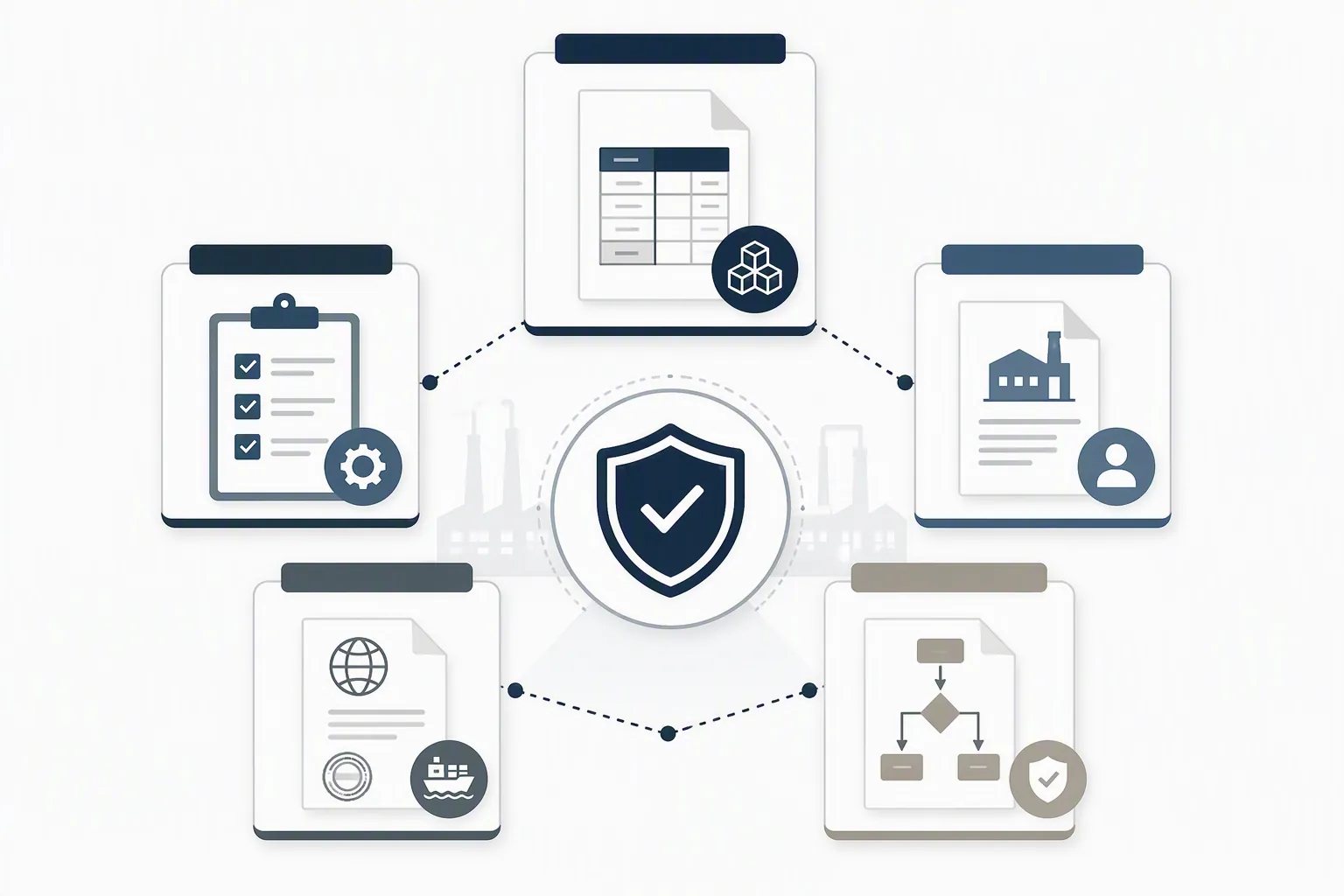
| Record category | What it needs to prove in practice |
|---|---|
| Bill of materials | What inputs went into the finished good and whether the claimed origin story accounts for those inputs. |
| Manufacturing records | What production steps occurred in Vietnam, when they occurred, and whether the work orders, routings, labor records, and output quantities make sense together. |
| Supplier documentation | Where materials came from, who supplied them, and whether purchase records support the sourcing represented in the BOM. |
| Customs documentation | Whether entry declarations, certificates, invoices, and shipping documents align with the production and supplier file. |
| Internal procedures | Who owns origin review, how exceptions are escalated, and how the company prevents sales commitments from outrunning substantiation. |
The point of this framework is not document volume. It is cross-checking. A BOM that identifies a Chinese-origin component may not be a problem by itself. A BOM that cannot be reconciled to supplier invoices, import records, production consumption, inventory depletion, and the value-add calculation is a problem waiting for the first serious inspection request.
Manufacturing records deserve more attention than they usually get in origin projects. Legal teams often receive a finished narrative: components enter Vietnam, the factory performs processing, finished goods ship to the United States. An inspector will usually need something less polished and more testable. Which line performed the work? Which work orders consumed the relevant materials? Did output quantities track input consumption? Were scrap, rework, and inventory adjustments recorded in a way that supports the claimed transformation?
Software IP adds another layer because it can affect value and product function without leaving the same physical trace as a component. The ChosunBiz account’s reference to software IP is therefore not a throwaway detail.[1] If software, firmware, design files, or licensed technology are material to the finished product, the origin file should explain how they fit into the production and value story rather than leaving that point to engineering emails after the government asks.
US exposure: penalties, false claims theories, and coordinated trade-fraud enforcement
On the US side, the tariff difference supplies the money at stake, but the enforcement tools supply the leverage. Section 1592 can expose importers to customs penalties, including penalties up to the domestic value of the merchandise in the most serious cases. False Claims Act theories can add treble-damages risk where the government frames avoided duties as false or fraudulent claims against the United States.
Recent trade-fraud settlements show why origin, classification, and duty-avoidance theories now belong on general counsel dashboards, not only in customs departments. The research file identifies Evolutions Flooring at $8.1 million in March 2025, Allied Stone at $12.4 million in August 2025, Ceratizit USA at $54 million in December 2025, and a plastic resin self-disclosure at $6.8 million.[4] Those matters are not proof that every Vietnam-routed supply chain is suspect. They are evidence that duty-related misstatements can produce settlement numbers large enough to change the risk calculation.
The CBP recovery figures cited in the research file point in the same direction, with an important sourcing limitation. A commercial legal source reports $192.77 million in CBP recoveries through June 2025 and 1,400 trade enforcement penalties in the first half of fiscal year 2025, citing CBP records.[4] Because those underlying CBP records were not independently available in the research file, the figures should be treated as sourced but not independently verified here.
Coordination also matters. Hogan Lovells’ analysis of the August 2025 Trade Fraud Task Force and DOJ Fraud Section trade enforcement unit places customs issues within a broader fraud-enforcement architecture.[5] For companies, that means the same origin file may be read by different audiences: CBP personnel looking at entry compliance, DOJ lawyers evaluating fraud theories, and internal auditors trying to determine whether the company knew or should have known that its substantiation was weak.
This is where overreliance on customs documentation becomes especially thin. A certificate, invoice, and entry summary may show what the importer declared. They do not necessarily show that the declaration was reasonable. If contemporaneous production records are missing, if supplier evidence is incomplete, or if internal procedures show that commercial teams promised origin outcomes before legal review, the file starts to answer a different question: not “what did the company declare,” but “why did the company think it could declare it.”
That distinction is familiar in other tariff contexts as well. The broader Section 301 enforcement environment discussed in the forced labor tariffs legal challenge shows how duty exposure can turn on records that sit outside the import entry packet.
Vietnam-side records now create their own pressure
The other side of the file is in Vietnam. Decree 169/2026/ND-CP became effective on July 1, 2026, and the research materials describe new obligations around BOM management, quarterly Authorized Economic Operator reporting, and facility registration updates.[6][7] The same Vietnamese-side records that help support a US origin position may also be tested by Vietnamese authorities for consistency across customs, production, and inventory systems.

The research file further identifies People’s Public Security fines up to VND 200 million for discrepancies between customs, production, and inventory records.[6] The amount is modest compared with some US settlement numbers, but the operational consequence can be larger than the fine suggests. A local discrepancy finding can give US counsel exactly the kind of record inconsistency they least want to explain during a CBP review.
This is the practical shape of dual-side exposure. The US question may be whether the importer properly claimed Vietnam treatment and avoided the 40% penalty tariff for transshipment.[2] The Vietnam question may be whether the factory’s BOM, inventory, production, customs, AEO, or facility-registration records are internally consistent under local obligations.[6][7] Those questions are not identical, but they can collide in the same set of documents.
A manufacturer that treats the US origin file as one project and the Vietnam compliance file as another may miss that collision. If the US importer’s BOM differs from the Vietnamese facility’s BOM-management records, if production volumes in one system do not track customs declarations in another, or if a facility update was missed after a process change, neither side needs a dramatic smoking gun. The mismatch is enough to slow clearance, trigger requests, or force a legal team into reconstruction mode.
What a defensible preparation file looks like
A defensible file starts before the next shipment. It does not wait for a CBP request, a Vietnamese inspection, or a customer questionnaire. The company should be able to pull a product-level package that shows the legal basis for the origin claim and the operational facts that support it.
- Map each finished product to its BOM, supplier sources, production routing, and value-add calculation.
- Reconcile supplier invoices and import records against raw material inventory and production consumption.
- Test whether Vietnamese production records show actual processing rather than only transfer, storage, relabeling, or minor handling.
- Confirm that customs entries, origin certificates, commercial invoices, and customer representations use the same facts and assumptions.
- Document who approves origin determinations, who updates them after sourcing or process changes, and who can stop shipment when the file is incomplete.
The last point is usually where files reveal whether compliance had authority or merely received paperwork. If sales has already committed to a delivery schedule and origin treatment, the compliance manager may be left trying to build evidence after the commercial fact. That is backwards. Origin review should be tied to product onboarding, supplier changes, engineering changes, and facility changes, because each of those events can affect the story the documents need to tell.
Companies should also decide what they will not claim. If a product has mixed-origin inputs and limited Vietnamese processing, the file may support a narrower representation than the sales team would prefer. That is not a compliance failure. The failure is making the broader claim without records that can survive a regulator asking the same question through the BOM, the inventory ledger, the production line, and the customs entry.
The source caveats do not soften the compliance lesson
The source limits remain real. The detailed account of the July 28 factory activity depends on a secondary report.[1] The July 2025 framework leaves “transshipment” undefined in the materials reviewed.[2] The CBP recovery and penalty figures come through a commercial legal source citing CBP records, not independently reviewed primary records in this file.[4] None of those limits should be converted into certainty that regulators will apply the rules in the most aggressive possible way.
They also should not be converted into comfort. The common thread across the materials is that importers and manufacturers are being pushed toward record-matching: US officials reportedly testing factory substance, US enforcement tools increasing the cost of unsupported declarations, and Vietnamese rules requiring consistency among the records that show what a facility actually did.[1][5][6]
The practical threshold is straightforward. Customs documents are necessary, but they are not enough on their own. Importers and manufacturers need factory-level records that reconcile sourcing, production, inventory, value-add, and internal controls before an inspector asks for them.
References
- ChosunBiz report on July 28, 2026 CBP inspections, ChosunBiz, July 28, 2026
- Vietnam Briefing analysis of the July 2025 US-Vietnam trade deal, Vietnam Briefing, October 2025
- Government Contracts, Procurement & PPP article on Vietnam origin documentation, Mondaq
- Trade enforcement settlements and CBP recovery data, Carra Globe
- Trade Fraud Task Force and DOJ Fraud Section trade enforcement analysis, Hogan Lovells, August 2025
- Vietnam Decree 169/2026/ND-CP analysis, Vietnam Briefing, June 4, 2026
- Decree 169/2026/ND-CP customs compliance analysis, DFDL
Related records
Tool profile
Browse tool evaluations →Governing regulation
Browse the obligations tracker →Preventive workflow
Browse verification workflows →
Report a correction or tip
Spotted an outdated figure, a misstated fact, or a ruling this case record should reflect? Public comments are disabled for this content given the professional cost of a misreported case outcome, penalty amount, or rule text — use the structured correction channel instead.
Report a correction or tip for this record →