
How Visa's AI Layoffs Reshape Employer Legal Obligations
The July 28, 2026 Visa layoffs announcement—2,600 cuts publicly tied to AI—exposes three converging legal risk vectors: WARN Act compliance, emerging state AI-disclosure laws, and novel discrimination theories from the Meta lawsuit. Employers need a compliance framework that treats these as interconnected, not separate silos.
- Jurisdiction
- us-federal
- Court
- U.S. District Court for the Northern District of California
- AI tool named
- AI performance ranking system
- Ruling date
- Jul 14, 2026
- Source document
- View primary court order ↗
- Last verified
- Jul 29, 2026
Lex Machina Review is an independent risk-tracking and reference resource. Nothing on this site is legal advice, and using it does not create an attorney-client relationship. Every record is reviewed against primary sources but may not reflect the most current status of a matter — always verify directly against the cited court order, rule text, or a licensed attorney before relying on it.
Companion explanation — secondary to the source document above
Visa’s July 28, 2026 layoff announcement is the kind of event that turns “AI impact on jobs” from a labor-market headline into an employment-law record problem. Public reporting describes 2,600 job cuts, about 7% of the company’s workforce, as part of an efficiency push, with CEO Ryan McInerney saying AI is “helping to accelerate” the company’s evolution.[1] One day later, the important legal caveat is still simple: public reporting does not yet answer which states received WARN filings, whether the cuts are concentrated at particular sites, which roles are affected, or how Visa internally classified the role of AI in the reduction.
That gap matters more than the headline. A company can announce an AI-accelerated restructuring in one channel, describe the same event as cost reduction in another, and then face discovery over a selection process that relied on activity data, productivity metrics, or model-generated rankings. The legal risk is not that every AI-linked layoff is unlawful. The risk is that the same workforce decision must remain coherent when read as a WARN event, an AI-disclosure event, and a discrimination file.
The timing also lands in a year when AI has become a mainstream layoff label. Challenger, Gray & Christmas reported that employers cited AI in 101,743 job cuts through June 2026, 23% of all 443,604 announced cuts, up from 54,836 AI-cited cuts in all of 2025; the firm also reported AI as the leading cited reason for four consecutive months.[2] Those figures are useful as a compliance signal, not as proof that AI independently caused each job loss. The data depends on employer-stated reasons, and that limitation is exactly why the label becomes dangerous when it later appears on statutory forms or in litigation.
The Same Reduction Has Three Legal Readers
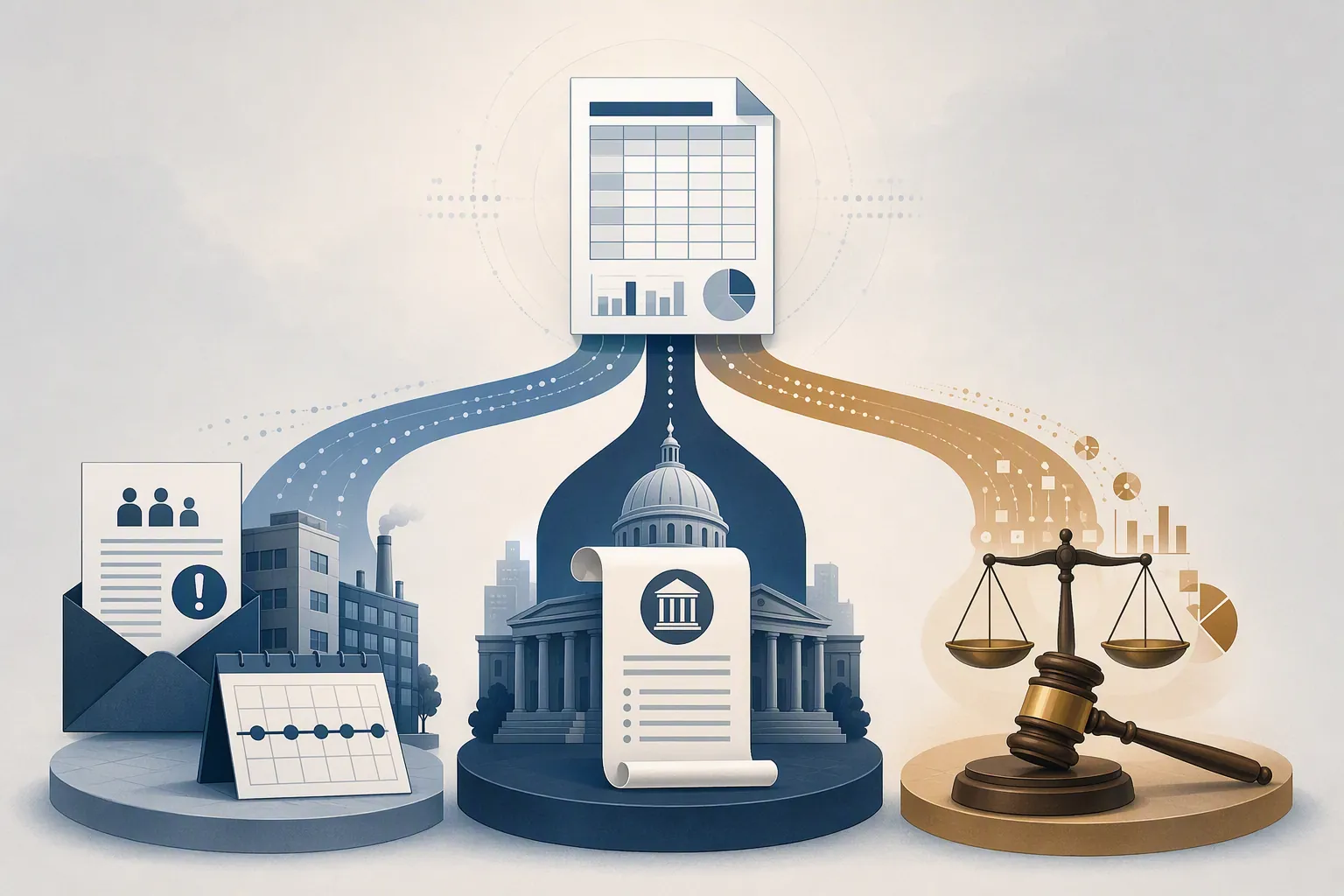
For a multi-state employer, the first reader is the WARN analyst asking about timing, counts, sites, employment losses, and notice recipients. The second is the state regulator or form designer asking whether a layoff is related to AI or technological change. The third is a plaintiff, agency, or court asking why particular employees were selected and whether the criteria predictably disadvantaged protected workers.
Those readers do not receive three different fact patterns. They receive different slices of the same record: the CEO memo, board materials, reduction-in-force spreadsheet, WARN notices, state attachments, manager talking points, selection rubric, model documentation, adverse-impact analysis, leave records, accommodation records, and the eventual litigation pleadings. The most expensive version of the problem is not an aggressive press quote. It is an aggressive press quote that cannot be reconciled with the operational files.
| Legal channel | Questions the record must answer | Documents likely to be compared |
|---|---|---|
| WARN Act and state WARN analysis | When were decisions made, how many employees suffered employment losses, where were they located, and when did notice obligations attach? | Reduction timeline, site lists, headcount data, notices, severance communications |
| AI-layoff disclosure regimes | Was the layoff related to AI, automation, or other technological change, and how did the employer define that relationship? | Public statements, statutory forms, HR reason codes, technology implementation records |
| Discrimination and leave-interference theories | Did selection criteria, metrics, or human review disadvantage employees because of protected status, leave, pregnancy, disability, or accommodation history? | Selection matrices, performance data, leave files, model inputs, reviewer notes, exception logs |
WARN Still Starts With Counts, Sites, and Timing
The federal WARN Act question does not become exotic because a CEO mentions AI. Counsel still needs the ordinary facts first: employment losses, affected employment sites, aggregation periods, timing of the decision, notice recipients, and whether state mini-WARN laws impose broader or earlier duties. For Visa, those facts cannot be assumed from the reported 2,600-companywide figure. A 7% global or national reduction tells the market something; it does not, by itself, tell a WARN reviewer whether a covered event occurred at a particular site.
That distinction is easy to lose in an AI-layoff story. A press report can compress thousands of cuts into one corporate event, while WARN analysis may turn on where employees report, whether remote workers are assigned to a particular site, how separations are staggered, and whether separate waves are treated as one employment loss event. Employers that publicly frame a restructuring as AI-accelerated should assume that timing documents will later be read against that statement: when the technology plan was approved, when affected roles were identified, when managers received lists, and when notices went out.
The practical consequence is document discipline before the notice clock becomes disputed. If the business rationale is operational efficiency aided by AI tools, say that consistently and specifically enough to survive later comparison. If AI changed some workflows but did not determine the layoff population, the record should say that too. A vague internal code such as “cost reduction” may be accurate at a high level and still create avoidable friction if the public record describes the reduction as accelerated by AI.
The AI-Disclosure Patchwork Is Moving Faster Than Definitions
Connecticut is the most immediate example because its SB 5 is scheduled to take effect on October 1, 2026. The law requires employers to disclose on WARN notices whether a layoff is “related to the use of AI or other technological change,” with enforcement under the Connecticut Unfair Trade Practices Act and exclusive enforcement by the attorney general.[3] As of this writing, the operative definition of an AI-driven layoff has been left to the Labor Commissioner and has not yet been issued.[3]
That unresolved definition is not a reason to wait. It is a reason to preserve the facts that would let the employer answer several possible versions of the question. Did AI eliminate tasks? Did it reduce staffing needs? Did it generate or rank the candidate list? Did it supply productivity measures used in selection? Did managers retain authority to override outputs? Did the company publicly attribute the restructuring to AI even if the statutory form uses narrower language?
California and New York show the same direction of travel, though in less settled form. California Executive Order N-6-26 directs the Employment Development Department to review Cal-WARN within 180 days and build an AI employment dashboard, while pending SB 951 would require 90 days’ advance notice for AI-driven cuts of 25 or more employees under a “caused entirely by AI” standard.[4] New York has proposed an AI-related WARN disclosure rule.[5] Neither should be treated as a mature nationwide template, but both make the same filing problem visible: employers will increasingly be asked to choose words for AI involvement before courts and agencies have fully settled what those words mean.
The “caused entirely by AI” phrase illustrates why over-simple labels are unhelpful. Many restructurings will not fit a clean causation box. AI may make a team more productive, change demand for a role, generate a skills map, or supply performance signals without being the sole cause of any termination. A yes-or-no form answer may be legally required, but the backup file should preserve the more exact account.
Selection Criteria Are Where the AI Story Becomes Discoverable
The discrimination risk is not limited to an employer saying, “AI selected the employees.” The more realistic issue is that supposedly neutral metrics may measure unequal opportunity to generate the metric. That is the theory now being tested in the Meta lawsuit filed July 14, 2026 in the Northern District of California, where 26 employees allege that AI systems using keystroke data, token consumption, and AI-native performance rankings selected employees on protected leave for termination.[6] The plaintiffs include a scientist allegedly notified two days before giving birth, and the complaint asserts claims under the FMLA, Title VII’s Pregnancy Discrimination Act framework, the ADA, and the Pregnant Workers Fairness Act.[6]
That case is a pleading, not a merits ruling. Meta has denied the claims and stated that workforce decisions “were and are made by people, not AI.”[6] The legal lesson is narrower and more useful: if a reduction process rewards recent activity volume, token usage, keyboard behavior, generated-output volume, ticket throughput, or other AI-native productivity signals, counsel should ask who had less chance to produce those signals because they were on leave, recovering from childbirth, using accommodations, or otherwise protected from being penalized for absence.
Human review does not cure that problem automatically. A manager who rubber-stamps a ranked list may become part of the evidentiary trail rather than a defense. The useful record is more concrete: what inputs were used, which inputs were excluded, whether leave periods were normalized or removed, whether reviewers saw protected-leave information, whether exceptions were allowed, who approved them, and whether the final pool was tested for adverse patterns before notices were issued.
The Workday/Mobley ruling, discussed in employment-law analysis of the Meta complaint, reinforces that employers should not assume an algorithmic tool ends the liability inquiry; a court allowed bias claims against an AI hiring tool to proceed in June 2026.[7] Hiring and layoff contexts differ, but the evidentiary instinct is the same. A tool’s output is not self-justifying just because the tool is technical.
What the Defensible File Should Contain
At-will employment still permits many business decisions to replace work with technology, and legal commentary has correctly noted that replacing employees with AI is generally lawful in itself.[8] The exposure sits downstream: discrimination, WARN compliance, trade-secret and governance controls, and the ability of the employer’s infrastructure to support the story it tells.[8] For large employers, that infrastructure should be treated as part of the reduction plan, not as cleanup after notices are sent.
- Decision chronology: when the AI initiative began, when restructuring became likely, when affected groups were identified, and when notice analysis started.
- Role analysis: which tasks changed, which roles were eliminated or reduced, and whether AI affected work volume, skills demand, cost assumptions, or selection.
- Selection criteria: the exact metrics used, their source systems, weighting, exclusions, manager discretion, and any treatment of leave or accommodation periods.
- Human review record: who reviewed model outputs or rankings, what they could change, what they did change, and why.
- Notice and disclosure alignment: the language used in WARN notices, state AI-disclosure fields, severance materials, FAQs, executive communications, and manager scripts.
- Privilege and preservation plan: what legal advice is protected, what business records must be preserved, and who is responsible for maintaining the final reduction file.
The hardest item is often the selection matrix. Many reduction files show final scores but not the reason a metric was chosen, the alternatives rejected, or the adjustment made for employees who were not active in the measurement window. In an AI-linked layoff, that omission matters. If the company later argues that people made the decisions, the people need a record showing what they reviewed and how they avoided penalizing protected inactivity.
The communications file deserves the same care. A CEO memo can fairly describe an efficiency push and still create problems if it overstates AI’s role for investors, understates it for WARN disclosures, and disappears entirely from HR talking points. Counsel does not need every audience to receive identical language. Counsel does need the differences to be explainable.
The Label Problem Will Not Disappear on a Form
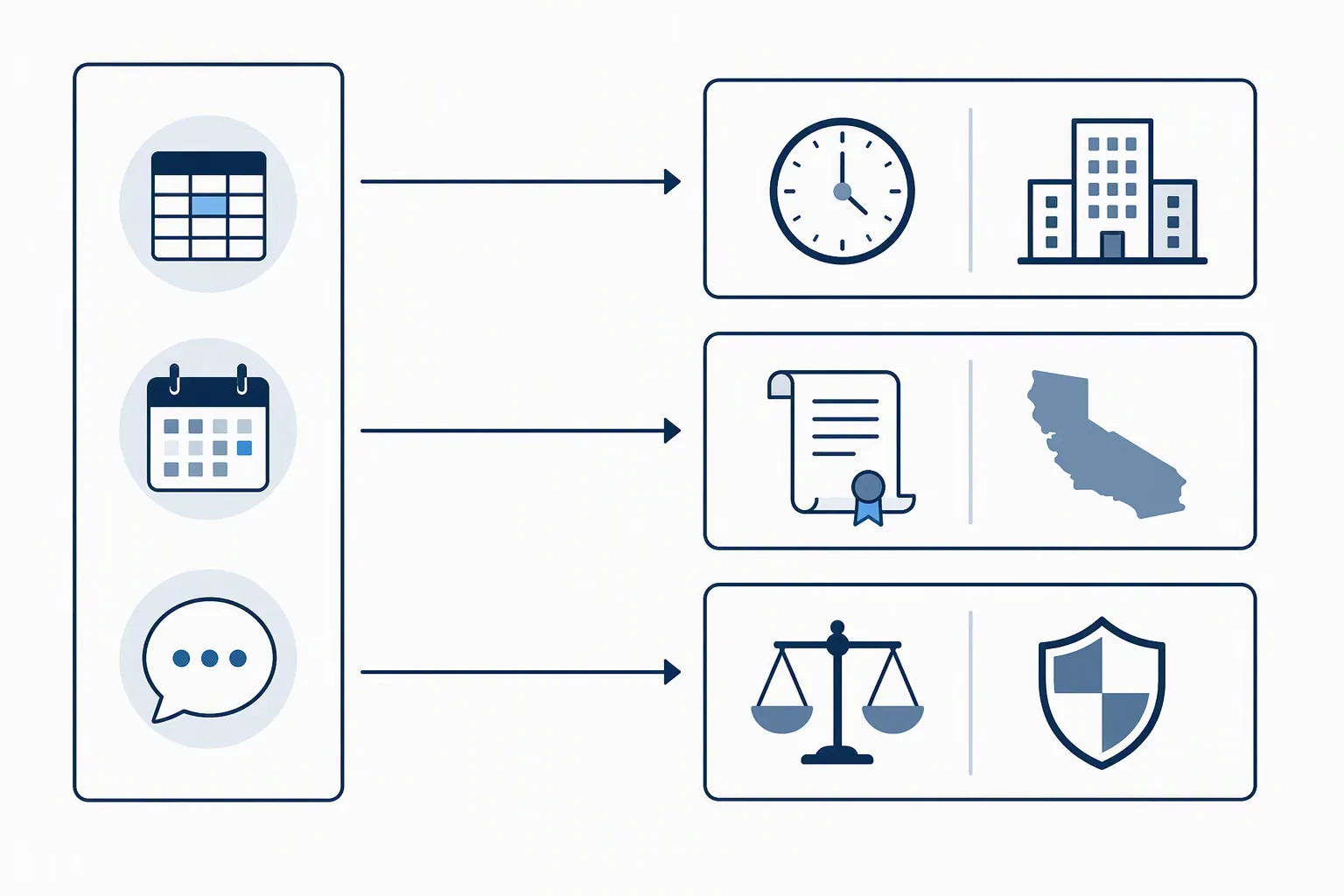
The Challenger data shows why AI-layoff language now attracts regulators, but it also shows why precision is difficult. The same analysis discussing Connecticut’s law notes a tension between employer-reported layoff reasons and executive claims that AI has “essentially no impact” on headcount.[3] That mismatch may reflect different definitions, different incentives, or different stages of adoption. It should not be flattened into a claim that executives are always hiding AI-driven cuts. It should, however, warn employers that voluntary labels become more consequential when they migrate into required notices.
A defensible answer to “was this layoff related to AI?” may need more than yes or no in the underlying file. One employer may have eliminated roles because a deployed system now performs a defined workflow. Another may have reduced headcount after AI changed productivity assumptions but still selected employees using conventional performance and skills criteria. A third may have used an AI tool to help identify employees for termination. Those are not the same fact pattern for disclosure, WARN explanation, or discrimination defense.
A Brief Edge Note on Collective Bargaining
There is also an emerging labor-law argument that AI-driven layoffs may implicate collective bargaining duties under the NLRA, but the current support is student-authored scholarship rather than a binding NLRB or court decision.[9] For unionized workforces, that is enough to flag bargaining and information-request issues early. It is not yet the center of the immediate legal framework for nonunion AI-linked reductions.
The Practical Legal Judgment
Visa may or may not become a litigated test case. The public record is too new to know. What it already shows is that a large employer cannot safely treat an AI-linked reduction as one story for the market, another for WARN compliance, another for state AI disclosure, and a fourth for discrimination discovery.
For employers planning similar reductions in Q3 2026, the safer operating assumption is that public statements, WARN timing, AI-disclosure answers, selection documentation, leave treatment, and human-review records are one evidentiary file. Connecticut’s undefined terms, California’s pending activity, New York’s proposal, and the early posture of the Meta complaint are not reasons to wait for perfect rules. They are reasons to preserve more detail now, while the business rationale and selection process can still be reconstructed accurately.
References
- Visa is cutting 7% of employees in efficiency push as AI reshapes work, CNBC, July 28, 2026
- Challenger Report: June Layoffs Cool to 45,849, Down 53% from May; AI Leads Reasons for Fourth Consecutive Month, Challenger, Gray & Christmas
- AI Layoff Disclosure Laws 2026, Pebblous
- California Lays the Groundwork for More Sweeping AI Workforce Regulation—Employers Should Start Preparing Now, K&L Gates, June 8, 2026
- NY Proposes AI Layoff Disclosure Rule Under WARN Act, SHRM
- Meta lawsuit layoffs AI, CNBC, July 14, 2026
- Employment Law Update: A Scheduling System Cost One Employer $125 Million. Now, 26 Employees Are Suing Over AI-Driven Layoffs. Is Your Organization Next?, Whiteford
- AI Employee Replacement Legal Risks, BoyarMiller
- NLRA Protections for AI-Driven Layoffs, University of Chicago Law Review
Related records
Tool profile
How Meta's AI Spending Reshapes Law Firm ProfitabilityGoverning regulation
Browse the obligations tracker →Preventive workflow
Browse verification workflows →
Report a correction or tip
Spotted an outdated figure, a misstated fact, or a ruling this case record should reflect? Public comments are disabled for this content given the professional cost of a misreported case outcome, penalty amount, or rule text — use the structured correction channel instead.
Report a correction or tip for this record →