
Does Overstaying a Visa Create a Criminal Record?
Overstaying a visa is a civil violation, not a criminal offense, but generative AI tools frequently fabricate this distinction. This article explains the legal boundary, why AI hallucinates it, and the real sanction risks for practitioners relying on unverified AI output.
- Jurisdiction
- US Federal
- Court
- U.S. Court of Appeals for the Seventh Circuit
- AI tool named
- AI legal research tool
- Ruling date
- Mar 30, 2026
- Source document
- View primary court order ↗
- Last verified
- Jul 26, 2026
Lex Machina Review is an independent risk-tracking and reference resource. Nothing on this site is legal advice, and using it does not create an attorney-client relationship. Every record is reviewed against primary sources but may not reflect the most current status of a matter — always verify directly against the cited court order, rule text, or a licensed attorney before relying on it.
Companion explanation — secondary to the source document above
Overstaying a visa, by itself, does not create a criminal record under current U.S. law. It is a civil immigration violation. That answer matters because a client who stayed past an authorized admission period may face serious immigration consequences without having been convicted of a crime, charged with a crime, or assigned a criminal history entry for the overstay alone.
The criminal line is elsewhere. Entering the United States unlawfully can be prosecuted under 8 U.S.C. § 1325, commonly treated as a federal misdemeanor for a first improper entry. Reentry after removal can be prosecuted under 8 U.S.C. § 1326, which carries felony exposure in specified circumstances.[1][2] An overstay may make a person removable, may trigger unlawful-presence bars after departure, and may complicate a later filing. It does not, standing alone, become a criminal conviction.
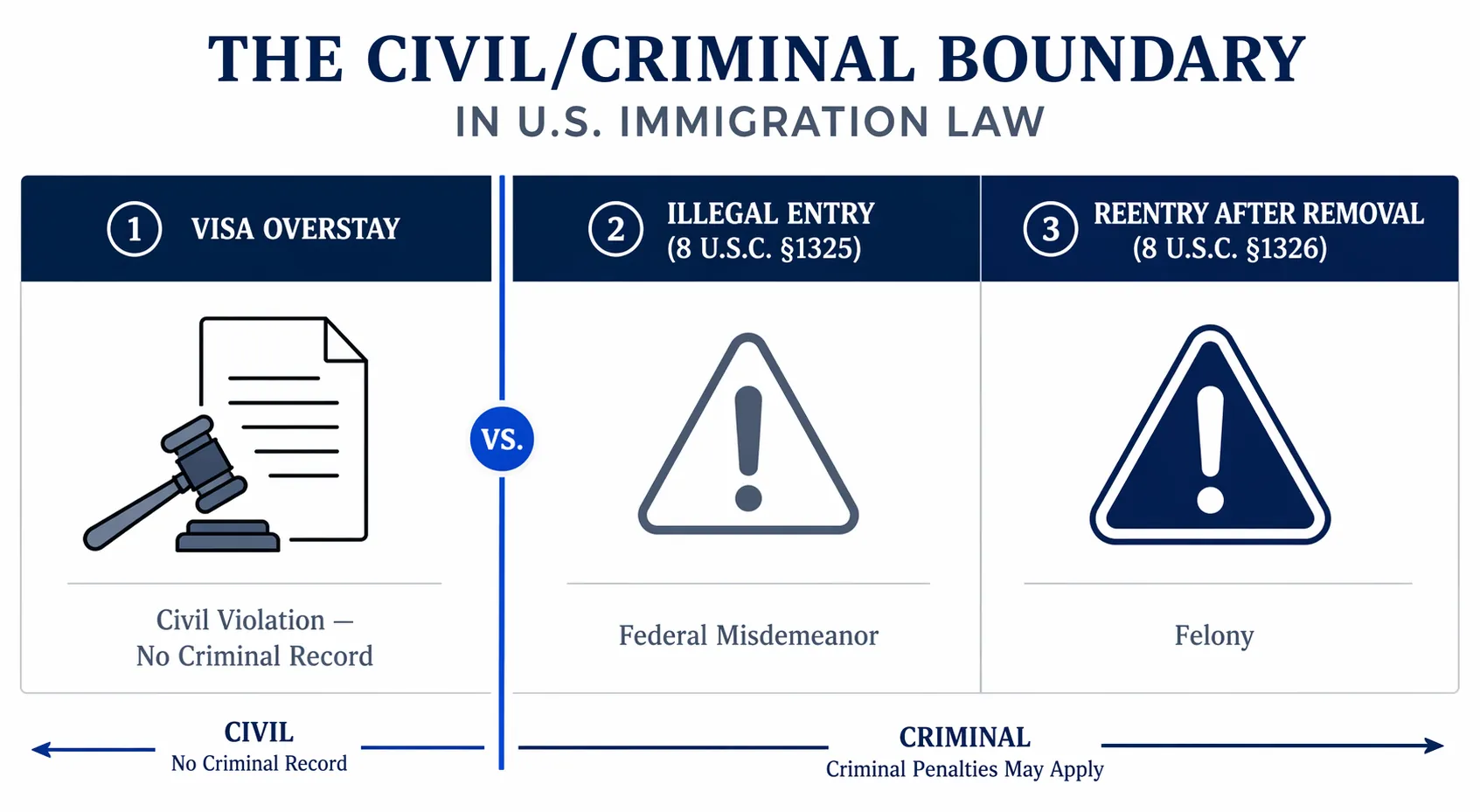
That distinction is simple enough to state and easy enough to damage. It is the kind of boundary a generative AI system can collapse when it treats immigration violation, unlawful presence, illegal entry, removability, inadmissibility, and criminal record as neighboring phrases rather than separate legal categories. A confident answer that says “visa overstay is a crime” is not merely imprecise. In a client conversation, it can misstate status. In a filing, it can misdirect legal analysis. In a supervising attorney’s review queue, it can look finished when it is only fluent.
The Civil Consequences Are Real, But They Are Not a Criminal Record
A visa overstay usually means the person remained in the United States beyond the period authorized by the admission record, not necessarily beyond the expiration date printed on the visa foil. That difference is familiar to immigration lawyers and often invisible to clients. The visa may permit travel to a port of entry during a certain period; the admission record controls the time allowed to remain after entry. When the authorized stay expires and the person remains without another lawful basis, the problem is immigration status, not a new criminal conviction.
Civil does not mean harmless. An overstay can support removability. It can lead to visa cancellation or make later discretionary applications harder. If the person accrues enough unlawful presence and then departs, statutory three-year or ten-year bars may apply depending on the length of unlawful presence accumulated before departure.[3] Those consequences can be severe enough that calling the matter “not criminal” may sound too gentle to a client. Precision is still necessary: severity and criminality are not the same thing.
The record question should therefore be answered in two parts. First, no: the overstay itself does not create a criminal record. Second, yes: the same facts may sit next to other events that do create criminal exposure. If the person entered without inspection, used false documents, violated a prior removal order, or reentered after removal, the analysis changes. The lawyer’s job is not to reassure the client with a broad label. It is to identify which legal event is being discussed.
| Event | Legal Character Under Current Law | Client-Facing Consequence |
|---|---|---|
| Remaining past an authorized stay | Civil immigration violation | No criminal record from the overstay alone; possible removability, unlawful-presence consequences, and future filing complications |
| Improper entry under 8 U.S.C. § 1325 | Federal criminal offense | Possible prosecution and criminal record if charged and convicted |
| Reentry after removal under 8 U.S.C. § 1326 | Federal criminal offense, with felony exposure in specified circumstances | Possible prosecution, conviction, imprisonment exposure, and criminal record |
That table leaves out many fact patterns on purpose. It does not resolve fraud, unauthorized employment, adjustment eligibility, asylum timing, consular processing strategy, waivers, or removal defense. Those issues may decide a case. They do not alter the starting proposition: a visa overstay alone is a civil violation, not a criminal conviction.
Where AI Answers Usually Go Wrong
A poor human answer often goes wrong by exaggerating. A poor AI answer often goes wrong by blending. It may correctly recognize that overstays can lead to removal and inadmissibility, then slide into language about “illegal immigration offenses” or “criminal penalties” without stopping to ask whether the statute being discussed is civil immigration law or criminal law.
The risk is not theoretical. Stanford RegLab and Stanford HAI researchers reported that legal AI tools still produced hallucinated citations in benchmark testing, with paid legal research tools fabricating citations between 17% and 34% of the time in the reported tests.[4] That figure measures citation fabrication in a benchmark environment; it does not prove that every tool will misstate visa-overstay law, and it does not measure practitioner competence. It does show why a polished immigration memo cannot be treated as authority merely because it contains case names, statutory references, and a confident conclusion.
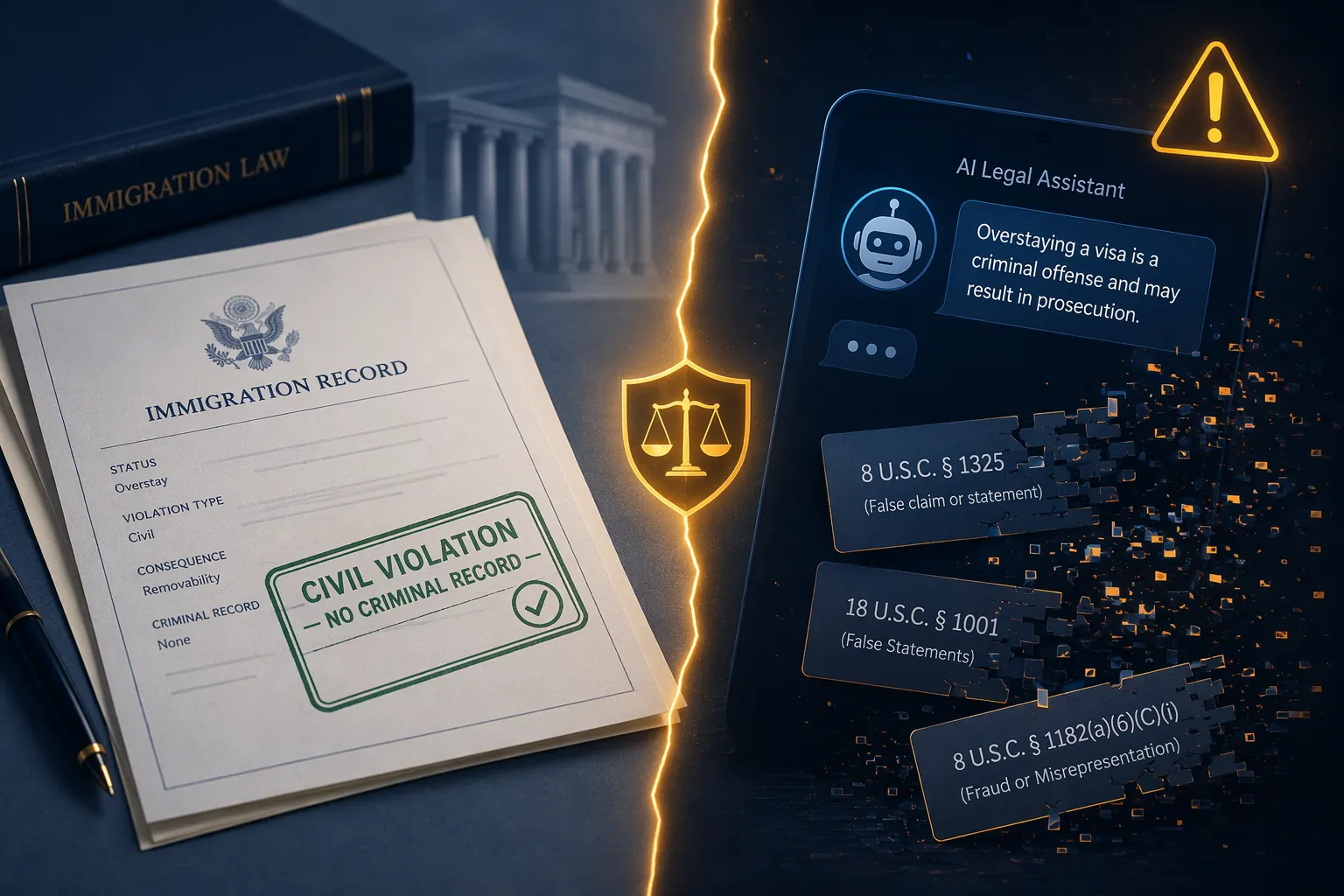
Immigration questions are particularly vulnerable because the vocabulary invites category errors. “Unlawful presence” sounds criminal to a lay reader. “Illegal entry” sounds interchangeable with “overstay” to a model trained on general web usage. “Deportable” sounds like a punishment, but removal is a civil process. A lawyer knows, or must know, that these words live in different legal boxes. A model predicts language near other language.
A hypothetical bad memo is easy to imagine: “Overstaying a visa is a criminal offense under 8 U.S.C. § 1325 and creates a criminal record.” The sentence has the shape of legal analysis. It includes a federal statute. It is also wrong as applied to a pure overstay. Section 1325 concerns improper entry, not merely remaining beyond an authorized period after lawful admission.[1] If that sentence reaches a client uncorrected, the lawyer has not just used a weak research shortcut. The lawyer has changed the client’s understanding of legal exposure.
Dec v. Mullin Is a Warning, Not an Overstay Case
The immigration-adjacent appellate warning sign is Dec v. Mullin, decided by the Seventh Circuit on March 30, 2026. The reported opinion involved AI-hallucinated citations in a removal-defense brief: two fabricated cases and one false quotation appeared in a standard-of-review section. The court admonished counsel but declined sanctions, emphasizing that the errors were unintentional, did not affect the outcome, and were met with contrition.[5]
That is related evidence, not a direct holding about visa overstay criminal record consequences. It should not be cited for the proposition that lawyers have already been sanctioned for misstating the overstay/criminal-record distinction. The cleaner lesson is narrower and more useful: an immigration filing can reach a federal appellate court with fabricated authority in it, and the fact that the fabricated material sits in a supposedly routine section does not make it professionally invisible.
There is also a secondary lesson for the lawyer on the other side. Commentary on Dec noted that the court criticized opposing counsel for not catching the false authorities earlier.[5] That observation should not be inflated into a universal duty to audit every opponent’s citation with equal depth. But it is a useful signal: once AI-generated legal text is common, courts may expect more than passive reliance on the adversary’s bibliography.
Sanctions Have Moved Past the Novelty Phase
The first wave of AI citation-error cases was sometimes discussed as if courts were reacting to a strange new technology problem. That period is over. Reported sanction examples now include the $5,000 sanction in Mata v. Avianca in 2023, a later reported $109,700 penalty, two-year district suspensions, and canceled trials in 2026 matters including Couvrette v. Wisnovsky and Withers v. City of Aberdeen.[6] The point is not that every AI error produces a severe sanction. The point is that courts now have a vocabulary for these errors and a growing record of remedies.
For immigration practitioners, the professional-responsibility risk is not limited to fake cases. A memo that invents a holding is dangerous. A memo that cites a real statute for the wrong legal event is also dangerous. A memo that states a pending bill as enacted law is dangerous in a quieter way, because it may survive a superficial citation check. The question is not whether the AI output looks like work product. It is whether every legal proposition that matters has been checked against primary authority or a reliable, current secondary source.
A supervising attorney signing a brief cannot outsource that check to the tone of the draft. If the filing says a client’s overstay created criminal exposure, the reviewer must know whether the draft is discussing overstay, improper entry, reentry, fraud, or some other conduct. If the filing cites § 1325 or § 1326, the reviewer must confirm that the facts actually fit the statute cited. That is not an AI-specific burden. AI simply increases the number of polished wrong answers that can arrive on a lawyer’s desk.
Pending Legislation Belongs in the File, Not in the Answer
There is pending legislation that could change the analysis if enacted. The Visa Overstay Penalties Act of 2025 was introduced as S. 1937 and H.R. 3781. As described by its sponsors, the bill would treat visa overstay as a form of criminal illegal entry and impose up to six months of imprisonment for a first offense.[7][8] The legislative push was publicly tied to the June 2025 Boulder terrorist attack.[7]
As of July 26, 2026, the current-law answer in this article treats that proposal as pending, not enacted. That status matters. A memo that ignores the bill may be incomplete for policy monitoring. A memo that treats the bill as law is wrong. This is exactly where AI systems with stale training data, mixed retrieval sources, or undated summaries can produce a bad answer in either direction.
The practical drafting habit is simple: separate current law from proposed law in the text itself. “Under current law, overstay alone is civil.” “Pending legislation would change that if enacted.” “Status last checked on July 26, 2026.” Those three sentences do more legal work than a paragraph of general caution about immigration enforcement.
Scale Does Not Change the Classification
Visa overstay is not a marginal issue. Congressional sponsor materials for the 2025 bill cited DHS data stating that more than 565,000 individuals overstayed visas in FY2023.[7] That number is useful for scale, but it should not be used as a shortcut for legal classification. A large number of civil violations does not convert them into crimes. Nor does the existence of national-security arguments around overstay enforcement rewrite the statute currently in force.
For client counseling, scale can even make precision more important. Many people may have the same threshold fear: “Do I now have a criminal record?” The accurate answer remains fact-specific at the edges but clear at the center. A pure overstay does not create one. Additional conduct may.
How the Distinction Should Appear in Work Product
A usable research note on visa overstay criminal record consequences should not bury the answer under pages of inadmissibility doctrine. It should identify the event, classify it, and then state the consequences that follow from that classification. If AI helped prepare the note, the verification record should be visible enough that the next lawyer can see what was checked.
- State the current-law rule: overstay alone is civil and does not create a criminal record.
- Separate overstay from improper entry under § 1325 and reentry after removal under § 1326.
- Describe immigration consequences without calling them criminal consequences.
- Check pending legislation separately and date the status check.
- Verify every case, quotation, and statutory citation outside the AI system before filing or advising.
That last item is not a formatting preference. It is the difference between using AI as a drafting aid and letting it become an unlicensed source of legal authority. A citation that cannot be found, a quotation that does not appear in the case, or a statute attached to the wrong conduct should be treated as unusable until independently verified.
The disciplined conclusion is narrow and current: visa overstay alone does not create a criminal record under current law. Illegal entry and reentry after removal are different statutory events with criminal exposure. Pending legislation could change the overstay rule if enacted. Any AI-generated answer on this point, especially one with citations, should be treated as a draft lead rather than authority until the lawyer has checked the primary sources and the bill status as of the date of use.
References
- 8 U.S.C. § 1325 — Improper entry by alien, Legal Information Institute, link
- 8 U.S.C. § 1326 — Reentry of removed aliens, Legal Information Institute, link
- Unlawful Presence and Inadmissibility, U.S. Citizenship and Immigration Services, link
- Legal Hallucinations, Stanford RegLab and Stanford HAI, link
- Seventh Circuit Declines to Sanction Lawyer for AI-Hallucinated Citations in Immigration Brief, The National Law Review, link
- AI Hallucination Cases Tracker, HAQQ, link
- Banks Introduces Visa Overstay Penalties Act, U.S. Senator Jim Banks, 2025, link
- Moran Introduces Visa Overstay Penalties Act, Congressman Nathaniel Moran, 2025, link
Related records
Tool profile
How Meta's AI Spending Reshapes Law Firm ProfitabilityGoverning regulation
Browse the obligations tracker →Preventive workflow
Browse verification workflows →
Report a correction or tip
Spotted an outdated figure, a misstated fact, or a ruling this case record should reflect? Public comments are disabled for this content given the professional cost of a misreported case outcome, penalty amount, or rule text — use the structured correction channel instead.
Report a correction or tip for this record →