
Who Can Be Sued After the Vitruvias Thyroid Recall
The August 2026 nationwide recall of one Vitruvias Therapeutics thyroid-tablet lot — an unapproved porcine-derived product with roughly 1,955 units sold — is a live intake and exposure question for counsel, but no recall-specific docket exists as of August 25, 2026. This record separates confirmed recall and FDA facts from the prospective defendant landscape, including the labeler's ceased-operations statement and H2-Pharma transfer, benchmarked against prior desiccated-thyroid litigation.
- Jurisdiction
- United States
- Court
- No recall-specific docket as of 2026-08-25
- AI tool named
- No AI tool implicated
- Ruling date
- Aug 24, 2026
- Source document
- View primary court order ↗
- Last verified
- Aug 25, 2026
Lex Machina Review is an independent risk-tracking and reference resource. Nothing on this site is legal advice, and using it does not create an attorney-client relationship. Every record is reviewed against primary sources but may not reflect the most current status of a matter — always verify directly against the cited court order, rule text, or a licensed attorney before relying on it.
Companion explanation — secondary to the source document above

Recall record last verified August 25, 2026
The legal-risk posture is narrower than many searches suggest. FDA published a Vitruvias Therapeutics recall notice on August 24, 2026, after the company’s August 21, 2026 announcement. The recall is described as being conducted with FDA’s knowledge. That is not the same thing as a confirmed public FDA investigation, warning letter, Form 483, inspection finding, filed complaint, or certified class action tied to this recall. As of August 25, 2026, no recall-specific docket is confirmed in the public record reviewed for this Risk Digest.
| Field | Confirmed public record |
|---|---|
| Product | Thyroid Tablets, USP 30 mg |
| Labeler / recalling firm | Vitruvias Therapeutics Inc. |
| Lot | 504950 |
| NDC | 69680-166-00 |
| Expiration date | September 30, 2026 |
| Reason stated for recall | Potential superpotency |
| Units released | 3,655 |
| Units sold | 1,955 |
| Distribution window | January 31, 2025 through September 30, 2025 |
| Announcement date | August 21, 2026 |
| FDA publication date | August 24, 2026 |
| Adverse events | No adverse events had been reported to Vitruvias as of the announcement |
| Recall classification | No Enforcement Report Class I/II/III classification confirmed as of August 25, 2026 |
This record is for legal-risk screening and issue spotting, not legal advice. The important point is not that a small lot automatically becomes a lawsuit. It is that the public record contains a defined product, a defined lot, a plausible injury mechanism worth intake screening, and a corporate-status wrinkle that could complicate the ordinary labeler-first defendant analysis.
What FDA publication proves, and what it does not
The FDA notice proves that the recall notice was published by FDA, that Vitruvias identified one lot of Thyroid Tablets, USP 30 mg as potentially superpotent, and that the recall was conducted with FDA’s knowledge. It also records the lot, NDC, expiration date, release and sales quantities, distribution period, and patient guidance. Those facts are enough to justify a preservation-and-intake file. They are not enough to write as though FDA has announced enforcement findings against Vitruvias.
The distinction matters because “FDA investigation” is doing too much work in many recall searches. A recall notice may later sit beside inspection records, warning letters, enforcement classifications, adverse-event summaries, or litigation filings. Here, as of the verification date, those additional public records are not confirmed for this Vitruvias lot. Counsel can say FDA published the recall and that the recall was conducted with FDA’s knowledge. Counsel should not convert that into a public finding that FDA investigated, inspected, or charged Vitruvias over Lot 504950 unless a later source supplies that record.
The product’s regulatory status is a separate issue from the recall mechanics. Public label databases identify the product in an “unapproved drug other” marketing category and carry the familiar disclaimer that FDA has not found the product safe and effective and that the labeling has not been approved by FDA.[3][4] That does not, by itself, establish causation or liability for a particular patient. It does change the regulatory context in which a superpotency recall will be evaluated.
The patient-risk facts are narrow but not trivial
The recall involves a porcine-derived desiccated thyroid product. FDA’s patient guidance in the recall notice tells patients not to discontinue thyroid medication without consulting a health care provider and to contact their provider for medical advice if they have taken the recalled product.[1] That guidance should not be treated as a throwaway consumer paragraph. For intake purposes, it means abrupt self-discontinuation is itself a risk, and the medical record may need to distinguish between harm allegedly caused by the recalled tablets, harm from switching or stopping therapy, and symptoms attributable to the patient’s underlying thyroid condition.
No adverse events had been reported to Vitruvias as of the company announcement, according to the FDA and Business Wire notices.[1][2] That statement is not a population-level safety conclusion. It is a reported status as of the announcement. It should keep a recall page from implying known injuries, but it should not end the analysis for a caller who can document use of Lot 504950 and a medically plausible adverse course.
The clean intake questions are therefore unglamorous: Did the patient receive NDC 69680-166-00? Is Lot 504950 shown on the bottle, pharmacy records, photographs, EHR medication list, or dispensing record? Was the prescription filled during or after the January 31, 2025 to September 30, 2025 distribution window? What dose was prescribed, what dose was taken, what labs changed, what symptoms appeared, and what did the treating clinician do after the recall?
Why the unapproved-thyroid context matters in 2026
FDA’s broader desiccated-thyroid enforcement page says unapproved thyroid medications remain on the market and estimates that more than 1.5 million patients are treated with desiccated thyroid extract products, compared with more than 22 million patients treated with levothyroxine.[5] Those figures are market-context facts, not proof of injury in the Vitruvias recall.
The current enforcement context does, however, make the recall harder to dismiss as a routine inventory correction. FDA has been publicly addressing unapproved thyroid medications, and this recall concerns a product already sitting in an unapproved-drug label category. That is enough for counsel to track whether the recall remains a small, isolated lot event or becomes attached to further regulatory action.
The H2-Pharma complication
The defendant question is not answered by typing “Vitruvias” into a caption. Vitruvias’ public website states that Vitruvias Therapeutics has ceased operations and that its products are now owned and/or distributed by H2-Pharma LLC of Montgomery, Alabama.[6] The public statement does not, on its face, resolve when operations ceased, whether ownership of liabilities transferred, whether H2-Pharma acquired only product rights or broader obligations, who manufactured Lot 504950, or who controlled distribution of the recalled bottles.
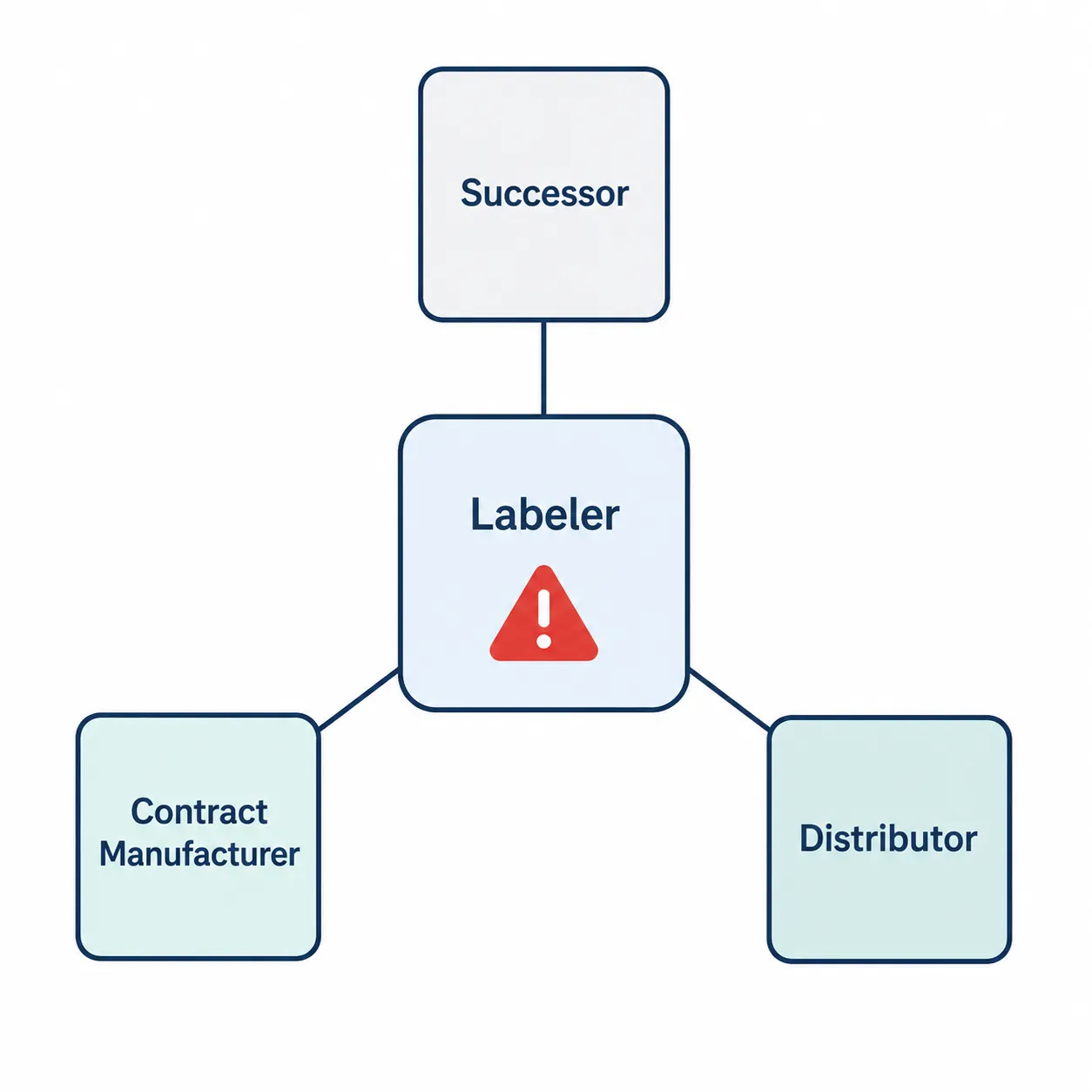
That is the part of this recall most likely to matter after the first client call or boardroom question. A labeler that has ceased operations may still be a proper party depending on corporate existence, insurance, indemnity, and transaction documents. A successor or product-line owner may or may not have assumed relevant liabilities. A distributor may have sale, storage, recall-notice, or traceability facts. A contract manufacturer, if one exists, may have batch, potency, testing, release, or quality-system records. None of those roles should be collapsed into a single named defendant before the documents are checked.
The public record reviewed for this entry does not identify a contract manufacturer for the recalled lot. It also does not publicly establish H2-Pharma’s manufacturing role, if any, in Lot 504950. Those are discovery or pre-suit investigation questions, not facts to plead as settled based only on the recall notice and website statement.
Possible defendant categories are not the same as named defendants
A careful legal action analysis can discuss categories of exposure now. It cannot honestly present filed Vitruvias recall claims as though they already exist. The practical defendant map currently looks like this:
- Vitruvias Therapeutics: the recalling labeler identified in the FDA and company notices. Any pleading analysis would start with corporate status, registered agent, insurance, assets, transaction history, and records custody.
- H2-Pharma LLC: a publicly referenced successor, owner, or distributor complication because Vitruvias states that products are now owned and/or distributed by H2-Pharma. The current public record does not by itself prove successor liability or a manufacturing role.
- Manufacturer or contract manufacturer: a potentially important category if batch production, testing, release, or stability work was performed by an entity other than the labeler. The identity and role are not confirmed in the public record summarized here.
- Wholesale distributors, pharmacies, or repackaging participants: possible fact witnesses or parties depending on chain-of-distribution law, notice timing, storage records, dispensing records, and state-law claims. Their relevance cannot be inferred merely from the existence of a nationwide recall.
- Prescribers and treating clinicians: more likely to be medical-causation witnesses than product defendants on the present record, absent separate facts about prescribing, monitoring, substitution, or post-recall advice.
For plaintiff intake, the first gate is product identification. For defense or in-house review, the first gate is document control: recall communications, lot-release records, quality testing, complaint files, pharmacovigilance records, transaction documents, distribution agreements, and insurance notice. The ceased-operations statement makes records custody and indemnity questions unusually early issues.
What prior desiccated-thyroid cases can and cannot tell us
The Acella NP Thyroid and RLC Labs records are useful benchmarks because they show how desiccated-thyroid potency issues can move from recall into litigation or regulatory escalation when the supporting record becomes more developed. They are not liability templates for Vitruvias.
FDA posted Acella NP Thyroid recall notices involving potency problems, and consumers later filed Vosburgh v. Acella Pharmaceuticals in the Middle District of Florida in October 2021.[7][8] Reported settlement coverage later described a $41.4 million class settlement involving NP Thyroid purchasers.[9] Those facts show that DTE recall litigation can mature when there is a larger record of recalled product, purchasers, alleged economic loss, and claimed therapeutic failure. They do not show that a class action exists against Vitruvias over Lot 504950.
RLC Labs is a different kind of benchmark. FDA’s October 9, 2020 warning letter to RLC Labs addressed unapproved thyroid products, and contemporaneous recall coverage reported 483 recalled lots and FDA sampling in which six of ten sampled products were subpotent, with some as low as 87% of labeled active ingredients.[10][11] That record had public regulatory escalation and broader lot coverage. The Vitruvias record, by contrast, is presently one lot, approximately 1,955 units sold, potential superpotency, and no confirmed recall-specific enforcement letter or docket.
Those prior matters still give counsel a sensible checklist for what to watch next: direct adverse-event evidence, pharmacy-level product identification, potency testing or stability data, complaint trends, prescriber communications, manufacturer identity, FDA inspection or warning-letter activity, and documents showing whether successor or distributor entities assumed duties connected to the recalled product.
Do not confuse the old Vitruvias docket with this recall
One docketed Vitruvias matter located in public docket databases is Dermpathe Pharmaceuticals LLC v. Vitruvias Therapeutics, LLC, filed in the Southern District of New York in 2016.[12] That case is not a 2026 thyroid recall lawsuit. It should not be used to suggest that the current recall has already produced litigation.
What can be said now
Counsel can say now that FDA published a nationwide recall notice for one Vitruvias Thyroid Tablets, USP 30 mg lot; that the recalled lot is Lot 504950, NDC 69680-166-00, expiring September 30, 2026; that 3,655 units were released and 1,955 were sold; that distribution ran from January 31, 2025 through September 30, 2025; that the stated reason was potential superpotency; that no adverse events had been reported to the company as of the announcement; and that patients were advised not to stop thyroid medication without provider guidance.[1][2]
Counsel can also say that defendant analysis should not stop at Vitruvias because the company’s public statement says it has ceased operations and that its products are now owned and/or distributed by H2-Pharma.[6] That fact supports investigation into successor, distribution, indemnity, insurance, and records-custody issues. It does not, without more, prove H2-Pharma liability.
Before pleading or advising on exposure, the missing pieces are concrete: product-use proof for a specific claimant, medical causation support, lab and symptom chronology, potency deviation evidence, lot-release and testing records, adverse-event file review, corporate transaction documents, manufacturing identity, and distribution-chain records. A later complaint, FDA Enforcement Report classification, warning letter, Form 483, inspection record, direct FAERS analysis, or confirmed settlement activity would change the posture. Until then, this is a live intake and exposure question, not a settled liability matter.
References
- Vitruvias Therapeutics Inc. Issues Nationwide Recall of One Lot Thyroid Tablets, USP 30 mg Due to Potential Superpotency — FDA — August 24, 2026 — link
- Vitruvias Therapeutics Inc. Issues Nationwide Recall of One Lot Thyroid Tablets, USP 30 mg Due to Potential Superpotency — Business Wire — August 21, 2026 — link
- THYROID tablet, setid b1085f7c-70b3-4850-89c0-5d2b3c6c46cf — DailyMed — link
- NDC 69680-166 Thyroid — NDC List — link
- FDA’s Actions to Address Unapproved Thyroid Medications — FDA — link
- Vitruvias Therapeutics — Vitruvias Therapeutics — link
- Acella Pharmaceuticals, LLC Issues Voluntary Nationwide Recall of Certain Lots of NP Thyroid — FDA — link
- Consumers Sue Acella Pharmaceuticals for Selling Defective Thyroid Medication — Law Street Media — October 2021 — link
- NP Thyroid class action settlement — Top Class Actions — link
- RLC Labs - 610728 - 10/09/2020 — FDA Warning Letter — October 9, 2020 — link
- Nature-Throid, WP Thyroid Recall Expanded Due to Subpotency Problems — AboutLawsuits — link
- Dermpathe Pharmaceuticals LLC v. Vitruvias Therapeutics, LLC — PacerMonitor — 2016 — link
Related records
Tool profile
How Meta's AI Spending Reshapes Law Firm ProfitabilityGoverning regulation
Browse the obligations tracker →Preventive workflow
Browse verification workflows →
Report a correction or tip
Spotted an outdated figure, a misstated fact, or a ruling this case record should reflect? Public comments are disabled for this content given the professional cost of a misreported case outcome, penalty amount, or rule text — use the structured correction channel instead.
Report a correction or tip for this record →