
Can you claim strike compensation from WestJet in Canada?
For passengers on strike-cancelled WestJet flights, the compensation answer is route-specific: on Canada-only itineraries, APPR s. 10(1)(j) treats the strike as outside the carrier's control, so no APPR cash compensation applies — yet refund, rebooking, and information duties still bind, and Montreal Convention and EU 261 claims arise on international and EU-departure routes. The record also covers the Moffatt v. Air Canada rule that an airline's AI chatbot compensation answers can be legally binding — a faster small-claims lever than the CTA backlog.
- Jurisdiction
- Canada (British Columbia)
- Court
- British Columbia Civil Resolution Tribunal
- AI tool named
- Air Canada AI chatbot
- Ruling date
- Feb 14, 2024
- Source document
- View primary court order ↗
- Last verified
- Aug 2, 2026
Lex Machina Review is an independent risk-tracking and reference resource. Nothing on this site is legal advice, and using it does not create an attorney-client relationship. Every record is reviewed against primary sources but may not reflect the most current status of a matter — always verify directly against the cited court order, rule text, or a licensed attorney before relying on it.
Companion explanation — secondary to the source document above
Start with the route, not the word “strike”
For a WestJet strike-cancelled flight wholly within Canada, the answer is narrow but important: the strike blocks APPR cash inconvenience compensation, because Canada’s Air Passenger Protection Regulations treat a labour disruption within the carrier as outside the carrier’s control under s. 10(1)(j).[1] That does not mean WestJet has no duties. Rebooking, refund, and passenger-information obligations remain live under the APPR framework when a flight is cancelled or delayed, including refund-to-original-payment rules where the carrier cannot complete the itinerary in the required way.[2][3]
That distinction is where many passenger-rights disputes go wrong. “No compensation” is accurate only if it means no APPR s. 19 cash inconvenience compensation for a Canada-only strike cancellation. It is inaccurate if it is used to dismiss a refund demand, a rebooking demand, a request for written reasons, or a claim on an international itinerary. This article is risk analysis, not legal advice; the practical first step is to classify the itinerary before accepting or rejecting any airline script.
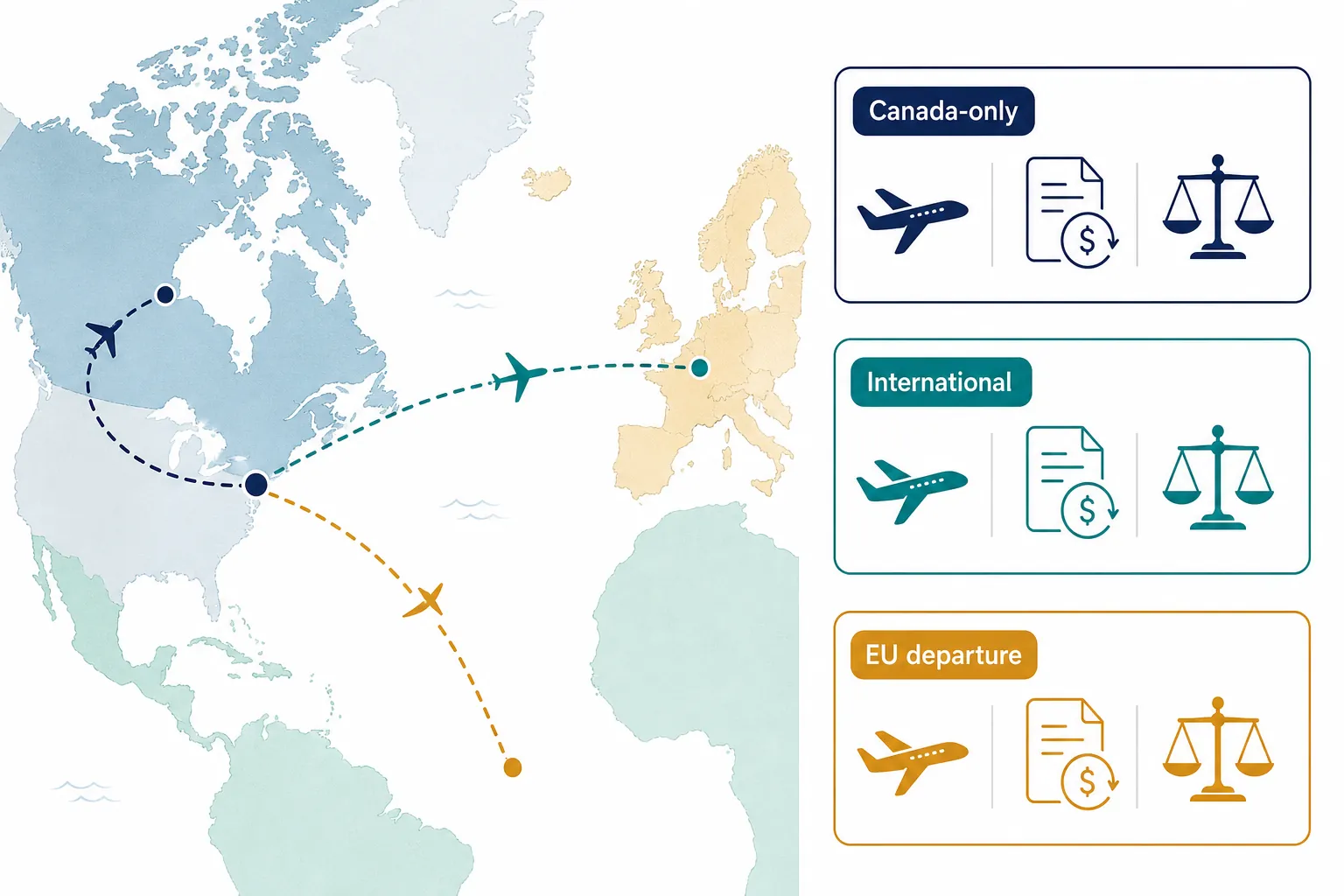
| Itinerary type | What the strike usually defeats | What may still matter |
|---|---|---|
| Canada-only WestJet itinerary | APPR cash inconvenience compensation for a cancellation caused by a carrier labour disruption outside WestJet’s control | Rebooking, refund, refund timing, method of refund, and required information to the passenger |
| International itinerary involving Canada | An automatic APPR-style cash payout is still not the right starting assumption | Montreal Convention delay damages may be available for provable loss, subject to the carrier’s defenses and liability limits |
| Flight departing the EU | The Canadian strike exception does not decide the EU 261 question | EU 261 compensation and care rules may apply, and strike analysis under EU law is different |
The August 2026 record is still moving
As of Aug. 2, 2026, the WestJet flight-attendant strike record should be treated as live rather than settled. CBC reported that the union representing WestJet flight attendants had served 72-hour strike notice on July 30, with a strike or lockout position possible at 12:01 a.m. MT on Aug. 2. CBC’s same-day cancellation figures moved from 198 cancelled flights as of Saturday afternoon to 276 cancelled flights by 3 p.m. MT, and the report described the bargaining unit as about 4,400 flight attendants.[4]

Those figures matter because volume creates pressure for scripted answers. Hundreds of cancellations can push passengers toward call-center queues, form emails, and chatbot flows. The legal risk is not only whether WestJet classifies the disruption correctly at headquarters; it is whether the passenger receives a route-specific answer at the point where they are deciding whether to buy replacement travel, accept a credit, wait for rebooking, or abandon the trip.
Canada-only flights: no APPR cash payout, but not “no rights”
For a domestic itinerary, APPR s. 10(1)(j) is the controlling starting point. It lists “a labour disruption within the carrier or within an essential service provider such as an airport or an air navigation service provider” as a situation outside the carrier’s control.[1] Once the cancellation is properly in that category, the APPR cash-compensation schedule for inconvenience does not apply in the way it would for a disruption within the carrier’s control and not required for safety.
But the APPR structure does not turn an outside-control event into a complete defense to every passenger demand. The Canadian Transportation Agency’s passenger guidance distinguishes between compensation and the carrier’s rebooking/refund obligations, and its WestJet strike guidance points affected passengers back to those continuing APPR duties.[2][3] The passenger who asks for the wrong thing — “strike compensation” as a cash inconvenience payment — may get a legally defensible refusal. The passenger who asks for the right thing — written reasons, rebooking, or a refund where the APPR refund trigger is met — is making a different claim.
The refund question also needs a clean separation between WestJet’s commercial flexibility policy and statutory cancellation rights. Reporting on WestJet’s strike-related passenger options described more flexible refund treatment for certain fare classes, including PremiumFlex and BusinessFlex, while other voluntary changes could be routed through Travel Bank credit rather than original-payment refunds.[6][7] That may be useful if a passenger is changing plans before a cancellation. It does not override the APPR analysis when WestJet cancels the flight and the regulation requires a refund.
What to demand on a domestic cancellation
- The cancellation notice and the stated reason for the disruption.
- The rebooking option WestJet is offering, including timing, routing, and whether it uses WestJet or another carrier.
- A refund to the original form of payment if the APPR refund conditions are met, rather than accepting a credit merely because a voluntary-change policy says so.
- Receipts for out-of-pocket expenses, while recognizing that a domestic APPR strike classification is not the same thing as an automatic expense-reimbursement entitlement.
International routes: Montreal Convention claims are not APPR inconvenience compensation
On an international itinerary, the legal question changes. The Montreal Convention is not a fixed “sorry for the disruption” payment regime. It is a damages regime. Article 19 concerns damage caused by delay in international carriage, and Article 26 prevents a carrier from contracting out of the Convention’s liability rules. Air Passenger Rights’ strike guidance frames the practical exposure at roughly CAD$12,000 in delay damages, subject to the Convention limit and the passenger proving loss.[5]
That makes the evidence file different. A missed domestic weekend trip may produce anger but no Convention claim if the itinerary is not international. A cancelled Canada–U.S. or Canada–overseas itinerary may raise Montreal Convention issues if the passenger can tie actual financial loss to delay and the carrier cannot establish the relevant defense. The claim is not made stronger by calling it “compensation”; it is made stronger by receipts, replacement-itinerary records, hotel invoices, prepaid-event losses, and a timeline showing why the loss flowed from the delay.
This is also where airline boilerplate can become too broad. A correct APPR statement — a labour disruption within the carrier is outside carrier control for Canadian cash-compensation purposes — does not answer the Montreal Convention question on an international itinerary. The regimes ask different questions and supply different remedies.
EU departures: do not import the Canadian strike exception
A WestJet passenger departing from an EU airport should not let APPR s. 10(1)(j) end the analysis. EU 261/2004 has its own structure, and Air Passenger Rights’ strike guidance points to EU-departure claims in the €300/€600 range, depending on route and timing, while noting that the Court of Justice of the European Union in C-195/17 did not treat the strike at issue as an “extraordinary circumstance” that automatically excused compensation.[5]
The route discipline matters in both directions. A WestJet flight departing Canada for Europe is not the same as a WestJet flight departing Europe for Canada. EU 261 analysis is particularly sensitive to departure point, operating carrier, distance, notice, rerouting, and arrival delay. A Canadian domestic strike answer copied into an EU-departure claim is not a legal analysis; it is a shortcut.
The chatbot answer is part of the evidence file

The most dangerous passenger-rights answer is not necessarily the one on a formal legal page. It may be the one a chatbot or scripted agent gives at the moment the passenger is deciding what to do. In Moffatt v. Air Canada, the British Columbia Civil Resolution Tribunal rejected Air Canada’s attempt to distance itself from misinformation supplied by its own chatbot and held the airline responsible for the representation made to the customer.[8]
That does not mean every chatbot sentence becomes a winning lawsuit. It means a concrete automated answer can become evidence of what the airline represented, what the passenger relied on, and whether the airline’s later position is consistent with its own customer-service system. For strike disruptions, that is a live risk because the correct answer depends on itinerary type, remedy type, and timing. “You are not eligible for compensation” may be defensible for one domestic APPR cash claim and misleading for an EU-departure claim or a refund request.
WestJet has already had a public chatbot failure in an unrelated context. CBC Calgary reported in September 2018 that WestJet’s “Juliet” chatbot gave a suicide-hotline response to a customer asking about a ticket.[9] That incident does not prove any present strike-related misstatement. It does show why airline automation should be treated as a controlled legal-risk surface rather than a harmless convenience layer.
Preserve the answer before it disappears
- Screenshot or export the full chatbot transcript, including timestamps if visible.
- Save the URL, app screen, or channel where the answer appeared.
- Keep the cancellation notice, booking confirmation, ticket receipt, itinerary, and fare rules.
- Record what you did after receiving the answer: bought a replacement ticket, accepted a credit, delayed travel, or cancelled the trip.
- Separate the remedy you requested: APPR cash compensation, APPR refund, rebooking, Montreal Convention damages, or EU 261 compensation.
The AI point is not that automation is legally suspect by default. The risk is narrower: automated compensation guidance often compresses several legal regimes into one customer-service answer. Moffatt makes that compression expensive when a passenger can show the airline’s system gave a specific answer and the passenger acted on it.
CTA complaints are one path, not the only path
The CTA complaint process is important, but delay changes enforcement strategy. CBC Go Public reported a backlog of about 92,500 air passenger complaints before the CTA.[10] CP24 reported on Feb. 3, 2026, that a new analysis found air passenger complaints were taking nearly three years to resolve.[11] For a passenger who needs reimbursement, a corrected refund, or damages tied to a concrete misrepresentation, that timeline can make a nominal right feel functionally stale.
A small-claims or tribunal path may be more practical where the dispute is fact-specific and evidence-driven: the itinerary, the governing regime, the cancellation notice, the chatbot or agent representation, the receipts, and the passenger’s reliance. That is the lesson to take from Moffatt, not a promise that every airline-bot error creates liability. The stronger case is usually the one that asks for a remedy the applicable regime actually provides.
There is a useful U.S.-law contrast here. In the site’s United Airlines system-failure evaluation, the absence of a general statutory cash-compensation regime does much of the work. Canada is different, but not in the simplistic way many passengers hope. Canadian law supplies APPR duties, EU law may supply fixed compensation on EU departures, and the Montreal Convention may supply damages on international carriage. Each route has to be pleaded on its own footing.
A workable demand starts with classification
For a strike-cancelled WestJet flight, the useful sequence is simple. First, identify the route: domestic Canada, international, or EU departure. Second, identify the legal source: APPR, Montreal Convention, or EU 261. Third, identify the remedy: cash inconvenience compensation, refund, rebooking, care, or provable damages. Fourth, preserve the evidence, especially any automated or agent statement that gave a concrete compensation answer.
On a Canada-only itinerary, APPR s. 10(1)(j) is a serious answer to a cash-compensation claim. It is not a universal answer to every passenger-rights demand. On international and EU-departure itineraries, the strike label does even less work by itself. Before filing anywhere, save the cancellation notice, the full transcript, the booking record, and the receipts; then compare the demand to the regime that actually governs the route.
References
- Air Passenger Protection Regulations (SOR/2019-150), section 10 — Justice Laws Website
- Flight delays and cancellations: rebooking, refunds and compensation — Canadian Transportation Agency
- Important information for WestJet customers — Canadian Transportation Agency
- WestJet cancels more flights as flight attendants prepare to strike — CBC News
- WestJet strike 2026: what are my rights — Air Passenger Rights
- WestJet strike: What are your passenger rights? — Global News
- With a strike possible, what are the WestJet refund rules? — Cabin Radio
- Moffatt v. Air Canada, 2024 BCCRT 149 — CanLII, 2024
- WestJet AI chatbot confusion suicide hotline — CBC Calgary, September 2018
- Airline complaints backlog CTA — CBC Go Public
- Air passenger complaints now taking nearly three years to resolve, new analysis finds — CP24, February 3, 2026
Related records
Tool profile
How Meta's AI Spending Reshapes Law Firm ProfitabilityGoverning regulation
Browse the obligations tracker →Preventive workflow
Browse verification workflows →
Report a correction or tip
Spotted an outdated figure, a misstated fact, or a ruling this case record should reflect? Public comments are disabled for this content given the professional cost of a misreported case outcome, penalty amount, or rule text — use the structured correction channel instead.
Report a correction or tip for this record →