
Refund rights for WestJet strike cancellations in Canada
APPR treats a strike as outside WestJet's control: passengers are owed rebooking within 48 hours and, if that fails, a refund — but no Section 19 cash compensation. The CTA's enforcement record shows recovery is not automatic, and self-cancelling first forfeits the claim.
- Jurisdiction
- Canada
- Court
- Canadian Transportation Agency
- AI tool named
- CTA AI drafting tool
- Ruling date
- Jul 29, 2026
- Source document
- View primary court order ↗
- Last verified
- Aug 2, 2026
Lex Machina Review is an independent risk-tracking and reference resource. Nothing on this site is legal advice, and using it does not create an attorney-client relationship. Every record is reviewed against primary sources but may not reflect the most current status of a matter — always verify directly against the cited court order, rule text, or a licensed attorney before relying on it.
Companion explanation — secondary to the source document above
Last verified: Aug. 2, 2026, UTC. For a passenger holding a WestJet ticket during the flight-attendant strike window, the first refund-rights question is not whether the airline has issued a sympathetic statement. It is whether WestJet has actually cancelled the flight or failed to rebook it as the APPR requires. Under Canadian Transportation Agency guidance modified July 29, 2026, a labour disruption is treated as outside the carrier’s control; that removes the APPR Section 19 cash-compensation claim for domestic strike cancellations, but it does not remove WestJet’s rebooking and refund duties under the outside-control rules.[1][2][3]
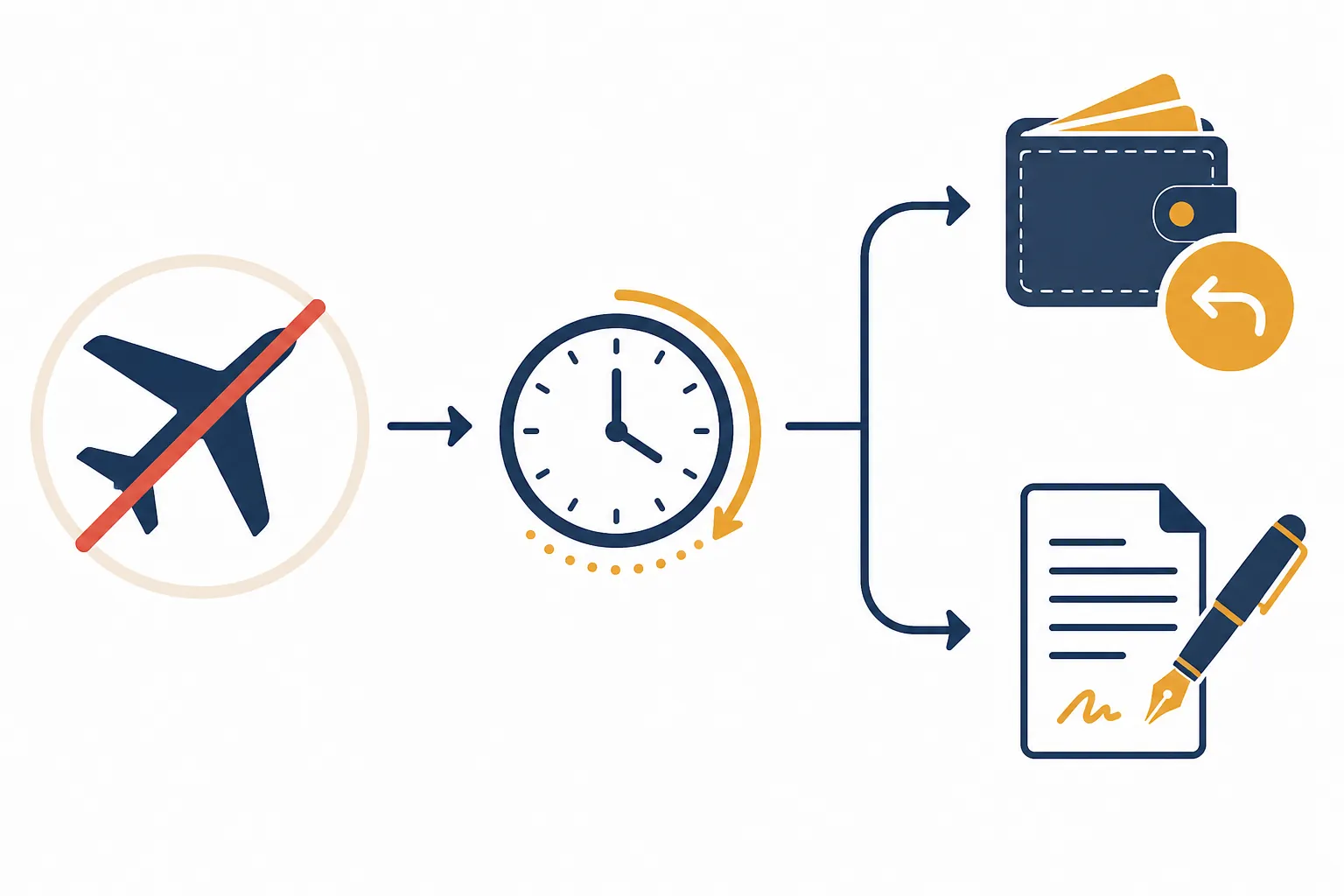
The practical answer is narrow. If WestJet cancels because of the strike, it must rebook the passenger on the next available flight within 48 hours. If it cannot provide that rebooking, the passenger may choose either a refund in the original form of payment within 30 days or alternate travel arrangements at no extra cost. A voucher or travel credit can replace that refund only if the passenger gives informed written consent.[2][3]

The mistake to avoid before WestJet acts
Self-cancelling can turn an APPR problem into a voluntary fare-rule problem. That distinction is not theoretical. In the Saavedra/Persad case reported during the Air Canada strike period, passengers who cancelled ahead of a potential strike lost about $1,500 after the airline had not yet cancelled their flight. The public warning from that case is blunt: if the passenger cancels first, APPR protections may be forfeited before they ever mature.[4]
That is the risk with “cancel now and rebook yourself” advice. It may be a sensible operational choice for someone who values certainty over recovery. It is not the same as preserving a statutory refund claim. Once the passenger voluntarily cancels, the airline can often process the request under the fare conditions or the temporary flexible policy rather than under the APPR cancellation framework.
| Passenger’s situation | Risk-sensitive instruction |
|---|---|
| WestJet has not cancelled the flight | Do not cancel if the goal is to preserve APPR rebooking and refund rights. |
| WestJet cancels and offers a rebooking within 48 hours | Assess whether the rebooking is usable; Section 19 cash compensation is not the domestic strike remedy. |
| WestJet cannot rebook within 48 hours | Ask for the APPR choice: refund in the original form of payment within 30 days, or alternate arrangements. |
| WestJet offers a voucher or travel credit | Treat it as optional only. It requires informed written consent to replace the refund right. |
The APPR chain: control, rebooking, then refund
The APPR analysis has to be kept in sequence. Coverage that jumps straight to “refund” often misses the first two questions: whether the disruption is within the airline’s control, and which rebooking rule follows from that classification.
A strike is treated as outside WestJet’s control
CTA guidance for airline labour disruptions says that labour disruptions are outside the carrier’s control. The APPR text also requires the carrier’s notice to state the reason for the delay or cancellation and lists labour disruption as an outside-control category. On that classification, the ordinary domestic strike cancellation does not trigger the Section 19 cash-compensation amounts of $400, $700, or $1,000.[1][2]
That does not mean there is no remedy. It means the remedy is rebooking first, then refund or alternate arrangements if rebooking fails. The word “compensation” should not be used as a synonym for refund here. A refund returns the fare paid. Section 19 compensation is a separate cash amount for certain within-control disruptions, and the CTA’s strike guidance does not put domestic strike cancellations in that lane.[1][2][3]
The rebooking clock is 48 hours, not 9 hours
The 9-hour standard belongs to a different APPR path: disruptions within the carrier’s control. For an outside-control labour disruption, the APPR rule to watch is the 48-hour rebooking obligation. WestJet must provide a confirmed reservation on the next available flight within 48 hours under the outside-control provisions.[2][3]
This is where imprecise advice can become expensive. A passenger told to buy a replacement ticket after 9 hours may be relying on the wrong rule for a strike cancellation. The stronger record is a demand for the outside-control rebooking that the APPR actually requires, followed by a clear note of when the 48-hour window expired.
The refund right matures only after failed rebooking
If WestJet cannot provide the required rebooking within 48 hours, the passenger gets a choice. The passenger may take a refund in the original form of payment, due within 30 days, or may choose free alternate travel arrangements. The airline cannot unilaterally convert that statutory refund into a voucher. A voucher or credit is valid as a substitute only with the passenger’s informed written consent.[2][3]
WestJet’s flexible policy is a different instrument
WestJet’s Aug. 2026 flexible policy matters because it may be the option passengers see first. Reports described a July 30–Aug. 4 flexible-policy window in which only PremiumFlex and BusinessFlex fares returned to the original form of payment, while other fare types generally received travel credit. That is not the same as an APPR refund after WestJet cancels and fails to rebook within 48 hours.[5]
The choice may still be rational. A passenger may need certainty and accept a credit. But the legal consequence should be named before the click is made: using a voluntary flexible-policy option can mean accepting the airline’s policy terms instead of waiting for the APPR cancellation remedy.
Insurance should also be separated from APPR rights. Travel Guard reportedly declared the WestJet dispute a “known event” on July 14, 2026, meaning policies bought after that point may exclude strike-related losses. That exclusion does not decide the APPR question, but it does affect whether a passenger can shift unrecovered costs to an insurer.[6]
The 2024 mechanics strike shows how the promise works at scale
WestJet’s 2024 mechanics strike is useful as an operational comparison, not as a new legal rule. During that disruption, reports counted 1,137 cancellations and more than 100,000 affected passengers. WestJet’s refund position was tied to the same sequence: refunds were promised where rebooking failed within 48 hours.[7]
That history matters because the statutory language can make the remedy sound automatic. At scale, passengers still had to wait for cancellations, review rebooking offers, and press the refund request when the 48-hour condition was not met.
Recovery is not automatic at the CTA

The enforcement record is part of the advice. A CBC analysis of 9,740 CTA rulings from Sept. 30, 2023, to June 30, 2024, found passengers won about 50% of the time. The same analysis reported that WestJet was involved in 30% of passenger-favourable rulings.[8]
Backlog figures have also moved over time. CBC reported a CTA backlog above 74,000 cases in 2024, while YYZ Law described a backlog exceeding 87,000 cases with roughly 18-month resolution times in 2026. Those numbers are date-dependent, but they point in the same direction: a valid claim may still require a long wait.[8][9]
The CTA complaints process is structured, but not informal in the way many passengers expect. Once a Start Notice is issued, the airline has 14 days to answer, the decision clock is described as 90 days from that Start Notice, and the resulting process can produce confidential binding decisions. The CTA also discloses that officers may use AI to draft summaries of evidence, which is another reason to keep the passenger’s own record clean, chronological, and easy to verify.[10]
There is also evidence that regulators do enforce refund and rebooking duties after strike-era failures. On Mar. 31, 2026, Air Canada was fined $426,000 for refund and rebooking failures connected to a strike period. That fine is not a guarantee of individual recovery against WestJet, but it is a useful reminder that the outside-control label does not erase the carrier’s APPR obligations.[11]
Arguments and overlays that should not be blended into the domestic answer
Preemptive cancellations before the strike begins
Air Passenger Rights has argued that some preemptive airline cancellations before a strike begins may be within the carrier’s control, potentially triggering Section 19 compensation up to $1,000. That is an advocacy position, not a settled CTA ruling supplied here. It should be preserved as an argument where the facts fit, not stated to passengers as the governing rule.[12]
The safer baseline for general WestJet strike advice remains the CTA’s published labour-disruption guidance: strike-related cancellations are treated as outside the carrier’s control, with the 48-hour rebooking and failed-rebooking refund path.[1][2][3]
International itineraries may add separate remedies
For international travel, the domestic APPR answer may not be the whole file. Montreal Convention Article 19 can support delay-damages claims for proven losses on international carriage, subject to a Special Drawing Rights cap. Air Passenger Rights has published an estimate of about CAD $10,000 per passenger, but that estimate should be checked against the current SDR conversion rate before publication or filing.[12]
EU, EEA, and UK-style passenger-rights regimes may also matter for covered departures. The Court of Justice of the European Union’s C-195/17 strike decision is the authority commonly cited for the proposition that certain airline labour actions do not automatically excuse compensation under EC 261/2004. That overlay belongs only on qualifying itineraries; it should not be folded into the domestic Canadian APPR strike answer.[13]
U.S. DOT refund rules are a separate legal regime and should not be used to state WestJet’s Canadian APPR obligations unless the itinerary independently brings U.S. law into the analysis.
Claim-preservation sequence for Aug. 2026 WestJet strike cancellations
- Do not self-cancel while WestJet has not cancelled the flight, unless the passenger knowingly prefers the fare-rule or flexible-policy outcome.
- If WestJet cancels, save the cancellation notice, the stated reason, the time received, and the original itinerary.
- Demand rebooking under the outside-control APPR rule and record the response. The key clock is the 48-hour rebooking window, not the 9-hour within-control standard.
- If WestJet cannot rebook within 48 hours, make the choice explicit: refund to the original form of payment within 30 days, or alternate arrangements at no extra cost.
- Do not treat a voucher, travel credit, or goodwill offer as equivalent to an APPR refund unless the passenger has given informed written consent.
- If buying replacement travel after failed rebooking, keep the rebooking demand, WestJet’s response or non-response, receipts, and a timeline. Passenger-advocate advice supports this sequence, but reimbursement still depends on the applicable legal route and proof.
- Before publication or client advice, recheck the live facts: cancellation counts, WestJet policy language, CTA guidance, insurance known-event dates, and any SDR-based Montreal Convention estimate.
The record to preserve is simple: wait for WestJet’s cancellation or failure to rebook, document the 48-hour rebooking demand, reject voucher substitution unless it is a deliberate written choice, and assume that a CTA complaint may be slow and uncertain even where the APPR rule is clear.
References
- Airline labour disruptions: what passengers should know, Canadian Transportation Agency, modified July 29, 2026.
- Air Passenger Protection Regulations (SOR/2019-150), Justice Laws Website.
- Flight Delays and Cancellations: A Guide, Canadian Transportation Agency.
- Report on the Saavedra/Persad self-cancellation case, CP24, July 31, 2026.
- Reports on WestJet Aug. 2026 flexible policy and strike timing, CBC News and National Post, July 30, 2026.
- Report on WestJet strike passenger rights and Travel Guard known-event declaration, Global News, July 31, 2026.
- Reports on WestJet 2024 mechanics strike cancellations and 48-hour rebooking/refund position, CBC News, June 2024, and Global News, July 2, 2024.
- CBC News analysis of CTA air passenger rulings, CBC News, August 2024.
- Air passenger complaint backlog and resolution timing discussion, YYZ Law, 2026.
- Air travel complaints resolution process, Canadian Transportation Agency.
- Report on Air Canada $426,000 fine for strike-era refund and rebooking failures, CTV News, March 31, 2026.
- Air Passenger Rights analysis of preemptive strike cancellations and Montreal Convention delay damages, Air Passenger Rights.
- Judgment of the Court in Case C-195/17, Court of Justice of the European Union.
Related records
Tool profile
How Meta's AI Spending Reshapes Law Firm ProfitabilityGoverning regulation
Browse the obligations tracker →Preventive workflow
Browse verification workflows →
Report a correction or tip
Spotted an outdated figure, a misstated fact, or a ruling this case record should reflect? Public comments are disabled for this content given the professional cost of a misreported case outcome, penalty amount, or rule text — use the structured correction channel instead.
Report a correction or tip for this record →