
Which grounds justify Wisconsin alcohol permit revocation?
Counsel analyzing a revocation must first identify which track applies: municipal retail licenses under Wis. Stat. § 125.12 or DOR-issued producer permits for breweries and warehouses. This tracker states the grounds and procedure for each, then maps the three stated grounds in Minocqua Brewing's 2026 revocation — and flags what remains reported versus confirmed.
- Jurisdiction
- US-Wisconsin
- Court
- Dane County Circuit Court
- AI tool named
- No AI tool implicated
- Ruling date
- Jul 28, 2026
- Source document
- View primary court order ↗
- Last verified
- Aug 3, 2026
Lex Machina Review is an independent risk-tracking and reference resource. Nothing on this site is legal advice, and using it does not create an attorney-client relationship. Every record is reviewed against primary sources but may not reflect the most current status of a matter — always verify directly against the cited court order, rule text, or a licensed attorney before relying on it.
Companion explanation — secondary to the source document above
The first sorting question is whether a Wisconsin alcohol “revocation” means a municipal retail license proceeding under Wis. Stat. § 125.12, or a state producer-permit action handled by the Department of Revenue. Those are not interchangeable tracks, and the legal grounds are not tested the same way.
This tracker was last checked against public materials on August 3, 2026. It is not legal advice. The formal DOR revocation decision in the Minocqua Brewing matter was not among the public materials reviewed here, so the Minocqua-specific grounds are treated as reported agency statements unless a cited primary document confirms the point. For the case chronology, keep this page paired with Why Wisconsin revoked Minocqua Brewing's license; this article is the statutory companion, not a second news record.

The track split controls the grounds
The word “license” does too much work in public reporting. A city or village retail alcohol license is one thing. A brewer’s permit, warehouse permit, or related state authorization is another. The first usually begins with a local complaint record. The second turns on whether the producer remains eligible to hold state-issued authority and whether permit conditions, tax obligations, and regulated-activity limits have been met.
| Question | Municipal retail-license track | DOR producer-permit track |
|---|---|---|
| Who issued the authority? | A municipality issues the retail license and uses the local § 125.12 discipline framework. | The Department of Revenue issues producer-related permits, including brewer and warehouse permissions. |
| What starts the revocation record? | For municipal license discipline, the useful file usually begins with a sworn written complaint, not a loose accusation or unsworn letter. Wisconsin practice materials identify § 125.12(2)(ag) as requiring a sworn written complaint before the local revocation process proceeds. [3] | For producer permits, the record turns on the DOR notice, the permit holder’s response or appeal, and the agency hearing path. |
| What grounds matter? | The municipal track uses enumerated grounds under § 125.12, with sanctions including forfeiture, suspension, and revocation. [1] | The producer-permit track focuses on whether the permit holder complied with the conditions of state-issued permits, tax obligations, and the limits on authorized activities. |
| What is the consequence of revocation? | After municipal revocation, § 125.12(3) imposes a six-month reapplication consequence. [2] | For a DOR producer-permit revocation, the immediate practical consequence is loss of the state operating authority covered by the permit; the appeal path described in the Minocqua matter runs through the DOR Secretary and a hearing examiner. [6] |
That table is not a clerical nicety. If the action is actually a DOR brewer’s-permit revocation, then a lawyer who builds the defense around a municipal sworn-complaint defect may be attacking a procedure that was never the operative procedure. If the action is a municipal license revocation, then the absence of a sworn complaint may be the first defect worth finding.
Municipal retail licenses: the complaint record has to be real
A municipal alcohol-license revocation under § 125.12 is a local discipline proceeding. The local governing body is not simply withdrawing a favor; it is acting under a statute that supplies the available sanctions and ties the action to statutory grounds. Section 125.12(1)(b) authorizes forfeiture, suspension, and revocation for covered violations. [1]
The sworn-complaint requirement is the part that should stop a file reviewer early. Wisconsin practice commentary describes § 125.12(2)(ag) as requiring a sworn written complaint in the license-revocation process, and it treats an unsworn complaint as a defect capable of defeating the proceeding. [3] That is the kind of procedural point that matters because it tells the municipality, the licensee, and a reviewing court what factual allegations were actually placed in issue.
The grounds themselves are not a free-form “public interest” inquiry. Wisconsin municipal guidance describes the revocation and nonrenewal grounds as including violations of Chapter 125, keeping or maintaining a disorderly or riotous house, and certain tax-nonpayment grounds. [7] The exact statutory text should be checked in the current Wisconsin Legislature version before a complaint, notice, or findings document is drafted.
The six-month reapplication consequence is also easy to miss when the story is described only as a lost license. Section 125.12(3) supplies the reapplication consequence after revocation. [2] For a business, that is not just a label change; it can determine whether the operator can quickly cure a defect and come back, or whether the revocation functions as a forced shutdown for a defined period.
A clean municipal file therefore needs more than a conclusion that the licensee behaved badly. It needs the sworn complaint, the statutory ground, notice, the hearing record, and findings that connect evidence to the ground selected. If the complaint alleges tax nonpayment, the record should show the tax obligation and nonpayment. If it alleges a Chapter 125 violation, the record should identify the provision and the conduct.
Producer permits: brewer, warehouse, tax, and permit-condition compliance
A brewery’s producer-side authority belongs on a different track. DOR materials for brewers’ permits describe the state permit framework for brewery operations, rather than a municipality’s retail-license discipline process. [5] Wisconsin law also contains a specific process for a brewer’s full-service retail outlet under § 125.295(2)(a)1., which matters when the alleged violation is not brewing beer as such, but operating a retail outlet without the required authority. [4]
The producer-permit analysis asks practical compliance questions. Was the beer being produced, stored, transferred, shipped, or sold under an authority that actually covered that activity? Was the location permitted for the role it was serving? Were excise or other alcohol-related tax obligations current? Were permit conditions followed? Those questions are more useful than asking whether the public controversy surrounding the business is sympathetic or distasteful.
The Minocqua reports also identify a state appeal path rather than a city-hall complaint path. The DOR statement carried in public reporting described an appeal going to the DOR Secretary, with a hearing examiner assigned to prepare proposed findings of fact and conclusions of law. [6] That matters because findings and conclusions are the hinge: tax arrears, unauthorized retail activity, or warehouse violations do not sustain a revocation merely because they are asserted in a press account. They have to survive the agency record.
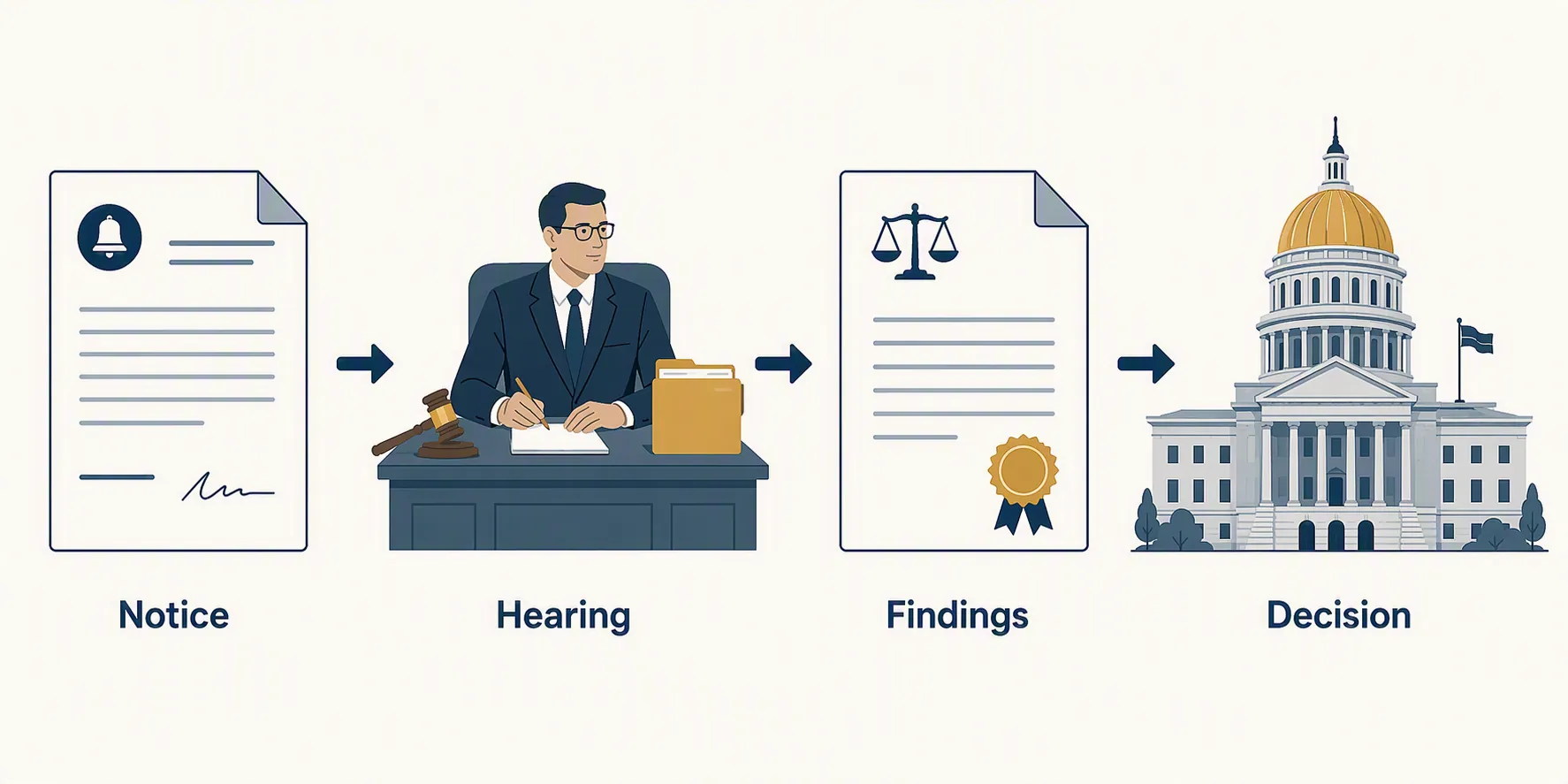
Mapping the Minocqua grounds
The reported Minocqua Brewing grounds fall on the producer-permit side of the split. Public reports describe three stated grounds: unauthorized retail outlet operation, shipping-law violations, and untaxed beer in an unpermitted warehouse. Those points appear in agency-attributed reporting, but the formal DOR revocation document was not available in the reviewed public record. [6][8][9]
| Reported ground | Where it fits legally | Evidence status in this tracker |
|---|---|---|
| Unauthorized retail outlet operation | This fits the producer-permit and retail-outlet authorization problem. If a brewer operated a full-service retail outlet without the required approval, the question is whether the activity exceeded the state authority held by the permittee. Section 125.295(2)(a)1. is the statutory entry point identified for brewer full-service retail outlet authorization. [4] | Treated as a reported DOR ground, not independently confirmed by the formal revocation document in the reviewed materials. [6][8][9] |
| Shipping-law violations | This belongs with regulated distribution and shipment limits. The legal question is which shipments occurred, under which permit authority, and whether the permit holder had the required authorization for those shipments. | Treated as a reported DOR ground. The public materials reviewed do not substitute for a shipment-by-shipment agency record. [8][9] |
| Untaxed beer in an unpermitted warehouse | This combines two producer-side issues: tax compliance and warehouse authorization. If beer was stored in a location that lacked the required permit, and taxes were unpaid when due, those facts may support state permit discipline if proved through the DOR process. | Treated as a reported DOR ground. The owner disputes the broader fairness and motivation of the enforcement posture. [8][9][11] |
This mapping does not decide the Minocqua appeal. It does identify the relevant lane. The strongest DOR theory, if the reported facts are documented, is not “the brewery is politically controversial.” It is that a permit holder allegedly operated outside retail, shipping, warehouse, or tax conditions attached to state alcohol authority.
The owner’s account belongs in the record, but in the right column. Kirk Bangstad has alleged, among other things, that the department refused an approximately $500 tax tender, delayed a warehouse permit for more than five months, relied on an inexperienced investigator, and acted for political reasons. Those are party allegations, not findings in this tracker. [11] They may become important if they are tied to documents, testimony, or procedural rulings. Until then, they do not erase a tax or warehouse violation if that violation is otherwise proved.
The June 2026 Dane County suit is relevant only to that procedural posture. WTMJ reported that Minocqua Brewing sued the Wisconsin DOR after a beer seizure, with the case filed in Dane County on June 12, 2026. [10] That lawsuit may explain why process objections are being pressed, but it does not itself establish whether the later producer-permit revocation grounds are true.
What still has to be verified
A durable revocation analysis still needs the primary agency record. News accounts can identify the issue; they cannot replace the notice, the cited permit conditions, the tax ledger, the warehouse records, and the hearing examiner’s findings.
- The exact authority revoked: brewer’s permit, warehouse permit, retail-outlet authorization, or some combination.
- The exact statutory and permit-condition citations used by DOR in the revocation notice.
- The tax record: what tax was due, when it was due, what was paid or tendered, and how DOR treated any attempted payment.
- The warehouse record: whether the location required a permit, whether an application was pending, and whether stored beer was legally authorized at that site.
- The retail and shipping record: what sales or shipments occurred, where they originated, and which permit authority, if any, covered them.
- The hearing record: proposed findings of fact, conclusions of law, and the Secretary’s final decision if the matter proceeds through the described DOR process.
Political-motive allegations should not be treated as either proven or irrelevant. They are separate from the first-order permit question. If the agency can prove tax arrears, unauthorized warehouse use, or activity outside the permits held, those facts may supply lawful grounds for a DOR producer-permit revocation. If the agency cannot document the stated grounds, or if the procedure fails in a way that matters to the permit holder’s rights, the public controversy around the brewery will not cure the defect.
References
- Wis. Stat. § 125.12(1)(b), Wisconsin Legislature.
- Wis. Stat. § 125.12(3), Wisconsin Legislature.
- WI Liquor License Revocation Fails Due to Unsworn Complaint, Gimbel, Reilly, Guerin & Brown.
- Wis. Stat. § 125.295(2)(a)1., Wisconsin Legislature.
- Pub 3111 Brewers Permits, Wisconsin Department of Revenue.
- Wisconsin’s anti-Trump brewery gets operation permit revoked, New York Post, July 28, 2026.
- Alcohol License Revocation / Non-renewal, Wisconsin Towns Association.
- State revokes brewing license for Kirk Bangstad, Wisconsin Public Radio.
- State seeks to revoke brewers’ permit for Minocqua Brewing Company, WXPR, July 28, 2026.
- Minocqua Brewing Company sues Wisconsin DOR after beer seizure, WTMJ, June 18, 2026.
- In an absurd act of heavy-handedness, Minocqua Brewing Company Times.
Related records
Tool profile
How Meta's AI Spending Reshapes Law Firm ProfitabilityGoverning regulation
Browse the obligations tracker →Preventive workflow
Browse verification workflows →
Report a correction or tip
Spotted an outdated figure, a misstated fact, or a ruling this case record should reflect? Public comments are disabled for this content given the professional cost of a misreported case outcome, penalty amount, or rule text — use the structured correction channel instead.
Report a correction or tip for this record →