
Did Wisconsin Revoke a Brewery Permit for Political Posts?
The Wisconsin DOR revoked Minocqua Brewing Company's permits citing alcohol transport and tax violations, not the owner's political posts. This record separates the confirmed agency grounds from the unproven First Amendment retaliation theory, with links to the controlling Seventh Circuit precedent and the pending appeal.
- Jurisdiction
- Wisconsin, U.S.
- Court
- Dane County Circuit Court
- AI tool named
- No AI tool implicated
- Ruling date
- Aug 4, 2026
- Source document
- View primary court order ↗
- Last verified
- Aug 3, 2026
Lex Machina Review is an independent risk-tracking and reference resource. Nothing on this site is legal advice, and using it does not create an attorney-client relationship. Every record is reviewed against primary sources but may not reflect the most current status of a matter — always verify directly against the cited court order, rule text, or a licensed attorney before relying on it.
Companion explanation — secondary to the source document above
Category: Risk Digest. Last verified: Aug. 3, 2026 UTC. This is a legal-record check, not legal advice.
For readers checking whether a Wisconsin brewery permit was revoked for political posts, the current record does not show that as a finding. The Wisconsin Department of Revenue’s stated grounds are alcohol-permit and excise-tax violations involving beer allegedly brewed in Illinois, then stored or sold in Wisconsin without the required permits and taxes. Owner Kirk Bangstad says the real reason is retaliation for anti-Trump political speech. As of this verification, that retaliation theory remains alleged, not proven by a court or agency.
Source status matters here. I have not located a DOR-published revocation letter in a public administrative-record URL. The revocation notice and DOR position are being treated through reported confirmations by news organizations, including USA Today and the Milwaukee Journal Sentinel, and through screenshots or descriptions reproduced in coverage. Those reports say DOR issued a notice revoking two brewer’s permits and one Alcohol Beverage Warehouse permit, with an effective date of Aug. 4, 2026. [1][2]
| Point | Current status |
|---|---|
| Agency action | Reported and confirmed in news coverage: DOR issued a revocation notice for two brewer’s permits and one Alcohol Beverage Warehouse permit, effective Aug. 4, 2026. [1][2] |
| Agency grounds | DOR’s stated grounds are alcohol transport, storage or sale, and excise-tax violations, not political posts. [1][2] |
| Owner’s theory | Bangstad alleges First Amendment retaliation. No located court or agency ruling has adopted that theory for the 2026 revocation. |
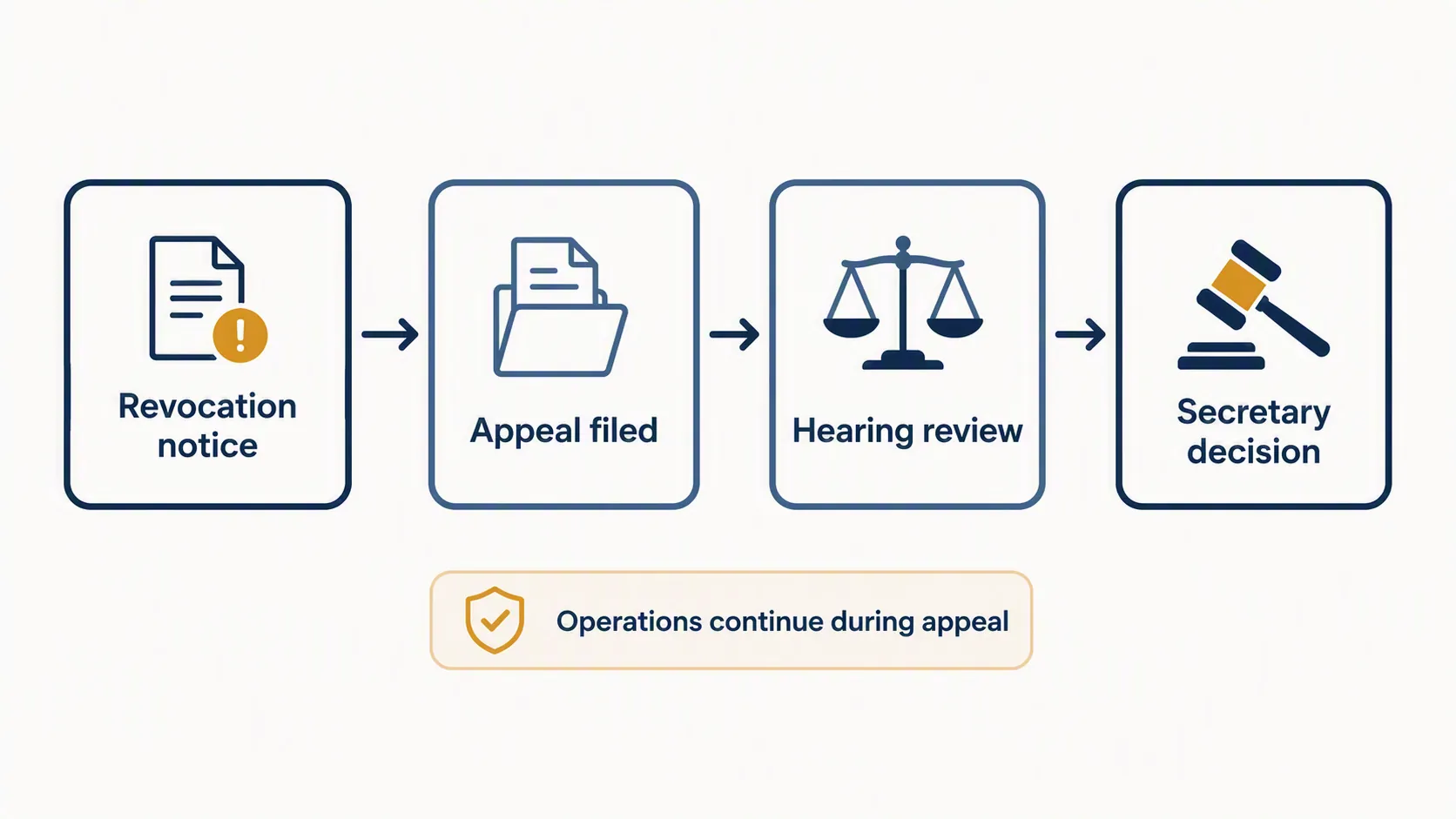
| Operations during appeal | DOR has been reported as saying the brewery may continue operating while an appeal is pending, with the appeal going to the DOR Secretary and then to a hearing examiner for proposed findings and conclusions. [3] |
What the revocation record currently shows
The procedural sequence is more useful than the viral shorthand. On June 11 and 12, 2026, DOR agents seized approximately 1,200 cans of beer valued at about $25,000. DOR described the inspection as being “pursuant to an application before the division” after months of compliance discussions that followed a complaint received the prior year. [4]
In late July, news reports said DOR had issued a revocation notice for Minocqua Brewing Company’s permits. The reported effective date is Aug. 4, 2026. The permits identified in coverage are two brewer’s permits and one Alcohol Beverage Warehouse permit. [1][2]
The revocation is not described by DOR as punishment for Facebook posts, campaign activity, or political criticism. It is described as enforcement over beer allegedly transported, stored, or sold in Wisconsin after being brewed in Illinois, without the required Wisconsin alcohol permits and excise-tax compliance. [1][2]
That does not make DOR’s explanation immune from challenge. It only identifies the present evidentiary posture. An agency denial of political motivation is a litigating position and a source statement; it is not the same thing as a judicial finding. The same is true in the other direction: a brewery owner’s claim that enforcement is retaliatory is an allegation until the administrative or court record supports it.
The appeal lane is still open
The reported appeal path is administrative first. DOR has been reported as saying the brewery can continue operating while an appeal is pending. The appeal goes to the DOR Secretary, who assigns a hearing examiner to develop proposed findings and conclusions. [3]
That matters because an effective date on a revocation notice is not the same thing as the end of the case. The administrative record may still develop on what DOR inspected, what permits were in place, what tax was due, what notices were given, and whether the same action would have been taken against a similarly situated permit holder without Bangstad’s political profile.
There is also parallel court litigation. Minocqua Brewing sued DOR in Dane County Circuit Court in June 2026, arguing that the agency gave the brewery no practical way to pay roughly $500 in outstanding excise taxes before seizing product. That dollar figure is the brewery’s position as reported in the suit coverage; it should not be read as an independently adjudicated tax amount. [5]
Why the earlier Seventh Circuit case is central
The 2026 revocation is not being assessed on a blank slate. In November 2025, the Seventh Circuit decided an earlier First Amendment retaliation dispute involving the same brewery. The court recognized that Minocqua Brewing had engaged in protected speech and had suffered adverse permit actions, but it held that the brewery failed, at the preliminary-injunction stage, to show likely success on causation because the permit denials and revocations “were based on the plaintiffs’ repeated and admitted violations of permit conditions, not on their speech.” [6]
That holding does not decide the 2026 revocation. It does, however, make the causation problem unavoidable. A First Amendment retaliation plaintiff generally must show protected expression, adverse government action, and causation—that retaliation was a motivating factor. If that showing is made, the government may still prevail by showing it would have taken the same action anyway. That is the Mt. Healthy burden-shifting framework described in federal retaliation doctrine. [7]
For this brewery, the hard question is not whether political speech exists. It plainly does. Nor is the hard question whether permit revocation is adverse. It is. The contested question is whether the speech caused the enforcement action, or whether DOR can show the same action would have followed from permit and tax violations regardless of viewpoint.
Alcohol regulation does not erase First Amendment protections. The Supreme Court has made clear in the Twenty-First Amendment context that state alcohol authority does not qualify the constitutional prohibition against laws abridging freedom of speech. [8] But that principle does not turn every alcohol-permit action against a political speaker into a speech case. The record still has to connect the adverse action to the protected expression.
What belongs in the political-post column, and what does not
The public attention is not mysterious. Bangstad is known for anti-Trump political messaging, and recent coverage has emphasized the brewery’s “free beer when Trump dies” framing. That context explains why the revocation spread as a national political story. It does not, by itself, establish why DOR acted. [1]
Bangstad’s own account adds more allegations: less than $500 in alleged missed excise taxes, more than 80 complaints, a special agent sworn in on Jan. 12, 2025, roughly $100,000 in legal bills per fight, and about $2 million in revenue. Those details are useful for understanding the owner’s narrative of disproportionate enforcement, but they are owner-attributed and have not been independently verified in the materials reviewed for this record. [9]
The same caution applies to reports of a voluntary FBI or Secret Service interview in May 2026. No charges are reported in the sources reviewed here. A voluntary interview may be part of the surrounding political atmosphere, but it is not evidence that DOR’s alcohol-permit revocation was legally retaliatory.
The current legal answer
On the record available as of Aug. 3, 2026 UTC, the legally careful answer is narrow: Wisconsin DOR revoked Minocqua Brewing Company’s permits on stated alcohol-permit and excise-tax grounds. The claim that the permits were revoked because of Bangstad’s political posts is a live allegation, not a finding.
The next record changes, if any, should come from the administrative appeal and the Dane County Circuit Court case. The documents that would matter most are the revocation notice itself, the inspection record, any tax assessments or payment correspondence, the hearing examiner’s proposed findings, and any ruling addressing causation rather than political atmosphere.
For a shorter earlier site record on the same controversy, see Why Wisconsin revoked Minocqua Brewing’s license. For the statutory and procedural companion, see Which grounds justify Wisconsin alcohol permit revocation?.
References
- Brewery that offered free beer when Trump dies loses permit, USA Today, July 29, 2026
- Minocqua Brewing Company permit revoked by state, Bangstad says, Milwaukee Journal Sentinel, July 27, 2026
- Wisconsin’s anti-Trump brewery gets operation permit revoked, New York Post, July 28, 2026
- Officials seize Minocqua Brewing’s canned beer amid investigation, USA Today, June 12, 2026
- Bangstad’s Minocqua Brewing Company sues over beer seizure, WisPolitics, 2026
- Minocqua Brewing Company LLC v. Hess, Justia, Nov. 26, 2025
- First Amendment Retaliation Claims: Recent Supreme Court Developments, Congressional Research Service
- State Power over Alcohol and First Amendment Free Speech and Religion Clauses, Cornell Legal Information Institute
- In an absurd act of heavy-handedness, Minocqua Brewing Company Times
Related records
Tool profile
How Meta's AI Spending Reshapes Law Firm ProfitabilityGoverning regulation
Browse the obligations tracker →Preventive workflow
Browse verification workflows →
Report a correction or tip
Spotted an outdated figure, a misstated fact, or a ruling this case record should reflect? Public comments are disabled for this content given the professional cost of a misreported case outcome, penalty amount, or rule text — use the structured correction channel instead.
Report a correction or tip for this record →