
What the AI stock bear market means for legal tech buyers
The 2026 AI stock bear market hit legal tech unevenly, splitting vendors into three risk cohorts with distinct continuity and pricing exposure. This vendor-risk map shows buyers what to verify before procurement or renewal: funding runway, consolidation status, and each tool's documented reliability record.
- Tool
- Harvey
- Benchmark source
- Artificial Lawyer (Legal Complex)
- Hallucination rate
- Not measured / undisclosed
- Test methodology
- Vendor-risk review of funding and market reports; no accuracy benchmark
- Test date
- Aug 1, 2026
For legal tech buyers in Q3 2026, the useful question is not whether an AI stocks bear market means “legal AI is unsafe.” It does not. The useful question is narrower and more contractual: does the selloff expose a vendor to pricing changes, roadmap delays, acquisition churn, support degradation, or abandonment risk before the next renewal?
That puts market data inside tool evaluations, not investment advice. A falling share price does not prove a research tool hallucinates. A large funding round does not prove an eDiscovery assistant is dependable. But stock repricing, capital concentration, and stalled seed financing can all become procurement facts when a tool is embedded in research, intake, drafting, review, or discovery workflows.
The 2026 evidence points to three legal-tech vendor cohorts, each with a different diligence file.
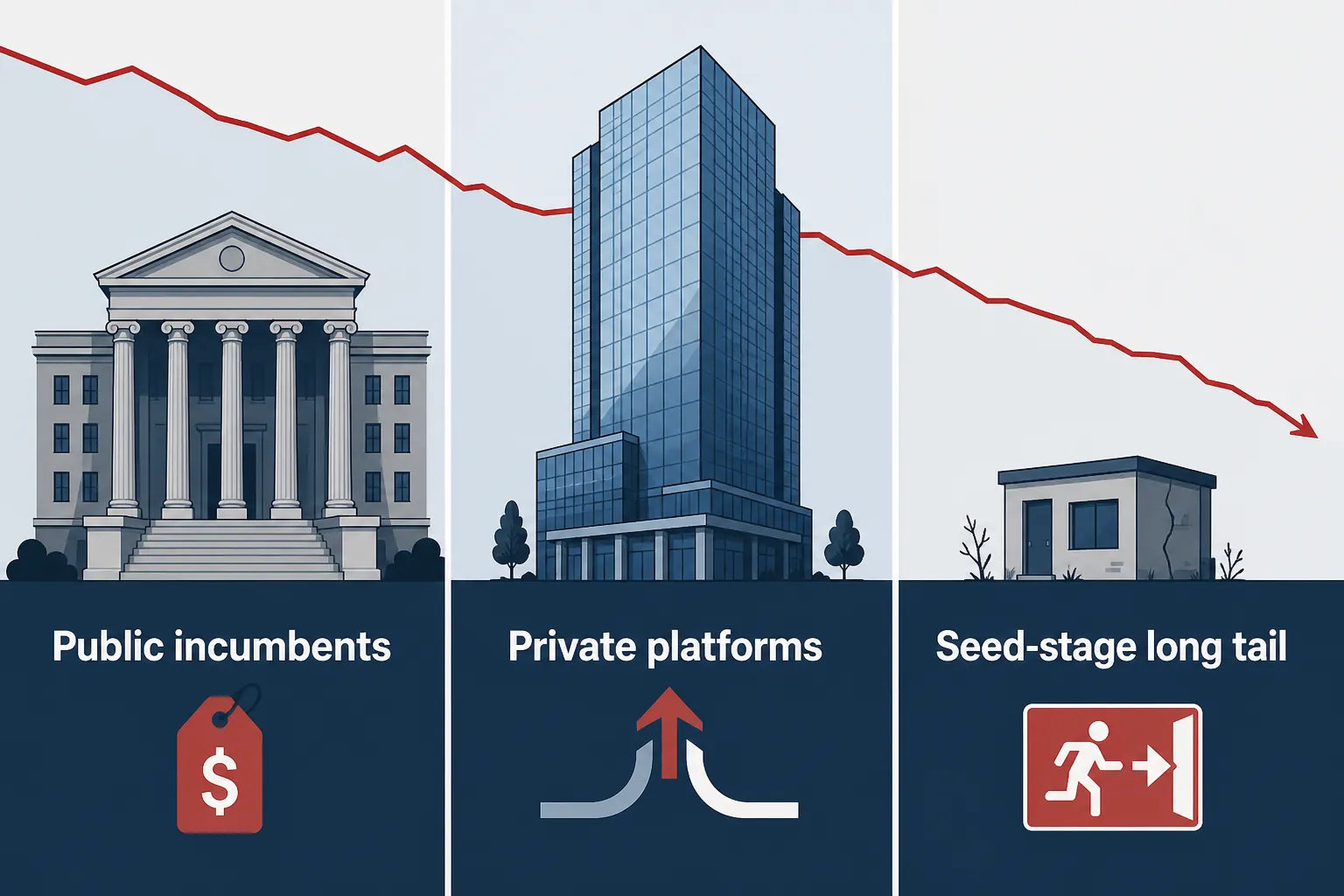
| Vendor cohort | What changed in the 2026 market | Buyer-facing risk | What to verify before procurement or renewal |
|---|---|---|---|
| Public legal-data incumbents: Thomson Reuters, RELX, Wolters Kluwer, LSEG, Pearson, LegalZoom | The early-February “Claude Crash” repriced legal-data and software incumbents. Reuters reported Thomson Reuters down nearly 16%, while The Guardian’s same-day account put the fall closer to 18%; RELX fell about 14%, and Wolters Kluwer fell up to about 13%. Reuters also reported roughly $830B wiped from software and services stocks over six sessions after Jan. 28, 2026, with the S&P 500 software index about 26% below its Oct. 2025 peak. [1][2] | These are not fragile startups. The risk is margin and roadmap pressure: AI features can be repackaged, premium tiers can move, credits can change, and product teams may prioritize defensive AI releases over buyer-requested improvements. | AI module pricing, usage caps, renewal uplift language, product-roadmap commitments, parent-company AI exposure, support SLAs, and documented reliability records for the specific tool class. |
| Hyper-funded private platforms: Relativity, Harvey, Legora and similar scale-up platforms | Legal Complex, reported by Artificial Lawyer, counted about $2.34B raised in Q1 2026, with roughly 63% going to three companies: Relativity’s $720M debt facility, Harvey’s $200M round, and Legora’s $550M Series D. The same account put the median round at about $1M. [3] | Capital is concentrating around fewer platforms. That can make some vendors more durable, but it also gives them leverage to alter terms, bundle features, acquire adjacent tools, or redirect roadmap priorities after buyers have already standardized around them. | Funding source and round recency, debt versus equity exposure, acquisition history, change-of-control clauses, data portability, integration lock-in, and whether reliability records match the buyer’s actual use case. |
| Seed-stage long tail: niche tools and workflow-specific legal AI vendors | Legal Complex data cited by Artificial Lawyer counted 979 companies that raised seed funding in 2023–2025 and had not raised since. [3] | This is the highest continuity-risk cohort. The tool may be clever, useful, and deeply embedded in a narrow workflow, but a stalled financing path can show up as slower support, frozen development, quiet pivots, acqui-hire exits, or shutdown risk. | Runway evidence, customer-reference recency, escrow or export options, fallback workflow, contractual notice periods, support staffing, and an exit plan if the vendor stops improving. |
Public incumbents: solid vendors can still change the contract economics
The public-incumbent cohort is where stock-market headlines are most likely to mislead procurement teams. Thomson Reuters, RELX, Wolters Kluwer, and similar legal-data businesses did not become operationally weak because investors sold software stocks in February. Their installed bases, content assets, sales organizations, and renewal machinery remain substantial.
The procurement issue is not solvency. It is repricing pressure. Reuters described the February selloff as a broad software-and-services drawdown after Anthropic’s legal AI launch, reporting about $830B erased over six sessions after Jan. 28, 2026. It also placed the S&P 500 software index about 26% below its Oct. 2025 peak. [1] The Guardian’s account of the same shock emphasized the legal-data names directly, including RELX’s roughly 14% one-day fall, described as its steepest one-day drop since 1988. [2]
Those figures should not be used as a proxy for product accuracy. They do belong in a renewal memo when an incumbent is selling AI as an add-on to research, analytics, drafting, or workflow systems. A business under market pressure may protect margin by moving generative features into higher-priced tiers, reducing promotional credits, changing seat definitions, tightening API usage, or bundling AI into packages that make apples-to-apples renewal comparisons harder.
Roadmap scrutiny matters for the same reason. A public incumbent facing an AI-disruption narrative has incentives to ship visible AI capability quickly. That may benefit buyers if the vendor has strong content rights, security controls, and support depth. It may also mean that requested improvements to existing workflows lose priority to new AI-facing product surfaces. Renewal committees should ask which roadmap commitments are contractual, which are sales representations, and which are simply direction-of-travel statements.
This is also where parent-company exposure is easy to overread. A metric such as the share of a parent company’s earnings tied to legal may be useful for investor exposure analysis if sourced directly from a primary or reliable market report. It is not a tool-accuracy metric. It says nothing by itself about whether a case-law answer is grounded, whether citations are verified, or whether a drafting assistant preserves privilege boundaries.
For buyers, the safer file separates two questions: financial pressure and product reliability. Financial pressure belongs beside pricing schedules, renewal mechanics, roadmap dependencies, and support commitments. Product reliability belongs beside hallucination records, sanction incidents, benchmark results, and human-review controls. The site’s related analysis of the Nvidia stock drop and legal AI funding exposure takes the same approach: market stress is a vendor-continuity signal, not a substitute for reliability testing.
Private platforms: concentrated capital can reduce failure risk and increase buyer lock-in
The private-platform cohort looks different. The headline is not a uniform funding freeze. It is concentration.
Legal Complex, as reported by Artificial Lawyer, counted about $2.34B in legal tech funding in Q1 2026 across 103 deals. Roughly 63% of that amount went to three companies: Relativity, Harvey, and Legora. The same tracker put the median round at about $1M, which is the number that matters when a buyer is evaluating the market beneath the largest platforms. [3]
Those tracker numbers should stay attached to their tracker. Legaltech Hub used a different scope and reported Q1 2026 legal tech funding of about $1.42B across 35 rounds, not the $2.34B and 103-deal Legal Complex count. [4] Law360 Pulse, looking at the first half of 2026, reported legal tech funding up about 12% year over year to roughly $4.01B while deal count fell. [5] These are not interchangeable figures. Blending them would create a false precision that is useless in a procurement file.
The buyer risk in this cohort is not simply that a vendor runs out of money. Some platforms may become more durable precisely because capital has concentrated around them. A well-funded discovery, litigation, or legal-workflow platform may have more time to absorb infrastructure costs, hire security staff, pursue enterprise certifications, and wait out weaker competitors.
The tradeoff is leverage. Once a platform becomes the default layer for review, knowledge work, intake, or matter workflows, the vendor can change packaging with less fear that customers will walk immediately. Consolidation can also alter the product a buyer originally selected: acquired tools may be folded into a suite, sunsetted, repriced, or redirected toward a larger platform roadmap. Litera’s 2026 discussion of legal tech consolidation framed platforms and trust as central market themes, which is the right procurement lens for this cohort. [6]
The term sheet deserves as much attention as the demo. Buyers should review assignment clauses, change-of-control rights, data-export obligations, API continuity, usage-credit mechanics, and notice periods for feature retirement. If the platform is becoming a system of record or a workflow dependency, the risk memo should say what happens if the vendor acquires a competing tool, is acquired itself, or shifts the purchased functionality into a higher enterprise tier.
Funding concentration also affects negotiation timing. A platform that has just raised a large round may be expanding aggressively, which can make enterprise references and implementation capacity attractive. It may also be moving toward standardized commercial terms, tighter packaging, and higher minimum commitments. The practical question is not whether the round is “good” or “bad.” It is what buyer protections survive if the vendor’s go-to-market motion changes during the subscription.
The seed-stage long tail is where continuity risk becomes operational
The seed-stage long tail is the easiest cohort to underestimate because its tools often solve a specific irritation better than a platform suite does. A small vendor may automate a clause-review handoff, support a niche investigation workflow, triage a plaintiff intake category, or summarize a specialized document set. That usefulness is exactly why continuity risk matters.
Legal Complex data cited by Artificial Lawyer counted 979 companies that raised seed rounds in 2023, 2024, or 2025 and had not raised again by the Q1 2026 analysis. [3] That number should not be read as 979 imminent failures. It should be read as a large watchlist of companies whose next financing, acquisition, pivot, or shutdown may matter to customers already building workflows around them.
Crunchbase News adds another narrowing point: disclosed legal AI capital has been heavily weighted toward plaintiff-side names, reporting that about 71% of disclosed legal AI capital sat in plaintiff-side companies and listing EvenUp at $370M, Eve at $164M, Supio at $85M, and Darrow at $63M. [7] That does not mean defense-side or generalist legal AI tools cannot be strong products. It does mean buyers should avoid assuming that “legal AI is well funded” applies evenly across the market.
The seed-stage diligence file should be blunt. When was the last round? How many enterprise customers are live, not merely announced? Who supports the product if the founding engineer leaves? Can the buyer export prompts, matter metadata, embeddings, review decisions, audit logs, or templates in a usable form? Is there a manual fallback that the practice group can operate within a week if access degrades?
A niche tool does not need to look like a public company to be safe enough for a limited use case. It does need a scope that matches its fragility. A pilot used by three lawyers for non-client administrative summarization carries a different continuity consequence from a tool embedded in client-facing intake, deadline-sensitive eDiscovery, litigation-risk scoring, or privileged knowledge management.
Market stress is not the same thing as hallucination risk
The AI stocks bear market can sharpen vendor diligence, but it should not become a shortcut for tool reliability analysis. A well-capitalized platform can still produce unsupported legal claims. A small vendor can still maintain careful retrieval controls in a narrow domain. A public incumbent can still sell an AI feature whose contractual disclaimers leave the legal team carrying the review burden.
That distinction matters because different failures land in different places. Financial fragility lands in procurement, IT continuity, and contract management. Hallucination and citation failures land in professional responsibility, court filings, client advice, and supervision. They should meet in the same evaluation packet, but they should not be collapsed into the same score.
A buyer comparing tools should therefore pair the cohort map with documented reliability evidence: sanction records, hallucination incidents, benchmark disclosures, retrieval design, citation-verification workflow, human-in-the-loop controls, audit logs, and escalation procedures. The relevant Risk Digest records and Verification Workflows belong beside the funding and ownership review, not after it.
Infrastructure stress belongs in that same continuity file when the product depends heavily on external compute, model access, or specialized hardware. The site’s analyses of the SK Hynix earnings miss as a legal AI due-diligence signal, negative free cash flow at Alphabet, and AXTI substrate shortages are adjacent to this question: they do not prove a legal AI vendor will fail, but they show why compute dependency now belongs in the procurement file.
What to verify before signing or renewing
The verification sequence should start with the vendor cohort, then move to the specific workflow. A research add-on from a public incumbent, an AI review layer inside a private discovery platform, and a seed-stage intake tool should not receive the same questionnaire.
- Funding runway and round recency: ask for the date and type of the last financing event, whether capital was debt or equity, and whether the vendor will represent that it has sufficient operating runway to support the contract term. Do not invent a universal “safe” runway threshold; the sources do not support one.
- Parent-company exposure: for public incumbents, review whether AI disruption is likely to affect the legal segment’s pricing, packaging, or roadmap. Keep investor-exposure metrics separate from tool-accuracy evidence.
- Pricing and packaging history: compare the current proposal with prior seat definitions, AI-credit rules, overage charges, API pricing, model-access limits, and bundled modules. Repricing pressure usually appears in the order form before it appears in a product outage.
- Consolidation status: identify recent acquisitions, pending integrations, discontinued products, and change-of-control terms. If the buyer depends on a feature from an acquired company, require a written continuity commitment.
- Roadmap dependency: separate must-have features from nice-to-have roadmap promises. If a workflow depends on a promised connector, jurisdictional expansion, admin control, or citation-verification feature, put the delivery obligation in the contract or downgrade the dependency.
- Reliability record: review documented hallucination incidents, court-sanction records, benchmark results, retrieval design, citation display, audit logs, and human-review controls for the specific tool class. Market capitalization and funding totals cannot answer those questions.
- Exit and fallback: require usable export rights, transition assistance, notice periods for shutdown or material feature retirement, and an internal fallback workflow. This is most urgent for seed-stage tools embedded in daily work.
The point is not to avoid legal AI or to pick the market’s eventual winners. The 2026 AI stocks bear market changes the diligence file. Public incumbents need pricing and roadmap scrutiny. Concentrated private platforms need consolidation, lock-in, and term-change scrutiny. Seed-stage tools need continuity, support, and exit-plan scrutiny. All three still need the same separate question answered with evidence: whether the tool performs reliably enough for the legal work it is being asked to touch.
References
- Selloff wipes out nearly $1 trillion from software and services stocks... — Reuters
- Anthropic's launch of AI legal tool hits shares in European data companies — The Guardian
- Legal Tech Raised $2.3B in Q1 '26, But 3 Companies Dominate — Artificial Lawyer
- Legal Tech Funding: 2026 Is on Track to Outpace 2025 — Legaltech Hub
- Legal Tech Funding Climbs In 2026 Despite Fewer Deals — Law360 Pulse
- The Legal Tech Market: Consolidation, Platforms, and Trust — Litera
- Investors Have Poured Billions Into Plaintiff-Side Legal AI... — Crunchbase News
Chronological incident history
No sanction cases have named this tool in the tracked record set to date. This does not imply the tool is safe — see Risk Digest for ongoing monitoring.
← Compare peer toolsReport a correction or tip
Spotted an outdated figure, a misstated fact, or a ruling this tool profile should reflect? Public comments are disabled for this content given the professional cost of a misreported case outcome, penalty amount, or rule text — use the structured correction channel instead.
Report a correction or tip for this record →