
What NVIDIA's earnings say about legal AI vendor durability
Read NVIDIA's earnings cycle as a vendor-durability signal for legal AI procurement, not a stock event: enterprise AI demand, the inference-cost squeeze behind vendors' own-model shifts, and the $500B compute-financing buildout convert into compute-economics checks buyers can run before the next RFP. The report illuminates vendor risk without deciding it, so the procurement questions it generates matter more than the headline.
- Tool
- Harvey AI
- Benchmark source
- Bloomberg Law
- Hallucination rate
- Not measured / undisclosed
- Test methodology
- Synthesis of NVIDIA earnings and vendor model-layer reporting; no hallucination benchmark
- Test date
- Aug 26, 2026
The useful legal-tech question in NVIDIA’s earnings cycle is not whether the stock liked the quarter. It is whether the report changes the diligence a law firm, legal department, or legal ops team should run before committing to an AI platform whose cost base depends on large-scale inference.
Last verified: Aug. 26, 2026, before NVIDIA’s scheduled after-market Q2 FY27 report. The Q2 figures below are consensus estimates, not actuals, and should be replaced once NVIDIA publishes the release. The last reported actual quarter was Q1 FY27: NVIDIA reported $81.6 billion in revenue, $75.2 billion in Data Center revenue, GAAP EPS of $2.39, and about 90% of total revenue coming from Data Center, with total revenue up 85% year over year and Data Center up 92% year over year.[1] For Q2 FY27, consensus before the report was around $92 billion in revenue, $2.09 in adjusted EPS, and more than $85.4 billion in Data Center revenue.[2]
That is enough financial context for a procurement reader. The Data Center number matters because it is the line where enterprise AI demand, AI cloud expansion, and inference infrastructure show up most directly. The EPS beat or miss may move a screen in a trading desk. For legal AI buyers, the more durable question is narrower: if the cost of delivering AI answers is still being shaped by scarce compute, frontier-model tolls, and financing structures, what protections need to be inside the RFP and contract?
What the earnings report can and cannot tell legal AI buyers
NVIDIA’s earnings do not tell you whether a legal AI vendor’s contract review tool will perform well on your playbooks. They do not prove that Harvey, Thomson Reuters, LexisNexis, vLex, Spellbook, or any other vendor is durable. They also do not establish that any vendor will raise prices next quarter.
They do, however, show the condition of the infrastructure layer beneath many legal AI products. When Data Center revenue keeps expanding, the signal is that cloud providers, AI labs, enterprises, and AI infrastructure buyers are still ordering the capacity needed to train and serve models. When margins and demand are watched this closely, buyers should assume compute economics are not a background detail. They are part of vendor durability.
| Item | What is known now | How a legal AI buyer should read it |
|---|---|---|
| Q1 FY27 actuals | $81.6B total revenue; $75.2B Data Center revenue; GAAP EPS $2.39; Data Center roughly 90% of revenue.[1] | The infrastructure layer for AI remained the dominant revenue engine in the last actual quarter. |
| Q2 FY27 consensus before release | Approximately $92B revenue, $2.09 adjusted EPS, and more than $85.4B Data Center revenue expected.[2] | Useful as a market expectation, not as an actual result. Replace after NVIDIA reports. |
| Data Center mix | The legally relevant read is not just total Data Center, but the demand color around hyperscale and ACIE. | Hyperscale speaks to the largest cloud platforms; ACIE is more useful for reading enterprise and AI cloud demand. |
| Legal AI implication | Not directly reported by NVIDIA. | A procurement inference: strong infrastructure demand can keep attention on inference cost, capacity commitments, and vendor model-routing strategy. |
That last row is the important boundary. No NVIDIA release says that a legal AI vendor will change its pricing model or swap models in response to a margin line. The connection from NVIDIA’s report to legal AI contract risk is analysis. It is still useful analysis, because the same cost pressures that appear at infrastructure scale tend to reappear later as usage minimums, token overages, seat bundles, model-routing disclosures, and subprocessor exhibits.
The three earnings-linked signals that belong in the RFP
For legal AI procurement, the NVIDIA earnings cycle is most useful when reduced to three signals: enterprise demand, the inference-cost squeeze behind owned-model strategies, and the financing buildout that keeps compute available. Each one converts into a different diligence check.
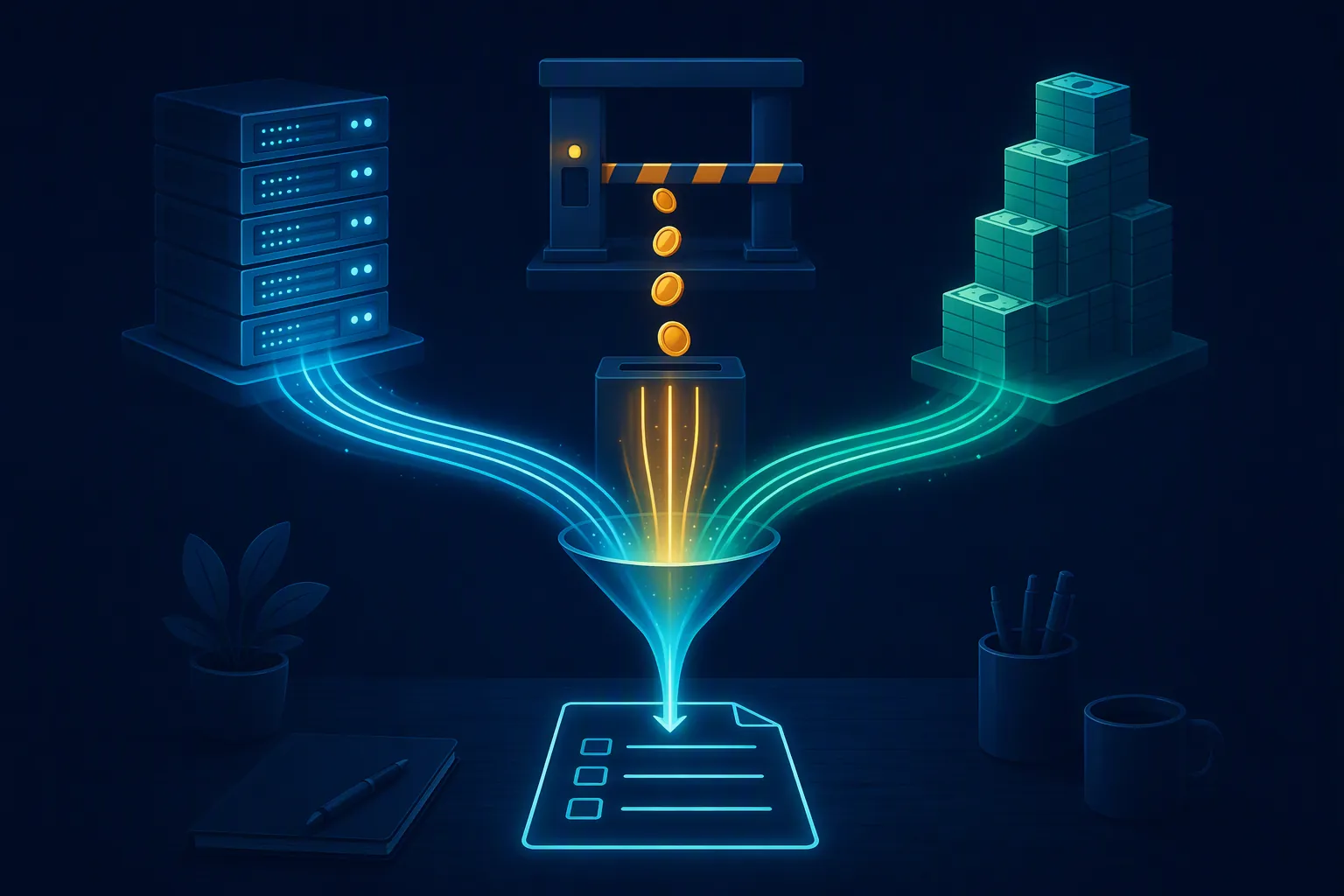
| Signal | What to watch | Procurement check |
|---|---|---|
| Enterprise AI demand | Data Center performance, including hyperscale and ACIE demand commentary. | Ask whether the vendor’s service depends on a single frontier model, a single cloud region, or a fixed capacity commitment. |
| Inference-cost squeeze | Vendor movement from pure frontier-model calls toward owned models, routers, and specialized model layers. | Ask who owns or routes the model, how inference is metered, and whether pricing protections survive model changes. |
| Compute-financing buildout | Large pools of capital being mobilized to finance AI compute infrastructure. | Ask what happens if cheap capacity assumptions change during the contract term. |
Enterprise demand: the Data Center line is a capacity signal, not a vendor ranking
Legal buyers should resist the lazy version of the argument: NVIDIA Data Center revenue is high, therefore legal AI vendors are safe. The better reading is that Data Center performance helps show whether the infrastructure market is still absorbing the capital and hardware needed to serve AI workloads at scale.
That matters because legal AI products are rarely sold as raw compute. They are sold as contract analysis, legal research, diligence review, intake triage, deposition preparation, clause extraction, or knowledge search. The buyer sees the workflow. The vendor sees the inference bill behind every query, upload, rerun, redline, citation check, and agentic task.
In an RFP, this should lead to capacity and dependency questions rather than broad market predictions:
- Which model providers and cloud providers are required to deliver the service as contracted?
- Does the vendor reserve or commit to capacity, or does it buy inference on demand?
- Are customer workloads routed differently by task type, jurisdiction, document sensitivity, or latency requirement?
- If the vendor loses access to a preferred model or region, what contractual notice, substitution, and service-level rights does the customer receive?
- Are usage floors, fair-use caps, overage rates, or throttling rights tied to the vendor’s compute costs?
This is where existing legal AI pricing work becomes more practical than a headline earnings recap. If a vendor’s commercial model is moving toward metered credits, annual usage pools, or seat minimums, buyers should model total cost under real usage patterns, not just compare per-seat numbers. The deeper pricing mechanics are covered in our analysis of server demand and legal-tech pricing and the cloud-cost guide for legal AI TCO modeling.
The model-ownership shift is where infrastructure economics reaches the contract
The most procurement-relevant signal is not that legal AI vendors are adding more features. It is that some are changing the model layer beneath those features.
Bloomberg Law reported that legal-tech AI firms are shifting away from reliance on Anthropic and OpenAI, including Harvey’s custom model Tenet, reportedly built on open-source Kimi K3, and Thomson Reuters’ Thomson model. Advisers quoted in that coverage expected own-model routing to help vendor profitability.[3] MarketScale described the same direction as vendors building their own models to reduce inference bills and platform dependence.[4]

For buyers, this is not automatically bad news. A well-designed owned model or routing layer can reduce dependence on frontier-model tolls, improve latency, lower serving costs, and allow more task-specific controls. In legal work, smaller or specialized models may be perfectly sensible for classification, extraction, summarization, privilege review support, or internal knowledge retrieval, provided the vendor is candid about where they are used and how performance is tested.
The problem is when “we own more of the stack” is sold only as a capability improvement. It is also a risk transfer. Brenda Leong, director of ZwillGen’s AI Division, warned that running own models shifts security and maintenance obligations from the frontier lab to the vendor.[3][4] That matters in legal procurement because a model change is not just an engineering substitution. It can change the subprocessor chain, security responsibility, evaluation burden, contractual warranties, and incident-response path.
Harvey’s cost framing makes the pressure visible. CEO Winston Weinberg was quoted as saying, “I just spent $1 billion on tokens. Where’s my ROI?”[5] The figure should not be treated as audited vendor financials. Its procurement value is the question it raises: if token consumption becomes infrastructure-scale spending, where does the vendor recover that cost?
Sometimes the answer will be obvious: higher usage minimums, stricter overage charges, a move from unlimited pilots to metered production tiers, or larger annual commitments. Sometimes it will be less visible: a cheaper default model for routine tasks, a proprietary routing layer, or a contractual right to modify the model stack without treating the change as material.
This is the diligence area that deserves the most time in the next legal AI RFP. Buyers should not simply ask which frontier model powers the demo. They should ask what happens after the demo architecture changes.
- Model inventory: Identify every model class used in production: frontier API, vendor-owned model, open-source model, fine-tuned model, retrieval layer, reranker, classifier, evaluator, or agent-planning component.
- Routing rules: Require a plain-language explanation of when the system routes work to different models and whether routing varies by task, customer tier, jurisdiction, document type, or sensitivity label.
- Change notice: Define which model substitutions require notice, which require approval, and which trigger a right to retest, suspend use, or terminate.
- Performance continuity: Require benchmark evidence or customer-specific validation before a lower-cost model becomes the default for high-risk work.
- Security ownership: State who is responsible for model security, vulnerability management, logging, access control, abuse monitoring, and remediation after a move away from a frontier provider.
- Data handling: Confirm whether prompts, documents, embeddings, metadata, and feedback are processed or retained differently when routed to owned models.
- Pricing protection: Make clear whether fixed fees, included usage, and overage caps survive a model swap or routing-policy change.
For buyers already evaluating Harvey specifically, the right follow-up is not to assume Tenet is either safer or riskier than a frontier-model dependency. It is to inspect the architecture, security allocation, and contract rights. The vendor-specific background is in our Harvey model-ownership analysis and the broader Harvey platform profile.
The $500B financing buildout is a capacity story with contract consequences
The third signal is financing. NVIDIA announced partnerships with Apollo, BlackRock, Blackstone, Brookfield, Goldman Sachs, and KKR to establish AI compute infrastructure financing platforms intended to mobilize more than $500 billion of third-party capital.[6] That is not a legal-tech announcement. But it is highly relevant to legal-tech economics because it treats compute infrastructure as an investable asset class rather than a normal vendor operating expense.
If that financing keeps capacity expanding, legal AI vendors may have more room to package inference into predictable enterprise contracts. If the financing assumptions weaken, the pressure may reappear as usage restrictions, narrower included workloads, longer minimum terms, or more aggressive pass-through language. That is an inference, not a sourced causal finding. The point is to test whether the vendor’s commercial promise assumes cheap and abundant inference throughout the contract term.
This is also the place to separate the current earnings-cycle question from the circular-financing risk around specific AI infrastructure deals. For deeper background on that separate vector, see the NVIDIA-OpenAI financing-risk record. The procurement action here is simpler: do not sign a legal AI agreement without understanding whether the vendor can keep serving your expected workload if compute prices, capacity access, or model-provider terms change.
Separate sourced facts from procurement inference
A clean diligence memo should not blur what NVIDIA reported, what analysts expected, what vendors disclosed, and what the buyer is inferring. The distinctions matter because partners and GCs will rely on them differently.
| Claim type | Example | How to use it |
|---|---|---|
| Reported actual | NVIDIA’s Q1 FY27 revenue, Data Center revenue, and GAAP EPS.[1] | Use as confirmed infrastructure-market context. |
| Consensus estimate | Q2 FY27 revenue, adjusted EPS, and Data Center expectations before the report.[2] | Use only as pre-release context; replace with actuals. |
| Vendor strategy reporting | Harvey and Thomson Reuters moving toward owned or proprietary model layers.[3][4] | Use to frame architecture and contract questions. |
| Vendor cost framing | Harvey’s token-cost quote.[5] | Use as a signal of cost pressure, not audited economics. |
| Procurement inference | Compute costs may reappear as overages, minimums, routing changes, or pricing protections. | Use as a diligence hypothesis to verify in the RFP. |
The inference step is where buyers add value. A vendor does not need to disclose its full margin structure for the customer to ask whether the contract protects the customer if the vendor changes the model stack, moves workloads to a cheaper model, or imposes usage controls after deployment.
The contract terms that should move after this earnings cycle
The NVIDIA earnings report should not cause a buyer to rewrite every AI clause. It should sharpen the clauses that already determine who bears compute-economics risk.
- Pricing schedule: Define included usage in operational terms, not just seats. For example: document pages, matters, uploads, searches, redlines, agent runs, or tokens, depending on how the product is actually used.
- Overage mechanics: Require advance notice before overages accrue, a right to throttle or approve excess usage, and a cap or rate card that cannot be changed unilaterally during the term.
- Model-change clause: Treat certain model substitutions as material changes when they affect security, accuracy, latency, data processing, regulatory posture, or customer validation.
- Subprocessor exhibit: Require the exhibit to distinguish cloud infrastructure, frontier-model providers, vendor-owned model hosting, analytics, logging, and support tools. A model swap should not silently become a subprocessor change after the fact.
- Evaluation rights: Preserve the customer’s right to rerun acceptance testing or matter-specific validation after a major model or routing change.
- Security commitments: Assign responsibility for model monitoring, patching, vulnerability response, access controls, logging, and incident notice when the vendor operates its own model layer.
- Service continuity: Ask what alternative model, region, or provider the vendor will use if its preferred compute or model provider becomes unavailable, more expensive, or contractually restricted.
- Renewal protection: Prevent a first-year enterprise deal from becoming a disguised pilot by locking renewal uplift limits, usage baselines, and migration assistance before the vendor has embedded itself in workflows.
None of these questions requires a buyer to predict NVIDIA’s margins. They require the vendor to explain whether its legal AI service is economically stable under the usage pattern the customer is actually buying.
A disciplined read of the report
The earnings cycle invites a stock-market answer. For legal AI procurement, the better answer is contractual. NVIDIA’s report can illuminate the infrastructure conditions underneath vendor durability, especially Data Center demand, inference economics, and compute financing. It cannot decide which legal AI vendors will last.
Before the next RFP, buyers should add the compute-economics checks: model ownership, routing, metering, overages, subprocessor changes, security responsibility after a model swap, and pricing protections that survive architecture changes. That is the usable legal-tech impact of the earnings cycle.
References
- NVIDIA Announces Financial Results for First Quarter Fiscal 2027, NVIDIA, May 20, 2026.
- NVIDIA Corporation (NVDA) Analyst Estimates, Yahoo Finance, Aug. 25, 2026.
- Legal Tech AI Firms Shift Away From Anthropic, OpenAI Reliance, Bloomberg Law, Aug. 19, 2026.
- Legal AI Vendors Are Building Their Own Models to Cut Inference Bills and Reduce Platform Dependence, MarketScale, Aug. 22, 2026.
- Harvey AI’s 12x Token Surge Reveals That Legal AI Has Crossed From Experiment to Infrastructure, Startup Fortune, Jun. 19, 2026.
- NVIDIA Partners With Apollo, BlackRock, Blackstone, Brookfield, Goldman Sachs and KKR to Establish AI Compute Infrastructure Financing Platforms to Mobilize Over $500 Billion of Third-Party Capital, NVIDIA, Aug. 10, 2026.
Chronological incident history
No sanction cases have named this tool in the tracked record set to date. This does not imply the tool is safe — see Risk Digest for ongoing monitoring.
← Compare peer toolsReport a correction or tip
Spotted an outdated figure, a misstated fact, or a ruling this tool profile should reflect? Public comments are disabled for this content given the professional cost of a misreported case outcome, penalty amount, or rule text — use the structured correction channel instead.
Report a correction or tip for this record →