
2026 AI Court-Filing Rules Every Attorney Must Know
A jurisdiction-by-jurisdiction guide to the four most consequential 2026 AI court-filing developments in New York, Florida, California, and federal courts, with direct links to official text and a compliance framework.
- Hallucination rate
- Not measured / undisclosed
The first mistake in checking court rules on ai for attorneys is looking for “the AI rule.” There is no single federal court-filing rule for generative AI, and even within federal courts the answer can turn on the individual judge’s standing order. As of Q3 2026, the practical filing question is narrower and more useful: which court, which judge, what document, what certification language, and what official text applies today?
| Jurisdiction | Status in Q3 2026 | Effective date or posture | Core obligation | Disclosure requirement | Source to check |
|---|---|---|---|---|---|
| New York state courts | Operative statewide rule: Part 161 | Effective June 1, 2026 | AI use is permitted, but attorneys and self-represented litigants must independently verify legal accuracy, including citations and legal authority, consistent with existing duties under 22 NYCRR 130-1.1 and Rule 3.3. | No general mandatory AI disclosure under Part 161; individual judges may require certification by order. | nycourts.gov/rules/part-161-use-artificial-intelligence-technology [1]; NYSBA effective-date analysis [2] |
| Florida state courts | Operative statewide filing certification rule: Rule 2.515(d)(2) | Effective June 15, 2026, at 12:01 a.m. | The signer of any court document certifies that all cited legal authorities exist and are accurately cited. | The statewide rule is framed as a signer certification, not a general AI-use disclosure rule; it preempts prior circuit-level AI disclosure orders. | Jones Day analysis of the Florida Supreme Court amendment [3] |
| California | Proposed professional conduct amendments; not adopted as of Q3 2026 | Approved for public comment March 13, 2026; 45-day comment period closed May 4, 2026 | Proposed amendments would address AI across Rules 1.1, 1.4, 1.6, 3.3, 5.1, and 5.3. | Not an operative court-filing disclosure rule as of Q3 2026. | calbar.ca.gov public comment page [4] |
| Federal courts | No single federal rule; judge-specific standing orders and local directives | Moving landscape; March 2026 secondary reporting identified 300+ AI-related court directives across federal and state courts | Federal approaches generally fall into mandatory disclosure-and-certification orders, rare prohibitions, and responsibility-based Rule 11-style orders. | Depends on the judge and order; do not assume a district-wide rule unless the district has actually adopted one. | Hintyr March 2026 tracker discussion [5]; Husch Blackwell framework [6]; Gentry Locke/Bloomberg Law examples [7] |
The table is intentionally blunt. New York and Florida now have statewide rules that change filing practice. California is important, but still proposed. Federal practice remains a standing-order search problem. Treating those four entries as the same kind of “AI compliance” requirement is how lawyers end up signing under the wrong assumption.
New York: AI Is Permitted, But Verification Is Not Optional
New York’s Part 161 is easy to misread if every AI rule is expected to require disclosure. It does not impose a blanket obligation to tell the court that AI was used. The official rule instead permits use of AI technology while requiring the person submitting work to verify that the filing does not contain fabricated citations, inaccurate legal authority, or other material that would violate existing duties of candor and non-frivolous filing practice [1].
That distinction matters in day-to-day drafting. A New York lawyer using a research, summarization, or drafting tool should not stop at asking whether the tool was used. The filing check should ask whether every cited case, statute, regulation, quotation, and procedural assertion has been independently verified outside the AI output. Part 161 points back to familiar obligations, including 22 NYCRR 130-1.1 and Rule 3.3, rather than creating a freestanding AI-disclosure regime [1].
The effective date is not a footnote. NYSBA’s discussion identifies June 1, 2026, as the effective date and describes the rule’s scope across the New York State Unified Court System [2]. For filings after that date, a firm’s internal review should assume that “we used AI but did not disclose it” is not automatically the issue. The issue is whether the attorney can stand behind the filing’s legal accuracy.
Part 161 also leaves room for judicial discretion. Individual judges may adopt a model rule requiring certification [1]. That means the statewide rule is the starting point, not the end of the search. Before filing, counsel still needs to check the assigned judge’s rules, part rules, chambers practices, and any case-specific order.
Florida: The Signature Now Carries an AI-Era Citation Certification
Florida takes a different route. Rule 2.515(d)(2), effective June 15, 2026, at 12:01 a.m., makes the act of signing any court document carry a certification that all cited legal authorities exist and are accurately cited [3]. The rule is not limited to briefs generated by a particular tool. It attaches to the signed court document.
That makes the Florida rule operationally simple and unforgiving. If a motion cites a case, the signer is certifying that the case exists and is accurately cited. If a memorandum quotes authority, the signer is certifying the accuracy of that legal authority. The rule reaches the consequence that courts were trying to prevent—nonexistent or inaccurate authority—without requiring the court to first determine exactly how the error entered the document.
Jones Day’s June 2026 analysis also reports that the Florida Supreme Court amendment preempts existing circuit-level AI disclosure orders [3]. That preemption point is important for anyone maintaining a filing checklist. A stale checklist built around a local circuit disclosure order may now point the signer to the wrong obligation.
The same analysis identifies potential sanctions that include reprimand, contempt, striking filings, dismissal, costs, and attorney’s fees [3]. The immediate compliance task is not to debate whether a particular tool counts as generative AI. It is to build a citation-verification step before signature, because the signature is where the rule lands.
The New York-Florida Contrast Is the Point
New York and Florida are both responding to AI-assisted filing risk, but they do not ask the same thing from the lawyer. New York permits AI use without general mandatory disclosure and centers the lawyer’s independent verification duty. Florida centers a statewide signature certification that all cited legal authorities exist and are accurately cited.
| Filing question | New York Part 161 | Florida Rule 2.515(d)(2) |
|---|---|---|
| Must AI use generally be disclosed? | No, not under Part 161’s statewide baseline; check whether the judge has added a certification requirement. | The statewide rule is not framed as general AI-use disclosure. |
| What is the core filing duty? | Independently verify accuracy and avoid fabricated or inaccurate legal authority. | By signing, certify that all cited legal authorities exist and are accurately cited. |
| Where should the checklist focus? | Verification of cited and quoted authority, plus judge-specific rules. | Pre-signature citation verification for every court document. |
| What stale assumption creates risk? | Assuming AI use must always be disclosed statewide. | Assuming old circuit-level AI disclosure orders still control. |
For a multi-state practice, those differences should appear in the workflow itself. A single “AI disclosure required?” checkbox is too crude. New York needs a verification-and-judge-order check. Florida needs a signer-certification check attached to every court document.
California: Watch the Proposed Rules Without Treating Them as Adopted
California belongs in any 2026 AI-for-attorneys filing discussion, but not because it has an operative AI court-filing rule comparable to New York or Florida. The State Bar of California’s public comment page describes proposed amendments to Rules 1.1, 1.4, 1.6, 3.3, 5.1, and 5.3 related to AI. The proposal was approved for public comment on March 13, 2026, and the 45-day public comment period closed May 4, 2026 [4].
As of Q3 2026, the amendments are proposed, not adopted. That status should travel with every summary of the California development. A firm may decide to align internal AI governance with the proposal because it touches competence, communication, confidentiality, candor, supervisory duties, and nonlawyer assistance. That is a risk-management choice, not the same thing as an operative filing rule.
The proposal is still worth monitoring because of its breadth. If adopted, the amendments would address AI across multiple professional conduct rules rather than only through a filing certification. But until adoption, a California filing checklist should separate three items: current court rules and standing orders, current professional conduct duties, and proposed AI amendments that may shape future obligations.
Federal Courts: Judge-Specific Orders, Not a Federal AI Rule
Federal practice is where the search problem becomes most obvious. There is no Federal Rule of Civil Procedure amendment that supplies one national AI filing standard. Instead, judges and courts have issued standing orders and local directives. Hintyr’s March 2026 discussion, citing Ropes & Gray and Bloomberg Law trackers, described more than 300 AI-related court directives across federal and state courts, but that count is a snapshot, not a stable number for Q3 2026 [5].
The better way to read the federal landscape is by model. Husch Blackwell’s practitioner analysis describes federal approaches that include mandatory disclosure-and-certification orders, rare prohibitions, and responsibility-based orders that keep the emphasis on counsel’s Rule 11-type obligations [6]. Those categories are useful because they change what the filing lawyer must do before submitting the document.
- Mandatory disclosure-and-certification orders require counsel to tell the court about AI use and often certify human review, legal accuracy, or both.
- Prohibition orders are rare but more severe; the research materials identify Judge Boyko in the Northern District of Ohio as an example of an outright prohibition approach [6].
- Responsibility-based orders do not necessarily require disclosure in every filing but make clear that existing duties, including Rule 11-style responsibility for the filing, remain with counsel.
Gentry Locke’s Bloomberg Law-linked discussion adds examples of federal courts taking different paths, including district examples that show why the inquiry cannot stop at the courthouse name [7]. A district may contain judges with different standing orders, and one judge’s chambers rule should not be described as the rule of the entire district unless the official district materials say so.
For federal filings, secondary trackers are useful as search tools, not substitutes for the order itself. They can point counsel toward the judge, district, or standing-order page that needs review. The filed document should be governed by the current official order, local rule, or case-specific directive, not by a cached alert or conference slide.
What to Check Before Filing Today
A usable AI filing workflow should be short enough to run before a deadline and specific enough to catch the rule that actually governs the signature. This is the minimum sequence.
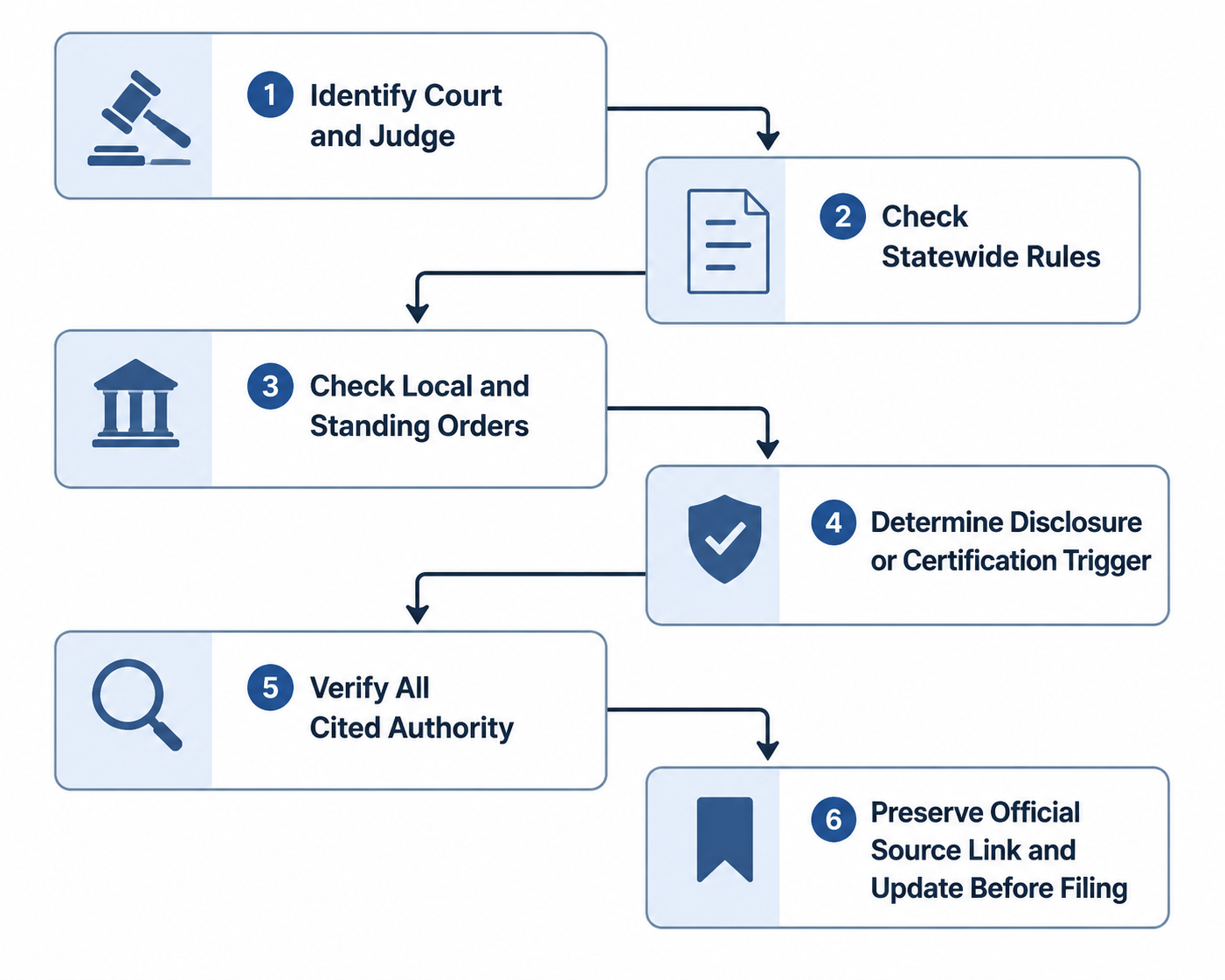
- Identify the court and the assigned judge. Do not rely on the jurisdiction name alone.
- Check statewide rules first. In New York, start with Part 161. In Florida, start with Rule 2.515(d)(2). In California, separate current rules from proposed amendments.
- Check local rules, standing orders, chambers procedures, and case-specific orders. This is essential in federal court and still necessary in state court.
- Determine whether disclosure, certification, or both are triggered. Use the exact language required by the governing order rather than a firm-created paraphrase.
- Verify every cited authority. Confirm that cases, statutes, regulations, quotations, pincites, and procedural assertions exist and are accurately represented.
- Preserve the official source link and update the check before filing. AI standing orders change too quickly for a saved PDF or old alert to be the final authority.
For firms building this into a broader process, the next layer is tool governance: who may use which AI tool, for what task, under what confidentiality controls, and with what verification step before work product leaves the firm. Existing internal resources on AI legal research tools, ChatGPT use by lawyers, AI adoption governance, implementation workflows, and task-level risk tiering can support that operational layer. They should not replace the court-rule check.
This article is for general informational purposes and is not legal advice. Court rules, standing orders, and professional conduct requirements can change quickly; verify the current official source for the court and judge before filing.
References
- Part 161. Use of Artificial Intelligence Technology, NY Courts, nycourts.gov/rules/part-161-use-artificial-intelligence-technology
- Effective June 1, 2026, The New York State Unified Court System Has Adopted a New Rule…, NYSBA, nysba.org
- Supreme Court of Florida Creates Statewide Standard for AI Certification in Court Filings, Jones Day, June 2026, jonesday.com
- Proposed Amendments to the Rules of Professional Conduct Related to AI, California Bar, calbar.ca.gov
- AI Disclosure in Court: 300+ Rules You Need to Track, Hintyr, March 2026, hintyr.com
- Navigating the New Frontier: How Federal Courts Are Regulating Gen AI in Litigation, Husch Blackwell, huschblackwell.com
- AI Standing Orders Proliferate as Federal Courts Forge Own Paths, Gentry Locke via Bloomberg Law, gentrylocke.com
Chronological incident history
No sanction cases have named this tool in the tracked record set to date. This does not imply the tool is safe — see Risk Digest for ongoing monitoring.
← Compare peer toolsReport a correction or tip
Spotted an outdated figure, a misstated fact, or a ruling this tool profile should reflect? Public comments are disabled for this content given the professional cost of a misreported case outcome, penalty amount, or rule text — use the structured correction channel instead.
Report a correction or tip for this record →