
Full profile
The phrase “25th Amendment removal process” tends to do more work in political argument than the Constitution allows it to do. Section 4 is often described as the faster, cleaner alternative to impeachment: no trial, no article of impeachment, no extended debate over culpability. That description misses the legal architecture. Section 4 of the 25th Amendment is not impeachment with fewer formalities. It is a different constitutional theory, triggered by different actors, producing different consequences, and, when the president contests it, demanding a higher congressional threshold than impeachment.
That distinction matters because the two mechanisms answer different questions. Impeachment asks whether the president has committed impeachable misconduct. Section 4 asks whether the president is unable to discharge the powers and duties of the office. One is accusatory and punitive in constitutional design; the other is functional and temporary. Treating them as interchangeable removal tools flattens the part of the Constitution that does the most practical work: deciding who must act first, what vote is needed, and whether the president is actually gone.

The legal theories diverge before the procedures begin
Impeachment begins with blame. Article II, Section 4 permits removal of the president, vice president, and civil officers for “Treason, Bribery, or other high Crimes and Misdemeanors.” The House impeaches; the Senate tries the case; conviction removes the officer. Section 4 of the 25th Amendment begins somewhere else entirely. It is directed at a president who is “unable to discharge the powers and duties” of the office, and it allows the vice president to become acting president after the required written declaration is transmitted by the vice president and a majority of the principal officers of the executive departments, or by another body Congress may provide by law.[1]
The word “unable” is doing the constitutional work. It is not a synonym for unfit in the broad political sense, nor for dangerous, reckless, unpopular, unlawful, or impeachable. Those categories can overlap in public debate, but Section 4 is not drafted as a misconduct remedy. It is drafted as a continuity-of-government device: a way to keep executive power functioning when the president cannot perform the office.
That is why the first serious mistake in many public invocations of Section 4 is not procedural but conceptual. A legal analysis of the 25th Amendment removal process has to ask whether the asserted problem is inability. If the argument is really that the president abused power, incited violence, violated law, defied Congress, or pursued catastrophic policy, the constitutional path designed for that claim is impeachment. Section 4 may be discussed in moments of political emergency, but its text does not become broader because the emergency is grave.
The vote count is the first hard stop
The usual shorthand says impeachment is hard because it requires two-thirds of the Senate. That is true, but incomplete. A contested Section 4 proceeding requires two-thirds of both houses of Congress. Brian Kalt’s National Affairs analysis makes the comparison bluntly: impeachment requires a simple House majority to charge and a two-thirds Senate vote to convict, while a contested Section 4 case requires two-thirds support in the House and two-thirds support in the Senate. Kalt calculates that this means Section 4 requires 72 more House votes than impeachment.[2]

The higher House threshold is not a technicality. It changes the institutional character of the remedy. Impeachment lets a House majority accuse and then places the decisive removal question in the Senate. Section 4, once disputed by the president, requires a supermajority confirmation in the same House that impeachment lets proceed by majority vote. Anyone calling Section 4 the easier route has to account for that arithmetic.
| Question | Impeachment | Section 4 of the 25th Amendment |
|---|---|---|
| Constitutional theory | Culpable misconduct: treason, bribery, or other high crimes and misdemeanors | Inability to discharge the powers and duties of the office |
| Who initiates | House of Representatives | Vice president plus a majority of principal executive department officers, unless Congress has provided another body |
| Congressional threshold | Simple House majority to impeach; two-thirds Senate vote to convict | If contested, two-thirds of both the House and Senate |
| Immediate effect | No removal until Senate conviction | Vice president becomes acting president after the required declaration, subject to the president's contesting declaration and congressional process |
| Final consequence | Removal from office; possible disqualification from future federal office | Acting presidency; president remains president and may assert recovery |
The two-thirds-in-both-houses requirement also explains why Section 4’s apparent speed can be misleading. The initial transfer of authority can be swift if the vice president and Cabinet act. But if the president declares that no inability exists, Congress must decide the dispute. The Constitution gives Congress a tight timetable for assembling and deciding, but it does not lower the confirmation burden. Speed in convening is not the same as ease of proof or political attainability.
Section 4 has an initiation problem impeachment does not have
Impeachment starts outside the executive branch. Members of the House may introduce articles, committees may investigate, and the chamber can decide whether to accuse. Section 4 starts inside the administration. The vice president and a majority of the principal officers of the executive departments must transmit the initial written declaration, unless Congress has created another body for that purpose.[1]
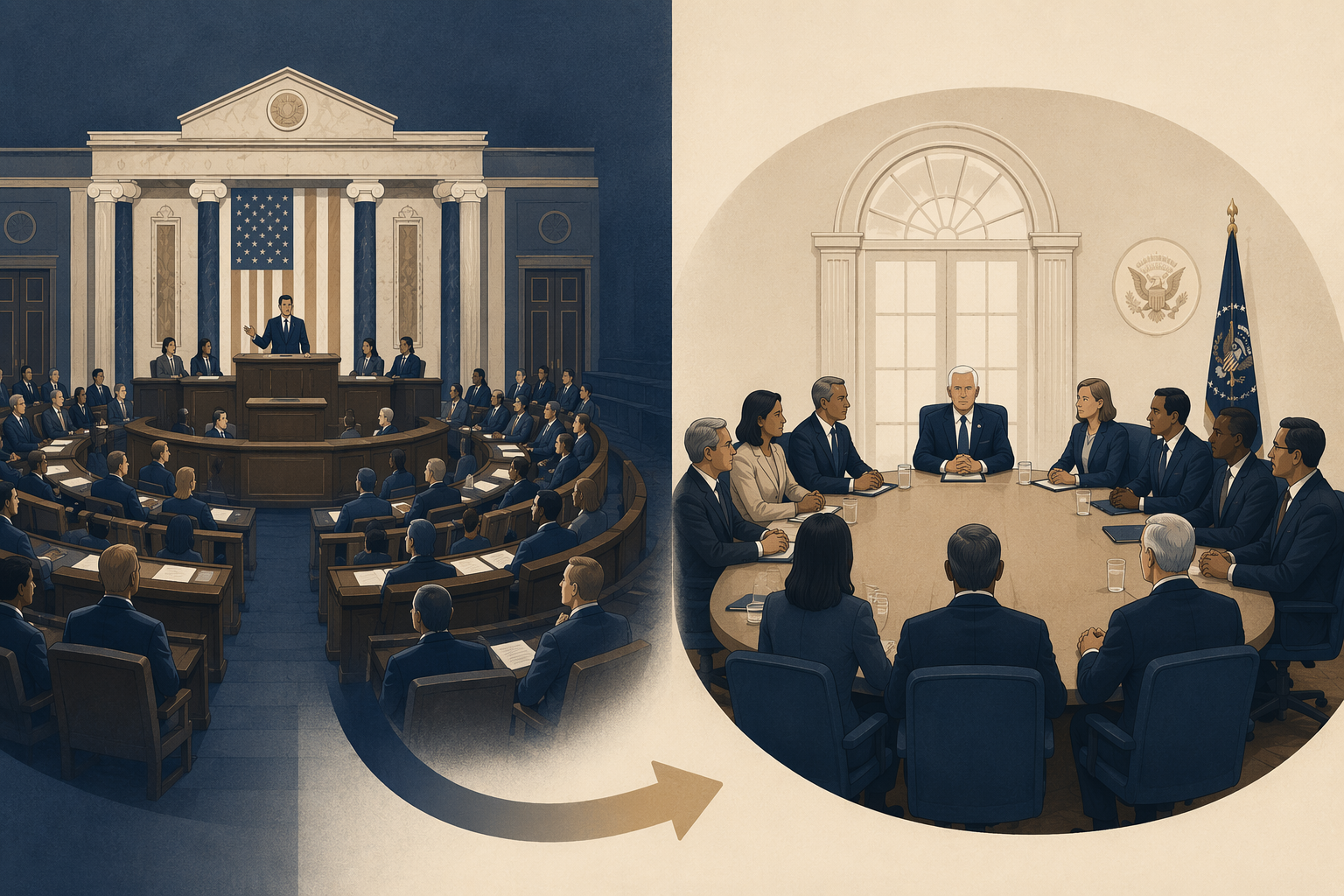
That placement is not incidental. It asks the president’s own vice president and senior executive officers to make the first legal move. The Brennan Center has described the vice president’s position as especially difficult because the vice president must judge the president’s inability while also becoming the immediate beneficiary of the transfer of power.[3] Elaine Kamarck likewise emphasizes the institutional difficulty of asking executive officials to determine presidential competence from within the administration’s political structure.[4]
The conflict is not merely personal ambition. It is evidentiary, political, and constitutional at once. The vice president must decide whether the facts justify declaring inability; must be prepared to defend the declaration to Congress and the public; and must then exercise presidential powers as acting president while the displaced president may be contesting the premise of the transfer. Cabinet officers face their own problem: they are asked to take a position that may end their service, divide the administration, and become the central fact in a constitutional crisis.
The result is a mechanism that cannot be activated by public demand alone. Legislators may urge, commentators may insist, and voters may be alarmed. None of that transmits the Section 4 declaration. Until the vice president and the required executive officers act, the process has not legally begun.
The near-use cases show friction, not settled precedent
The Reagan shooting in 1981 remains the classic near-use episode. After President Reagan was wounded, officials considered the 25th Amendment; accounts describe letters being prepared but not signed. Birch Bayh, the principal Senate author of the amendment, later argued that Section 4 should have been invoked.[5] The episode is useful because it shows what the mechanism looks like under conditions closest to its core purpose: sudden medical incapacity. It is less useful if treated as a binding gloss on what Section 4 requires, because the declaration was never made and no court or Congress resolved a contested dispute.
The January 2021 Trump episode is the sharper comparison with impeachment. After the Capitol attack, the House passed H.Res. 21 urging Vice President Mike Pence to invoke Section 4. Pence refused in a public letter, warning that such action would risk further division. The House then proceeded to impeach President Trump for incitement of insurrection shortly before the end of his term.[6] The constitutional contrast is hard to miss: the House could urge Section 4, but it could not initiate it; the House could, however, initiate impeachment itself.
The 2026 Iran-related calls show the same initiation barrier in current form. In April 2026, NBC News reported that more than 70 House Democrats called for invocation of the 25th Amendment after Trump made threats connected to Iran, including the statement that “whole civilization will die.” No vice president or Cabinet action followed.[7] That episode is not a legal precedent. It is a contemporary reminder that political pressure, even from dozens of members of Congress, does not satisfy Section 4’s threshold act.
These episodes should be handled with care. They do not establish a judicial rule, and they do not prove that Section 4 can never be used. They do show why non-use is not mysterious. The mechanism places the first formal step in the hands of the very officials most likely to face the immediate political, institutional, and reputational costs of taking it.
Section 4 does not remove the president in the impeachment sense
Even when Section 4 works, it does not do what impeachment does. A president convicted after impeachment is removed from office, and the Senate may also vote to disqualify that person from future federal office. Section 4 creates an acting presidency. The vice president exercises the powers and duties of the office, but the president remains president and may later declare that the inability no longer exists.[8]
That distinction is not semantic. Impeachment has finality once the Senate convicts. Section 4 has a built-in restoration pathway. If the president transmits a declaration of recovery and the vice president and Cabinet do not contest it, the president resumes the powers and duties of the office. If they do contest it, Congress must decide. The mechanism is built for incapacity that may change over time, not for a conclusive judgment of wrongdoing.
The absence of disqualification is equally important. A Section 4 transfer carries no constitutional bar on future office. Paul Campos has emphasized that Section 4 is not a substitute for the impeachment consequence of disqualification.[8] A president displaced under Section 4 could, as a constitutional matter, seek election again unless some other legal disability applied.
The “revolving door” problem completes the comparison
Section 4’s recovery mechanism creates a problem impeachment does not have: recurrence. If a president can declare recovery, and the vice president and Cabinet can dispute it, the Constitution supplies a process for that confrontation. But it does not eliminate the possibility of repeated declarations and repeated contests. Recent commentary has described this as a “revolving door” problem, because a displaced president may keep trying to restart the dispute by asserting recovery.[9]
The practical consequences would be severe. The acting president would be exercising power while the president asserts entitlement to resume it. Cabinet officers would have to decide whether to reaffirm inability. Congress could be forced back into the same dispute. Markets, agencies, military commanders, foreign governments, and courts would all be watching for a legally operative answer. The Constitution gives a process, but no experience has tested how stable that process would be under repeated use.
This is another reason Section 4 is a poor fit for misconduct claims. Where the complaint is that a president should be permanently removed and possibly barred from holding federal office again, Section 4 supplies neither the final judgment nor the punitive consequence. It supplies a temporary allocation of presidential powers during inability.
Simultaneous use remains an unresolved edge case
Could Congress pursue impeachment while the vice president and Cabinet pursue Section 4, either at the same time or in sequence? Scholars have discussed overlap scenarios, but there is no settled judicial answer. Campos’s analysis treats the interaction as constitutionally significant precisely because the remedies serve different purposes and produce different consequences.[8] The question is interesting, but it should not obscure the main point: the mechanisms are not substitutes merely because both can result in a president losing operational power.
Nor is there a settled judicial roadmap for a contested Section 4 crisis. David Pozen’s Constitution Center interpretation stresses the deceptively clear quality of the amendment: the text appears orderly, yet serious questions remain about how disputes would unfold in practice.[10] No court has resolved a Section 4 fight. That absence matters for lawyers advising institutions, because constitutional text, legislative history, and scholarly judgment would be doing more work than precedent.
Why the comparison matters
The comparison between impeachment and Section 4 is not a contest over which remedy is more dramatic. It is a question of institutional fit. Impeachment is available to Congress when the constitutional claim is misconduct. Section 4 is available only when the required executive-branch actors are prepared to say the president is unable to discharge the office, and when they are prepared for the possibility that the president will contest that judgment.
That structure explains the amendment’s history of non-use better than any single political explanation. The design requires internal executive initiation. It imposes a two-thirds threshold in both houses if contested. It produces an acting presidency rather than permanent removal. It allows recovery declarations. And it has no body of judicial precedent waiting to settle the hardest questions the next morning.
For a closer treatment of Section 4 mechanics standing alone, see The 25th Amendment's Legal Process for Cognitive Fitness. The comparison here is informational constitutional process analysis for legal professionals, not advice about any live removal effort.
References
- 25th Amendment. Cornell Legal Information Institute.
- The Limits of the 25th Amendment. National Affairs, Fall 2018.
- The Unworkable Amendment. Brennan Center for Justice.
- 25th Amendment: How do we decide whether the president is competent?. Brookings.
- 25th Amendment. HISTORY / A&E Television Networks.
- Can the Cabinet 'remove' a President using the 25th amendment?. Constitution Center.
- Dozens of Democrats call for Trump's removal after his Iran threats. NBC News, April 2026.
- A Constitution for the Age of Demagogues: Using the Twenty-Fifth Amendment to Remove an Unfit President. Denver Law Review, 2019.
- The Problem with the 25th Amendment—And a Partial Fix. Executive Functions, May 2026.
- Interpretation: The Twenty-Fifth Amendment — The Deceptively Clear Twenty-Fifth Amendment. Constitution Center.
Comments
Join the discussion with an anonymous comment.