
ABA Formal Opinion 512: The Six Duties — A Practitioner's Two-Year Compliance Guide
This guide maps ABA Formal Opinion 512's six duties to specific failure modes—hallucination rates, confidentiality risks, fee compression, and supervision gaps—and provides a documented compliance framework that protects practitioners in an AI-ethics inquiry.
- Hallucination rate
- Not measured / undisclosed
Two years after ABA Formal Opinion 512, the harder question is no longer whether a lawyer has heard of the six generative AI duties. In an ethics inquiry, sanctions motion, client complaint, or confidentiality review, the question is more concrete: show how the system addressed the failure mode tied to each duty. Show who approved the tool. Show who trained the user. Show how citations were checked. Show when client consent was required. Show how AI-assisted time was billed. Show where those records are kept.
Formal Opinion 512 did not create a separate AI ethics code. It applied existing Model Rules to generative AI, including competence, confidentiality, communication, fees, candor, and supervision.[1] That is why it has become a practical national baseline: the opinion is framed around familiar professional duties, but the evidence needed to prove compliance is now tool-specific, workflow-specific, and dated.
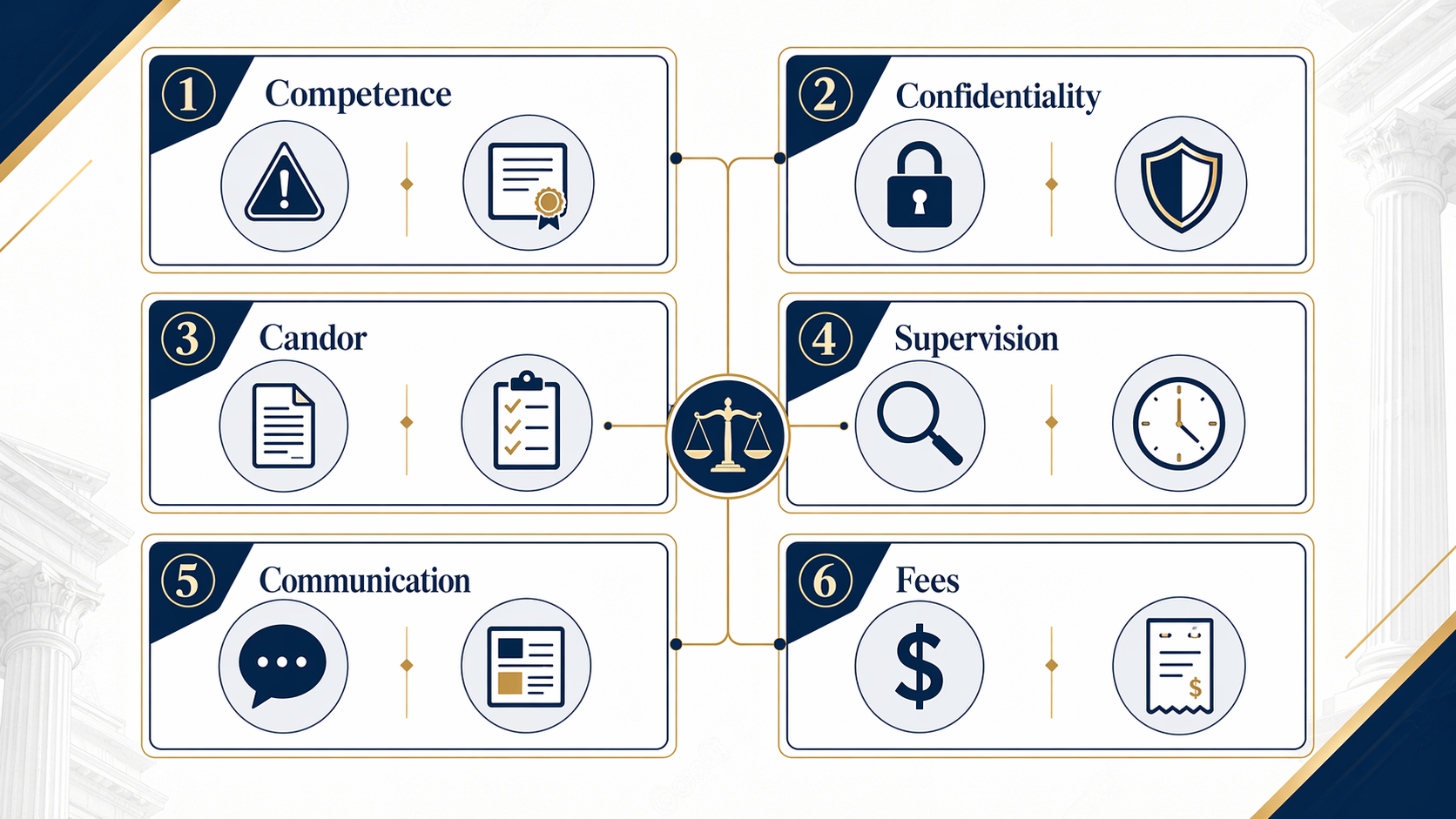
The Opinion Is Shorter Than The Compliance File
A lawyer can recite the six duties and still have no defensible answer when a filing contains fabricated authority or a client asks whether confidential information was entered into a self-learning system. The useful reading of ABA Formal Opinion 512 is not as a philosophy paper about technology. It is a reconstruction guide for the file that will be examined later.
| Duty | Failure mode an inquiry will examine | Artifact that helps answer it |
|---|---|---|
| Rule 1.1 competence | The lawyer used a tool without understanding its limits, retrieval behavior, or hallucination risk. | Tool-specific training records, approved-use notes, and documented review procedures. |
| Rule 1.6 confidentiality | Client information was exposed to a tool, vendor, or training process without adequate diligence or consent. | Vendor diligence files, data-use terms, risk assessment, and matter-specific consent where required. |
| Rules 3.3 and 8.4 candor | AI-assisted work introduced false citations, quotations, or propositions into a tribunal filing. | Citation verification protocol, source logs, and sign-off records. |
| Rules 5.1 and 5.3 supervision | Partners, managers, staff, or vendors used AI outside firm controls. | Written AI policy, approved-tools list, training logs, escalation rules, and audit records. |
| Rule 1.4 communication | The client was not told about AI use when disclosure was needed for informed decision-making. | Disclosure triggers, consent templates, and matter notes. |
| Rule 1.5 fees | AI compressed the work but the bill did not reflect the actual time, cost, or fee agreement. | Billing policy for AI-assisted time, pass-through costs, flat fees, and review time. |
That table is not a substitute for legal judgment. It is the beginning of the proof file. The more serious failures are rarely explained by one bad input. They tend to involve an unmanaged chain: unapproved tool, no training record, no citation protocol, unclear billing rule, and no one able to say who had supervisory responsibility.
Competence And Candor: Human Review Has To Mean Something
Rule 1.1 is often summarized as the duty to understand the benefits and risks of technology. In generative AI practice, that statement is too general to be useful. Published Stanford RegLab benchmarks reported materially different hallucination rates across legal research systems and general-purpose models: approximately 17% for Lexis+ AI on legal questions, approximately 33% for Westlaw AI-Assisted Research, and approximately 58% for GPT-4 on federal case questions.[2] Those figures came from 2024 research using particular configurations, so they should not be treated as permanent performance measures. They still make the ethics point hard to avoid: competence is not an attitude toward AI. It is a tool-specific inquiry.
A firm that allows lawyers to use generative AI for legal research should be able to identify which tools are approved for which tasks, what training was required, what output must be independently verified, and whether any subject-matter review is required before use in client advice or a court filing. A generic lunch-and-learn on “AI risks” may be useful, but it is thin evidence if the actual failure involved a particular research product, a particular model setting, or a particular workflow.
Candor duties under Rules 3.3 and 8.4 sharpen the point. The lawyer does not violate the rule merely because a tool is capable of hallucinating. The problem arises when AI-assisted work is placed before a tribunal without adequate verification. The documented sanctions chronology is no longer limited to one infamous early case: Mata v. Avianca produced a $5,000 sanction; Park v. Kim produced sanctions exceeding $1,000; Wadsworth v. City of New York produced a $3,000 sanction; Lacey v. State Farm involved sanctions of roughly $31,000; and People v. Crabill was reported as involving a one-year suspension.[3] The amounts and outcomes vary, but the recurring defect is familiar: false authority reached the court.
The Charlotin AI Hallucination Cases Database reported 1,348 documented AI hallucination cases worldwide as of April 24, 2026, including 915 in the United States and approximately 511 involving licensed attorneys.[4] That database is best used as a documented lower bound, not a census. It likely misses unpublished state trial court activity and matters resolved without public orders. Even stated that carefully, it defeats the comfortable story that hallucinated legal authority is only a pro se problem.
For a defensible candor file, “the lawyer reviewed it” is the beginning of the answer, not the end. A citation verification protocol should require the reviewer to confirm that each cited authority exists, that the quoted language appears in the source, and that the proposition attributed to the authority is actually supported. For firms building this into litigation workflows, a more detailed hallucination audit can sit alongside the filing checklist; the point is that verification is recorded before the document leaves the firm, not reconstructed after a judge asks for an explanation.
A practical version can be modest. For every AI-assisted filing, the responsible lawyer should be able to produce the final filing, the source-confirmation record, the person who performed the verification, the date of verification, and any escalation note for authorities that could not be confirmed. The protocol can be incorporated into an existing AI hallucination audit checklist. What matters is that the review is not treated as a private mental act.
Supervision And Confidentiality Are Firm-System Duties
Rules 5.1 and 5.3 are where institutional AI programs either become real or collapse into aspiration. Lawyers with managerial authority must make reasonable efforts to ensure that lawyers and nonlawyers conform to professional obligations. In AI practice, that means approved tools, prohibited uses, training requirements, vendor review, escalation channels, and records showing that the rules reached the people doing the work.
The April 2026 Sullivan & Cromwell incident is useful precisely because it does not fit the easy story that only unsophisticated lawyers get into trouble. Contemporary reporting described the firm as self-reporting approximately 28 to 40 AI-generated erroneous citations in an emergency motion. The apology letter reportedly acknowledged that AI policies “were not followed” and that “the review process did not identify the inaccurate citations.”[5] As of that coverage, final sanctions status still required confirmation. The supervision lesson is already visible: a written policy that does not shape conduct, review, and escalation is not much of a control.
The same system question applies to confidentiality under Rule 1.6. ABA Formal Opinion 512 warns lawyers to consider whether information submitted to a generative AI tool may be disclosed to or accessed by third parties, used to train the system, or otherwise handled in a way that compromises confidentiality.[1] The opinion is especially direct about consent: “boiler-plate provisions to engagement letters” are insufficient for informed consent.[1] That language should make firms cautious about treating one generic AI paragraph as a universal cure.
The defensible approach is to separate vendor diligence from client consent. Vendor diligence asks what the tool does with prompts, uploaded documents, metadata, user history, and outputs; whether data is retained; whether it is used for training; who can access it; what security commitments apply; and whether the product terms are compatible with the matter. Consent asks a narrower but sometimes necessary question: given this client, this information, this tool, and this risk, has the client received enough information to make an informed decision?
A firm can centralize much of the vendor work through an AI vendor due diligence checklist and reserve matter-specific consent for situations where client information will be exposed to a tool in a way the client would reasonably care about. Drafting help on a public legal issue may not raise the same problem as uploading a confidential acquisition chronology, a witness interview, or privileged strategy material into a system with unclear retention and training terms.
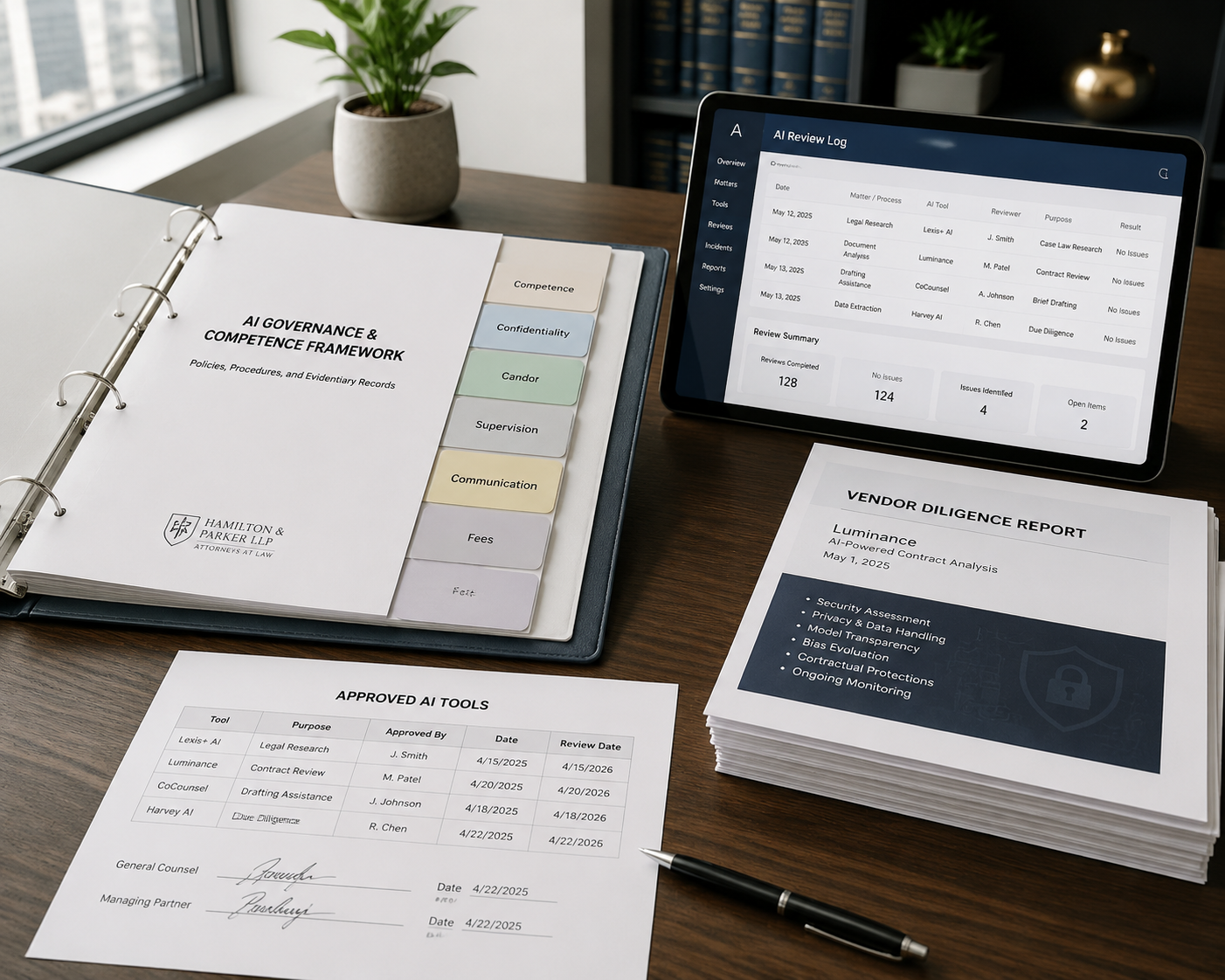
What A Supervisory Record Should Contain
- A dated AI policy that identifies permitted, restricted, and prohibited uses.
- An approved-tools list with owner, approval date, permitted tasks, and review date.
- Vendor diligence files covering confidentiality, retention, training use, access controls, and contract terms.
- Training records for lawyers, paralegals, staff, and anyone supervising AI-assisted work.
- Escalation procedures for novel tools, confidential-data use, court filings, and suspected hallucinations.
- Periodic review records showing that the policy changed as tools, risks, and court expectations changed.
Those records can be maintained through a broader law firm AI governance policy or a more focused duty-to-supervise AI tools protocol. The label is less important than the ability to prove that supervision existed before the failure.
Communication: Disclosure Is Triggered By Client Significance, Not Curiosity
Rule 1.4 does not require a lawyer to narrate every internal technology choice. It does require enough communication for the client to make informed decisions about the representation. ABA Formal Opinion 512 applies that standard to generative AI by asking whether the use of the tool is material to the representation or affects the client’s interests in a way the client should understand.[1]
Disclosure is more likely to be required when the lawyer proposes to input confidential client information into a tool with nontrivial retention, training, or third-party access questions; when AI use materially affects the strategy or substance of advice; when a client has instructed the lawyer not to use AI; when the fee arrangement depends on how AI-assisted work is handled; or when a court, agency, contract, or protective order imposes its own AI disclosure requirement. Those are not branding moments. They are decision points.
For many firms, the right control is a set of disclosure triggers and short consent templates, not a promise to seek consent for every spell-check-adjacent use of technology. Where consent is needed, the template should identify the tool category, the information involved, the reason for using it, the material risks, and available alternatives. Existing AI consent clauses for engagement letters can help, but the opinion’s warning about boilerplate means the clause should not be treated as self-executing compliance.
Fees: AI Can Compress Time, But It Cannot Disappear Billing Judgment
Rule 1.5 is where generative AI changes the economics in ways that can become ethics problems. ABA Formal Opinion 512 uses a direct hypothetical: if a lawyer uses generative AI to produce a pleading in 15 minutes, the lawyer may not bill the client as though the task took substantially longer simply because it would have taken longer without the tool.[1] The bill must reflect the actual basis for the fee arrangement, the time reasonably spent, and the lawyer’s professional work reviewing and revising the output.
Hourly matters need one rule; flat-fee matters may need another. Pass-through costs require particular care. If the AI subscription is ordinary firm overhead, charging it separately as a client expense may be hard to justify without an agreement. If a matter requires a distinct tool, database, or usage charge, the client agreement should address whether and how that cost is passed through. The same file should show whether the lawyer billed for prompting, reviewing, revising, cite-checking, and applying legal judgment, rather than for fictional time saved by automation.
The safest billing policy is not hostile to AI use. It tells timekeepers how to record AI-assisted work, how to describe review time, when tool costs are overhead, when expenses require client agreement, and who approves exceptions. Firms that have not yet written those rules can start from a dedicated generative AI billing policy and adapt it to their fee agreements.
Adoption Pressure Does Not Prove Control
The governance gap matters because AI use has moved faster than institutional control. A Clio Legal Trends Report figure cited in secondary materials states that 79% of legal professionals have used AI tools, while 44% of firms lack formal AI governance policies; the underlying report year and methodology should be verified against the primary publication before relying on those numbers in a formal risk memorandum.[6] Even with that caveat, the direction of the problem is credible: individual adoption can outrun firm systems.
State-level analysis is similar. Secondary sources report that 49 of 50 states have adopted the core structure of the Model Rules, with California as the well-known outlier, and that more than 35 states had issued formal AI guidance by 2026.[7] Inclusion criteria vary, so the count should be checked before citing it as a precise regulatory inventory. The practical point is narrower and sturdier: ABA Formal Opinion 512 is not binding everywhere by itself, but it sits close to the professional responsibility architecture most U.S. lawyers already live under.
That baseline will not excuse a firm that adopted tools faster than it built controls. It may, however, help a firm show that its controls were tied to recognized duties rather than improvised after a problem. A maintained AI compliance file should include the opinion, state-specific guidance, court standing orders where relevant, firm policy, tool approvals, vendor diligence, training records, verification protocols, consent templates, and billing rules.
The Defensible Op. 512 File
The most persuasive response to an AI-ethics inquiry is not a speech about innovation or caution. It is a dated record showing that the firm identified the relevant failure modes and built controls around them. For ABA Formal Opinion 512, that file should contain at least these materials:
- Written AI policy: permitted uses, prohibited uses, supervisory responsibility, escalation rules, and review cadence.
- Approved-tools list: tool owner, approved tasks, confidentiality limits, training requirements, and approval date.
- Vendor diligence files: terms, retention, training use, access, security commitments, and matter restrictions.
- Training records: who was trained, on which tools, when, and for what approved uses.
- Citation verification protocol: existence check, quotation check, proposition check, reviewer identity, and date.
- Client communication materials: disclosure triggers, consent templates, and matter-specific consent records where needed.
- Billing rules: AI-assisted time entries, review time, flat-fee treatment, overhead classification, and pass-through cost approvals.
ABA Formal Opinion 512 is survivable because it is not mysterious. It is not survivable by memory alone. The lawyer or firm that can produce the file has a different conversation than the one that can only say everyone was told to be careful.
References
- ABA Formal Opinion 512, American Bar Association, July 29, 2024.
- AI on Trial: Legal Models Hallucinate in 1 out of 6 (or More) Benchmarking Queries, Stanford HAI, 2024.
- Mata v. Avianca, Inc., U.S. District Court for the Southern District of New York, June 22, 2023.
- AI Hallucination Cases Database, Damien Charlotin, accessed April 24, 2026.
- Sullivan & Cromwell apologizes for AI-generated citation errors in emergency motion, Reuters, April 2026.
- Legal Trends Report, Clio.
- Artificial Intelligence and the Practice of Law, North Carolina State Bar, July 19, 2024.
Chronological incident history
No sanction cases have named this tool in the tracked record set to date. This does not imply the tool is safe — see Risk Digest for ongoing monitoring.
← Compare peer toolsReport a correction or tip
Spotted an outdated figure, a misstated fact, or a ruling this tool profile should reflect? Public comments are disabled for this content given the professional cost of a misreported case outcome, penalty amount, or rule text — use the structured correction channel instead.
Report a correction or tip for this record →