
AI Consent Clauses for Engagement Letters: Drafting Language That Meets ABA 512 and State Bar Standards
This article provides clause-level language for law firm engagement letters and client consent forms that satisfies the specific-consent standard under ABA Formal Opinion 512 and aligns with state bar ethics opinions, giving practitioners immediately adaptable templates for different AI use scenarios.
- Hallucination rate
- Not measured / undisclosed
The engagement letter problem usually starts with a sentence that once felt harmless: “The firm may use technology and third-party service providers in representing you.” Before generative AI tools began accepting prompts, summarizing files, drafting work product, and processing discovery sets, that sentence could do useful work. It no longer does enough work.
ABA Formal Opinion 512 makes the gap hard to ignore. When a lawyer’s use of generative AI involves information relating to the representation, the lawyer must consider whether client disclosure and informed consent are required, and boilerplate language is not a safe substitute for specific consent. The consent analysis turns on the actual tool, the work being done, the data being entered, the treatment of that data, the information excluded, and the client’s affirmative agreement.[1]
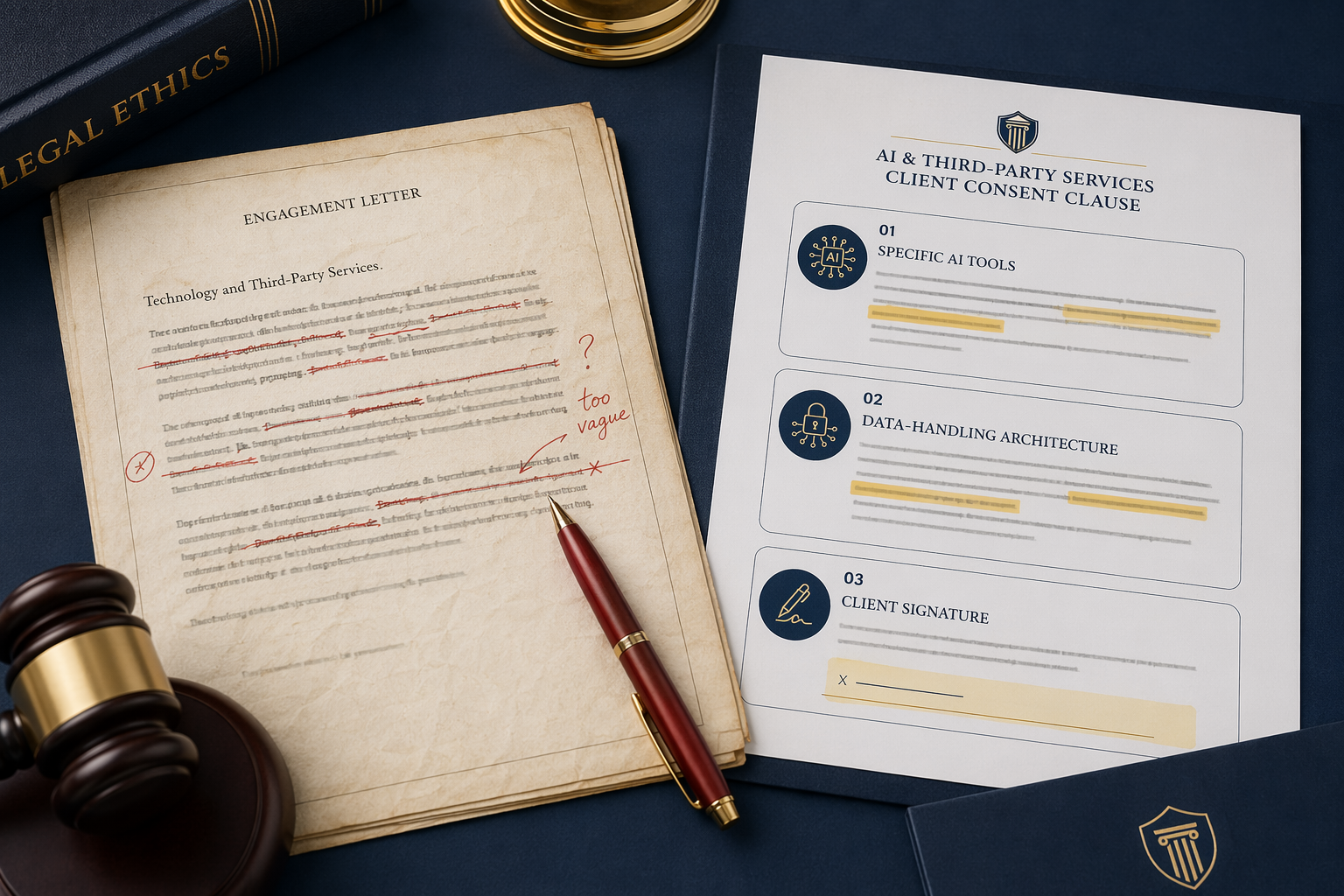
That is why an AI client consent letter for legal work should not be one clause. It should be a small set of clauses matched to the firm’s actual use cases. A time-entry assistant does not raise the same question as uploading a full set of medical records into a document-analysis platform. A drafting tool used with anonymized prompts is not the same as a litigation database that ingests privileged deposition outlines. The consent language should show that someone at the firm knows the difference.
The adoption numbers explain the urgency, though they should not be asked to prove more than they measure. Clio’s 2025 Legal Trends Report says 79% of legal professionals use AI, 78% of clients want disclosure when AI is used, and only 18% of legal professionals always disclose AI use to clients; Clio’s audience may over-represent smaller firms, but the disclosure gap is still the kind of gap that creates bad files.[2]
The Clause Has to Carry Five Facts
For client-confidential information, a useful AI consent clause should carry five facts before anyone calls it consent: the tool or tool class, the categories of legal work, the data-handling architecture, any information excluded from AI processing, and the client’s signed approval. Those elements track the practical consent problem identified in ABA Formal Opinion 512 and are the safest way to move from general permission to informed permission.[1]
| Consent element | What the clause should say | Why it matters |
|---|---|---|
| Named tool or tool class | Identify the specific AI product or a tightly described class, such as an enterprise document-review platform approved by the firm. | A client cannot evaluate consent to an unnamed system. |
| Work categories | State whether AI may be used for scheduling, research support, drafting assistance, document review, contract analysis, translation, summarization, or other defined tasks. | Risk changes with the task. |
| Data-handling architecture | Say whether client information is stored, retained, used to train models, shared with third parties, or isolated in an enterprise tenant. | Confidentiality analysis depends on what happens after upload. |
| Carve-outs | Exclude categories such as trade secrets, medical records, privileged strategy, source code, sealed materials, or client-designated restricted information unless separately approved. | The same matter may contain low-risk and high-risk information. |
| Signed specific consent | Use a signature or separately acknowledged consent for substantive or confidential-information use. | A buried sentence in an engagement letter may not prove informed agreement. |
The mistake is trying to make one broad paragraph do all five jobs. It becomes vague at the exact point where it needs to become factual. Better drafting separates low-risk operational use from substantive legal work, and then separates ordinary confidential information from sensitive categories that deserve separate handling.
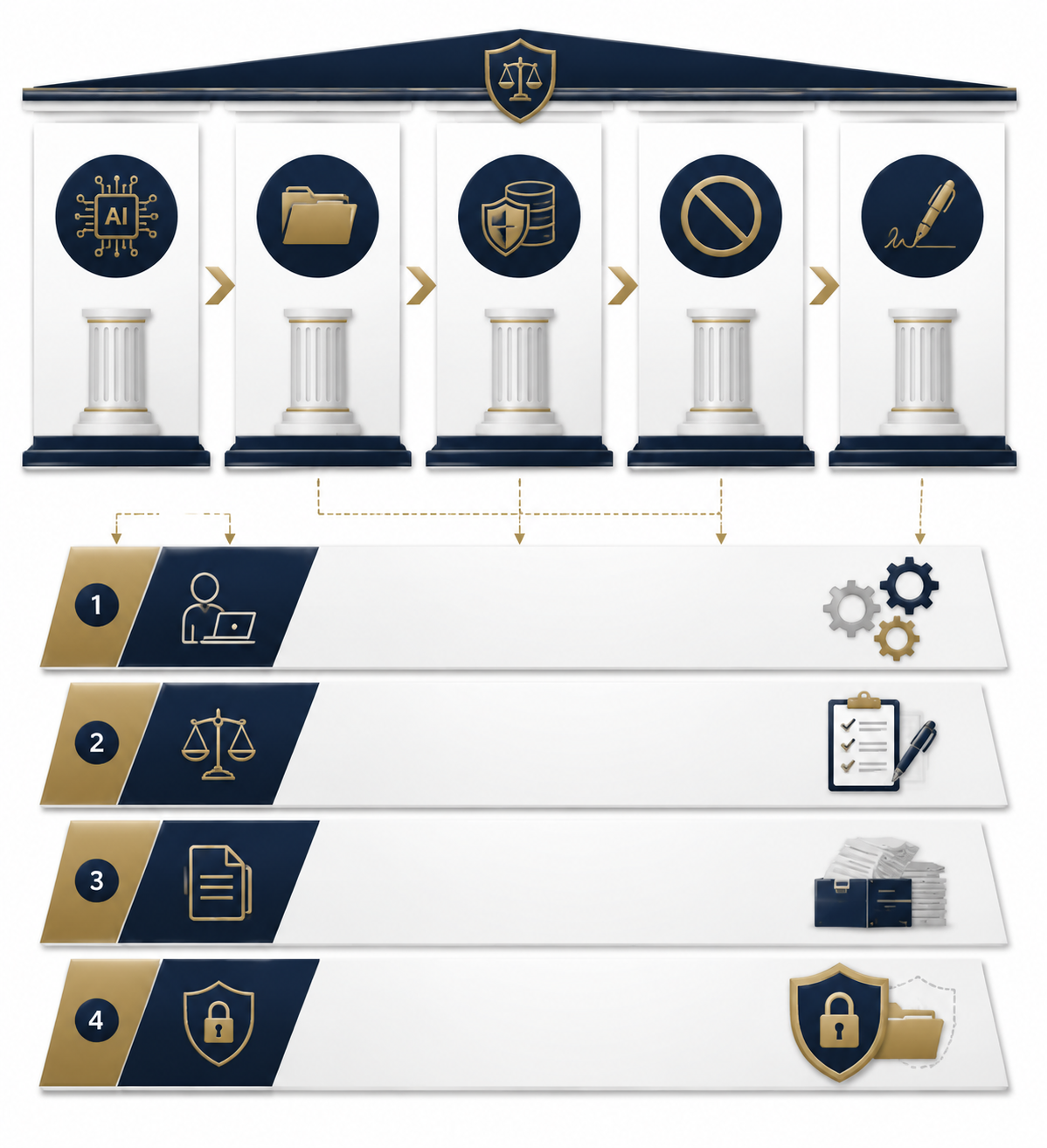
A Tiered Language Pack for Engagement Letters
The following clauses are drafting starting points, not jurisdiction-neutral certificates. Before using them, fill in the actual tools, vendor terms, tenant settings, retention rules, training status, matter type, and state ethics requirements. If the firm cannot answer those questions, the clause is not ready.
Tier 1: Minimal Administrative AI Disclosure
Use this for background tools that do not receive client-confidential legal substance: scheduling, internal workflow routing, billing categorization that does not change the fee charged, formatting, grammar review, or similar administrative support. If the tool receives confidential matter information, move to a higher tier.
Sample clause: The firm may use approved technology tools, including limited artificial-intelligence-enabled administrative tools, to support scheduling, document formatting, internal workflow management, grammar review, timekeeping administration, and similar non-substantive tasks. The firm will not intentionally submit confidential legal advice, privileged communications, substantive client documents, or sensitive client information to such tools under this paragraph. Any use of artificial intelligence to analyze, summarize, draft, review, or process substantive client information is governed by the separate AI consent provisions in this engagement letter or by a separate written consent.
This language does two quiet things. It gives the firm room to use ordinary administrative tools, and it prevents the administrative sentence from becoming the back door for substantive AI use. That distinction matters because ABA 512 does not treat every AI interaction the same way; it requires a facts-and-circumstances assessment of whether disclosure and consent are needed.[1]
Tier 2: Substantive-Work AI Consent
This is the clause most firms need and most old engagement letters lack. Use it when a lawyer, paralegal, or staff member may use AI to assist with legal research, drafting, contract analysis, issue spotting, summarization, deposition preparation, due diligence, or other substantive work. It should name the tool or tool class, describe the task, and say what happens to inputs.
Sample clause: Subject to the limitations below, you authorize the firm to use the following firm-approved artificial intelligence tools or tool classes in connection with this matter: [identify tool names or approved enterprise tool classes]. The firm may use these tools to assist with [legal research support / drafting assistance / summarization / contract analysis / due diligence / document comparison / other specified tasks]. The firm remains responsible for the legal work performed, and all AI-assisted output will be reviewed by a lawyer or other appropriate professional before it is used, sent to you, submitted to another party, or filed with a tribunal.
For data handling, add the part that many clauses skip:
Data-handling addendum: The firm will use these tools only under settings or agreements that provide the following data protections: [describe enterprise tenant, access controls, retention limits, encryption, logging, and vendor confidentiality commitments]. The firm will not use tools that train a public or vendor-wide model on your confidential information unless you provide separate informed written consent. The firm will not submit information listed in the “Excluded Information” section below unless you separately approve that use in writing.
The sentence about training is not decorative. Florida Bar Opinion 24-1 gives a stricter drafting floor: a lawyer may not input confidential information into a generative AI tool that uses the information to train the model unless the client gives informed consent.[3] A multi-state firm that cannot tailor every engagement letter by jurisdiction should usually draft to that floor rather than hope a looser general disclosure will survive the hardest state analysis.
The human-review sentence also deserves to stay in the consent provision, not just in an internal policy. Texas Opinion 705 emphasizes lawyer oversight of AI-assisted work and separately raises disclosure concerns when AI affects billing.[4] If the firm is using AI to reduce time, change staffing, generate flat-fee economics, or support a charge for technology expenses, the billing language should say so plainly.
Billing addendum where applicable: The firm may use approved AI tools to improve efficiency in performing certain tasks. Unless otherwise stated in this engagement letter, the firm will not bill you for time not actually spent by firm personnel. If a separate technology charge, AI-related expense, or alternative-fee arrangement applies, it will be described in the fee section of this engagement letter.
Tier 3: Document-Processing Consent With Signature
Use a separate signed consent when AI will process client documents at scale: discovery productions, contract sets, medical records, HR files, transaction data rooms, investigation materials, patent materials, or claim files. This is where “AI-assisted” stops being an abstract label and becomes a custody question.
Sample consent form: You authorize the firm to use [name tool/platform] to process, search, classify, summarize, extract information from, and assist in reviewing documents and data provided by you or obtained in this matter. The categories of materials that may be processed are: [identify categories, such as contracts, correspondence, pleadings, discovery materials, transaction documents, claim files, or business records]. The purpose of this use is to assist the firm with [document review / due diligence / fact development / privilege review support / chronology preparation / contract analysis / other specified purpose].
Platform and data protections: The firm has approved this tool for this matter based on the following information available to the firm: [vendor name], [deployment model], [whether data is stored in a segregated tenant or workspace], [whether prompts and uploads are retained], [whether inputs or outputs are used to train models], [access restrictions], [retention or deletion settings], and [security or confidentiality commitments]. The firm will not authorize use of your documents to train a public or vendor-wide AI model unless you separately agree in writing after receiving additional information.
Client acknowledgment: You understand that AI tools may assist firm personnel in organizing, searching, summarizing, or drafting from documents, but they do not replace the firm’s professional judgment. The firm will take reasonable steps to review AI-assisted work product, protect confidentiality, and comply with applicable professional-responsibility obligations. You may withdraw this consent prospectively by written notice, although withdrawal may affect cost, timing, workflow, or available review methods.
Signature: Agreed and consented to by client: __________________________ Date: __________________.
This is the place to resist elegance. A short signature block is less graceful than a blended engagement-letter paragraph, but it creates a better record. It also forces the firm to confirm the operational facts before the documents move.
Tier 4: Litigation Privilege and Court-Filing Protection
Litigation matters need one more layer. Privilege, work-product protection, protective orders, sealing orders, expert materials, and court-specific AI certifications can all affect whether AI use is permissible and how it must be documented. Court-facing consequences are no longer theoretical: reported sanctions examples involving AI-related legal work include $5,000 in Mata v. Avianca in the Southern District of New York in 2023, $31,000 in Lacey v. State Farm in the Central District of California in 2024, and $110,000 in Couvrette v. Wisnovsky in the District of Oregon in 2025.[6][7]
Court rules are also fragmenting. Ropes & Gray’s AI Court Order Tracker has tracked more than 700 court orders addressing AI, including orders that require AI-use certifications for filings.[8] That does not mean every litigation task needs client consent in the same way. It does mean the engagement letter should not promise AI freedom without accounting for judges who demand certification, verification, or disclosure.
Sample litigation addendum: In litigation, arbitration, investigation, or other contested matters, the firm will evaluate any proposed AI use for consistency with applicable privilege, work-product, confidentiality, protective-order, sealing, tribunal, and certification requirements. The firm will not knowingly submit privileged strategy, protected work product, sealed material, or information subject to a protective order into an AI tool unless the firm determines that the use is permitted under the applicable order, rule, agreement, or client instruction and that appropriate confidentiality protections are in place. AI-assisted citations, quotations, authorities, and factual assertions will be reviewed before use in a filing or submission.
Sensitive-Data Carve-Out
A carve-out is not an admission that the rest of the consent is weak. It is how the firm avoids pretending that every piece of client information carries the same consequence if mishandled.
Sample carve-out: Unless you separately authorize the firm in writing, the firm will not submit the following categories of information to AI tools: trade secrets; source code; unpublished patent or invention materials; medical, mental-health, or genetic information; minors’ information; criminal-defense strategy; immigration status information; litigation strategy or settlement authority; documents marked highly confidential or attorneys’ eyes only; sealed materials; credentials, keys, or authentication information; merger, financing, or securities information before public announcement; and any other information you designate in writing as excluded from AI processing.
The list should be edited by practice area. A family-law lawyer, a life-sciences transactions team, a criminal-defense practice, and an employment investigations group should not use identical carve-outs. If the client has its own information-security schedule, the AI carve-out should be reconciled with it rather than pasted beside it.
Pressure-Test the Template Against State Guidance
ABA 512 is the starting point, not the ceiling. State guidance changes the drafting pressure. Some states frame the issue through confidentiality, some through competence and supervision, some through disclosure factors, and some through billing or court-facing verification. A firm that practices across states should not assume the least demanding formulation will travel well.
| Authority | Drafting pressure | Clause response |
|---|---|---|
| ABA Formal Opinion 512 | Specific consent may be required depending on the facts; boilerplate is inadequate for confidential AI use. | Name tools, tasks, architecture, exclusions, and signed consent. |
| Florida Bar Opinion 24-1 | Confidential information cannot be entered into a training-enabled generative AI tool without informed consent. | Use no-training language and require separate consent for exceptions. |
| Texas Opinion 705 | Lawyer oversight remains required; AI use can affect billing disclosure. | Add human-review and billing provisions. |
| California guidance | Disclosure depends on factors including novelty, risk, scope, and client sophistication. | Escalate consent when the tool, task, client, or matter risk increases. |
| Pennsylvania and North Carolina guidance | State materials may require or encourage more affirmative discussion of benefits, risks, limits, and guardrails. | Do not rely on a bare permission sentence where fuller disclosure is expected. |
California’s approach is useful because it avoids a false binary. Its practical guidance points lawyers toward a risk-sensitive assessment that considers the nature of the AI use, the risks involved, the scope of the representation, and the client’s sophistication.[5] That is not an excuse for vague drafting. It is a reason to make the consent tier match the matter.
For example, a general counsel who asks the firm to use an enterprise contract-analysis tool on a vendor-paper review project may not need the same explanation as an individual client whose medical records will be summarized by a third-party platform. The clause should not hide behind sophistication, but sophistication can affect how much explanation is needed for informed consent.
An Amendment Workflow for Active Matters
New engagement letters are the easy part. Active matters are where firms get careless. A lawyer discovers that a document-summary tool would save time, the client file contains an old technology clause, and no one wants to pause the workstream. That is exactly when a short amendment is safer than a generous interpretation of a stale sentence.
- Identify the proposed AI use: tool, task, user group, data category, and expected output.
- Check the current engagement letter for AI-specific consent, not just general technology permission.
- Confirm vendor settings: training, retention, tenant isolation, access controls, logging, deletion, and subcontractor access.
- Screen for sensitive-data carve-outs, protective orders, court rules, client outside-counsel guidelines, and information-security schedules.
- Send a matter-specific amendment or consent form if confidential information, substantive work, sensitive data, billing treatment, or court certification is implicated.
- Record the consent in the matter file and configure the tool so the approved use matches the approved scope.
Sample active-matter amendment: We are writing to request your consent to use [name tool/platform] for the following additional purpose in this matter: [describe purpose]. The tool would process the following categories of information: [describe categories]. Based on the information available to us, [describe data handling, including whether inputs are retained or used to train models]. We will not submit information listed as excluded below unless you separately authorize that use. The firm remains responsible for reviewing AI-assisted work product and for complying with applicable confidentiality, privilege, court, and professional-responsibility obligations. If you agree, please sign below.
This amendment should be short enough to send during a live matter and specific enough that a lawyer can defend the consent later. It should not be turned into a new master engagement agreement unless the relationship actually needs one.
What to Fill In Before You Use Any Clause
The clauses above assume the firm has done a minimum amount of tool governance. If no one knows whether a vendor trains on inputs, whether data is retained, or whether the firm has an enterprise tenant, the engagement letter should not paper over that uncertainty.
- Tool name and version or approved tool class.
- Permitted work categories and prohibited work categories.
- Whether client inputs or outputs are used for model training.
- Retention, deletion, logging, and access-control settings.
- Vendor confidentiality commitments and any subcontractor access.
- Jurisdictions governing the lawyer, client, matter, and tribunal.
- Client outside-counsel guidelines, security schedules, protective orders, and court AI orders.
- Billing treatment for AI-assisted work, technology expenses, and alternative-fee arrangements.
If the firm needs the policy layer behind these clauses, that belongs in a separate governance document, not inside every engagement letter. A firmwide inventory, approval workflow, supervision rule, and incident path are better handled in a law firm AI governance policy. Day-to-day staff rules can sit in an AI acceptable use policy template for law firms. The engagement letter’s job is narrower: tell this client enough about this use of these tools on this matter before the firm puts client information into the system.
References
- ABA issues first ethics guidance on a lawyer’s use of AI tools, American Bar Association, July 2024, link
- AI Disclosure: What Lawyers Need to Tell Clients, Clio, link
- Florida Bar Ethics Opinion 24-1, The Florida Bar, January 2024, link
- Opinion 705, Professional Ethics Committee for the State Bar of Texas, link
- Practical Guidance for the Use of Generative Artificial Intelligence in the Practice of Law, State Bar of California, link
- AI Legal Ethics: A Comprehensive Guide for In-House Counsel, GC AI, link
- AI Legal Ethics Bar Association Guidelines, The Legal Prompts, link
- Artificial Intelligence Court Order Tracker, Ropes & Gray, link
Chronological incident history
No sanction cases have named this tool in the tracked record set to date. This does not imply the tool is safe — see Risk Digest for ongoing monitoring.
← Compare peer toolsReport a correction or tip
Spotted an outdated figure, a misstated fact, or a ruling this tool profile should reflect? Public comments are disabled for this content given the professional cost of a misreported case outcome, penalty amount, or rule text — use the structured correction channel instead.
Report a correction or tip for this record →