
AI-Generated Citation Sanctions: A Documented Case Reference (2023–2026)
A maintained reference of documented court sanctions for AI-generated fake citations from 2023 through the first quarter of 2026, covering monetary penalties, attorney disqualification, pro hac vice revocation, and the escalation of enforcement across U.S. jurisdictions.
- Hallucination rate
- Not measured / undisclosed
By Q3 2026, the practical question around sanctions for AI-generated case citations is no longer whether a court might punish a lawyer for filing fake authority. Courts have done it with fixed fines, disciplinary referrals, client and judge notification orders, attorney disqualification, pro hac vice revocation, and, in Oregon, a per-infraction schedule that prices each fabricated citation and quotation.
The known record is still a floor. Damien Charlotin’s AI Hallucination Cases database listed more than 1,696 cases globally as of July 3, 2026, including about 1,187 from U.S. courts, but that database tracks AI hallucination issues in legal proceedings, not only sanctions imposed for fake legal citations.[1] Public sanctions orders are unevenly published, and many AI-tainted filings may never produce a written order. Still, the documented sanctions record is now too specific to treat as anecdote.
The Current Reference Posture
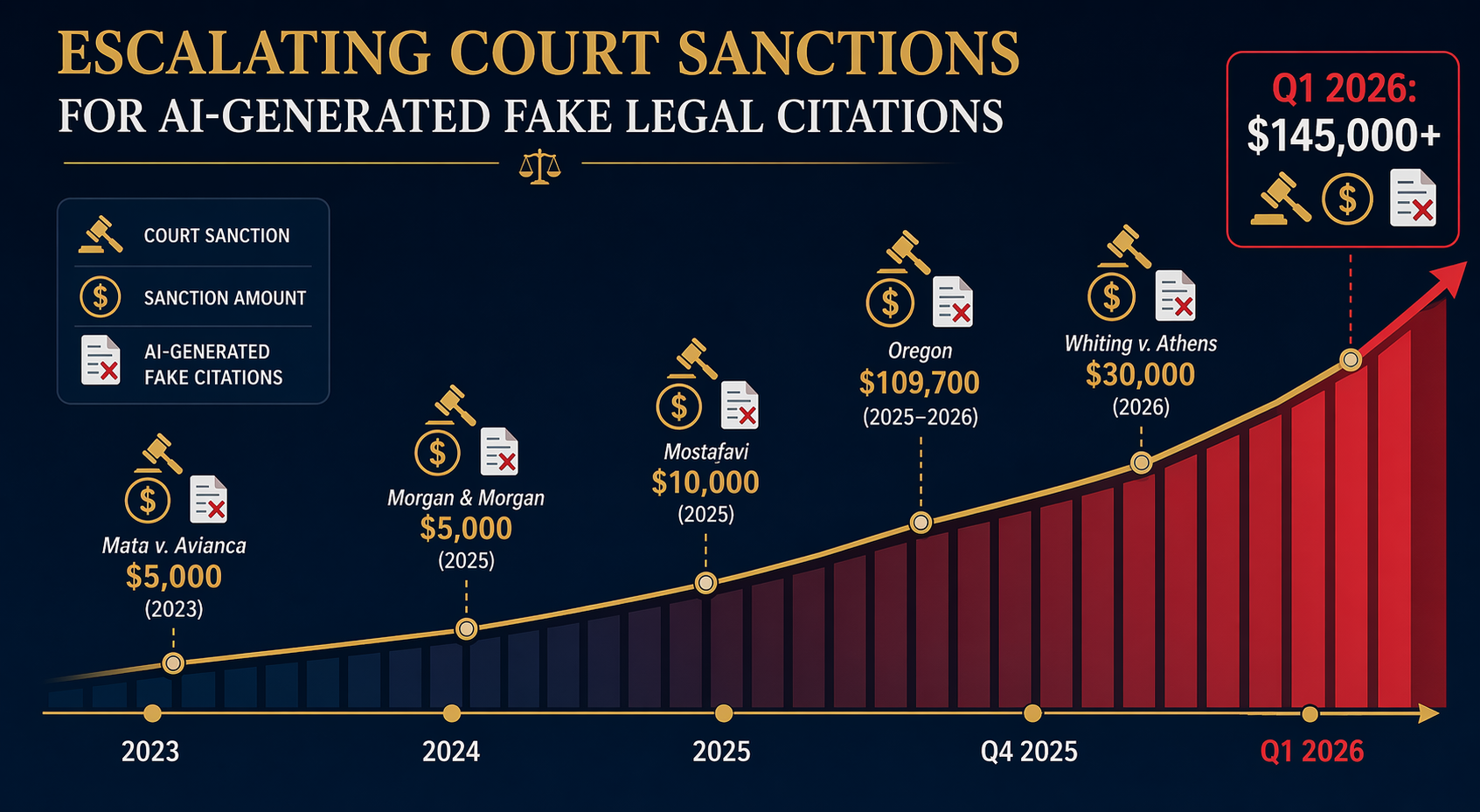
The sanctions cases through the first quarter of 2026 show a widening range of consequences. The early benchmark was a $5,000 penalty. The current record includes a reported $30,000 federal appellate sanction, a $109,700 Oregon aggregate penalty, and at least $145,000 in publicly reported monetary sanctions in Q1 2026 alone.[2][3][4]
| Severity | Documented consequence | Why it matters |
|---|---|---|
| Baseline monetary penalty | $5,000 in Mata v. Avianca | The first widely cited federal warning that counsel cannot outsource citation verification to a chatbot.[2] |
| Moderate monetary sanctions | $3,000 for nearly 30 defective citations; $5,000 against Morgan & Morgan; $10,000 in California | The risk moved beyond one famous Southern District of New York episode and reached large-firm, federal, and state-court settings.[3][5] |
| Practice-disrupting sanctions | Disqualification and pro hac vice revocation | The consequence is not just money; counsel can lose the ability to appear in the matter.[3] |
| Systematic fee schedule | $500 per fabricated citation and $1,000 per fabricated quotation in Oregon | The sanction becomes administrable, not improvised.[4] |
| Six-figure aggregate exposure | $109,700 Oregon aggregate penalty | The cleanup cost can be calculated across repeated fabricated authorities and quotations.[4] |
That ladder matters because sanctions doctrine is not developing only through judicial scolding. It is developing through orders that allocate the cost of remediation: the judge’s time, opposing counsel’s time, the client’s notice problem, the disciplinary system’s involvement, and the integrity of the docket.
Mata Remains the Baseline, Not the Whole Story
Mata v. Avianca is still the starting point because it supplied the basic pattern: lawyers filed a brief containing six ChatGPT-generated fake cases, the court sanctioned them $5,000, referred the matter to a disciplinary committee, and ordered notice to judges whose names had been attached to nonexistent authority.[2]
The lesson was never that a lawyer once used a new tool badly. The lesson was that a court had to spend institutional time proving that cases submitted as law did not exist. The order also made the remedial burden visible. A fake citation is not a private drafting error once it reaches a docket; it becomes a task assigned to the court, the opposing party, and sometimes judges falsely named in the invented material.
Mata also explains why later sanctions orders do not need to profess surprise. After 2023, the argument that fabricated AI citations were a novel mishap became harder to sustain. Lawyers had a public warning, a published sanction, and a clear professional obligation to put eyes on authorities before filing them.
Documented Sanctions and Penalties, 2023–2026
The cases below are not a complete census of every AI citation problem. They are the documented incidents identified in the available record where the penalty type, amount, jurisdiction, or professional consequence is concrete enough to support risk analysis.
| Case or incident | Court or jurisdiction | Date or period | AI-citation issue | Sanction or consequence |
|---|---|---|---|---|
| Mata v. Avianca | S.D.N.Y. | 2023 | Brief filed with six fake ChatGPT-generated cases | $5,000 penalty, disciplinary referral, and order to notify judges named in fake citations.[2] |
| Morgan & Morgan sanction | Reported U.S. proceeding | 2025 | AI-generated citation problem at a major national firm | $5,000 sanction.[3] |
| Colorado federal defective-citation filing | Federal district court in Colorado | 2025 | Nearly 30 defective citations in one filing | $3,000 sanction.[3] |
| Mostafavi | California state-level proceeding | September 2025 | AI-generated citation misconduct | $10,000 fine, reported as a significant California state-level sanction.[5] |
| Johnson v. Dunn | N.D. Ala. | 2025 | AI-generated citation errors | Attorney disqualification.[3] |
| Wadsworth v. Walmart | D. Wyo. | 2025 | AI-generated citation errors by out-of-state counsel | Pro hac vice revocation.[3] |
| Couvrette v. Wisnovsky / Oregon framework | Oregon Court of Appeals | December 2025 | Fabricated citations and quotations | Per-infraction framework of $500 per fabricated citation and $1,000 per fabricated quotation.[4] |
| Ghiorso application of Oregon framework | Oregon | March 2026 | Application of the Oregon per-infraction sanctions approach | Part of reported $109,700 aggregate penalty across two lawyers in related cases.[4] |
| Whiting v. City of Athens | Sixth Circuit | 2026 | Fabricated citations at the federal appellate level | $30,000 sanction, reported as the highest federal appellate penalty for fabricated citations on record.[3] |
| Q1 2026 reported monetary sanctions | Publicly reported U.S. sanctions | Q1 2026 | AI-generated fake citation sanctions | At least $145,000 in monetary sanctions reported for the quarter.[3] |
Several entries in that table come from reporting rather than a uniform national sanctions registry. That matters. The record is strong enough to show penalty types and escalation, but not strong enough to support claims about the total frequency of sanctions across all courts.
The Monetary Range Has Become Specific
The money figures are useful only when they show what courts are learning to administer. Mata’s $5,000 sanction in 2023 was a warning shot.[2] By 2025, reported sanctions included another $5,000 penalty involving Morgan & Morgan, a $3,000 sanction after a Colorado filing with nearly 30 defective citations, and a $10,000 California fine in Mostafavi.[3][5]
The pattern is not that every defective AI citation produces a large sanction. The narrower point is more useful: courts now have examples across different settings, including a large national firm, a state-level California sanction, and a filing where the problem was not one stray hallucination but nearly 30 defective citations in a single submission.[3][5]
The reported Q1 2026 figure is the clearest sign that monetary exposure is no longer a one-off headline. EDRM/ComplexDiscovery reported at least $145,000 in publicly reported monetary sanctions in the first quarter of 2026 alone.[3] That number should not be inflated into a count of all AI citation misconduct. It counts publicly reported monetary sanctions, not every AI hallucination, not every disciplinary referral, and not every filing corrected before an order issued.
Oregon Turned Embarrassment Into a Fee Schedule
The Oregon sanctions deserve more attention than another moderate fine because they changed the arithmetic. In Couvrette v. Wisnovsky, the Oregon Court of Appeals established a per-infraction framework of $500 per fabricated citation and $1,000 per fabricated quotation.[4] Reporting on the related Oregon matters describes an aggregate penalty of $109,700 across two lawyers, with the framework applied in Ghiorso in March 2026.[4][6]
A schedule like that does something a flat sanction does not. It lets a court connect the penalty to the number of false legal representations in the filing. One fabricated citation has one price. A fabricated quotation has a higher price. Repetition is not just aggravating rhetoric; it becomes multiplication.
That does not mean Oregon’s framework is national law. The available record does not show that other jurisdictions have adopted the same $500 and $1,000 amounts. Its significance is narrower and still serious: at least one appellate court has shown how AI citation sanctions can be made administrable at scale.[4]
Status Penalties Change the Exposure
Money is not always the most damaging consequence. Johnson v. Dunn in the Northern District of Alabama is reported as the first disqualification sanction for AI-generated citations.[3] Wadsworth v. Walmart in the District of Wyoming involved pro hac vice revocation for AI-generated citation errors.[3]
Those penalties are different in kind from a check written after an embarrassing order. Disqualification can disrupt the client’s representation. Pro hac vice revocation can remove out-of-state counsel from the case. The court is not merely pricing the defect; it is deciding whether the lawyer should continue to occupy the role.
Other non-monetary consequences belong in the same risk file: orders to notify clients, orders to notify judges named in fake citations, mandatory continuing legal education on AI, publication of sanctions opinions, and bar referrals.[2][3] These remedies are aimed less at compensating a single opponent than at repairing the record and warning the profession.
What the Scale Evidence Proves, and What It Does Not
Charlotin’s database is indispensable because it prevents the comfortable fiction that AI hallucinations in legal proceedings are a tiny curiosity. The July 3, 2026 context—more than 1,696 global cases and about 1,187 U.S. cases—shows a large and maintained body of incidents.[1]
But the database should not be used carelessly. It covers AI hallucination issues in legal proceedings, not only fake legal citations and not only sanctions against lawyers. Some entries may involve non-citation hallucinations. Some may involve warnings, corrections, or procedural consequences rather than monetary sanctions. For a litigation risk reader, the database supplies scale; the sanctions orders supply penalty mechanics.
The same caution applies to quarterly monetary totals. The Q1 2026 figure of at least $145,000 is important because it is tied to publicly reported monetary sanctions during a defined period.[3] It is not a denominator for all AI use in litigation, and it cannot tell us the probability that any given AI-assisted filing will be sanctioned.
The Failure Mode Courts Are Punishing
These sanctions are not about mere technological adoption. The punished act is narrower: filing legal authorities that counsel did not verify. A lawyer may use drafting software, research tools, or generative AI inside the office. The sanctions record turns when invented cases, false quotations, or defective citations leave the office as representations to a tribunal.
That is why generic statements about AI literacy are not enough for sanctions prevention. The court’s problem is not that a model predicted text. The court’s problem is that counsel signed, submitted, or relied on legal material that could not survive ordinary cite-checking. For ethics and supervision frameworks, readers can connect this record to ABA Formal Opinion 512, AI confidentiality obligations, and Model Rules 5.1 and 5.3 supervisory duties; the sanctions cases show the cost when those duties are not carried through at the filing stage.
A defensible filing process therefore has to assign ownership before filing. Someone must open the cited authority. Someone must confirm that the case exists, that the quoted language appears where claimed, that the proposition is supported, and that the citation format does not mask a nonexistent source. If the answer is “the tool said so,” the sanctions record now supplies the court’s likely response.
The 2026 Risk Posture
The documented range now runs from several thousand dollars to six-figure aggregate exposure, with federal appellate penalties, state-level sanctions, disqualification, pro hac vice revocation, disciplinary referrals, notice orders, and continuing-education requirements in the record.[2][3][4][5] That is enough to move AI-generated fake citations from “embarrassing mistake” to measurable professional liability.
The limits of the record should make the conclusion more precise, not weaker. We do not know every defective AI-assisted filing. We do not know how often courts resolve the problem without a published order. We do not know whether Oregon’s per-infraction schedule will spread. What we do know is that by Q3 2026, a litigation attorney cannot reasonably treat fabricated AI citations as a new or unforeseeable mishap. Courts have already shown the penalty types, the dollar ranges, and the failure modes they are prepared to punish.
References
- Damien Charlotin's AI Hallucination Cases Database
- Mata v. Avianca, 678 F. Supp. 3d 443, S.D.N.Y., 2023
- EDRM/ComplexDiscovery Q1 2026 reporting, EDRM.net, April 2026
- Oregon Court of Appeals per-infraction sanctions reporting, ABA Journal
- Mostafavi fine reporting, CalMatters, September 2025
- Oregon AI-generated citation sanctions reporting, NPR
Chronological incident history
No sanction cases have named this tool in the tracked record set to date. This does not imply the tool is safe — see Risk Digest for ongoing monitoring.
← Compare peer toolsReport a correction or tip
Spotted an outdated figure, a misstated fact, or a ruling this tool profile should reflect? Public comments are disabled for this content given the professional cost of a misreported case outcome, penalty amount, or rule text — use the structured correction channel instead.
Report a correction or tip for this record →