
Full profile
The most important number in the current debate over AI for law firms is not a promised efficiency gain. It is the gap between use and control: 69% of legal professionals report using generative AI at work, while only 9% of firms have an enforced written AI policy. In the same 2026 8am/ABA report, 43% of firms say they have no AI policy and no plans to create one.[1]
That is not an innovation story. It is an operations story. Lawyers, paralegals, administrators, and business professionals are already using these tools in the course of legal work. The institution, in many cases, has not yet decided who is allowed to approve a tool, what information may be entered, what work product must be checked, or who will explain the decision after something goes wrong.

Other surveys do not measure exactly the same thing, but they point in the same direction. Clio’s 2025 Legal Trends Report found that 79% of firms were using AI tools while 44% lacked formal AI governance, as summarized in the NC Bar’s 2026 comparison of law-firm AI adoption surveys.[2] The 79% figure is broader than the 8am/ABA 69% figure: one concerns AI tools generally, while the other concerns generative AI use at work. The useful conclusion is not that one number should replace the other. It is that individual and workflow-level adoption has moved faster than firm-level oversight across more than one data source.
For a practical way to map that divide, see this workflow-guided framework for implementing AI in a law firm. The central problem is not that lawyers are curious. It is that many firms are still treating AI use as a future governance item when it is already part of daily work.
The Gap Is Wider Than a Missing Memo
A written policy matters. It gives lawyers and staff a reference point, and it gives firm leaders a basis for enforcement. But a policy that nobody is trained on, nobody updates, and nobody ties to actual software procurement is mostly decorative. The 8am/ABA report’s training numbers make that clear: 54% of firms provide no responsible-AI training and have no plans to start.[1]
The large-firm numbers complicate the picture rather than solve it. Among firms with 500 or more attorneys, 78% reported responsible-AI training completion, but only 5 of 31 large firms achieved 100% completion.[1] That matters because partial training is exactly where governance tends to fail in practice. The people who attended the session may know not to paste a client’s deposition transcript into an unapproved tool. The new lateral, summer associate, contract attorney, or overextended practice assistant may not.
The NC Bar’s survey synthesis reaches the same broad conclusion from a different angle: adoption data, governance data, and training data are not moving together.[2] That is the institutional risk. A firm can be full of lawyers who individually believe they are being careful while the firm as a whole lacks a reliable answer to basic questions: which AI tools are in use, what data they receive, whether the vendor terms have been reviewed, and what verification is required before output reaches a client, court, or deal counterparty.
Readers who want the survey-methodology layer can compare the adoption measures in the 2026 legal AI data overview and the broader state-of-the-market analysis. For management purposes, the fine distinction between survey instruments should not become an excuse for inaction. The instruments differ; the direction of travel does not.
Why Bans Fail Once AI Is Built Into Ordinary Tools
The easiest policy to draft is a ban. It is also the easiest policy to misunderstand. A firm can prohibit lawyers from using consumer chatbots for client work and still have AI features available inside the systems the firm already licenses: legal research platforms, Microsoft 365, videoconferencing software, document tools, and practice-management systems. The NC Bar’s 2026 guidance warns that blanket bans become unrealistic when AI is already embedded in tools such as Westlaw, Lexis+, Microsoft 365, and Zoom.[3]
That is how individual use becomes shadow infrastructure. Nobody sets out to create an unmanaged technology stack. A lawyer sees an AI research assistant in a familiar platform. A team uses a meeting summary feature after a client call. A marketing coordinator drafts a seminar description with a general-purpose tool. A litigation associate tests a chronology prompt late at night because the brief is due in the morning. Some of those uses may be harmless. Some may be prohibited. The point is that the firm cannot tell the difference without an inventory, classification system, and approval path.
The phrase “shadow AI” can sound more dramatic than the facts require. The usual problem is not a rogue lawyer trying to defeat firm controls. It is a governance vacuum created by normal work pressure, vague rules, and procurement that moved faster than risk review. If the only instruction is “do not use AI,” but the document platform offers AI drafting help and the research service offers AI search, the instruction is not operational. It has not told anyone which feature is approved, which feature is disabled, what data is off limits, or who decides when the vendor changes the product.
Start With a Traffic-Light Rule People Can Actually Use
A workable AI program usually begins with a distinction lawyers and staff can remember under pressure. The traffic-light model appearing in law-firm policy guidance is useful because it classifies use by risk rather than by hype.[3]
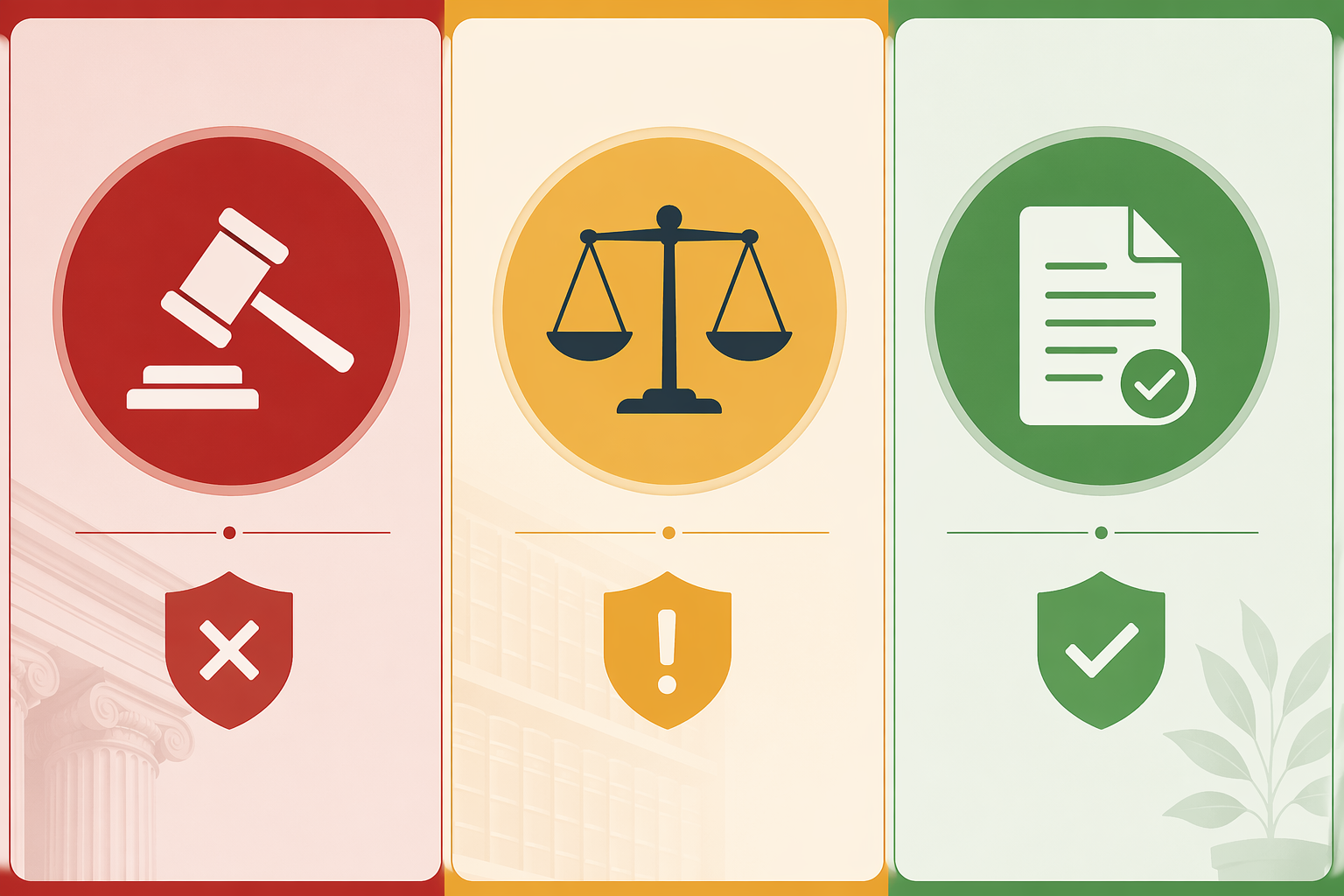
| Category | Typical Rule | Examples of Use |
|---|---|---|
| Red | Prohibited without exception or specific written approval | Entering confidential client information into an unsanctioned public AI tool; using an unreviewed tool for privileged materials |
| Yellow | Allowed only with supervision, approved tools, and human verification | Drafting research summaries, first-pass contract issue lists, deposition outlines, or internal litigation chronologies |
| Green | Allowed as standard low-risk administrative use | Formatting internal agendas, improving non-client-facing prose, creating generic training outlines, or summarizing non-confidential administrative material |
The red category should be blunt. If a tool has not been approved for confidential client information, lawyers and staff should not put confidential client information into it. That includes facts that identify a client, reveal a legal strategy, expose deal terms, or disclose sensitive personal or business information. The issue is not whether the tool sounds impressive. The issue is whether the firm has reviewed the vendor terms, data handling, retention, training use, access controls, and security commitments.
The yellow category is where most of the legal-work debate belongs. A lawyer may use an approved AI tool to accelerate a first draft, organize a record, or generate a research starting point, but the output does not become legal work product merely because it is fluent. Someone competent must verify citations, reasoning, factual assumptions, privilege implications, and jurisdiction-specific law. The verification duty should be written into the workflow, not left as a cultural expectation.
The green category keeps the policy from becoming absurd. Not every AI-assisted task carries the same risk. A receptionist using an approved tool to polish a non-confidential internal announcement should not face the same approval process as a partner uploading a merger agreement. If every use is treated as high risk, people stop asking. If low-risk uses are clearly permitted, the firm has a better chance of receiving honest questions about the hard ones.
Governance Is the Machinery Behind the Policy
The policy says what the rule is. Governance determines whether the rule can survive contact with a Tuesday afternoon. DISCO’s legal AI governance blueprint draws that distinction by emphasizing operating infrastructure: AI landscape mapping, responsible ownership, risk management, and structures such as a Center of Excellence for larger organizations.[4]
A firm does not need to adopt another vendor’s terminology, but it does need to answer the same operational questions:
- Inventory: Which AI features and tools are currently available through firm-approved systems, lawyer-installed applications, browser extensions, research platforms, document tools, meeting software, and practice-management systems?
- Classification: Which workflows are red, yellow, or green based on confidentiality, privilege, legal judgment, court-facing use, client commitments, and data sensitivity?
- Ownership: Who approves tools, who reviews vendor terms, who maintains the inventory, who trains users, and who can suspend a tool when terms or features change?
- Verification: What must a lawyer check before relying on AI-assisted output, and how is that check documented for high-risk work?
- Training: What must each role know before using AI, and how does the firm refresh that training when tools or rules change?
This is where many firms lose the thread. They assign the policy to a committee, the committee debates language, the draft circulates, and then everyone returns to existing habits. Meanwhile, vendors keep releasing features. Associates keep experimenting. Staff keep solving practical problems with whatever tools are available. Governance requires someone to own the unglamorous maintenance work after the policy is approved.
A larger firm may need a formal AI governance group with representatives from risk, IT, knowledge management, practice leadership, procurement, information security, and professional responsibility. DISCO’s blueprint connects this work to NIST-style risk management language, which can help firms make AI review look less like a special project and more like a repeatable risk process.[4] That structure is useful where the scale justifies it: many offices, many vendors, many practice groups, and many lawyers who will otherwise make inconsistent decisions.
A five-lawyer firm should not pretend it has a Center of Excellence. It still needs governance, but governance may be a one-page tool register, a named partner responsible for approvals, a short list of approved tools, a red-yellow-green use chart, and a quarterly calendar reminder to review vendor changes. For small firms evaluating products, a right-sized selection process matters more than a heavy committee structure; this small-firm legal AI tool selection guide is a more realistic starting point than an enterprise governance chart.
Professional Responsibility Sets the Floor
AI does not create a separate ethics universe. ABA Formal Opinion 512, issued in July 2024, states that lawyers using generative AI must comply with existing Model Rules, including duties related to competence, confidentiality, communication, fees, candor, and supervision.[5] The ABA Business Law Today discussion of AI in modern legal practice also highlights supervisory duties under Model Rules 5.1 and 5.3 when lawyers use AI-assisted tools in ways comparable to support from nonlawyer assistants.[5]
Confidentiality is the hard stop. Under Model Rule 1.6, the risk is not merely that a firm might suffer an IT incident. The professional responsibility issue is that a lawyer may disclose information relating to the representation of a client without authorization or adequate protection. If confidential data goes into an unsanctioned consumer-grade AI system, the firm’s problem is not cured by saying the lawyer was experimenting.
Competence and supervision are just as practical. A lawyer who relies on AI-generated research without checking the law has not delegated judgment to a magic box; the lawyer has failed to supervise a tool used in the representation. A partner who lets a team use AI without instructions, training, or review should not be surprised when the resulting mistake is treated as a management failure rather than a technology accident.
The details still vary by jurisdiction. State bars are moving at different speeds, and technology-competence duties are not worded identically everywhere. Broader regulation is also changing, including outside the United States; firms with cross-border practices should track developments such as the EU AI Act’s implications for law firms. The safe formulation is simple: there is no AI exception to existing duties, and local rules may add more specific obligations.
A Practical Oversight Sequence
The sequence below is deliberately plain. It is not meant to impress an innovation committee. It is meant to give a managing partner, risk officer, IT lead, or practice administrator a way to move from informal usage to defensible oversight.
- Find the tools already in use. Ask practice groups, staff teams, IT, procurement, and knowledge management what AI features are available today, including features bundled into existing subscriptions.
- Separate tools from workflows. A tool may be acceptable for one task and unacceptable for another. Classify the use, not just the product.
- Create red, yellow, and green rules. Keep the categories short enough for people to remember and specific enough to guide behavior.
- Name owners. Assign responsibility for approval, vendor review, training, exception handling, and periodic updates.
- Write verification duties into workflows. For legal analysis, citations, factual summaries, contract review, and court-facing work, identify what human review is required before output is used.
- Train against real scenarios. Use examples from the firm’s actual work: research memos, client intake, deposition summaries, deal checklists, billing narratives, marketing drafts, and meeting notes.
The first step is often the most revealing. Firms frequently discover that “we are not using AI” really means “we have not formally approved a standalone AI product.” That is not the same thing. AI may already be present in research, drafting, transcription, email, document management, analytics, or client-service tools. The inventory should include disabled features too, because disabled features have a habit of becoming enabled features after a vendor update or a well-intentioned administrator change.
The second step prevents overbroad conclusions. A legal research platform might be approved for general research queries but not for uploading confidential client documents. A meeting tool might be approved for internal administrative meetings but not for privileged strategy sessions. A drafting assistant might be approved for marketing copy but not for unsupervised contract redlines. Governance becomes enforceable when these distinctions are made before the work begins.
Training should not be a recorded webinar nobody remembers. The 54% no-training figure is troubling because responsible AI use depends on habits formed at the point of work.[1] People need to know what to do when the tool is convenient, the client deadline is near, and the answer is not obvious. A useful training exercise asks whether a particular prompt is allowed, what information must be removed, whether the tool is approved, who must review the output, and what should be documented.
What “Good Enough” Looks Like in 2026
No firm will control AI perfectly. That should not become the standard, because impossible standards produce paper compliance and quiet workarounds. The better question is whether the firm can show that it made reasonable, role-specific, and updated decisions about AI use.
For a large firm, “good enough” may include a formal governance body, documented vendor review, a maintained tool inventory, risk classifications by practice area, training completion tracking, exception procedures, and audit-ready records for high-risk workflows. For a midsize firm, it may mean a smaller steering group, designated owners, approved-tool lists, matter-level guidance for sensitive work, and periodic training. For a solo or small firm, it may mean a short written policy, a tool log, a confidentiality rule that is easy to follow, and a disciplined habit of checking AI-assisted legal work before relying on it.
What is no longer credible is the position that AI governance can wait until adoption becomes official. Adoption is already official in the only way that matters operationally: people are using the tools to get work done. The firm-level question is whether that use remains invisible until a client, court, regulator, or insurer asks about it.
Once a firm can identify its AI tools, classify permitted uses, protect confidential data, require human verification where legal judgment is involved, and train people on the rules they actually face, it has moved out of shadow AI and into defensible oversight.
References
- 8am Legal Industry Report, American Bar Association, 2026
- By the Numbers: What Surveys Show About Law Firm AI Adoption, North Carolina Bar Association, May 2026
- Beyond the Ban: Why Your Law Firm Needs a Realistic AI Policy in 2026, North Carolina Bar Association, January 13, 2026
- Legal AI Governance Blueprint, DISCO
- Legal Ethics and Practical Considerations for Lawyers Using AI in Modern Legal Practice, American Bar Association Business Law Today, July 2026
Comments
Join the discussion with an anonymous comment.