
AI Hallucination Sanctions in 2026: The Enforcement Wave by the Numbers
This article provides the first aggregated quantitative analysis of court sanctions for AI-generated legal hallucinations through mid-2026, revealing the scale, trajectory, and jurisdictional patterns that practicing lawyers and firm leaders need to calibrate risk models and AI policies.
- Hallucination rate
- Not measured / undisclosed
By mid-2026, lawyer AI hallucination sanctions are no longer a collection of odd docket entries that risk committees can treat as training anecdotes. The public record now has enough mass to show an enforcement pattern: at least $145,000 in monetary sanctions in Q1 2026 alone, 17 separate court decisions flagging suspected AI hallucinations on March 31, 2026, and a tracking database that listed 1,696 global hallucination cases as of July 3, 2026, including 1,187 from U.S. courts.[1][2]
Those numbers do not all count the same thing. That distinction matters more than the headline. The $145,000 figure is a monetary-sanctions floor drawn from an aggregate Q1 analysis, not a final census of every sanctionable filing. The 1,696-case figure is broader still: it includes global matters, suspected hallucinations, pro se filings, and non-U.S. jurisdictions. The attorney-specific U.S. count is lower; the Charlotin database had identified approximately 511 licensed U.S. lawyers as of April 2026, while the database itself continued to grow afterward.[1][2]
The cleanest reading is not that every AI error now produces sanctions. It is that courts, opposing counsel, and public trackers are finding the errors faster, preserving them more consistently, and turning them into remedial orders that can survive beyond the embarrassed correction letter.
The Counts Are Growing, But They Are Not Interchangeable
The Charlotin database is the spine of the current public picture because it tracks hallucination cases across jurisdictions and over time. It listed 87 cases in May 2025 and had accelerated to roughly 50 or more flagged cases per week by mid-2026.[2] That is the difference between an issue a managing partner can address in one CLE and an issue that starts to look like a recurring litigation-control failure.
| Measure | What It Counts | Mid-2026 Reading |
|---|---|---|
| 1,696 global cases | AI hallucination matters in the Charlotin database as of July 3, 2026 | Broadest public tracking figure; includes non-U.S. and non-lawyer matters |
| 1,187 U.S. court cases | U.S. matters within the Charlotin database | Closer to the domestic litigation exposure picture, but still not limited to sanctioned lawyers |
| Approximately 511 licensed U.S. lawyers | Identified licensed U.S. lawyers as of April 2026 | More useful for professional-liability and supervision analysis, but not current through July |
| At least $145,000 in Q1 2026 monetary sanctions | Aggregated monetary penalties reported for Q1 2026 | A documented floor, not a complete national sanctions registry |
The table is the part many sanction summaries blur. A database entry is not the same thing as a sanctions order. A suspected hallucination is not the same thing as a finding of bad faith. A U.S. court entry is not the same thing as a licensed attorney discipline event. When those categories are collapsed, the risk looks dramatic but less usable. When they are separated, the picture is still serious and easier to price.
The March 31, 2026 cluster is useful for that reason. Seventeen court decisions flagged suspected AI hallucinations on one day.[1] That does not prove 17 sanctions orders were entered in one day. It does show that the detection environment had changed. Courts were no longer waiting for a single notorious case to define the problem; they were encountering enough suspect filings to create same-day clustering in public reporting.
For readers who need the case-by-case docket trail rather than the aggregate pattern, the maintained AI-generated citation sanctions reference is the better tool. The point here is narrower: the enforcement environment now has enough repetition to affect supervision, intake, review staffing, and escalation rules.
The Money Moved First
The early benchmark was modest enough to mislead people. In Mata, the 2023 sanctions order imposed $5,000 after fake cases appeared in a federal filing.[3] It was embarrassing, public, and disciplinary in tone, but it did not yet look like a line item that would change the cost assumptions behind motion practice.
By Q1 2026, the aggregate monetary picture had changed. ComplexDiscovery and EDRM reported at least $145,000 in monetary sanctions for the quarter.[1] That figure should be treated as a documented floor because public tracking is uneven and case-level verification of every component is not always available from open sources. Even as a floor, it is large enough to make hallucination controls a billing, insurance, and supervision issue rather than a technology-use preference.
The Oregon penalty is the sharpest monetary example because it made the risk arithmetic visible. The aggregate penalty reached $109,700, described in Norton Rose Fulbright’s 2026 sanctions survey as the first six-figure AI hallucination sanction in U.S. legal history. The schedule was $500 per fabricated citation and $1,000 per fabricated quotation.[3]
That structure does something a general reprimand cannot. It turns each unsupported citation into a separate cost event. A brief with ten fabricated authorities and several fabricated quotations is no longer just a bad filing; it is a multiplying penalty framework. The schedule is state-specific and has not become a national rule. Still, it gives risk officers a concrete way to explain why cite-checking AI-assisted work cannot be compressed into a final skim.
The Harder Deterrent Is No Longer the Fine
The dollar amounts get attention because they are easy to compare. The stronger deterrent in 2026 is the order that interferes with a lawyer’s ability to keep practicing normally: suspension, removal, disclosure duties, double costs, and bar referrals. Those remedies create cleanup work for the lawyer, the firm, the client, and sometimes the next court that has to decide whether a filing can be trusted.
In Whiting v. City of Athens, the Sixth Circuit imposed $30,000 in punitive fines, split as $15,000 against each of two attorneys, plus double costs and a bar referral. Norton Rose Fulbright described it as the highest federal appellate sanction linked to fabricated citations, with the refusal to cooperate playing a major role in the sanction.[3]
That order is less about the original hallucination than about what happened after the problem surfaced. Noncooperation turns a verification failure into an institutional trust problem. Once the appellate court has to spend time documenting fabricated authorities and resistance from counsel, the sanction is no longer just pricing the bad cites. It is punishing the burden imposed on the court and the opposing side.
The Ninth Circuit’s June 3, 2026 order in Lnu v. Blanche moved in a different direction. The court imposed $2,500 each, suspended the lawyers from practicing before the circuit for six months, and required mandatory AI disclosure for two years. Reuters described it as the Ninth Circuit’s first AI hallucination sanctions order.[4]
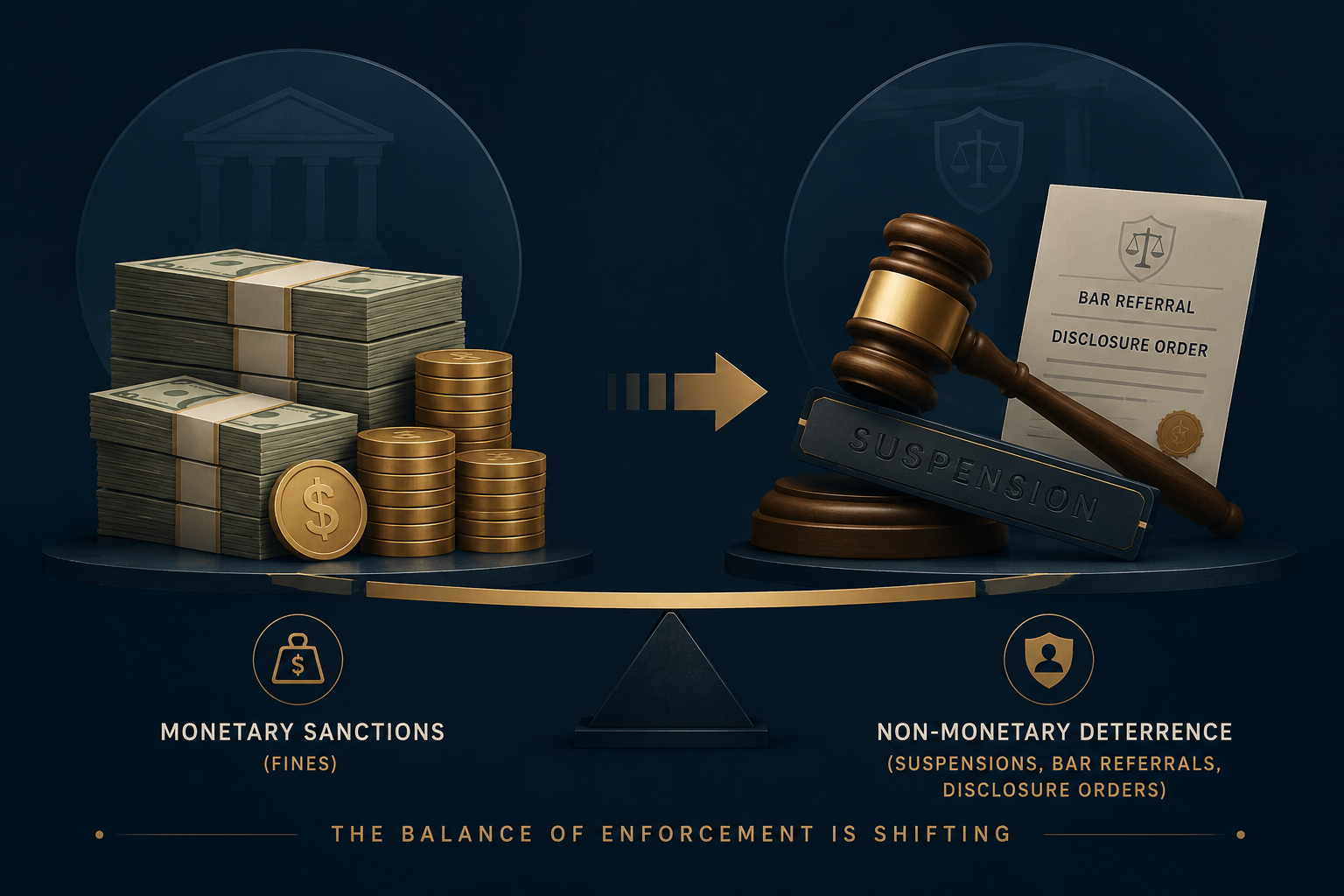
The disclosure obligation is the important part for future conduct. A fine closes a file. A suspension and two-year disclosure requirement follow the lawyer into later matters and put future courts on notice. For a firm, that means the consequence is not contained inside the sanctioned case. It becomes part of conflicts, staffing, client communication, and appellate-practice oversight.
Tool Choice Helps, But It Does Not Carry the Verification Burden
The available hallucination-rate data makes one excuse harder to maintain: that the problem belongs only to general-purpose chatbots. Stanford RegLab’s 2024 work found that Lexis+ AI hallucinated about 17% of answers, Westlaw AI-Assisted Research about 33%, GPT-4 about 58%, and Llama 2 about 88%.[5] The study is now two years old, and model performance may have changed. But its risk lesson remains useful: purpose-built legal tools may reduce exposure, not eliminate the need for human verification.
That is where procurement and litigation supervision meet. Selecting a legal AI product is not just a feature comparison; it changes the type and frequency of verification work a firm must perform. For small-firm buyers, the practical tool-selection questions belong in a separate buying analysis, including the factors covered in how to choose a legal AI tool for a small law firm in 2026. In litigation filings, the operational rule is simpler: no vendor’s confidence score signs the Rule 11 certificate.
The ethics framework behind that burden is not mysterious. Verification, supervision, confidentiality, communication, fees, and competence obligations all shape AI use; the site’s ABA Formal Opinion 512 compliance guide maps that structure in more detail. The sanctions cases show what happens when those duties arrive in a court order rather than a policy memo.
Courts Are Experimenting Too, But the Asymmetry Remains
There is an uncomfortable asymmetry in the current record. A Northwestern survey reported that 61.6% of responding federal judges used generative AI, but the survey had 112 responses from a sample of 502 judges, leaving room for response bias and limiting how broadly the result should be generalized.[6] Courts are experimenting with the same class of technology they are sanctioning lawyers for misusing.
That does not make the sanctions inconsistent. A judge using generative AI internally is not the same thing as a lawyer filing nonexistent authorities and asking the court to rely on them. The asymmetry is practical, not philosophical: the lawyer’s filing creates a public adjudicative burden. The court, the clerk’s office, opposing counsel, and sometimes disciplinary authorities have to identify the false material, document it, and decide what remedy is proportionate.
Policies Fail at the Handoff
The Sullivan & Cromwell incident is not, at least on the reported record, a sanctions case. That is why it is useful. In April 2026, Bloomberg Law reported that the AmLaw 100 firm self-reported 28 to 40 AI hallucinations in an emergency bankruptcy motion after opposing counsel flagged errors. No sanctions had been imposed as of the coverage date, and the firm acknowledged that its review process failed and internal policies were not followed.[7]
The relevant fact is not that a large firm stumbled. Large firms have better written policies than most of the market. The relevant fact is that emergency motion practice is exactly where a written policy can dissolve into a handoff problem: one lawyer drafts, another revises, a specialist checks substance, a partner checks strategy, and no one owns the final citation-level verification before filing.
That failure mode is not solved by telling lawyers to be careful. It is solved, if at all, by assigning the verification step to a person, a deadline, and a source trail before the filing reaches the court. If the first complete cite check happens after opposing counsel objects, the firm is no longer managing risk. It is building the record for someone else’s sanctions motion.
Opposing Counsel Is Part of the Detection System
The enforcement wave is not driven only by judges finding bad cases on their own. Opposing counsel has become an important detection layer. Seventh Circuit guidance in 2025 addressed counsel’s obligations when an adversary’s brief contains AI hallucinations, including the duty to flag fabricated citations rather than exploit them silently.[8]
That changes the incentives on both sides of the caption. The filing lawyer has to assume the brief will be checked by someone with every reason to preserve the error. The receiving lawyer has to decide how to document the problem without turning a defective citation into gamesmanship. Appellate clerks and trial courts then inherit a record shaped by how promptly and clearly the issue was raised.
What the 2026 Pattern Supports
The strongest supported conclusion is calibrated rather than apocalyptic. AI hallucination sanctions are no longer rare enough to treat as freak events. The Q1 monetary floor, the Charlotin acceleration, the March 31 cluster, and the 2026 appellate sanctions show a maturing enforcement environment. They do not establish a complete national registry, a uniform sanctions formula, or a reliable prediction that any given court will respond the same way.
The public record remains uneven. Some matters are reported quickly; others remain buried in docket entries. Some orders punish the fabricated citation itself; others punish noncooperation, delay, or the burden imposed on the court. Some courts price each false item. Others restrict practice, refer lawyers to bars, require future disclosure, or shift costs.
That is enough to build policy around documented enforcement patterns rather than headline panic. The recurring controls are traceability, jurisdiction-specific review, and human verification before filing. The recurring consequence of getting them wrong is not just a fine. It is a public order that tells the next court, client, insurer, and disciplinary body exactly where the handoff failed.
References
- EDRM/ComplexDiscovery Q1 2026 analysis, ComplexDiscovery/EDRM, April 2026.
- AI Hallucination Cases, Damien Charlotin.
- 2026 sanctions survey, Norton Rose Fulbright, 2026.
- Ninth Circuit AI hallucination sanctions coverage, Reuters, June 3, 2026.
- Stanford RegLab hallucination rate study, Stanford RegLab, 2024.
- Northwestern federal judge AI use survey, Northwestern.
- Sullivan & Cromwell AI hallucination coverage, Bloomberg Law, April 2026.
- Seventh Circuit guidance on adversary AI hallucinations, National Law Review, 2025.
Chronological incident history
No sanction cases have named this tool in the tracked record set to date. This does not imply the tool is safe — see Risk Digest for ongoing monitoring.
← Compare peer toolsReport a correction or tip
Spotted an outdated figure, a misstated fact, or a ruling this tool profile should reflect? Public comments are disabled for this content given the professional cost of a misreported case outcome, penalty amount, or rule text — use the structured correction channel instead.
Report a correction or tip for this record →