
Full profile
The hard liability question in AI hurricane forecasting does not begin with a spectacularly bad model. It begins with a model that is good enough to be used. During the 2025 Atlantic season, NPR reported that Google DeepMind’s GraphCast had the lowest mean track error among the models it compared for Hurricane Melissa, a result that made AI forecasting look less like a laboratory curiosity and more like part of the operational weather conversation.[1] NOAA then moved that conversation further into the public system in December 2025, deploying AIGFS, AIGEFS, and a hybrid AI-physics ensemble called HGEFS as a “first-of-its-kind” operational suite of global weather models.[2]
That is where legal comfort should stop. The National Hurricane Center’s 2025 verification data showed official mean track errors running 15% to 30% below the prior five-year averages, from 20 nautical miles at 12 hours to 162 nautical miles at 120 hours.[3] Better performance, however, does not identify the party responsible when a forecast misses the relevant danger. It only raises the stakes of reliance. A model can improve average track error and still fail in the particular way that matters to a coastal county, a hospital system, an energy facility, or an insurer.
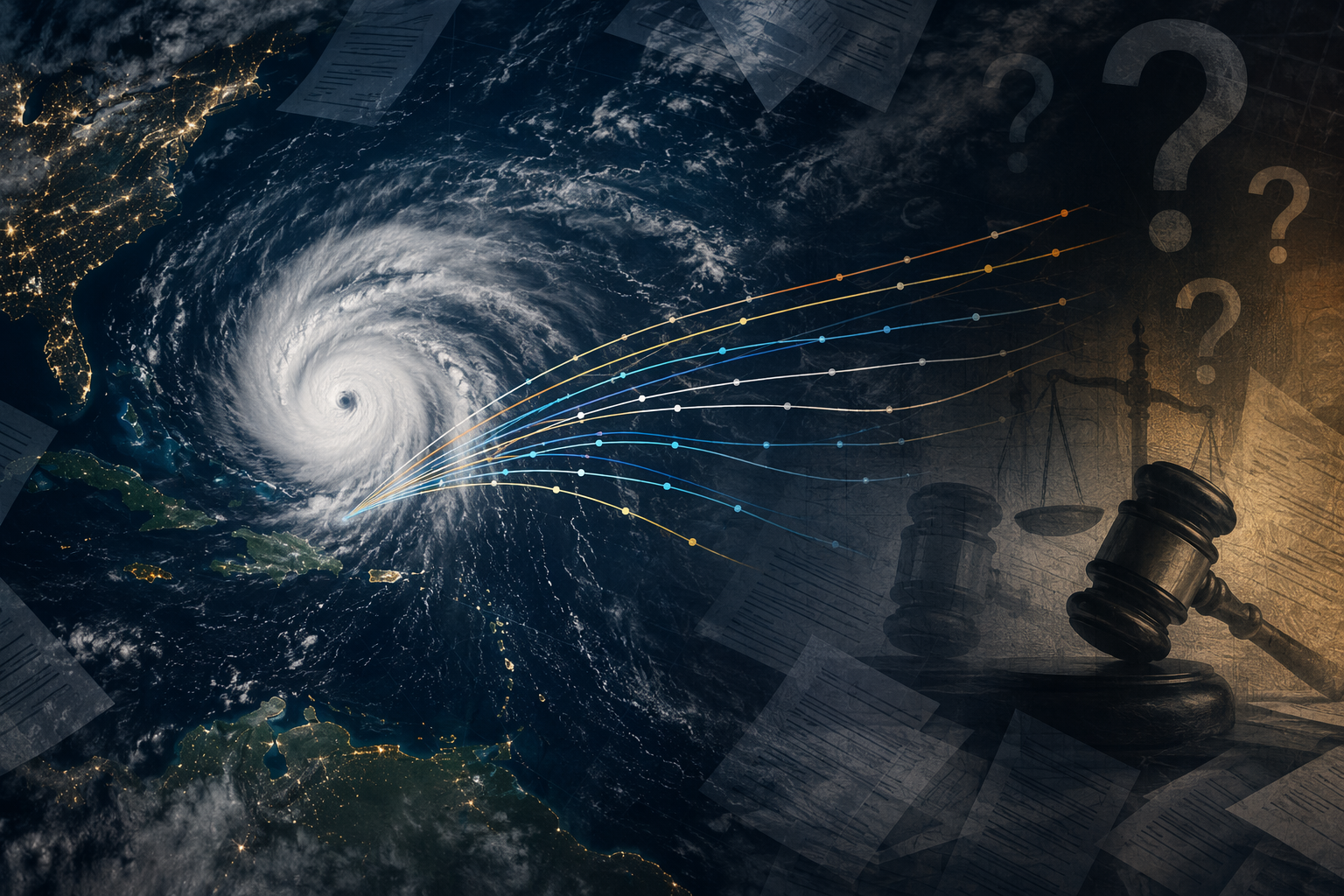
The physical limits are not just theoretical. A Rice University study published in March 2026 examined roughly 200 storms and found that some AI weather models “can look realistic while violating key aspects of atmospheric physics.”[4] That finding should be kept in its lane: the study evaluated Pangu-Weather and Aurora, not GraphCast, and it should not be inflated into a verdict on every operational AI model. Its narrower warning is still important for lawyers. A hurricane output may look usable to a non-modeler even when the system’s internal representation misses something physically consequential.
NHC Science Operations Officer Wallace Hogsett has described the present explainability problem plainly: “active research is ongoing to help forecasters understand not only the answer the model produces, but also why it produced that answer.”[5] That sentence matters more than the usual debate over whether AI will “replace” forecasters. It identifies the gap where liability arguments will live: between an answer accurate enough to influence conduct and a rationale still difficult to audit before people act.
The Wrong Forecast Is Not One Legal Event
A wrong hurricane forecast can fail in several legally different ways. A track error may put the cone too far east or west. An intensity error may leave officials underprepared for wind, surge, or rapid intensification. A timing error may compress an evacuation window. An explainability gap may prevent a forecaster or emergency manager from understanding why a model has diverged from other guidance. A training-data limitation may create a pattern of underestimating the very hazard that later causes loss.
Those distinctions matter because liability rarely turns on the abstract statement that “the forecast was wrong.” It turns on duty, reliance, causation, and reasonable conduct in a specific decision chain. Who selected the model? Who represented its reliability? Who saw the caveats? Who retained discretion? Who had the institutional capacity to challenge the output before it was operationalized?
| Failure mode | Why it matters legally |
|---|---|
| Track error | Often compared against historical forecast performance and alternative guidance available at the time. |
| Intensity error | May affect preparation decisions differently from track, especially where physical or training-data limitations are alleged. |
| Explainability gap | Complicates whether a human actor meaningfully exercised judgment or merely passed along an opaque output. |
| Training-data limitation | Can shift attention toward model design, validation, warnings, and known systemic bias. |
| Unsupported reliance | Places scrutiny on the emergency manager, insurer, or other professional who converted the forecast into action. |
The same miss can therefore produce different exposure theories. A federal agency may argue that forecasting remains protected discretionary judgment. A model developer may face allegations about defective design, inadequate warnings, or misleading reliability claims. A downstream professional may be asked why the AI forecast was treated as sufficient without corroboration. None of those theories is cleanly settled for operational AI hurricane forecasts.
Federal Forecasting Immunity Was Built Around Human Judgment
The historical anchor is the Federal Tort Claims Act and, more specifically, the discretionary function exception. Public weather forecasting has long benefited from the idea that forecast judgments involve policy-laden discretion rather than ordinary operational negligence. Secondary summaries of cases such as Bergquist v. United States National Weather Service and Taylor v. United States describe courts as reluctant to impose tort liability for allegedly negligent federal weather forecasts, and a Bulletin of the American Meteorological Society article captured the practical point in its title: “Bad Weather? Then Sue the Weatherman!”[6]
That reluctance is administrable for familiar reasons. Forecasting is uncertain. Public warnings serve many constituencies at once. Over-warning carries costs; under-warning carries different ones. Agencies should not be forced to defend every cone shift, advisory phrase, or model-weighting decision after the storm, with hindsight supplying a confidence that no forecaster had in real time.
AI does not erase those reasons. It does, however, put pressure on one of the assumptions underneath them. The discretionary function exception protects judgment. If an agency forecaster weighs multiple models, evaluates uncertainty, and issues an advisory, the doctrine has a recognizable human decision to protect. If an operational AI system generates a forecast product through a process that even specialists are still working to explain, the protected act becomes harder to locate. Is the discretion in the agency’s original procurement decision? In the decision to deploy the model? In the forecaster’s later use of it? Or in each automated forecast run?
No U.S. court has answered that question for AI-generated hurricane forecasts. The safest reading, for now, is not that federal immunity disappears, but that the immunity analysis becomes more fact-dependent. A plaintiff will look for a ministerial representation: the agency adopted a system, described it as operational, embedded it in workflows, and allowed downstream users to rely on it without adequate caveats. The government will answer that model selection, warning issuance, and uncertainty communication remain discretionary forecasting functions.
NOAA’s December 2025 deployment makes that dispute less hypothetical. AIGFS, AIGEFS, and HGEFS were not merely outside tools observed from afar; NOAA described them as a new generation of operational global weather models.[2] Once AI outputs sit inside the same public forecasting architecture that has historically relied on immunity, courts may be asked whether an old doctrine protects a new kind of machine-produced intermediate judgment.
For counsel advising public agencies, the immediate legal question is not whether a claimant can defeat the discretionary function exception in the abstract. It is whether the record shows continuing institutional judgment. Documentation matters: what validation was reviewed, what limitations were known, how caveats were communicated, when humans could override outputs, and how alternative guidance was considered. The more an agency record looks like a passive relay of AI output, the more inviting it becomes for a plaintiff to argue that no protected discretion was exercised at the decisive point.
AI Developers Face Product-Liability Pressure, But Not a Settled Rule
Developer exposure is the second corner of the map. It is tempting to state the issue too simply: if AI forecasts are products, product liability applies; if they are services or scientific opinions, it does not. The actual legal movement is messier. Brookings analysis by John Villasenor has argued that products-liability law offers one possible framework for addressing AI harms, but that is a policy and legal analysis rather than a binding weather-model rule.[7] Lawfare commentary by Catherine Sharkey likewise treats AI products liability as an emerging field whose categories are still being tested.[8]
The practical plaintiff theory is easy to imagine. A developer trained, validated, marketed, or licensed an AI forecasting model. The model produced a hurricane output that downstream actors foreseeably relied on. The output failed in a way linked to known limitations. The developer either overstated reliability, failed to warn about the relevant failure mode, or released a system whose design was defective for the foreseeable use.
What makes that theory difficult is not the absence of harm; it is classification. A hurricane forecast is information, but it may be generated by software. It may be embedded in an agency process, but designed by a private entity. It may be probabilistic, but presented through interfaces that encourage operational reliance. It may be free research output in one context and a licensed decision-support tool in another. Product-liability law is more comfortable with a defective physical device than with a probabilistic model whose failure appears only after an atmospheric event unfolds.
The direction of travel is nevertheless worth watching. K&L Gates’ March 2026 AI litigation tracker noted that the EU Product Liability Directive treats software and AI systems as products for liability purposes, with member-state transposition due by December 2026.[9] That does not make EU law controlling in a U.S. hurricane case. It does give plaintiffs, regulators, and courts a concrete example of a legal system refusing to keep AI outside product-liability categories merely because the harm flows through software.
The Air Canada chatbot decision is another pressure point, but it should not be asked to do too much. In 2024, the Civil Resolution Tribunal of British Columbia rejected Air Canada’s attempt to avoid responsibility by treating its chatbot as a separate legal actor, a case Pinsent Masons covered as an AI liability warning.[10] The case involved customer-service information, not hurricane forecasting, public warnings, or atmospheric models. Its more limited lesson is that courts and tribunals may be unsympathetic when organizations try to separate themselves from AI systems they deploy to the public.
Developer-side risk will also depend on how the model enters use. ECMWF announced that its AIFS became operational in February 2025 and reported a 20% track improvement over the previous top ensemble.[11] That kind of operational milestone is technically impressive, but legal significance depends on surrounding facts: who controlled deployment, what representations accompanied the model, whether warnings addressed known limitations, and whether users were told when human meteorological judgment remained necessary.
Pending U.S. legislative debates cut in both directions. Reporting on proposed AI liability protections, including the Lummis AI civil-liability bill, indicates that lawmakers are considering whether and when AI developers should receive shields from lawsuits.[12] A bill is not a rule unless enacted, and even an enacted rule would require careful reading. But the presence of such proposals confirms that developer liability is no longer an academic edge case.
Professional Users May Become the Residual Defendant
If federal immunity remains strong and developer liability remains unsettled, the professional who operationalized the forecast may become the most reachable defendant. That is not because emergency managers, insurers, hospital administrators, and infrastructure operators are the most culpable actors. It is because they make the decision that most visibly connects forecast to consequence.
An emergency manager does not merely “use” a forecast. The office decides whether to recommend evacuation, when to open shelters, how to message uncertainty, and how to coordinate with neighboring jurisdictions. An insurer does not merely read a model output. It prices risk, adjusts exposure, buys reinsurance, or decides how much confidence to place in a seasonal or event-specific hazard view. Those are professional judgments, and professional judgments invite standard-of-care questions.
The difficulty is that there is no mature standard of care for AI-informed hurricane decisions. It is easier to say what bad facts would look like. A professional treats a single AI output as dispositive. The output conflicts with official guidance or other models, but no one investigates the divergence. The user never reviews known limitations. The organization lacks a protocol for documenting why it accepted or rejected an AI signal. After the loss, the file contains the forecast but not the judgment.
The opposite record is not a guarantee against liability, but it is more defensible. It shows that AI was one input among several; that official NHC guidance, ensemble spread, local vulnerability, and operational constraints were considered; that uncertainty was communicated rather than shaved away; and that someone with relevant authority retained discretion. A court may still second-guess the decision. It will have a harder time treating the professional as someone who simply outsourced judgment to a machine.
Insurance presents its own version of the same problem. If an AI model underestimates hurricane intensity or landfall risk, the dispute may not look like a wrongful evacuation case. It may look like underpriced exposure, inadequate reserves, disputed underwriting assumptions, or miscommunication with reinsurers. The relevant question becomes whether reliance on the model was reasonable in light of its disclosed limits, available alternatives, and the sophistication of the user.
Accuracy Metrics Will Be Evidence, Not Answers
Forecast verification data will matter in litigation, but it will not settle the case by itself. NHC’s 2025 track-error performance gives agencies and users a strong baseline argument that the forecasting environment was improving rather than deteriorating.[3] GraphCast’s performance during Hurricane Melissa gives AI advocates a concrete example of superior track accuracy in a high-profile storm.[1] ECMWF’s AIFS operational result supplies another data point for the proposition that AI weather models can improve track guidance.[11]
Those facts may help defeat a claim that AI reliance was categorically unreasonable. They do not defeat a narrower claim that the specific output failed in a known way, that warnings were inadequate, or that the defendant over-relied on a metric that did not measure the relevant hazard. Mean track error is not peak intensity error. A five-day average is not a county-level evacuation decision. A season-level improvement is not proof that a particular forecast was fit for a particular downstream use.
The Rice study is especially useful on this point because it separates visual or statistical plausibility from physical fidelity. It does not prove that every AI hurricane forecast is suspect. It does warn that realistic-looking outputs can conceal limitations that a non-specialist user may not detect.[4] That is the kind of evidence that can change a case from “the forecast was unlucky” to “the defendant should have known what this model could not reliably represent.”
The Record Counsel Should Want Before the Storm
The legal file for AI hurricane forecasting cannot be built after landfall. It has to exist before the forecast becomes controversial. For public agencies, that means preserving why an AI model was selected, how it was validated, how it was integrated with human forecasting, and what instructions governed conflicting guidance. For developers, it means disciplined statements about performance, known limitations, intended uses, and uses that require independent meteorological review. For professional users, it means decision records that show how the forecast was weighed against other evidence.
- Identify the decision owner: name the office or role that can accept, reject, or qualify an AI forecast.
- Preserve model context: keep version, source, timestamp, input assumptions, and any disclosed limitations.
- Record divergence: document when the AI output conflicts with official guidance, physics-based models, or local observations.
- Separate metrics: avoid treating track accuracy as proof of intensity, surge, rainfall, or operational-decision accuracy.
- Keep human discretion visible: show who reviewed the output and why the final action was reasonable at the time.
This is not paperwork for its own sake. It answers the liability questions that will later be asked with less patience: who knew what, who had authority, what uncertainty was available, and whether the organization treated AI as decision support or decision substitute.
A Shared-Exposure System
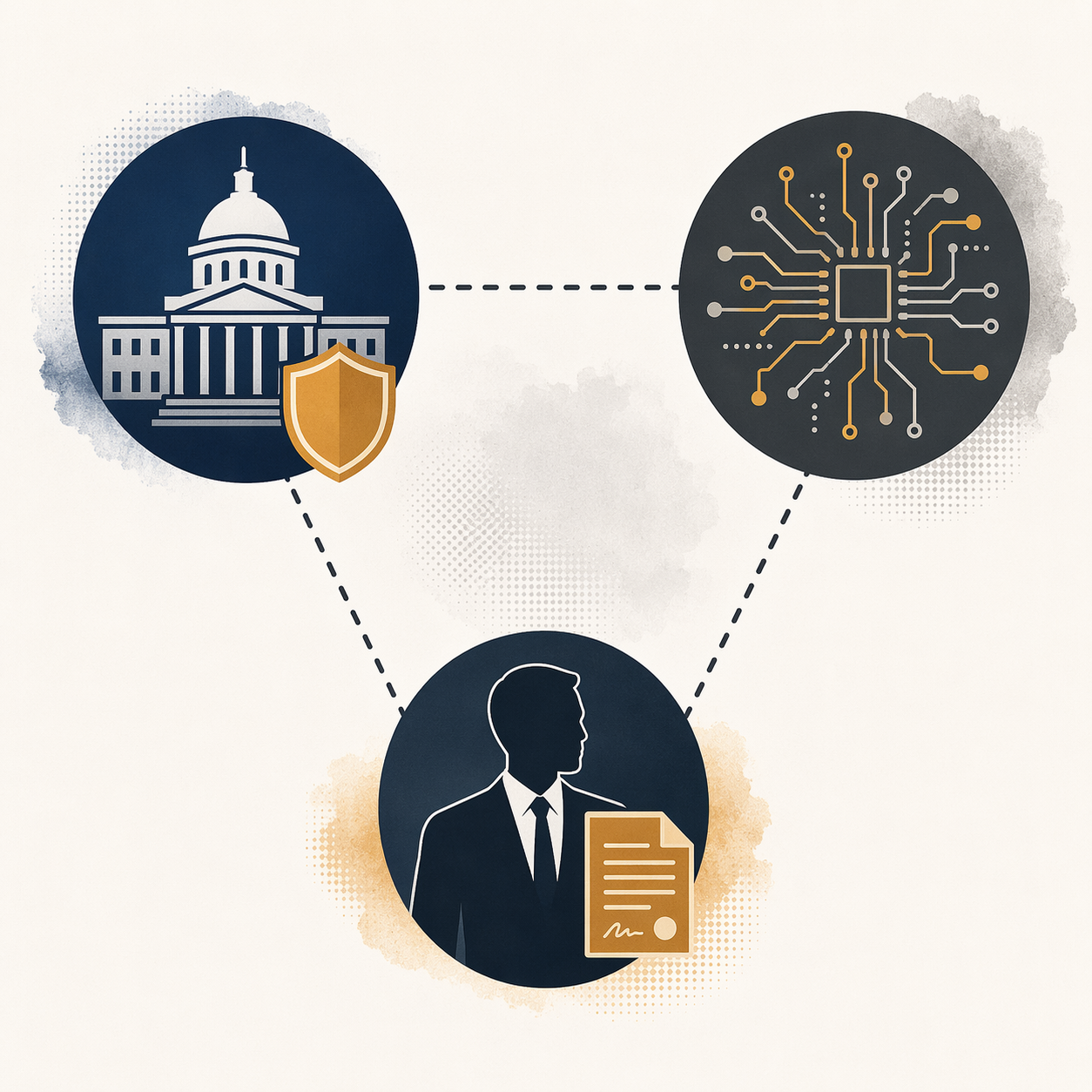
AI hurricane forecasting accuracy has improved enough to enter serious operational use, but the legal implications remain unsettled. Federal agencies still have the strongest historical shield through discretionary function doctrine, yet AI-generated outputs complicate the human-judgment premise that makes the doctrine easiest to administer. Developers face increasing pressure from product-liability theories, EU software-as-product treatment, chatbot-liability reasoning, and legislative debate, but those materials are not yet a clean U.S. rule for weather models. Professional users face the residual risk that comes from turning probabilistic forecasts into evacuations, underwriting assumptions, and public instructions.
Until courts or legislatures clarify immunity, product status, and the standard of care for AI-informed disaster decisions, counsel should treat operational AI hurricane forecasting as a shared-exposure system. The key question after a damaging miss will not be whether AI was accurate on average. It will be whether each institution understood the limits of the forecast it chose to trust.
References
- The future of hurricane forecasting is AI — NPR, Nov 2025.
- NOAA deploys new generation of AI-driven global weather models — NOAA, Dec 2025.
- NHC Official Forecast Verification — nhc.noaa.gov, updated Jul 2026.
- AI weather models show promise for hurricane forecasts, but new Rice study finds key physical limitations — Rice University, Mar 2026.
- AI in Hurricane Forecasting at NHC — Q&A with Science Operations Officer Wallace Hogsett — weather.gov.
- BAD WEATHER? THEN SUE THE WEATHERMAN! — Bulletin of the AMS, Vol. 83, No. 12.
- Products liability law as a way to address AI harms — Brookings, 2019.
- Products Liability for Artificial Intelligence — Lawfare.
- AI Product Liability: The Next Wave of Litigation — K&L Gates, Mar 2026.
- Air Canada chatbot case highlights AI liability risks — Pinsent Masons, Feb 2024.
- ECMWF's AI forecasts become operational — ECMWF, Feb 2025.
- New GOP bill would protect AI companies from lawsuits — NBC News.
Comments
Join the discussion with an anonymous comment.