
Full profile
The most common AI legal advice disclaimer starts and ends with one sentence: the chatbot is not a lawyer, and nothing it says is legal advice. That sentence is useful. It is also too thin for the places law firms are now putting AI: intake forms, website chatbots, client portals, draft generators, research assistants, and internal triage tools.
The harder questions arrive after the user has already typed facts into the box. Did the person understand that no attorney-client relationship was formed? Did the warning say anything meaningful about confidentiality or privilege? Was the AI output marked as unreviewed? Did the firm disclose where client data goes? Does the disclaimer fit the jurisdiction whose ethics rules apply?
Those are separate risk vectors. A disclaimer that handles one of them may still fail the others. The useful AI legal advice disclaimer examples are not the ones with the most polished prose; they are the ones that make the workflow safer before anyone has to explain it to a client, a court, a bar investigator, or a firm risk committee.
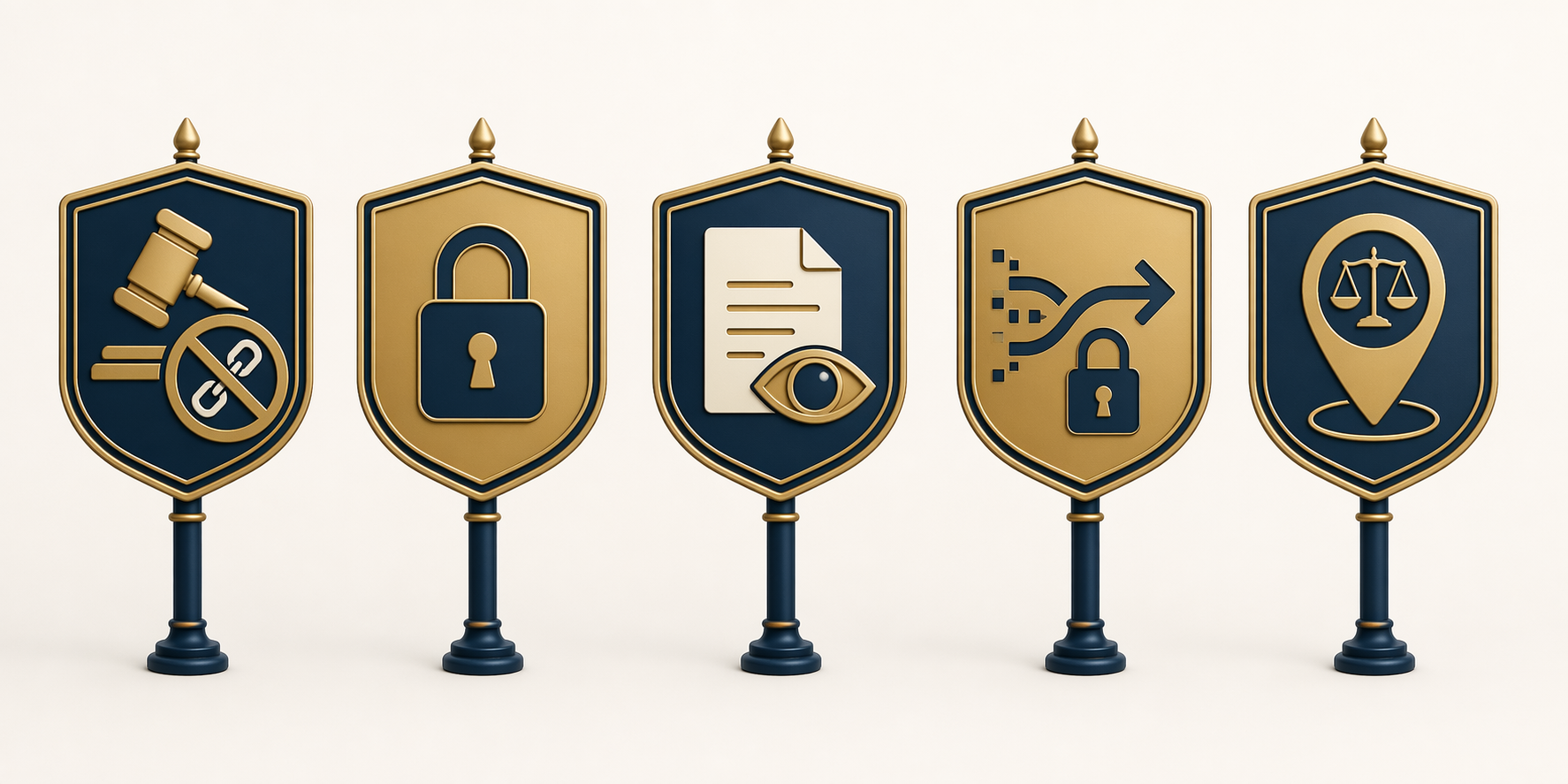
The Five Vectors a Legal AI Disclaimer Has to Cover
Real-world examples show the pattern quickly. Bell Law Group’s AI disclaimer covers the familiar no-legal-advice ground and includes confidentiality-oriented language.[1] Beltz Law Group’s chatbot disclaimer is valuable because it appears before the user starts interacting with the bot, which is where a chatbot warning belongs.[2] The Florida Bar’s LegalFuel guide includes optional sample language, including a client consent clause.[3] Texas Bar Practice offers a model chatbot disclaimer that gathers several of the right components in one place.[4]
Read side by side, however, these examples also show why copying a disclaimer is a poor substitute for mapping the risks. The table below is not a compliance scorecard. It is a diagnostic pass: what does each example make visible, and where would a lawyer still need to verify, revise, or layer additional notice?
| Example | What it usefully covers | Where the drafting risk remains |
|---|---|---|
| Bell Law Group AI Disclaimer | No legal advice and confidentiality-oriented warnings.[1] | A firm still needs to test whether the language is specific enough for AI data flows and privilege consequences. |
| Beltz Law Group ChatBot Disclaimer | Pre-interaction placement before chatbot use.[2] | Placement is strong, but a single front-end notice may not reinforce limits at the point where sensitive facts are requested. |
| Florida Bar LegalFuel sample | Optional sample disclaimer and client consent language.[3] | Optional Florida-oriented language should not be treated as a national template. |
| Texas Bar Practice chatbot model | A practical cluster of chatbot disclaimer components.[4] | The model still has to be adapted to the tool, vendor, client data, and governing jurisdiction. |
| PW Lawyers sample disclaimers | Structured disclaimer approaches for legal practitioners.[7] | The source is Australian, so U.S. firms can borrow drafting architecture, not jurisdictional conclusions. |
Vector 1: No Attorney-Client Relationship
This is the component most firms already know to include. A public chatbot or intake assistant should say, before the user submits facts, that using the tool does not create an attorney-client relationship and that the firm has not agreed to represent the user unless and until a separate engagement process is completed.
That language matters because AI systems can sound responsive in a way static website copy does not. A user who asks a legal question and receives a tailored-sounding answer may reasonably experience the interaction as advice, even if the firm intended it as screening or general information. The disclaimer’s job is to interrupt that assumption at the correct moment.
The better examples do not hide this notice in a footer. Beltz Law Group’s chatbot disclaimer is useful precisely because the warning is attached to the chatbot interaction itself, rather than buried in a general website terms page that the user may never open.[2] For AI intake, placement is not cosmetic. A warning delivered after the user has disclosed the problem arrives too late to do much work.
A workable relationship disclaimer should therefore answer four practical questions: who is not representing the user, what interaction does not create representation, what event would create representation, and what the user should avoid sending until that event occurs. The last item is where many disclaimers become too polite. If the firm does not want prospective clients sending privileged or confidential facts to an AI tool, the notice should say that plainly.
Vector 2: Confidentiality and Privilege Are Not Solved by Saying “Not Legal Advice”
The privilege problem is the least forgiving part of the exercise. A no-legal-advice disclaimer tells the user what the AI output is not. It does not necessarily tell the user what happens to the input. In a chatbot or AI intake workflow, the input is often the dangerous material: names, dates, allegations, diagnoses, strategy, admissions, documents, or employment facts.
The SilverCain discussion of Heppner and Warner is useful here because it presses on a point many disclaimers avoid: privilege may be affected by the privacy terms and data practices of the AI system itself, particularly where consumer-tier tools or third-party platforms are involved.[5] These rulings are discussed through secondary analysis rather than official docket materials, so a firm relying on them should verify the primary sources. Even with that caveat, the drafting lesson is immediate: a disclaimer that says “not legal advice” but says little about confidentiality leaves the most sensitive part of the interaction underexplained.
Bell Law Group’s example is stronger than the thinnest templates because it does not limit itself to the legal-advice label; it also addresses confidentiality.[1] That is the right instinct. The remaining question is whether the language gives the user enough information to decide what not to disclose. “Do not submit confidential information” is better than silence, but the warning should be tied to the actual system: chatbot, form, third-party AI service, public-facing assistant, or internal client portal.
For a public law firm chatbot, the warning should not imply that privilege automatically attaches just because the user is seeking legal help. It should say, in ordinary language, that communications through the AI tool may not be confidential or privileged, that the firm may not yet represent the user, and that the user should not submit sensitive facts unless the firm has instructed them to do so through an approved channel.
For an existing client tool, the analysis changes but does not disappear. If the tool is used inside an active representation, the firm still has to control where the information goes and whether disclosure to a vendor, model provider, or external system is consistent with the client’s authorization and the lawyer’s confidentiality duties. The better drafting does not pretend every AI interaction has the same privilege posture.
Vector 3: Human Review Must Be More Than an Internal Promise
A legal AI disclaimer should tell the user whether the output has been reviewed by a lawyer. If it has not, the notice should not blur that fact with friendly language about “assistance,” “support,” or “general guidance.” A chatbot response, draft clause, issue spotter, or intake summary can be useful and still be unreviewed.
Texas Bar Practice’s model is helpful because it treats the chatbot disclaimer as a cluster of components rather than a single talismanic sentence.[4] That is closer to how these tools actually operate. The user needs to know both that the AI is limited and that any legal judgment must come from a qualified human reviewer.
This point is not only about client expectations. It connects directly to supervision and competence. If a firm tells clients that AI may be used in delivering services, the firm should also be able to show how lawyers review the output before it becomes advice, work product, a filing, a demand letter, or a client-facing recommendation. A disclaimer cannot perform the review. It can, however, stop the reader from mistaking an unreviewed machine output for the firm’s final legal judgment.
That is why the disclaimer should fit the workflow. A public chatbot can say that responses are automated, general, and not reviewed for the user’s specific legal matter. A client portal might say that AI-assisted drafts or summaries are subject to attorney review before the firm relies on them. An internal tool may need a different notice for lawyers and staff: AI output must be verified before use, and responsibility remains with the supervising lawyer.
For adjacent governance work, the disclaimer should be paired with actual supervision controls, not left to carry the policy alone. The human-review language belongs with a broader duty-to-supervise framework, and verification practices belong with an AI hallucination audit process. Useful internal companions include The Lawyer’s Duty to Supervise AI Tools and A Six-Phase AI Hallucination Audit Checklist.
Vector 4: Data Handling Has to Be Specific Enough to Support Consent
Data-handling language is where many AI disclaimers become vague just when they need precision. A user does not need a vendor security white paper in the chatbot window. But the disclaimer should not pretend that “we may use AI” tells the client enough to evaluate confidentiality, retention, model training, third-party processing, or access controls.
ABA Formal Opinion 512 is the pressure test. The opinion’s framework, as discussed by the ABA Business Law Section, treats generic consent for use of client confidences in generative AI as insufficient where informed consent is required; the client needs information specific enough to understand the relevant risks and implications.[6] That makes boilerplate AI consent a weak foundation. “We use technology to improve efficiency” does not tell a client whether their information is being submitted to a public model, a private instance, an enterprise tool with contractual restrictions, or a vendor that retains prompts.
The Florida Bar’s LegalFuel guide is notable because it includes optional sample language with a client consent clause, not only a public-facing disclaimer.[3] That distinction matters. A website warning can tell a visitor not to submit sensitive information. An engagement-letter consent clause can address how the firm may use AI during the representation. They should be consistent, but they are not the same document.
A public disclaimer usually needs enough data-handling detail to prevent surprise: whether the chatbot is automated, whether submissions may be processed by third-party technology, whether the firm discourages confidential submissions through that channel, and where the user should send sensitive material instead. A client consent clause may need more: categories of tools, types of information, confidentiality safeguards, review procedures, and any material limitations. For firms drafting that second document, AI Consent Clauses for Engagement Letters is the more natural place to handle clause architecture.
The drafting mistake is to use one bland sentence for both audiences. A prospective client on a public website needs a boundary. An existing client being asked for consent needs a disclosure. A lawyer using an internal tool needs an instruction. Those notices can share vocabulary, but they do different work.
What the Better Examples Have in Common
The strongest examples are not necessarily the longest. They tend to do three things clearly.
- They place the warning before the risky interaction, especially for chatbots and intake forms.
- They separate relationship formation from confidentiality and privilege, instead of treating “not legal advice” as a cure-all.
- They tell the user whether AI output is automated, unreviewed, or subject to lawyer review.
- They give at least some tool-specific information about data handling rather than hiding behind generic technology language.
- They leave room for jurisdiction-specific updates instead of presenting one disclaimer as universally sufficient.
Bell Law Group and Beltz Law Group are useful because they show two different drafting instincts: substance and placement.[1][2] The Bell example gives more attention to the legal character of the interaction. The Beltz example demonstrates the value of confronting the user at the chatbot threshold. A firm building its own notice should want both: a visible pre-interaction warning and language that actually explains the relevant boundaries.
The Florida and Texas materials are useful for a different reason. They show how bar-adjacent resources are beginning to translate AI governance into practical drafting. The Florida Bar guide’s sample language is optional under Florida rules, while the Texas Bar Practice material offers a governance-oriented model rather than a binding national rule.[3][4] A compliance team should treat those sources as drafting aids, then check the governing rules and opinions for the jurisdictions in which the firm practices.
PW Lawyers’ sample disclaimers deserve a narrower use. Their structures may help a U.S. lawyer think about layered notices, client communications, and responsible generative AI use. But PW Lawyers operates in an Australian context, including New South Wales and Federal Court considerations, so the examples should not be imported as U.S. ethics analysis.[7]
Vector 5: Jurisdictional Disclosure Triggers Keep Moving
The fifth vector is the reason a universal AI legal advice disclaimer is risky even when the language is otherwise thoughtful. Disclosure expectations are not developing evenly across jurisdictions. Some authorities focus on competence and confidentiality. Others address client consent, court filings, billing, supervision, or specific uses of generative AI.
Spellbook’s state-bar chart, last updated June 20, 2026, is useful as a map of uneven development, not as a final fifty-state answer.[8] The research brief notes that no comprehensive source covering all state bars was found. That limitation should make a drafter more cautious, not less. If the firm practices across states, the disclaimer and related AI policy need a maintenance process.
Jurisdictional variation also affects what belongs in the disclaimer versus what belongs elsewhere. A public notice may need to avoid overpromising. An engagement letter may need client-specific consent. A court filing protocol may need certification, citation-checking, or disclosure steps. A billing policy may need to explain how AI-assisted work is charged. For the billing side of Formal Opinion 512, firms should handle the details in a separate policy such as Generative AI Billing Policies for Law Firms, not by stuffing every governance issue into the chatbot warning.
A Layered Notice Works Better Than a Longer Paragraph
The practical answer is not to write a single dense disclaimer that tries to do everything. The better workflow is layered.
| Layer | Where it appears | What it should accomplish |
|---|---|---|
| Pre-interaction warning | Before chatbot or intake use | Stop the user before they submit sensitive facts. |
| Relationship boundary | Chatbot, intake page, website terms | State that no attorney-client relationship is formed without a separate engagement. |
| Privilege and confidentiality warning | At the point of factual submission | Explain that communications through the AI tool may not be confidential or privileged. |
| Human-review notice | AI output, portal, internal workflow | Clarify whether responses are automated, unreviewed, or subject to lawyer review. |
| Data-handling disclosure | Disclaimer, privacy notice, engagement letter | Describe AI processing, third-party involvement, and limits with enough specificity for the setting. |
| Jurisdictional update process | AI governance policy | Track state-bar, court, and ethics-opinion requirements over time. |
That structure is more defensible because it matches the moment of risk. The person opening a chatbot needs a short warning before typing. The client signing an engagement letter needs a more specific consent discussion. The associate pasting a draft into an AI tool needs an internal instruction. The partner reviewing the final work needs verification obligations. The disclaimer is one part of that system, not the whole system.
It also keeps the disclaimer readable. A notice can be professionally adequate without sounding like a litigation hold letter. The discipline is to put the right warning in the right place, then connect it to the policy, engagement letter, privacy notice, and supervision process that carry the heavier detail.
How to Judge an AI Legal Advice Disclaimer Example Before Borrowing It
Before reusing any example, run it through the five vectors rather than asking whether it sounds lawyerly. The review can be blunt.
- Relationship: Does it clearly say that using the AI tool does not create an attorney-client relationship?
- Privilege: Does it warn that communications through the tool may not be confidential or privileged?
- Review: Does it say whether AI responses are automated, unreviewed, or subject to attorney review?
- Data: Does it disclose, at the right level of detail, how information may be processed or shared?
- Jurisdiction: Has the language been checked against the rules, opinions, and court requirements that actually govern the firm’s work?
If the answer is no on privilege or data handling, the disclaimer is not merely incomplete in a stylistic sense. It is incomplete at the point where the professional risk is most likely to become expensive. If the answer is no on human review, the firm may be letting users mistake an AI response for legal judgment. If the answer is no on jurisdiction, the firm may be relying on a template built for someone else’s ethics landscape.
Disclaimers also should not be used to lower the standard of legal work. A firm cannot solve hallucinations, supervision failures, or competence problems by telling the user that AI is imperfect. Those duties persist. For the broader competence analysis, see Beyond Cite-Checking: Duty of AI Competence. For a parallel risk framework in a specific workflow, Four Risk Categories for AI Deposition Summary Tools shows how confidentiality, professional responsibility, hallucination, and preservation risks separate in practice.
The final drafting judgment is straightforward: an adequate AI legal disclaimer is not one paragraph with stronger wording. It is a layered notice system matched to the tool’s use. Real examples are valuable because they show available drafting moves, but none should be treated as complete without primary-source verification in the relevant jurisdiction and a clear account of the tool’s actual data flow.
References
- AI Disclaimer, Bell Law Group.
- ChatBot Disclaimer, Beltz Law Group.
- Guide to Getting Started with AI, The Florida Bar LegalFuel.
- AI Policy and Governance, Texas Bar Practice.
- AI Disclaimers, Terms of Use, and the Illusion of Free Legal Advice, SilverCain.
- ABA Ethics Opinion on Generative AI Offers Useful Framework, American Bar Association Business Law Today, October 2024.
- Using Generative AI Responsibly: Sample Disclaimers for Legal Practitioners, PW Lawyers.
- State Bar Rules on AI Use, Spellbook, June 20, 2026.
Comments
Join the discussion with an anonymous comment.