
Full profile
A pro se legal information site can add an AI chat box in an afternoon. The harder question is whether that new feature has moved the site out of the old legal-information lane and into a compliance field where state unauthorized-practice rules, court filing certifications, and direct-liability theories all operate at once. That is the practical problem behind AI policy for pro se legal information sites: the user may experience one conversation, but the operator is exposed to several legal systems that do not coordinate with each other.
The familiar banner — “not legal advice” — still matters, but it no longer does the work many operators want it to do. Before conversational large language models became common, ethics scholarship already treated AI assistance to self-represented litigants as a UPL and professional-responsibility problem, especially when software helped users select claims, complete forms, or decide what to file. Brimo’s 2022 Georgetown Legal Ethics Journal article is useful precisely because it predates the ChatGPT-era scramble: it shows that the legal-information versus legal-advice problem was not invented by generative AI.[1] What changed after that baseline is the product surface. A static guide can say “here are common defenses.” A conversational model can ask follow-up questions, synthesize facts, produce a pleading, and sound confident while doing it.
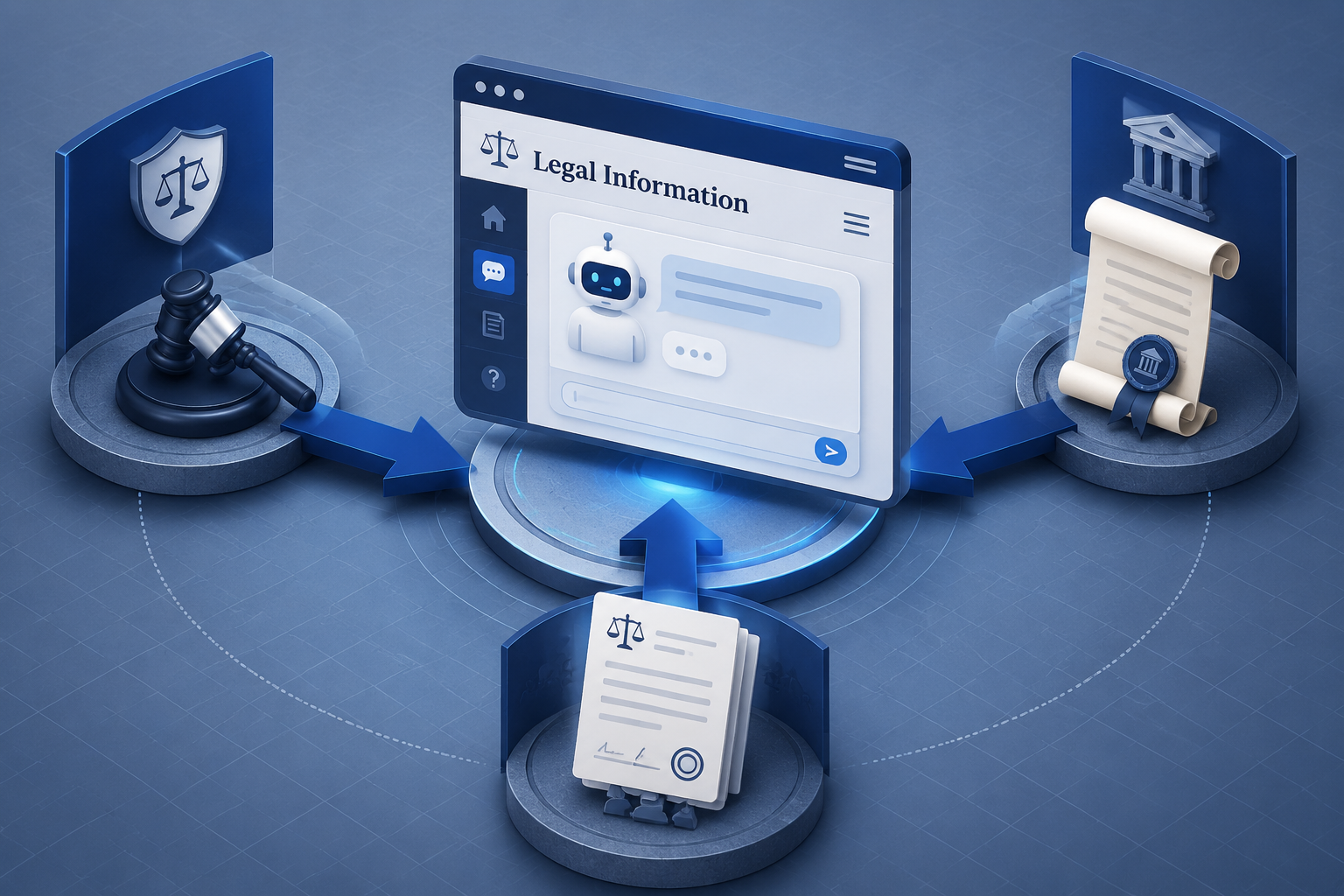
That is why a launch review has to begin with three concurrent questions, not one. Is the feature practicing law under any state definition that may apply? Could the user’s later filing trigger court disclosure, verification, or certification duties? And could the platform itself face liability even if the user is the one who files the document? Treating those questions as separate “legal issues” understates the operational problem. A single answer generated for a tenant, employee, debtor, or family-court litigant can travel from the website, to a draft pleading, to a court certification, to a sanctions hearing or platform-liability complaint.
The old information/advice line is now a product-design problem
The usual distinction is easy to state and hard to build around. Legal information describes law in general terms. Legal advice applies law to a person’s facts and recommends a course of action. In a brochure, that line can be managed with editorial discipline. In a chatbot, the line becomes an interaction pattern.
A2J Lab’s 2026 analysis of general-purpose AI and UPL scrutiny is the right starting point because it refuses to pretend that UPL is nationally uniform. It contrasts Alaska’s comparatively narrow approach, where “holding out” as entitled to practice law is central, with Georgia’s more expansive definition, which reaches a broad set of activities associated with legal practice.[2] That contrast is not an academic curiosity for a national pro se site. It changes how a feature should ask questions, route users, generate text, and decide when to stop.
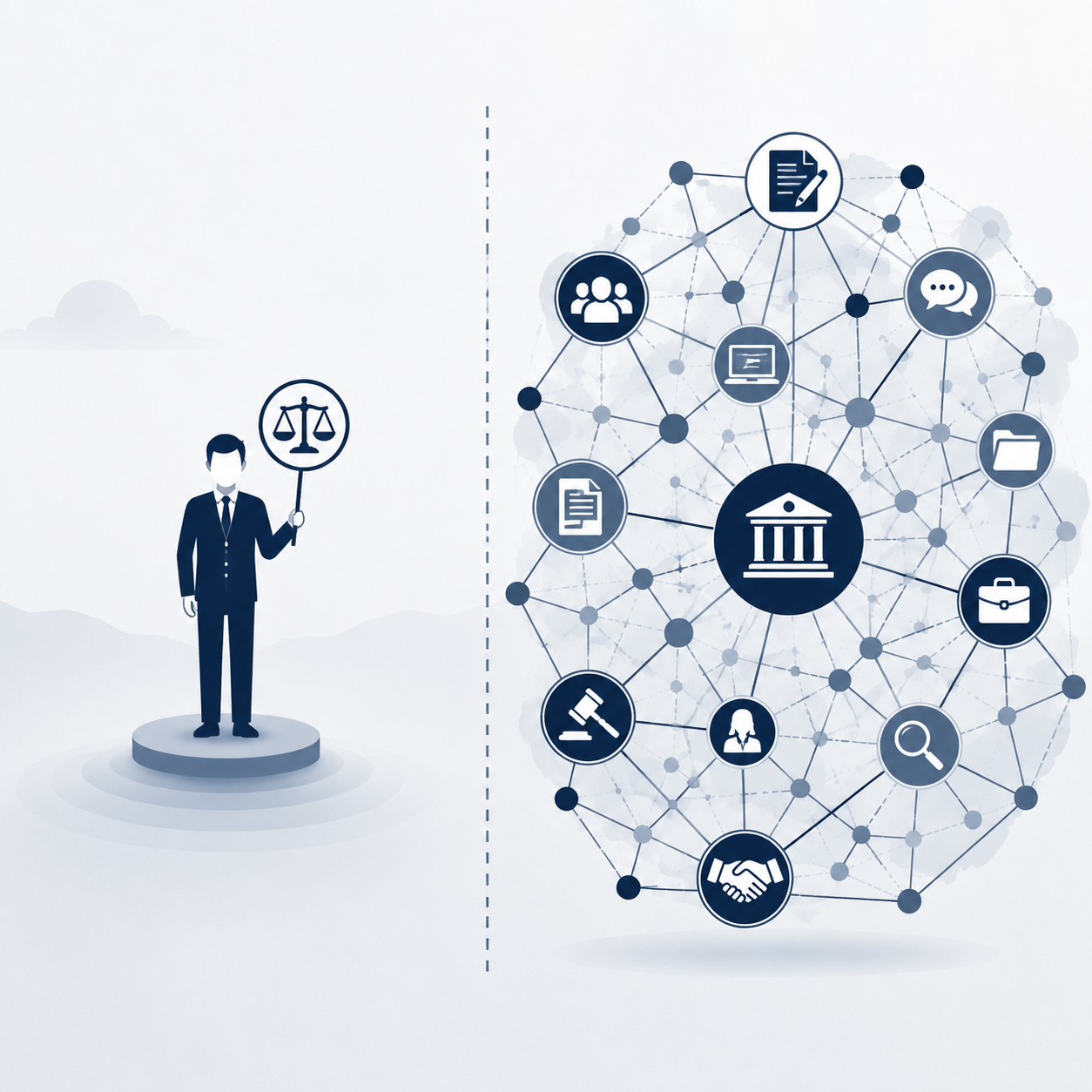
Under a holding-out-centered analysis, the operator’s representations matter intensely. Does the interface imply that it is acting as a lawyer? Does it present itself as a substitute for counsel? Does it produce answers in the voice of legal authority rather than general education? Under a broader state definition, the inquiry may not stop with branding. The same product behavior — selecting claims, tailoring arguments, drafting allegations, or advising whether a deadline applies — may look like legal practice even if the site carefully avoids lawyer-like language.
This is where many AI policies become too thin. They say the tool provides only general legal information, then permit the interface to do the very thing the policy disclaims. A user types, “My employer fired me after I complained about unpaid overtime. What should I file?” The model answers with a claim theory, a venue suggestion, a limitations warning, and draft complaint language. Even if each sentence is phrased cautiously, the sequence has moved from general education toward fact-specific legal guidance.
The harder design question is not whether the site can write a better disclaimer. It is whether the system can reliably recognize jurisdiction, procedural posture, subject matter, user role, and the point at which a general explanation becomes a recommendation. If it cannot, the operator should not design as if the most permissive jurisdiction controls every interaction. A site serving users across state lines has to assume that the same chat transcript may be judged under a less forgiving UPL definition than the one its product team had in mind.
| Compliance dimension | Question for the operator | Why it changes the product |
|---|---|---|
| State UPL law | Could this interaction be treated as practicing law in any relevant jurisdiction? | It affects intake questions, model permissions, drafting limits, escalation rules, and state-by-state availability. |
| Court AI orders | Could the user later have to disclose, verify, or certify AI use in a filing? | It affects user warnings, document history, filing workflows, and audit trails. |
| Direct platform liability | Could the provider be sued for the substance or consequences of the AI output? | It affects risk allocation, monitoring, terms, insurance, and whether certain legal tasks should be offered at all. |
The table is intentionally spare because the hard work is not taxonomy. It is deciding what the product must not do for certain users, in certain states, at certain procedural moments. An operator that cannot answer those questions before launch is not solving access to justice; it is outsourcing the risk to the self-represented person least equipped to identify it.
State UPL variation is not a footnote
The legal-information/advice boundary is often presented as if it were a national bright line. It is not. A2J Lab’s Alaska-versus-Georgia contrast shows why a single national AI behavior policy can be overconfident even when it is written in good faith.[2] The relevant issue is not merely what the operator intends. It is how state law characterizes the activity, how the interface represents itself, and how much individualized legal direction the user receives.
Consider four product choices that look ordinary in a legal help chatbot:
- The bot asks for the user’s state and county, then says which court appears to be appropriate.
- The bot asks the user to describe facts, then identifies the strongest claim or defense.
- The bot fills pleading language using the user’s allegations.
- The bot warns that one filing route is risky and recommends another.
None of those choices is automatically unlawful in every setting. Some may be permissible when embedded in a court-approved form process, limited to neutral information, or supervised by lawyers. But they are not the same as publishing a general article about eviction defenses or wage claims. They are moments where the software applies legal categories to a user’s facts, and UPL analysis tends to care about that movement.
The product team’s instinct is often to solve this with jurisdiction selection. Ask where the user lives, serve the right rules, and move on. That is necessary but not sufficient. A person may live in one state, work in another, face a federal claim, file in state court, or ask about a dispute connected to a different jurisdiction. The chatbot may not know which fact controls. Worse, the user may not know either. The compliance design has to assume uncertainty, not treat every location field as a reliable legal conclusion.
A practical state-law screen therefore needs more than a terms-of-use page. It needs a map of prohibited or lawyer-supervised functions by jurisdiction, a classification system for high-risk tasks, and a way to degrade the interaction when the system cannot place the user safely. “Degrade” does not have to mean abandon the user. It can mean giving general information, linking to official forms, explaining what facts a court commonly asks for, or suggesting that the user contact legal aid without selecting a claim or drafting a filing.
Upsolve’s public terms offer a familiar example of legal-information positioning: the service distinguishes educational material from legal advice and says it does not create an attorney-client relationship.[10] That kind of language is useful as a boundary marker. It is not, by itself, a control. The control is what the software actually does after the user starts describing a problem.
The court-order layer follows the document
A pro se site operator may think the only regulatory question is whether the website gave legal advice. Courts have been building a second layer: rules and standing orders that ask filers to disclose, verify, or certify the use of generative AI. That layer attaches downstream, at the courthouse door. The user may not learn about it until after the chatbot has produced the text.
Ropes & Gray’s AI Court Order Tracker reported, as of the research window for this article, more than 153 orders requiring disclosure or verification, 714 court materials addressing generative AI, five prohibiting AI outright, and 117 imposing consequences.[3] The exact count will keep moving because the tracker is dynamic. The direction is what matters for site operators: court AI policy is no longer a handful of judge-specific experiments that only large firms need to watch.
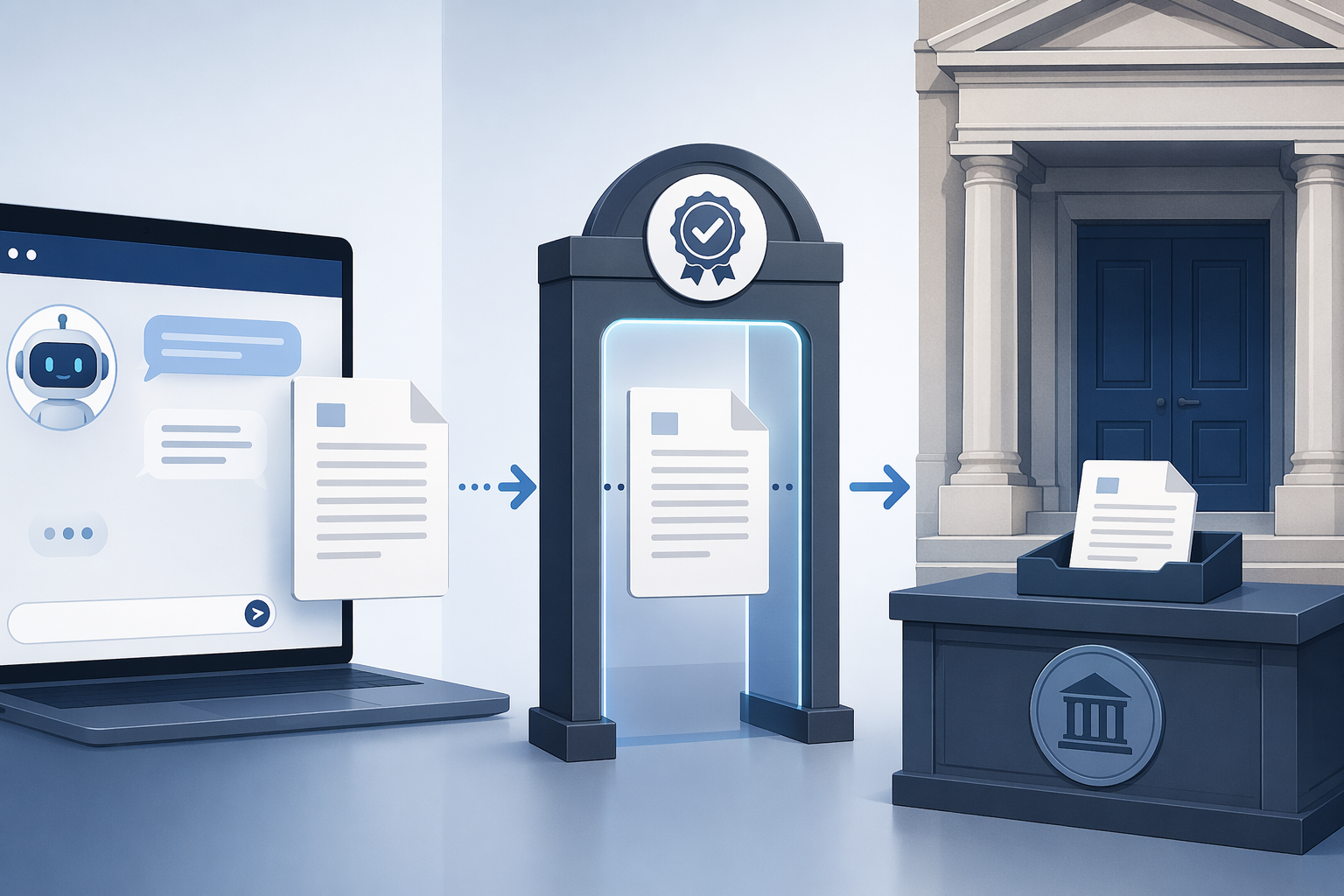
Miami-Dade Administrative Order 26-04, issued in January 2026, made the self-represented point explicit. It applies to attorneys and self-represented litigants and requires certification language when generative AI is used in preparing a filing.[4] That detail matters. Many AI governance discussions still imagine a lawyer reviewing output before anything reaches court. Pro se legal information sites cannot assume that professional review exists. Their users may be the certifying party.
Florida then moved from circuit-level variation toward a statewide rule. The Florida Supreme Court amended Rule 2.515(d)(2), effective June 15, 2026, to create a uniform certification standard for AI use in court filings and to preempt circuit-level orders.[5] For operators, that is both simplifying and sobering. A uniform rule can be easier to track than scattered local orders, but it also confirms that AI filing certification is becoming part of ordinary court procedure, not an optional ethics sidebar.
The compliance consequence is concrete. If a chatbot generates a complaint, motion, affidavit, declaration, or memorandum that a user later files, the platform should not treat that output as finished when the download button appears. The user may need to know whether AI was used, what was generated, what was verified, and whether the court requires a certification. A site that cannot answer those questions may leave the litigant choosing between silence, inaccurate certification, or procedural delay.
The sanctions examples now appearing in practice commentary show why this is not just formalism. FordHarrison’s June 2026 analysis described documented consequences including a $10,000 fine involving a Missouri pro se litigant, a $2,900 sanction in the Western District of Michigan, and the $5,000 sanction in Mata v. Avianca; it also discussed courts restricting AI use in mediation and a Seventh Circuit warning in Jones v. Kankakee County that “accuracy and honesty matter,” while declining to sanction a pro se plaintiff.[6] Those examples do not prove that every AI-assisted pro se filing is defective. They show that courts are willing to attach consequences to AI-related inaccuracies and disclosure failures.
The volume pressure is also rising in at least some dockets. Coverage of the Lex Machina 2026 Employment Litigation Report stated that pro se employment filings rose from under 10% in 2021 to over 16% in 2025, with AI cited as a driving factor.[7] That figure should be read carefully: it is an employment-litigation trend reported through coverage of a Lex Machina/LexisNexis source, not a universal measure of all pro se litigation. Still, it helps explain why court staff and defense counsel are paying attention. AI-assisted filings are not merely a product experience; they become docket events.
What the court layer requires from the platform
A court-order tracking process should sit next to the state UPL screen, not inside it. The questions are different. UPL asks whether the platform may provide the interaction. Court certification rules ask what the filer must say about AI use later. A workflow that respects one can still fail the other.
- Track court AI orders by jurisdiction, court type, and document type, with dates and preemption notes.
- Flag when output is likely to be filed rather than merely read.
- Maintain a user-visible record that distinguishes AI-generated text from user-entered facts.
- Require verification checkpoints before a user exports filing-ready text.
- Warn users when a court may require disclosure or certification, without telling them how to make a legal representation the platform cannot verify.
The most important word in that list is “may.” A national pro se site will not always know where a document will be filed. It may know only that the user is drafting something that looks like a court document. In that setting, the safer workflow is to preserve information and alert the user to check filing requirements, rather than act as if the absence of certainty means the absence of a duty.
Platform liability is moving upstream
The third compliance dimension is newer and less settled: claims aimed directly at AI providers or chatbot proprietors. This is where the analysis widens again. The operator cannot assume that risk attaches only to the user who files or to the lawyer who fails to verify.
The Nippon v. OpenAI lawsuit, filed in March 2026, seeks $10.3 million in damages and alleges that ChatGPT engaged in unauthorized practice of law in connection with pro se litigation assistance.[8] The merits remain to be tested, and a single lawsuit should not be treated as a national rule. Its significance is different: it frames the chatbot’s conduct itself as the target, not merely the user’s later misuse.
That theory is especially important for specialized pro se legal information sites because they are not general-purpose assistants accidentally answering a legal question. Their brand, audience, prompts, retrieval sources, and output templates may all show that legal self-help is the intended use. That can be a virtue when the system is carefully bounded. It can also make it harder to argue that the platform merely hosted neutral technology.
New York’s SB 7263 points in the same upstream direction. Holland & Knight’s March 2026 analysis describes the bill as creating a private right of action against chatbot proprietors whose systems provide substantive professional advice, and as preventing proprietors from avoiding liability through disclaimer language alone.[9] The bill is not a nationwide enactment, and proposed legislation should not be described as current universal law. Its value here is as a model of where liability arguments are going: away from user-only responsibility and toward the design, deployment, and commercialization of advice-like systems.
This is the point at which disclaimer drafting reaches its natural limit. A disclaimer can tell users that the tool is not a lawyer. It can help preserve the distinction between education and representation. It can reduce confusion when paired with a constrained interface. It cannot make an advice-generating system informational by declaration, and it cannot guarantee that a court, legislature, regulator, or plaintiff will accept the operator’s chosen label.
A launch framework that treats all three layers as live
A serious AI policy for pro se legal information sites should be built around concurrent controls. Sequential review is too slow and too brittle: the product may pass a general legal-information analysis, then fail a state-specific UPL screen; it may pass UPL review, then leave users without court certification information; it may handle filings responsibly, then ignore emerging claims against the proprietor.
The minimum framework has four parts.
- State-law screening: classify product functions by UPL risk across relevant jurisdictions, including where the user is located, where the dispute arises, and where filing may occur.
- Court-disclosure tracking: maintain a current map of AI filing orders, certifications, verification duties, prohibitions, preemption rules, and sanctions consequences.
- User-facing workflow controls: limit fact-specific recommendations, preserve AI-use history, distinguish user facts from generated text, and slow export when a filing is likely.
- Liability review: evaluate whether the platform’s intended use, marketing, prompts, training materials, and terms could support claims that the system itself delivered substantive legal advice.
The framework does not require abandoning AI for self-represented users. It does require being honest about who bears the cost of ambiguity. If a platform gives an overconfident answer, the pro se litigant may sign the filing. A clerk may reject it. A judge may demand a certification. Legal aid staff may be asked to repair the problem after a deadline has already started running. The operator’s internal belief that the tool was “only informational” will not undo those consequences.
The better access-to-justice design is narrower and more durable: give users usable legal information, make the limits visible in the workflow, stop before individualized legal direction where state law makes that risky, and carry court-disclosure obligations forward when the output becomes filing-ready. No single disclaimer, permissive jurisdiction, or policy source absorbs the others.
References
- How Should Legal Ethics Rules Apply When Artificial Intelligence Assists Pro Se Litigants? Georgetown Legal Ethics Journal, Fall 2022
- How Can General-Purpose AI Withstand UPL Scrutiny? A2J Lab, 2026
- Artificial Intelligence Court Order Tracker Ropes & Gray
- Disclosure of Use of Generative Artificial Intelligence by Attorneys and Self-Represented Litigants Miami-Dade Bar, January 2026
- Supreme Court amends rules to address AI use in court filings The Florida Bar
- Hey Claude – Write Me a Lawsuit: The Alarming Rise of Pro Se Plaintiffs Using AI Chatbots in Employment Law Claims FordHarrison, June 2026
- AI, pro se employment lawsuits: Lex Machina report Michigan Lawyers Weekly, April 22, 2026
- GPT, Esquire: How the Nippon Case May Shape the Future of AI in Pro Se Litigation Georgetown Legal Ethics Journal, 2026
- New York Bill Would Create Liability for Chatbot Proprietors Holland & Knight, March 2026
- Terms of Use Upsolve
Comments
Join the discussion with an anonymous comment.