
Full profile
“Redlining” can mean markup in a contract. That is not the problem here. This legal AI redlining workflow guide is about automated systems that sort, score, rank, approve, deny, price, or screen people in ways that may produce unlawful discrimination in lending, hiring, housing, insurance, and adjacent eligibility decisions.
The important point is that AI does not need to ask for race, national origin, age, disability, sex, or another protected trait to create legal exposure. A school attended, ZIP code, employment gap, benefits history, default-rate measure, commute radius, or work-history pattern can perform the work of a protected-class variable if it changes who gets through the gate. That is where older civil rights and consumer protection regimes still matter: ECOA, the FHA, Title VII, the ADEA, and the ADA were not suspended because the decision tool became automated.
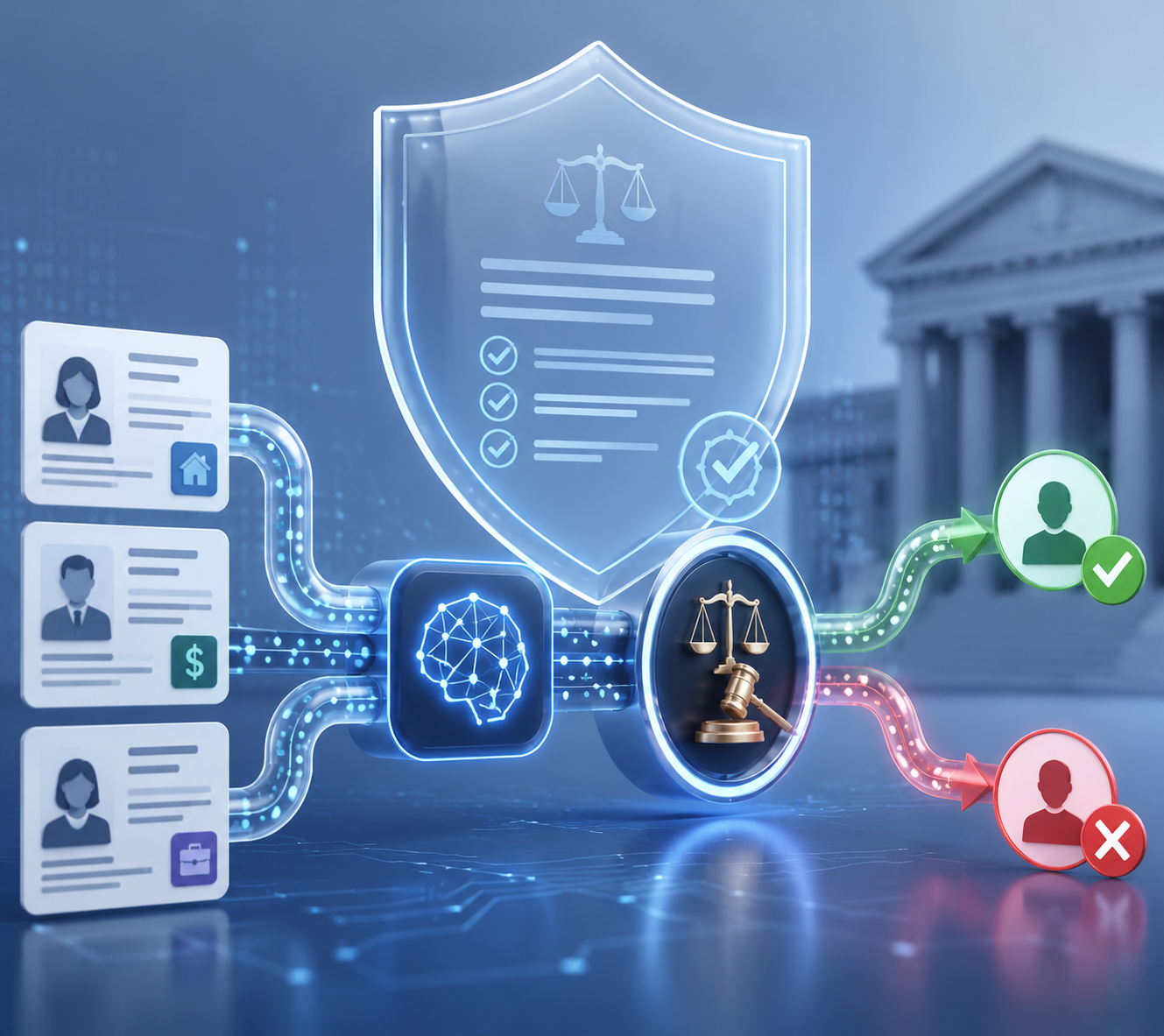
The cleanest warning comes from the Massachusetts Attorney General’s July 2025 settlement with Earnest. The AG announced a $2.5 million settlement over student-loan underwriting practices that allegedly used a Cohort Default Rate as a proxy for race and national origin and a “Knockout Rule” that automatically disqualified applicants based on the school they attended. The enforcement theory was not that education data is always forbidden. It was that neutral-looking variables and automatic rules produced unlawful disparate impact, and that failing to test for that disparate impact could itself be treated as an unfair practice.[1][2]
That is the file legal teams need to be able to defend: why the variable was allowed, what it measured, what protected-class outcome testing showed, what alternatives were considered, who approved the residual risk, and what monitoring happened after launch.
Use the right bias vocabulary before the workflow starts
A legal review becomes muddy fast when every skewed output is called “bias.” The Judicature primer published by Duke separates three meanings that should not be collapsed: positive-tendency bias, statistical bias, and discriminatory bias.[3]
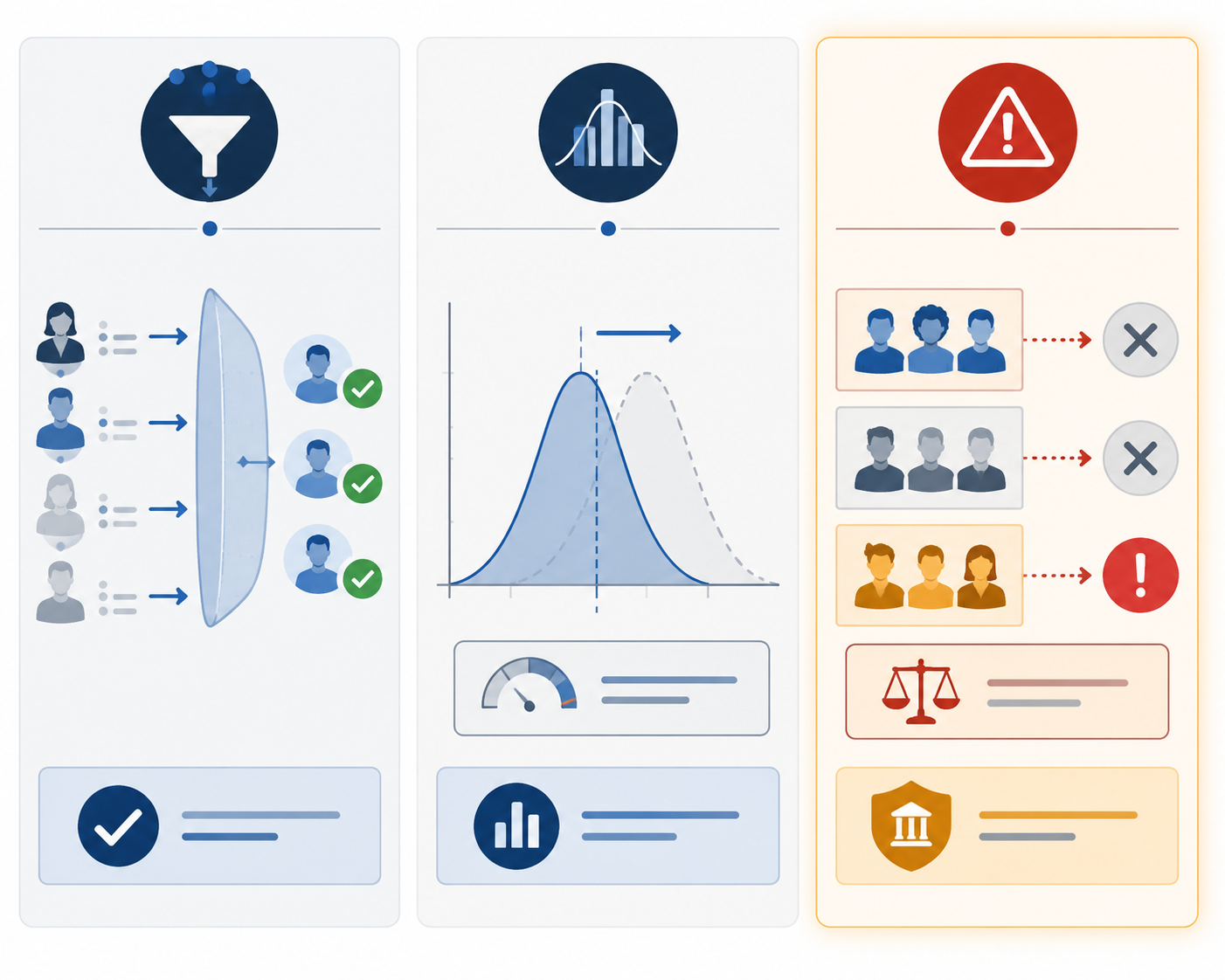
| Bias type | What it means in review | Legal consequence |
|---|---|---|
| Positive-tendency bias | The model prefers some signals because they are relevant to the task. | Not inherently unlawful; a useful model must distinguish among inputs. |
| Statistical bias | The data or measurement process is skewed, incomplete, stale, or unrepresentative. | May create reliability, validation, and governance problems; can become legally significant if it affects protected groups. |
| Discriminatory bias | The system treats protected groups differently or produces unjustified adverse effects on protected groups. | This is the legally actionable category under anti-discrimination regimes. |
A vendor statement that a model is “unbiased” usually does not answer the legal question. The better question is narrower: which form of bias was tested, against which protected classes, at which decision point, with what data, by whom, and with what result?
The workflow at a glance
The workflow should follow the system lifecycle. It should begin before procurement is complete and continue after deployment. A one-time vendor questionnaire after launch is too late for the questions that matter most.
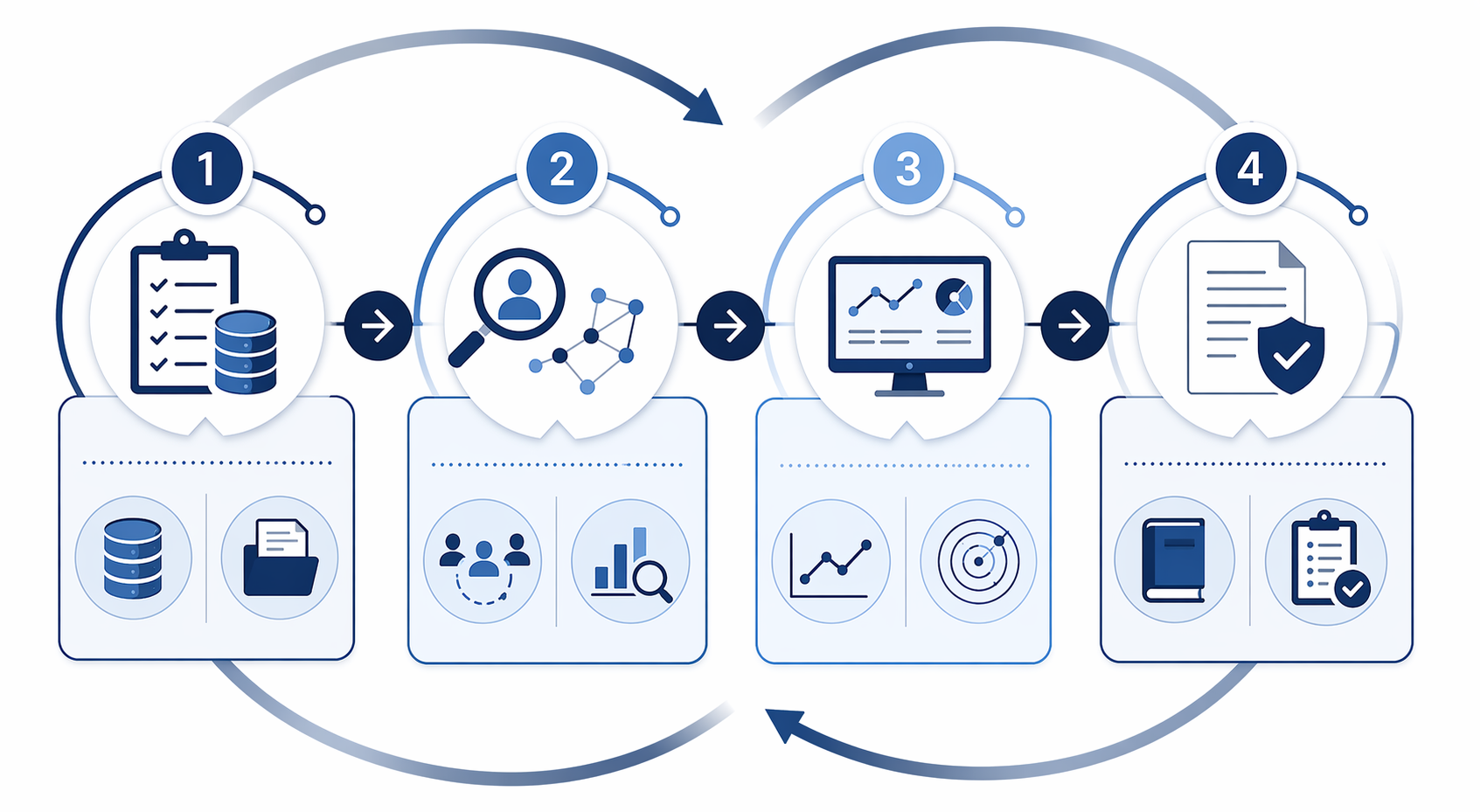
| Phase | Primary legal task | Defensible output |
|---|---|---|
| 1. Pre-deployment due diligence | Identify where the system affects protected opportunities and which variables may operate as proxies. | Decision inventory, vendor file, data map, proxy-variable analysis, legal risk memo. |
| 2. Bias audit methodology | Test outcomes across protected groups and decide whether observed disparities require mitigation. | Audit protocol, impact-ratio results, validation notes, remediation record. |
| 3. Launch controls | Prevent automation from becoming an unreviewed final decision where law or policy requires review. | Human-review standards, exception process, adverse-action language, approval record. |
| 4. Ongoing monitoring | Detect drift, complaint patterns, and emerging disparate impact after deployment. | Monitoring dashboard, escalation log, periodic re-audit results, change-control record. |
| 5. Governance and documentation | Assign ownership and preserve evidence of competent review. | AI policy, committee minutes, board or senior oversight materials, vendor accountability terms. |
Phase 1: Map the decision before reviewing the model
Start with the decision, not the technology. Legal should be able to point to every place the system changes a person’s chance of getting an interview, loan, apartment, insurance product, benefit, price, limit, renewal, or other material opportunity.
The decision inventory should distinguish scoring from screening. A model that recommends a risk tier is different from a rule that automatically rejects an applicant. Earnest matters here because the alleged Knockout Rule did not merely contribute to a score; it automatically disqualified applicants based on school attended.[1][2]
- Identify the covered decision: application approval, pricing, ranking, eligibility, renewal, termination, interview selection, accommodation routing, or fraud flagging.
- Identify the affected population: applicants, borrowers, tenants, insureds, employees, contractors, students, patients, or customers.
- Identify the legal regime: ECOA for credit, FHA for housing, Title VII for employment, ADEA for age, ADA for disability, plus any state or local analogues.
- Identify the automation role: recommendation, ranking, score, rule, eligibility screen, pricing input, document triage, or final decision.
- Identify who can override the system and what evidence they must record when they do.
This inventory is not administrative housekeeping. It determines the unit of testing. If the model screens out candidates before a recruiter sees them, the relevant impact analysis cannot be limited to final hiring decisions. If a credit model assigns pricing tiers, approval-rate testing alone may miss disparate effects in cost of credit.
Phase 2: Build the vendor file before accepting “bias-free” language
Vendor diligence should be conducted before the business is operationally dependent on the tool. The goal is not to make the vendor promise perfection. The goal is to learn whether the buyer can explain and monitor the system well enough to use it lawfully.
Mobley v. Workday is useful here because it weakens the comfort of outsourcing. As described in litigation tracking materials, the case has allowed an agency-liability theory against an AI vendor to survive at the pleading stage, and preliminary certification has been granted, but the case remained in discovery as of mid-2026 and is not a final merits ruling.[4] The practical lesson is still immediate: customers and vendors both need a record showing who controlled which part of the decision process.
- Ask what the model was trained to predict and whether that target is legally appropriate for the covered decision.
- Request the full list of input variables, derived variables, exclusion rules, and any post-processing logic.
- Require documentation of training data sources, time periods, known limitations, validation populations, and missing-data handling.
- Ask whether protected-class testing was performed directly, through proxy methods, or not at all.
- Require prior audit results, remediation history, model cards or equivalent technical documentation, and material-change notice obligations.
- Contract for audit rights, regulator-cooperation obligations, complaint support, and access to records needed to answer a demand letter or agency inquiry.
A refusal to disclose proprietary model weights is not the same as a refusal to disclose decision logic, variables, validation, and outcome testing. Legal can tolerate some trade-secret boundaries. It cannot defend a system whose vendor will not say what categories of information are used to reject people.
Phase 3: Treat proxy variables as a legal issue, not a data-science curiosity
Proxy review is where many AI redlining files become either useful or decorative. A variable can be facially neutral and still carry protected-class information. School attended, neighborhood, employer type, income volatility, arrest history, benefits receipt, commute distance, device data, and educational pedigree may all require closer analysis depending on the decision context.
The Earnest allegations show the shape of the problem. The challenged Cohort Default Rate was tied to schools, but the AG alleged that it functioned as a proxy for race and national origin. The school-based Knockout Rule allegedly created automatic disqualification. That is exactly the kind of variable a business team may describe as predictive and neutral while legal asks a different question: predictive of what, for whom, and with what protected-class effect?[1][2]
- Flag variables that are geographically specific, institution-specific, history-based, network-based, or derived from socioeconomic status.
- Separate variables used for eligibility cutoffs from variables used only as minor scoring inputs.
- Ask whether a less discriminatory alternative could serve the same legitimate objective.
- Document why each high-risk variable is necessary, what alternatives were rejected, and who approved the decision.
- Retest after removing or transforming a suspect variable; do not assume deletion alone eliminates proxy effects if correlated variables remain.
This is also where counsel should resist a false binary. The answer is not always “ban the variable” or “approve the variable.” Sometimes the answer is to remove an automatic cutoff, limit use to manual review, add an individualized exception process, narrow the variable’s weight, substitute a more direct measure, or require periodic revalidation.
Phase 4: Audit outcomes, not just intentions
A bias audit should be written before the test is run. Otherwise, the organization is tempted to keep changing the metric until the result looks acceptable. The audit protocol should state the covered decision, population, comparison groups, time period, protected traits or proxy methods, statistical measures, thresholds for escalation, and remediation process.
NYC Local Law 144 is limited to automated employment decision tools, but its structure is useful beyond New York hiring: independent bias audit, impact ratios, and public-facing disclosure. Commentary on 2026 compliance practice treats impact ratios and the four-fifths rule as central audit mechanics under that local framework.[5] That does not make Local Law 144 a national rule for lending, housing, or insurance. It does make it a practical template for turning fairness talk into testable outputs.
| Audit question | What to test | Why legal cares |
|---|---|---|
| Who is selected? | Selection, approval, interview, eligibility, or renewal rates by protected group. | Disparate impact often appears at the gatekeeping step. |
| Who is rejected automatically? | Knockout rules, hard cutoffs, fraud flags, missing-data exclusions, and adverse-action triggers. | Automatic disqualification leaves little room for individualized review. |
| Who pays more or receives less? | Pricing tiers, credit limits, insurance rates, benefit levels, or job-ranking positions. | Equal approval rates can still hide unequal terms. |
| Who gets reviewed by a human? | Override rates, exception approvals, manual-review queues, and escalation outcomes. | Human oversight may reduce or amplify disparity depending on how it is used. |
| What changes over time? | Monthly or quarterly outcome shifts, model drift, data-source changes, and population changes. | A launch audit does not prove later compliance. |
Impact ratios are often a useful starting point. If one group’s selection rate is materially lower than another group’s selection rate, the audit should not stop at noting the gap. The team should identify which variables, thresholds, or workflow steps are contributing to the difference, whether the business justification is legitimate and documented, and whether a less discriminatory alternative is available.
The four-fifths rule can help structure review, especially in employment audits influenced by Local Law 144 practice, but it should not be treated as a universal safe harbor. Passing a ratio screen does not prove legal compliance. Failing it does not, by itself, decide liability. It is a triage signal that should trigger deeper analysis.
When independent audit support is worth the cost
Independent review is most valuable when the system makes or materially shapes high-volume decisions, uses nontransparent vendor logic, affects legally protected opportunities, or will be difficult to explain to regulators, courts, or plaintiffs’ counsel. It is also useful when internal teams disagree over whether a disparity is acceptable, because the disagreement itself becomes part of the risk file.
The independent reviewer should not merely certify that the model is “fair.” The engagement should specify what data was reviewed, which protected groups were tested, what assumptions were necessary, which limitations remain, and what mitigation options were considered.
Phase 5: Examine training data and labels for inherited discrimination
Training data can import prior human discrimination while making it look mathematical. In employment, a model trained on historical “successful employee” profiles may inherit past exclusion. In lending, repayment or default labels may reflect earlier access barriers, product steering, or servicing practices. In housing, prior tenant-screening outcomes may embed neighborhood and criminal-record disparities.
Brookings has emphasized that algorithmic bias detection requires attention to data, model design, and consumer harm, rather than a narrow focus on whether protected-class fields are present.[6] For compliance purposes, the review should cover at least four data questions: who is missing, who is mislabeled, which historical decisions supplied the labels, and whether the training population matches the current applicant population.
- Missingness: Are records absent because certain groups lacked access to the product, job, housing, or service?
- Label quality: Does the outcome label measure the lawful objective, or does it measure a past decision-maker’s preference?
- Time period: Does the data reflect outdated policies, pandemic-era anomalies, or business conditions that no longer apply?
- Coverage: Does the validation set include enough cases from relevant protected groups to support meaningful testing?
- Feedback loops: Does the model create fewer opportunities for a group and then use the resulting thinner record as evidence of higher risk?
Do not let the audit file say only that protected-class fields were removed. That is a weak defense when the disputed variable is a proxy, the target label is contaminated, or the model was trained on decisions that already reflected unequal access.
Phase 6: Put launch controls around human oversight
“Human in the loop” is not a control unless the human has authority, time, information, and a standard for disagreement. A reviewer who sees only the model’s recommendation and clicks approve is not meaningfully reviewing anything.
- Define which decisions require human review before denial, adverse action, termination, nonrenewal, or escalation.
- Give reviewers the variables or reason codes that drove the recommendation, not just the final score.
- Require reviewers to record the reason for accepting or overriding the recommendation.
- Track override rates by reviewer, business unit, protected group where legally permissible, and decision type.
- Create an exception path for applicants whose records do not fit the model’s assumptions, including disability-related accommodation issues where applicable.
Launch controls should also cover notices. If the organization must provide adverse-action reasons, the AI system has to support reasons that are accurate, specific, and tied to the actual decision. A generic “model score did not meet threshold” explanation may be operationally convenient, but it is rarely the explanation legal wants to defend.
Phase 7: Monitor drift, complaints, and exceptions after deployment
A model that tested acceptably before launch can become risky later. Applicant pools change. Marketing channels change. Vendors update features. Business teams add manual workarounds. A new data feed can alter outcomes without anyone calling it a new model.
Fair-lending compliance guidance on digital redlining emphasizes ongoing monitoring, including attention to channels, geographies, data inputs, and outcome disparities.[7] The same operational lesson travels well to employment, housing, and insurance: the review has to follow the decision as it operates, not as it appeared in the procurement deck.
- Outcome tracking: approval, denial, ranking, price, limit, interview, renewal, and exception rates by relevant group and geography where legally supportable.
- Temporal drift: changes in input distributions, score distributions, and protected-group outcomes over monthly or quarterly review periods.
- Complaint signals: recurring applicant, borrower, tenant, employee, or customer claims that a criterion is unfair, unexplained, or impossible to correct.
- Exception review: patterns in overrides, manual approvals, appeals, accommodations, and reconsiderations.
- Incident escalation: a documented path for pausing a rule, disabling a variable, notifying the vendor, preserving evidence, and informing legal leadership.
Monitoring should have thresholds. If the organization will investigate only when someone feels uneasy, it has not built a control. The threshold can be statistical, operational, complaint-driven, or tied to material model changes, but it should be written before the issue arises.
Phase 8: Govern the system like a legal risk, not a software feature
Governance determines whether the audit survives contact with a regulator, a plaintiff, or an internal investigation. The file should show who owned the risk, who had authority to stop launch, who reviewed the results, and who accepted any residual disparity after mitigation.
ABA Formal Opinion 512, issued in 2024, anchors the professional-responsibility side of this work by tying competence under Rule 1.1 to understanding the benefits and risks of generative AI, including limitations and bias-related failure modes.[8] The opinion is directed to lawyers’ use of generative AI, but its competence logic is hard to cabin when lawyers are advising on automated systems that affect protected opportunities.
- Written AI policy: define covered systems, prohibited uses, approval requirements, audit triggers, and escalation paths.
- Cross-functional ownership: include legal, compliance, data science, product, security, privacy, business, and vendor-management personnel.
- Senior oversight: report material AI discrimination risks, audit findings, remediation delays, and unresolved vendor issues to an accountable executive or board committee.
- Change control: require legal or compliance review before new variables, thresholds, models, data sources, or use cases are deployed.
- Vendor accountability: require notice of model changes, audit cooperation, documentation access, incident support, and allocation of responsibility for failures.
The governance file should not be performative. Meeting minutes that say “AI bias discussed” are not very useful. Minutes that record the tested disparity, the business justification, rejected alternatives, required mitigation, owner, deadline, and follow-up date are useful.
Do not forget AI inside the legal function
The same discipline applies when legal teams use AI themselves. Bloomberg Law reported in April 2026 that AI legal-research tools can systematically exclude precedents benefiting underrepresented parties, tying bias risk to the quality of legal research rather than only to customer-facing decisions.[9] That is a different harm from credit denial or hiring exclusion, but it is still a competence problem if lawyers rely on the output without understanding what may be missing.
For legal operations, the practical control is straightforward: document approved uses, require source verification for research outputs, test tools against known matters where the team already understands the relevant authority, and prohibit unsupervised use for advice that affects client rights, litigation positions, or regulated decisions.
What a defensible AI redlining file contains
A defensible file does not promise that the system is fair forever. It shows that the organization knew which laws applied, tested the actual decision path, looked for protected-class effects, addressed proxy variables, monitored after launch, and preserved evidence of the choices it made.
- Decision inventory showing where automation affects eligibility, ranking, pricing, approval, denial, renewal, or review.
- Legal classification of the decision under ECOA, FHA, Title VII, ADEA, ADA, or other applicable law.
- Vendor documentation, audit rights, model-change notice terms, and records sufficient to explain the system.
- Variable list, proxy-variable analysis, training-data review, and justification for high-risk inputs.
- Bias audit protocol with protected-group outcome testing, impact-ratio analysis where appropriate, limitations, and remediation decisions.
- Human-review standards, exception procedures, adverse-action support, and override tracking.
- Monitoring reports, drift analysis, complaint review, escalation logs, and change-control approvals.
- Governance records showing accountable owners, senior oversight, unresolved issues, and follow-up.
The strongest compliance position is not that a vendor called the tool neutral. It is a record showing that legal, compliance, technical, and business teams treated automated discrimination risk as part of the decision system itself, before applicants, borrowers, tenants, insureds, or employees had to live with the result.
References
- Massachusetts AG’s $2.5M settlement with Earnest, Mass.gov, July 2025, https://www.mass.gov/
- Massachusetts AG’s $2.5M settlement with Earnest client alert, Paul Hastings, July 2025, https://www.paulhastings.com/
- AI Bias: Meanings for Legal Practice, Judicature, Duke Law, 2026, https://judicature.duke.edu/articles/ai-bias-meanings-legal-practice/
- Guide to AI Lawsuits, TCAI, 2024–2026, https://tcai.org/
- Algorithmic Bias Audit Compliance, Bochner PLLC, 2026, https://www.bochner.law/
- Algorithmic bias detection best practices and policies to reduce consumer harms, Brookings Institution, https://www.brookings.edu/
- Managing fair lending risks of digital redlining, Ncontracts, https://www.ncontracts.com/
- ABA Formal Opinion 512 and generative AI competence discussion, ABA Business Law Today, April 2024, https://businesslawtoday.org/
- AI tools can systematically exclude precedents benefiting underrepresented parties, Bloomberg Law, April 2026, https://news.bloomberglaw.com/
Comments
Join the discussion with an anonymous comment.