
Full profile
By the time a ticket phishing case reaches litigation, the neat dashboard view is usually gone. What remains is a mixed record: email headers, SMS screenshots, payment logs, domain-registration fragments, platform exports, security alerts, and a few detection scores someone now wants to treat as proof. That is where the legal problem starts. AI-generated phishing has become fast and convincing enough that detection systems are no longer optional in many fraud-control programs, but the same systems create records that may be tested later under evidence rules rather than security-team expectations.
The urgency is real, even if the figures need careful labeling. Hoxhunt’s 2026 phishing trends report, based on data from 4 million users, says AI-generated phishing surged 14x in December 2025, rising from 4% to 56% of reported attacks that bypassed email filters; the same report says AI-generated phishing reached a 54% click-through rate, compared with 12% for traditional phishing.[1] Those are vendor-published findings, not a neutral census of all phishing activity. Still, they describe the practical asymmetry litigation teams now inherit: attackers can generate plausible lures quickly, while the people reconstructing the event later must explain which records were observed, preserved, and validated.

That distinction matters in disputes over ticket phishing and AI detection. The technical question is not simply whether an AI tool can flag a message as suspicious. The litigation question is what the tool observed, how it generated that classification, whether its error rate is known, whether the underlying logs were preserved, and whether a qualified witness can explain the method without reciting a sales sheet.
“Ticket Scam” Is Too Loose for the Legal File
One early mistake is treating every “ticket scam” as the same fact pattern. The phrase can refer to traffic or toll citation SMS scams, where the lure is a government-style demand for payment or account verification. It can also refer to event-ticket resale fraud, where the lure is access to a concert, game, festival, or theater seat. Those schemes may use similar phishing mechanics: impersonation, urgency, a spoofed domain, a payment link, or a fake support flow. But they do not necessarily occupy the same legal posture.
A toll-message scam may raise questions about impersonation of a public agency, deceptive collection practices, payment processing, telecom records, and the preservation of SMS metadata. Event-ticket resale fraud may involve platform terms, seller identity, inventory misrepresentation, chargebacks, consumer-protection statutes, and marketplace records. If an investigation collapses both into a generic “ticket phishing” bucket, it becomes harder to identify the right custodian, the relevant transaction records, and the statute or claim theory the detection output is supposed to support.
AI detection can help in both settings, but it does not erase those differences. A model that flags a suspicious SMS impersonating a toll authority may be observing different features than a model that flags a resale-account takeover campaign or a fake ticket-transfer email. Before the output is useful in a legal file, someone has to separate the fraud theory from the detection label.
What AI Detection Actually Produces
AI phishing detection is often described as if it produces a conclusion: fraudulent, malicious, safe. In a litigation workflow, that wording is too blunt. The system usually produces a set of signal-derived outputs: alerts, scores, classifications, confidence measures, matched indicators, timestamps, and logs. Those outputs may be extremely useful for triage. They are not, by themselves, a complete account of what happened.
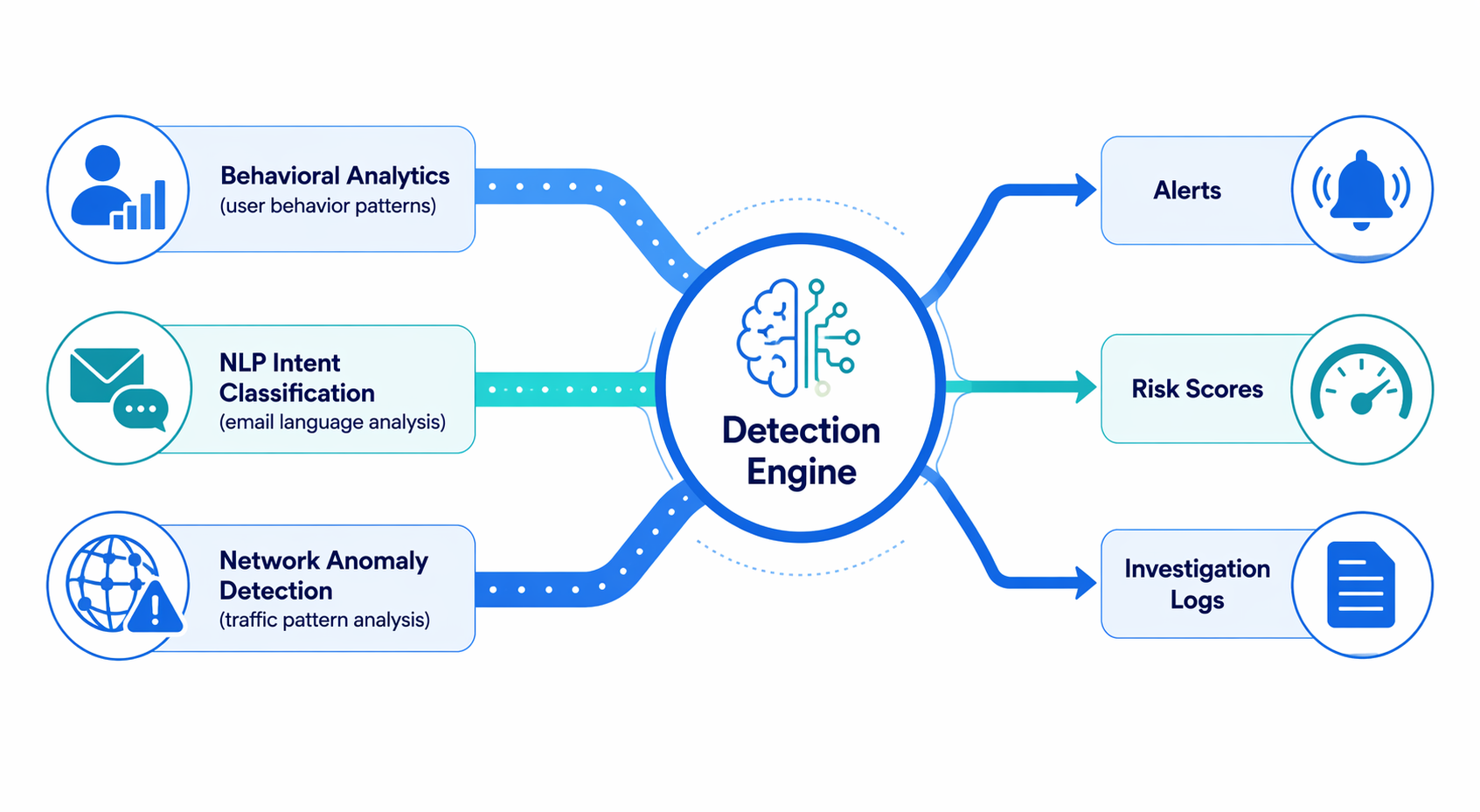
In practice, the useful signal streams tend to fall into different categories. They should be kept distinct because they answer different questions and fail in different ways.
| Signal stream | What it may observe | Litigation significance |
|---|---|---|
| Behavioral analytics | Login timing, device changes, account activity, transaction patterns, message-sending behavior | May help show anomalous activity, but requires baseline data and a clear explanation of what counted as normal |
| NLP-based intent classification | Language patterns, urgency cues, impersonation language, payment demands, credential-harvesting instructions | May support investigative triage, but counsel needs to know training data, validation methods, and false-positive behavior |
| Network anomaly detection | Domains, URLs, redirects, IP activity, infrastructure reuse, unusual connection patterns | May link messages to suspicious infrastructure, but preservation of logs and timestamps becomes critical |
Behavioral analytics is often the most helpful when the fraudulent act depends on an account or transaction path. In an event-ticket setting, it might flag a sudden change in seller behavior, rapid listing activity after a credential event, or a login pattern inconsistent with prior account use. In a toll-message setting, it may be less about the victim’s normal behavior and more about campaign-level patterns: repeated clicks, repeated payment attempts, or clusters of complaints associated with similar message templates.
NLP-based intent classification looks at the content and structure of the lure. A message demanding immediate payment for a supposed citation, threatening penalties, and pointing to a non-government URL may receive a high-risk classification because its language and call to action resemble known phishing patterns. The important word is “classification.” The model is not a witness to the sender’s subjective intent. It is sorting text against learned patterns, rules, embeddings, or other model features that must be explained with enough detail for the legal use at hand.
Network anomaly detection is often closer to the hard record lawyers want, but it still needs translation. Domains, redirects, IP addresses, and infrastructure reuse can be powerful leads. They can also be messy. Shared hosting, URL shorteners, compromised legitimate sites, content-delivery infrastructure, and incomplete logging can all complicate attribution. If a detection tool says a ticket-transfer link was suspicious because it resolved through risky infrastructure, counsel needs the underlying observables, not only the risk score.
The Risk Environment Is Bigger Than One Vendor Chart
The broader fraud environment explains why these tools are being pushed into front-line use. Vectra AI reported 1,210% growth in AI-enabled fraud in 2025, compared with 195% growth in traditional fraud; the same source attributes to IBM research the finding that AI can generate a convincing phishing email in 5 minutes, compared with 16 hours for a human, described as a 192x speed advantage.[2] StrongestLayer, citing KnowBe4 and SlashNext, says 82.6% of phishing emails now contain AI-generated content.[3] These figures do not measure exactly the same population, and they come from vendor-published or vendor-distributed research. They should not be stitched together as if they were one harmonized dataset.
The consumer-loss backdrop is also severe. CNBC reported FTC 2025 data showing $15.9 billion in total fraud losses, a 27% year-over-year increase and a 430% increase since 2020, with imposter scams accounting for $3.5 billion.[4] Those numbers are based on reported losses, so they are better understood as a floor than a complete measure of harm. Fortune reported Experian’s forecast that AI fraud would surge in 2026 after $12.5 billion in losses.[5]
For an operational security team, the lesson may be straightforward: waiting for manual review is too slow. For a legal team, the lesson is narrower. Scale pressure explains why AI detection was deployed. It does not prove that a specific alert was accurate, that a specific victim clicked because of a specific message, or that a specific defendant controlled the infrastructure behind the lure.
From Alert to Evidence
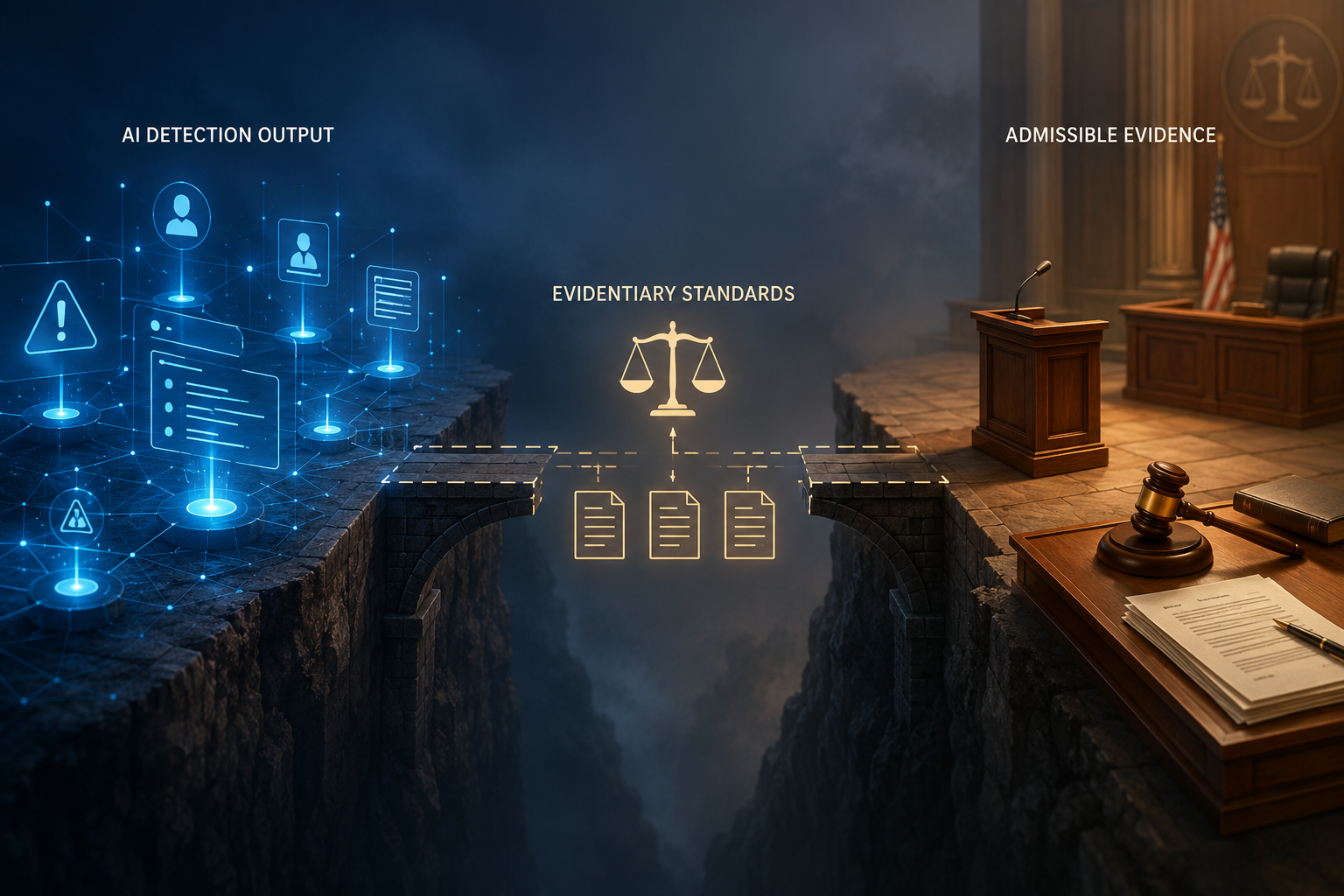
The evidentiary bridge starts the moment an alert is generated. If the alert later matters, the legal team will want more than a screenshot of a dashboard. It will want the event timestamp, the rule or model version, the input data available to the system, the output score or classification, the thresholds then in effect, any analyst action taken, and the downstream preservation path. A fraud timeline built from changing dashboards is a fragile timeline.
The best operational record is not always the best evidentiary record. Security tools often enrich, normalize, deduplicate, and suppress data so analysts can move quickly. That is sensible during incident response. It can become a problem if the original message, headers, URL resolution chain, click logs, account events, and model output are not preserved in a way that can be authenticated later. A risk score without the surrounding event record tells the court very little about what was actually observed.
- Preserve the original message or SMS content, including headers or available carrier/platform metadata.
- Export detection logs with timestamps, model or rule version identifiers, scores, and alert-disposition history.
- Retain URL, domain, redirect, and network-resolution artifacts where the tool used them.
- Document analyst actions, including escalation, suppression, manual overrides, and case notes.
- Identify custodians for platform records, vendor records, payment records, and incident-response records before routine retention periods expire.
Those steps do not make the AI output admissible by themselves. They keep the record from collapsing before an admissibility argument can even begin.
The Daubert Problem Is Methodology, Not Vocabulary
When AI-detection testimony is offered through an expert, Federal Rule of Evidence 702 and Daubert push attention toward reliability: whether the expert is qualified, whether the testimony is based on sufficient facts or data, whether the principles and methods are reliable, and whether the expert has reliably applied those principles and methods to the case. The problem is not that the system uses machine learning. The problem is whether the methodology can be tested, explained, bounded, and connected to the facts in dispute.
That inquiry is uncomfortable for tools marketed in confident shorthand. A vendor may say its model detects AI-generated phishing, impersonation, malicious intent, or fraud infrastructure. A court will need a more exact account. What data was the model trained or tuned on? Was ticket-related phishing represented in the training or validation set, or is the tool generalizing from broader phishing examples? What is the known or estimated false-positive rate? What is the false-negative rate? Were thresholds adjusted during the relevant time period? Can the same input be reprocessed through the same model version, or has the model changed?
False positives deserve particular attention in ticket-scam investigations because urgency and payment language are not automatically fraudulent. A legitimate last-minute ticket transfer, a valid parking or toll notice, or a platform security warning may share surface features with a scam lure. If a tool classified the message as malicious because of language patterns alone, that is a different evidentiary posture from a tool that also observed credential-harvesting infrastructure, account takeover behavior, and victim payment flow.
Training-data provenance is equally important. If a vendor will not disclose enough about the training and validation population to permit meaningful scrutiny, counsel may still use the alert to guide investigation. But the gap matters when the output is offered as a reliable classification. A model trained heavily on corporate email phishing may perform differently on SMS toll scams. A tool validated on English-language enterprise messages may not behave the same way on mobile-first consumer lures, resale-platform chat, or abbreviated payment prompts.
What the Expert Must Be Able to Explain
The expert does not need to turn the courtroom into a machine-learning seminar. But the expert must be able to explain the method at the level needed for the disputed issue. If the issue is whether a message was part of a phishing campaign, the testimony may focus on the combination of language features, infrastructure indicators, and campaign clustering. If the issue is whether a particular defendant sent the message, the detection output alone will usually be far too thin without account, device, payment, hosting, or communications evidence tying the activity to that person or entity.
- Qualifications: whether the witness understands both the detection method and the records generated by the system.
- Methodology: whether the model, rules, thresholds, and validation process can be described without relying on unsupported marketing claims.
- Error rates: whether false positives and false negatives are known, estimated, or undisclosed for comparable data.
- Application: whether the expert applied the method to the actual preserved records in the case, not to a later reconstruction.
- Limits: whether the expert can identify what the detection output does not prove.
That last point is not cosmetic. A careful expert may be more useful than an emphatic one. “The system flagged this message because its text, URL path, and redirect behavior matched known phishing patterns” is a different statement from “AI proved this was a scam.” The first can be tested against records. The second invites a cross-examination that starts with the word “proved” and gets worse from there.
Content Detection Is Getting Less Comfortable
AI-generated phishing also weakens one of the old practical shortcuts: bad writing. The Hoxhunt click-through figures, if taken as reported within that vendor’s dataset, suggest AI-generated phishing messages were materially more effective than traditional phishing messages that bypassed filters.[1] That does not mean every polished ticket message is fraudulent. It means content quality is no longer a reassuring discriminator.
This is why litigation teams should be wary of content-only conclusions. A message that sounds official may be generated by a fraudster. A message that sounds awkward may be legitimate. The better evidentiary record combines content analysis with preserved technical and transactional artifacts: sender path, domain age or control where available, redirect chain, account activity, payment destination, platform event history, and victim interaction records.
There is also a difference between detecting AI-generated text and detecting phishing. A tool may classify text as AI-generated without establishing that the message was fraudulent. Conversely, a human-written message may be a phishing lure. In a ticket-fraud case, the more relevant question is usually not “was this written by AI?” but “what evidence connects this communication to a deceptive scheme, a victim action, and a recoverable loss?”
Vendor Research Can Start the Inquiry, Not End It
The vendor studies in this area are useful for understanding why organizations are investing in detection. They are less useful as litigation foundations unless their methodology is disclosed and case-specific records are available. Hoxhunt, Vectra AI, StrongestLayer, KnowBe4, Experian, and similar sources may each see a different slice of the problem: enterprise training data, customer telemetry, threat-intelligence feeds, identity-fraud forecasts, or reported-loss datasets. Those populations are not interchangeable.
A chart showing a surge in AI phishing does not tell the court whether the disputed message in a ticket-resale case was fraudulent. A reported growth rate in AI-enabled fraud does not establish causation in a particular loss. A forecast about AI fraud does not validate a specific model’s classification. These materials may explain industry risk and reasonableness of controls. They do not replace authentication, chain of custody, expert methodology, or proof of the elements of a claim.
This distinction is especially important for in-house counsel evaluating AI-detection vendors before any case exists. Operational usefulness is a real value. A system that flags suspicious ticket-transfer messages, clusters related domains, and speeds analyst review may prevent losses even if no one ever mentions Daubert. But if the organization later expects those outputs to support a fraud action, a regulatory response, or a law-enforcement referral, procurement should ask litigation-grade questions early.
- Can the vendor export raw and enriched logs in a stable, reviewable format?
- Are model versions, threshold changes, and rule updates recorded for historical events?
- Does the vendor disclose validation methods and error rates for comparable use cases?
- Can the organization preserve original messages, headers, URLs, and analyst actions outside the live dashboard?
- Is there a witness who can explain the system’s records and limits without overstating what the model proved?
The Litigation-Ready Use of AI Detection
A defensible workflow treats AI detection as an early observer, not as the whole case. The alert identifies a suspect communication or pattern. The investigation preserves the underlying artifacts. Analysts document what they did. Counsel maps the records to the legal theory. Experts explain the method and its limits. Only then can the detection output be considered as part of an evidentiary presentation.
For ticket scam phishing, that workflow has to stay tied to the actual scheme. In a toll-SMS matter, the important records may include message content, sending numbers, landing pages, payment processors, complainant reports, and agency-impersonation indicators. In an event-ticket resale matter, they may include account-access logs, listing history, transfer records, marketplace messages, payment flows, chargebacks, and buyer communications. AI detection can point to suspicious clusters in either matter, but the admissible record will be built from the preserved evidence around the alert.
That position is not hostile to AI detection. It is almost the opposite. Given the speed and scale described in current vendor-published research, legal and security teams would be imprudent to rely only on manual review. But admissibility is a different question from necessity. AI detection may be essential for identifying ticket phishing at scale; whether its output can survive a Daubert challenge depends on transparent methodology, disclosed error rates, preserved logs, reliable chain of custody, and a qualified expert who can explain what the system did and did not determine. Without that bridge, the output remains an investigative lead, not a litigation-ready foundation.
References
- Hoxhunt Phishing Trends Report 2026, Hoxhunt
- AI scams in 2026, Vectra AI
- AI-Generated Phishing Enterprise Threat 2026, StrongestLayer
- Imposter scams led fraud reports to FTC in 2025, $3.5 billion losses, CNBC, June 2026
- AI fraud forecast 2026: Experian deepfakes scams, Fortune, January 2026
Comments
Join the discussion with an anonymous comment.