
How to Choose AI Tools for Your Law Firm in 2026
This guide provides a structured decision framework for evaluating AI tools by workflow category, firm size, and risk tolerance, helping legal professionals build a stack strategy rather than selecting a single 'best' tool. It covers eight practice areas, ethics obligations, and real-world failure modes to support informed adoption decisions.
- Hallucination rate
- Not measured / undisclosed
Choosing AI tools for lawyers in 2026 is no longer a contest to find one product that can do everything. The harder problem is that AI is already inside legal work before many firms have decided who may use it, which matters it may touch, where outputs must be verified, and how the firm will explain the decision if something goes wrong.
That gap is now visible in the numbers. Clio’s 2025 Legal Trends Report found that 79% of legal professionals use AI tools, while ABA 2025 reporting found that only 21% of firms had firm-wide generative AI deployment.[1][2] In other words, many lawyers have moved faster than their firms’ systems of supervision. The purchase decision is therefore not just “Which AI is best?” It is “Which workflow can safely absorb AI, under what controls, and with whose review?”
The market is large enough to encourage overbuying. Research cited by Azumo places the legal AI market in roughly the $4.59 billion to $5.59 billion range, although market-sizing definitions vary across research firms and should not be treated as exact equivalents.[3] A firm can now buy AI for research, contracts, drafting, discovery, intake, compliance, practice management, and litigation analytics. Buying one product in each category is rarely a strategy. It is usually how tool sprawl gets a nicer invoice.

Start With The Stack, Not The Vendor List
For most firms in Q3 2026, the durable pattern is a foundation-plus-specialized stack. The foundation is a general-purpose enterprise AI environment, usually a controlled version of a model family such as Claude or ChatGPT rather than an unmanaged consumer account. It handles lower-risk drafting, summarization, internal brainstorming, meeting notes, and administrative work. The specialized layer is narrower: legal research, contract review, e-discovery, practice management, or another workflow where domain data, auditability, integrations, and source traceability justify the extra cost.
The foundation tool should be chosen for security controls, admin visibility, data-use terms, retention settings, access management, and ease of training. The specialized tools should be chosen only where the workflow has enough volume, risk, or repeatability to deserve a legal-specific product. A litigation boutique and an estate-planning solo may both need AI, but they do not need the same stack.
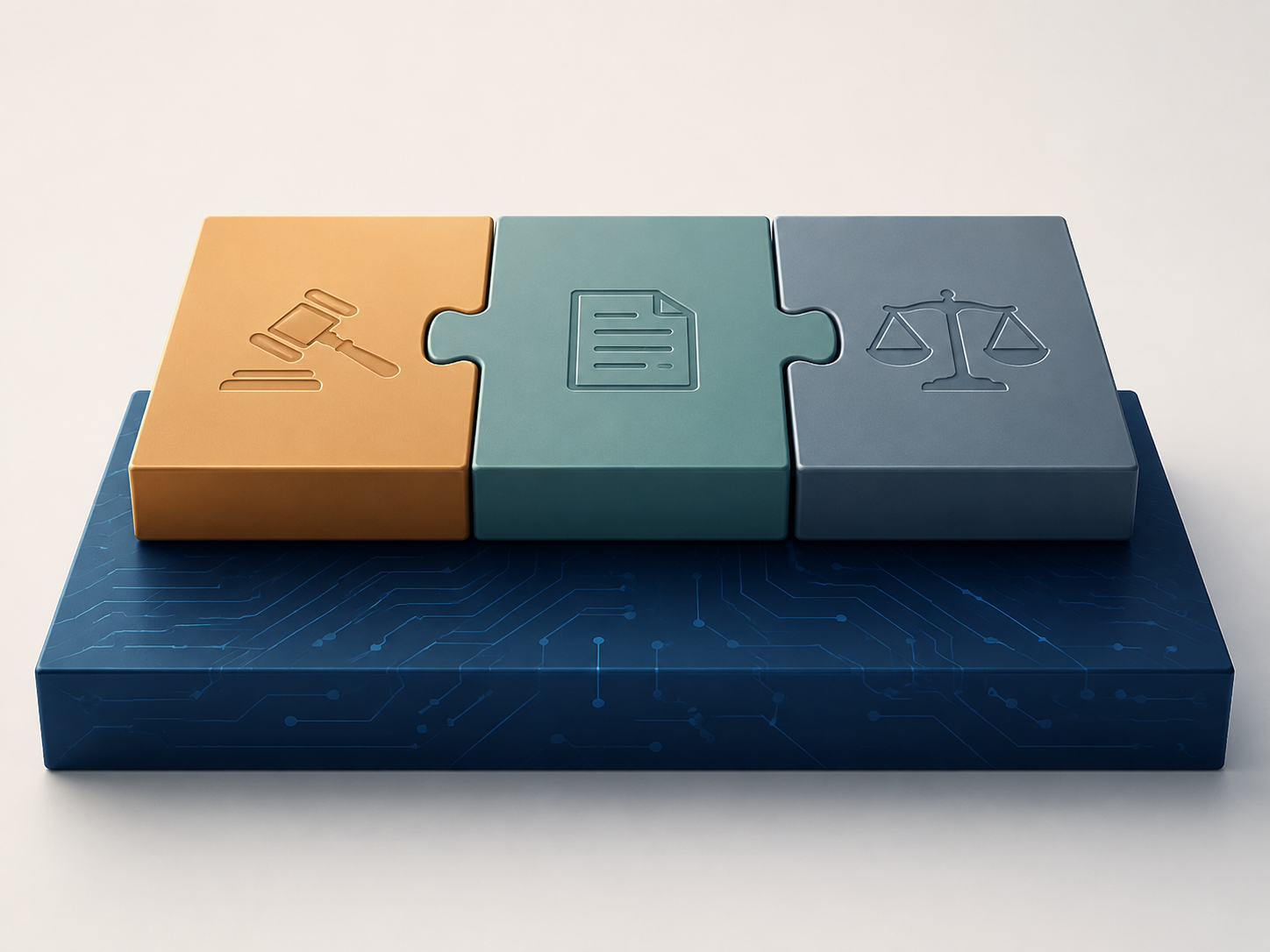
| Layer | What It Should Handle | What It Should Not Be Trusted To Handle Alone | Buying Test |
|---|---|---|---|
| Enterprise foundation AI | Internal drafting, summarization, knowledge work, first-pass analysis, administrative support | Unverified legal authority, confidential uploads without approved controls, final client advice | Can the firm control access, data retention, training use, and supervision? |
| Specialized legal AI | Research, contracts, discovery, case workflows, compliance, due diligence, intake, or litigation support | Work outside the product’s verified data sources or designed workflow | Does it reduce a real bottleneck while preserving source review and accountability? |
| Human review layer | Legal judgment, privilege calls, client communication, court filings, final risk allocation | Rubber-stamping AI output | Who verifies the output, and what record shows that review occurred? |
Eight Workflow Categories That Actually Change The Buying Decision
The useful way to compare legal AI tools is by workflow. The same model behavior that is acceptable for a first draft of a client alert may be unacceptable for a cited legal proposition in a brief. The same contract review feature that saves a corporate team hours may be irrelevant to a small criminal defense practice. The categories below are not equal in risk, evidence, or maturity, so they should not receive equal budget by default.
1. Legal Research AI
Legal research is the category where source discipline matters most. A general-purpose LLM can be useful for framing issues, generating search terms, summarizing known materials, or preparing questions for further research. It should not be treated as a legal authority engine unless the firm has a verified path back to the underlying cases, statutes, regulations, or secondary sources.
That distinction is not theoretical. HAQQ’s 2026 benchmark reported that 24% of answers cited law that did not support the claim made, and the benchmark should be read with the caveat that HAQQ is itself a legal AI vendor.[4] The broader point is reinforced by Stanford RegLab’s independently published 2024 work on legal hallucinations: legal AI evaluation cannot stop at whether the prose sounds plausible.[5]
| Representative Options | Pricing Tier Awareness | Strength | Weakness | Best Fit | Main Risk | Separating Criterion |
|---|---|---|---|---|---|---|
| CoCounsel, Lexis+ AI, other research tools tied to verified legal databases | Usually premium or enterprise legal research subscriptions; pricing often requires a sales process, last checked Q3 2026 | Citable research path, legal-source grounding, workflow fit for lawyers | Cost and platform lock-in can be significant | Firms that file, advise, or negotiate based on legal authority | Treating a confident answer as a checked answer | Can the lawyer move from answer to cited source and verify the proposition quickly? |
| Claude or ChatGPT enterprise tier used as a research assistant | Enterprise tiers; consumer or team tiers may not satisfy firm governance needs, last checked Q3 2026 | Good for issue spotting, summaries, search planning, and internal explanation | Not a substitute for a verified legal database | Early-stage thinking and non-final internal work | Hallucinated or mismatched authority | Does the workflow require legal authority, or only assistance thinking through known material? |
For research, the safest buying rule is blunt: if the output will support legal advice, a court filing, or a client-facing position, the tool must make source verification easier, not merely writing faster. A beautiful answer that sends a lawyer on a citation chase is not automation; it is a liability with better typography.
2. Contract Review And Analysis
Contract review is one of the strongest candidates for specialized AI because the work is repetitive, document-bound, and heavily dependent on playbooks, clause positions, fallback language, and version control. Gartner has reported that contract review AI can reduce review time by 60%, while an Attorney at Work case study reported cycle-time reductions of up to 40%.[6][7] Those figures should not be read as a guarantee for every firm; they depend on document volume, clause consistency, review discipline, and how much of the old process was already inefficient.
The main product split is not “AI versus no AI.” It is whether the tool lives where lawyers actually work. A contract tool with strong Word integration, redlining support, clause-library customization, and playbook enforcement will usually survive implementation better than a clever chat interface that requires lawyers to leave the document, paste text, copy output back, and then reconstruct the audit trail.
| Representative Options | Pricing Tier Awareness | Strength | Weakness | Best Fit | Main Risk | Separating Criterion |
|---|---|---|---|---|---|---|
| Spellbook | Published and tiered pricing may vary; verify current terms, last checked Q3 2026 | Lawyer-friendly drafting and contract assistance inside Word-oriented workflows | May be less suitable where large-scale enterprise repository analysis is the main need | Small to mid-size transactional teams that live in Word | Accepting suggested language without comparing it to client position | How deeply does it integrate with Word, clause libraries, and review playbooks? |
| Harvey | Enterprise-oriented, often quote-based; demo call commonly required, last checked Q3 2026 | Broad legal AI platform with strong positioning for larger legal teams | May exceed the budget or governance capacity of smaller firms | Large firms and enterprise legal departments with multiple AI workflows | Platform enthusiasm outrunning matter-level controls | Can the firm govern it across teams, matters, and data classes? |
| Kira, Luminance | Typically enterprise or quote-based; confirm current modules and pricing, last checked Q3 2026 | Strong document analysis and diligence heritage | Implementation effort can be meaningful | M&A, finance, real estate, and diligence-heavy practices | False comfort from extracted issues that still require legal judgment | Does it reliably extract, classify, and surface the provisions the team actually negotiates? |
AI Vortex and CASUS comparisons are useful here because they show how sharply tools differ on pricing visibility, Word integration, clause-library features, and contract workflow design.[8][9] A general-purpose model may help draft a clause from instructions. A contract review system should help a team enforce a position consistently across repeated documents.
3. Drafting And Document Generation
Drafting is where many lawyers first feel the benefit of AI, because the bottleneck is visible. A blank page becomes a rough motion section, client email, discovery request, board memo, engagement letter, or internal research summary. This is also where firms can quietly lose control if everyone is using a different tool with different confidentiality settings.
| Representative Options | Pricing Tier Awareness | Strength | Weakness | Best Fit | Main Risk | Separating Criterion |
|---|---|---|---|---|---|---|
| Claude or ChatGPT enterprise tier | Enterprise plans generally require admin setup and current pricing verification, last checked Q3 2026 | Flexible drafting, summarization, rewriting, and internal analysis | Not inherently legal-source verified | Firms standardizing a foundation AI tool | Unapproved confidential uploads or unverified legal propositions | Can the firm control data use, access, retention, and review? |
| Legal-specific drafting tools within research, contract, or practice platforms | Often bundled into existing subscriptions or premium modules, last checked Q3 2026 | Closer to the legal workflow and source materials | May be narrower and less flexible | Teams that draft from structured templates, precedent, or matter records | Assuming template-based output resolves legal judgment | Does it draft from approved templates, sources, and matter context? |
The practical control is simple: separate drafting assistance from final legal work product. AI can prepare a first version, convert tone, summarize facts, or propose structure. A lawyer still owns the legal position, factual accuracy, privilege analysis, and client communication.
4. E-Discovery
E-discovery has been using machine learning and technology-assisted review long before the current generative AI wave. The 2026 buying question is less about whether AI belongs in discovery and more about chain of custody, defensibility, privilege protection, production controls, and how generative features sit on top of established review workflows.
| Representative Options | Pricing Tier Awareness | Strength | Weakness | Best Fit | Main Risk | Separating Criterion |
|---|---|---|---|---|---|---|
| Relativity, Everlaw, DISCO, and comparable discovery platforms with AI features | Matter-volume and enterprise pricing vary; confirm hosting, review, and AI module costs, last checked Q3 2026 | Designed around document populations, review teams, production workflows, and audit trails | Can be expensive or excessive for low-volume disputes | Litigation teams with substantial document review burdens | Privilege leakage, production errors, or poorly documented review decisions | Can the team defend the workflow and reconstruct review decisions? |
| Foundation AI used for discovery-adjacent summaries | Depends on enterprise controls, last checked Q3 2026 | Useful for internal summaries of approved materials | Not a discovery platform | Small matters with limited, controlled document sets | Breaking confidentiality or losing document context | Is the task summarization, or is it review, coding, and production? |
5. Practice Management And Workflow Automation
Practice management AI deserves more attention than it often gets because it is less glamorous than research and less flashy than contract redlining. It is also where many small and mid-size firms can reduce friction without creating a separate AI island. Clio, MyCase, and Smokeball are not merely competing with standalone AI tools; they are competing with the habit of adding yet another login for every problem.
Clio’s 2026 materials and MyCase’s AI coverage point toward the value of embedding AI into existing case management workflows rather than layering disconnected products on top of billing, calendaring, documents, client communication, and tasks.[10][11] The strongest argument for embedded AI is not that it is always the most advanced model. It is that lawyers and staff are more likely to use it in the place where the work, deadline, matter record, and client context already live.
| Representative Options | Pricing Tier Awareness | Strength | Weakness | Best Fit | Main Risk | Separating Criterion |
|---|---|---|---|---|---|---|
| Clio Manage AI | Usually tied to Clio subscription tiers or add-ons; verify current plan availability, last checked Q3 2026 | Embedded in widely used small-firm practice management workflows | AI scope depends on platform features and plan | Solo, small, and growing firms already using Clio | Assuming embedded means fully governed for every AI use | Does it reduce steps inside the existing matter workflow? |
| MyCase IQ | Plan and feature availability should be verified, last checked Q3 2026 | AI inside a practice management environment familiar to small firms | May not replace specialized research or contract tools | Firms that want workflow help without new standalone systems | Overextending practice AI into substantive legal analysis | Does it improve intake, drafting, communication, or matter administration where the team already works? |
| Smokeball AI features | Subscription-based; confirm current AI modules and regional availability, last checked Q3 2026 | Strong fit for document-heavy small-firm workflows | Less relevant if the firm uses another matter platform | Small firms with repeatable matter types and document needs | Automating stale templates or inconsistent processes | Does the platform already hold the matter data needed for useful automation? |
This is the category where a managing partner should ask staff what they are actually doing twice. If a paralegal is summarizing client emails in one app, updating tasks in another, drafting reminders in a third, and then copying everything into the case management system, the firm has not adopted AI. It has created more clerical transfer points.
6. Litigation Support And Predictive Analytics
Litigation support tools can help with chronology building, deposition preparation, brief analysis, argument mapping, judge or venue research, and sometimes outcome-oriented analytics. The caution is that “prediction” can sound more authoritative than the underlying data deserves. A tool that organizes past rulings or extracts patterns from a judge’s opinions is different from a tool that implies it can price certainty into litigation.
| Representative Options | Pricing Tier Awareness | Strength | Weakness | Best Fit | Main Risk | Separating Criterion |
|---|---|---|---|---|---|---|
| Litigation analytics within major research platforms; litigation support tools such as Clearbrief-style brief checking and source review | Often premium subscription or quote-based; verify modules, last checked Q3 2026 | Can connect arguments, filings, citations, and litigation records | Predictive claims may be misunderstood or overused | Litigators who need source-backed argument review and matter preparation | Confusing statistical pattern, vendor score, or document analysis with legal judgment | Does the tool show the documents, citations, or records behind the insight? |
7. Client Intake And Communication
Client intake AI is attractive because missed calls, slow follow-up, and incomplete intake forms cost firms real opportunities. It can triage inquiries, collect facts, route matters, prepare summaries, draft follow-up messages, and reduce the time between first contact and conflict checks. It should not silently create attorney-client expectations, give legal advice before engagement, or collect sensitive information without clear controls.
| Representative Options | Pricing Tier Awareness | Strength | Weakness | Best Fit | Main Risk | Separating Criterion |
|---|---|---|---|---|---|---|
| AI intake features in practice management platforms; legal chat and intake assistants | Subscription, add-on, or lead-intake pricing models vary; verify current terms, last checked Q3 2026 | Improves response speed and structured information capture | Can blur advice, marketing, and engagement boundaries | Consumer-facing practices with high inquiry volume | Premature legal advice, confidentiality confusion, or poor conflict intake | Does the workflow clearly separate information gathering from legal advice and engagement? |
8. Compliance And Due Diligence Tools
Compliance and due diligence AI sits between document review, knowledge management, and risk monitoring. It is most valuable when the task is high-volume and rule-bound: reviewing policies, surfacing regulatory obligations, comparing documents against checklists, extracting provisions across deal rooms, or flagging gaps in controls. It is weakest when the firm has not defined the standard it wants the tool to apply.
| Representative Options | Pricing Tier Awareness | Strength | Weakness | Best Fit | Main Risk | Separating Criterion |
|---|---|---|---|---|---|---|
| Kira, Luminance, enterprise compliance and diligence platforms | Typically enterprise or quote-based; implementation scope drives cost, last checked Q3 2026 | Strong fit for high-volume document sets and recurring review standards | Requires configuration, playbooks, and disciplined review | Corporate, M&A, finance, real estate, privacy, and regulated-industry teams | Treating extraction as analysis or checklist matching as legal conclusion | Has the firm defined the review standard clearly enough for the tool to apply it? |
Ethics Is A Selection Criterion, Not A Cleanup Task
ABA Formal Opinion 512, issued in July 2024, frames generative AI use through familiar professional duties: competence under Model Rule 1.1, confidentiality under Rule 1.6, communication under Rule 1.4, and supervisory duties under Rules 5.1 and 5.3.[12] That matters for purchasing because the ethical question is not limited to whether a lawyer may use AI. It includes whether the firm can understand the tool well enough to supervise it, protect client information, communicate appropriately with clients, and review work product before relying on it.
The governance gap is still large. The 8am 2026 report found that 44% of firms had no AI policy, 54% provided no AI training, and only 18% tracked ROI, with an important sample caveat: the report skewed heavily toward solo and small firms.[13] Thomson Reuters 2026 reporting likewise underscores that adoption is moving ahead while formal governance remains uneven.[14] These numbers should make buyers more disciplined, not more fearful. If a firm cannot say who may use a tool, what data may be entered, how outputs are checked, and where usage is recorded, then the tool is not ready for unsupervised matter work.
The court examples are now familiar because they are useful. Mata v. Avianca, Gauthier v. Goodyear, and Iovino v. Michael Stapleton Associates show what happens when AI-generated output is treated as authority rather than work product requiring verification.[15] They do not prove that legal AI is uniquely dangerous. They prove that a lawyer’s review obligation does not disappear because the draft arrived instantly.
| Professional Duty | What It Means For AI Tool Selection | Question To Ask Before Purchase |
|---|---|---|
| Competence | Lawyers need enough understanding of the tool’s capabilities and limits to use it responsibly. | Can users explain what the tool can and cannot verify? |
| Confidentiality | Client information should not be entered into systems without approved data-use, retention, and access terms. | What happens to prompts, uploads, outputs, and metadata? |
| Communication | Clients may need to be informed when AI use affects representation, depending on the context and duty involved. | When does the firm disclose AI use, and who decides? |
| Supervision | Partners and managers must supervise lawyer and nonlawyer use, including paralegals, vendors, and outsourced support. | Who reviews outputs before they affect a client, court, counterparty, or transaction? |
How Firm Size Changes The Right Stack
Firm size does not determine sophistication, but it does change the economics and governance load. A solo can adopt faster but may have fewer people to review output. A mid-size firm may have enough volume to justify specialized tools but not enough administrative capacity to govern a sprawling stack. A large firm or enterprise legal department may need stronger controls, procurement review, information security approval, and matter-level usage rules before a tool reaches lawyers.
Clio’s 2026 Solo & Small Firm Report is useful here: it reported 71% solo adoption, 86% with no pricing adjustment, and 57% with no AI policy, with methodology worth verifying before publication use and with the small-firm context kept in view.[16] The point is not that solos are careless. It is that AI can enter small-firm work quickly, while pricing, policy, and client-value decisions lag behind.
| Firm Posture | Likely Foundation | Specialized Layer | Governance Minimum | Avoid |
|---|---|---|---|---|
| Small-firm lean stack | One approved enterprise or business-grade general-purpose AI tool, or AI embedded in the existing practice management platform | Add one specialist only if it matches the dominant work, such as contract review for a transactional practice or research AI for litigation-heavy work | Written AI use policy, confidentiality rules, citation verification, and staff training | Paying for overlapping tools when the bottleneck is actually intake, documents, or billing workflow |
| Mid-size workflow stack | Standardized foundation AI with admin controls and defined use cases | One or two specialist tools tied to high-volume workflows such as contracts, research, discovery, or practice management | Matter-type rules, approval process for new tools, output-review protocols, and basic ROI tracking | Letting each practice group buy a separate AI product without integration or supervision |
| Larger-firm governed stack | Enterprise foundation AI with security, procurement, and information governance review | Specialized platforms selected by practice group need, data sensitivity, integration capacity, and audit requirements | Formal policy, training, vendor review, data classification, logging, supervision, and periodic evaluation | Assuming a platform contract alone solves professional responsibility or model-risk concerns |
Risk Tolerance Should Narrow The Shortlist
Two firms can look at the same tool and make different correct decisions. A firm doing low-volume advisory work may not need an enterprise contract analytics platform. A firm reviewing hundreds of commercial agreements a month may be wasting lawyer time without one. A litigation team filing in federal court should treat unverified legal research output as a different risk class from a marketing team drafting a newsletter outline.
- Low-risk internal use: brainstorming, formatting, summaries of nonconfidential materials, training examples, administrative drafts.
- Moderate-risk matter support: first drafts, client email drafts, contract clause suggestions, intake summaries, deposition prep notes, internal research memos.
- High-risk legal reliance: court filings, cited legal propositions, final advice, privilege calls, regulatory conclusions, settlement recommendations, diligence findings.
The higher the risk class, the more the tool needs verified sources, audit trails, permissioning, workflow integration, and documented review. The lower the risk class, the more a well-governed foundation tool may be enough.
Pricing: Treat Every Number As Temporary
Legal AI pricing changes too quickly for a 2026 buyer to rely on old comparison charts without verification. As of Q3 2026, many tools use a mix of published tiers, per-user pricing, matter-volume pricing, add-on modules, and quote-based enterprise plans. Some pricing pages are useful for initial screening; many enterprise products still require demo calls before a firm can understand the real cost.
The better pricing question is not only “What does the license cost?” It is “What internal work does this add?” Implementation, training, template cleanup, playbook design, information security review, permissions, migration, support, and output verification all belong in the cost model. A cheap tool that requires staff to copy material across systems may be more expensive than a pricier tool embedded in the workflow.
The 2026 Buying Sequence
A defensible buying process does not need to be slow, but it does need to be ordered. The most common mistake is to demo tools before naming the workflow. A vendor can always show a polished answer. The firm has to know whether that answer removes a bottleneck that matters.
- Name the workflow: research, contracts, drafting, discovery, practice management, litigation support, intake, compliance, or due diligence.
- Classify the risk: internal assistance, matter support, or legal reliance.
- Decide whether the foundation tool is enough or whether a specialized legal product is justified.
- Test the tool on the firm’s own representative materials, not only the vendor’s demo set.
- Check source traceability, confidentiality terms, integrations, admin controls, and review workflow.
- Pilot with a defined group, written policy, training, and a metric the firm will actually track.
For many firms, the first metric should be boring: fewer review steps, faster turnaround, fewer missed follow-ups, reduced time to first draft, fewer duplicate tools, or better consistency against a playbook. If nobody can say what improved, the firm has bought novelty rather than capacity.
Where The Decision Usually Lands
A small firm should usually begin with one governed foundation tool or the AI already embedded in its practice management system, then add a specialist only where the practice has repeated, high-value work. A transactional small firm may justify contract review AI before research AI. A litigation small firm may make the opposite choice. The mistake is buying both because both demos looked useful.
A mid-size firm should standardize the foundation layer and then pick one or two workflow specialists by volume and risk. Contracts, research, discovery, and practice management are the usual candidates, but the right answer depends on where lawyers and staff are losing time now. This is also the size range where tool sprawl becomes expensive enough to notice but informal governance may still feel tempting.
A larger firm or enterprise legal department should expect a governed stack: enterprise foundation AI, specialist tools approved by workflow, formal data controls, vendor review, training, logging where appropriate, and periodic reassessment. The scale advantage is that large teams can support more specialized tools. The scale risk is that a poorly governed product can spread across matters before anyone has mapped the exposure.
In Q3 2026, the firms that do best with AI tools are not the ones collecting the most products. They standardize the foundation, add specialists only where the workflow justifies them, and build enough governance that saved time does not become unmanaged risk.
References
- Clio Legal Trends Report 2025, Clio, 2025.
- ABA 2025 Generative AI Deployment Reporting, American Bar Association, 2025.
- Legal AI Market Size Research Citing Research and Markets, Azumo.
- HAQQ Legal AI Accuracy Benchmark 2026, HAQQ, 2026.
- Stanford RegLab Legal AI Benchmark 2024, Stanford RegLab, 2024.
- Contract Review AI Time Reduction Research, Gartner.
- Contract Review AI Case Study, Attorney at Work.
- AI Vortex Contract Review Comparison Chart, AI Vortex.
- CASUS Independent Contract Review AI Comparison, CASUS.
- Clio 2026 AI Practice Management Resource, Clio, 2026.
- MyCase AI Practice Management Blog, MyCase.
- Formal Opinion 512: Generative Artificial Intelligence Tools, American Bar Association, July 2024.
- 2026 AI Adoption and Governance Report, 8am, 2026.
- 2026 Legal AI Report, Thomson Reuters, 2026.
- AI Hallucination Court Cases Coverage and Court Records, Clearbrief.
- Solo & Small Firm Report 2026, Clio, 2026.
Chronological incident history
No sanction cases have named this tool in the tracked record set to date. This does not imply the tool is safe — see Risk Digest for ongoing monitoring.
← Compare peer toolsReport a correction or tip
Spotted an outdated figure, a misstated fact, or a ruling this tool profile should reflect? Public comments are disabled for this content given the professional cost of a misreported case outcome, penalty amount, or rule text — use the structured correction channel instead.
Report a correction or tip for this record →