
How Australia Is Reshaping AI Copyright Protection for Creatives
This analysis traces Australia's decision to reject an AI training copyright exception and maps the political, commercial, and comparative stakes for legal professionals monitoring global AI governance.
- Hallucination rate
- Not measured / undisclosed
Australia’s AI copyright position hardened over two days in late October 2025. On October 26, Attorney-General Mark Dreyfus and Arts Minister Tony Burke announced that the government would not introduce a text-and-data-mining exception for AI training. The next day, public reporting made the political significance plain: the government had declined the path recommended in the Productivity Commission’s interim work and instead emphasized the “unique importance of creative works to our cultural identity and economy.”[1][2]
That decision is the starting point for any serious account of Australia’s AI copyright protection for creatives. It is not merely a refusal to copy another jurisdiction’s drafting. It is a choice to keep legal friction in the training pipeline at a time when AI policy is being sold through national productivity estimates, datacentre commitments, and creator-rights claims that do not sit neatly together. The Productivity Commission’s interim report had estimated that AI could add A$116 billion to the Australian economy over a decade, which means the government’s copyright decision was made with the productivity argument already on the table, not before it arrived.[3]
For legal teams, the practical consequence is simple enough to state but harder to price: Australia currently has no AI-specific TDM exception that gives developers a broad statutory path to train on copyrighted works without permission. That does not answer every infringement, fair dealing, authorization, database, contract, or evidence question. Nor does it create a completed licensing market. It does, however, change the default negotiation posture. Developers seeking Australian content cannot point to a new training exception. Rights holders can resist, license, or organize collectively from a stronger starting position than they would have had under a broad exception.
The Rejection Was Decisive, but Not Final
The October 2025 announcement matters because it converted a policy contest into an official position. The government did not simply delay consultation or say the drafting was difficult. It rejected a TDM exception after the Productivity Commission had pointed in the other direction.[1][3]
That sequence is important. A government can accept the macroeconomic promise of AI and still decide that copyright holders should not carry the transition through uncompensated use. It can also reject a general exception without solving the next problem: how AI developers obtain scalable, reliable rights clearance across books, journalism, music, images, audiovisual material, archives, and works whose owners are hard to identify or hard to reach.
The phrase “creator protection” can hide as much as it reveals. Protection for a major publisher with a licensing department is not the same thing as protection for a freelance illustrator, a songwriter, a photographer, a First Nations artist, or a small magazine with thin contracting records. The October decision improved the bargaining position of rights holders as a class. It did not automatically give each rights holder visibility into whether their work has been used, a seat at the negotiating table, or a low-cost enforcement path.
That is why the decision should be read as infrastructure policy with a copyright label. It affects who can build models cheaply, who must pay transaction costs, who can aggregate rights, and who bears uncertainty while the licensing machinery is still being designed.
August 2025 to July 2026: The Policy Timeline
| Date | Development | Why it matters |
|---|---|---|
| August 2025 | The Productivity Commission interim report estimated AI could deliver a A$116 billion economic boost over a decade and recommended a TDM exception. | It put the economic case for lower-friction AI development directly before government. |
| October 26-27, 2025 | Dreyfus and Burke announced the government would not introduce a TDM exception, citing the importance of creative works to Australian cultural identity and the economy. | It set the present legal-policy baseline: no new AI training exception. |
| 2025 | Creative-sector bodies including NAVA called for mandatory training-data transparency, opt-in licensing, attribution, and standalone Indigenous Cultural and Intellectual Property protection. | It showed that creator demands went beyond payment and into control, provenance, and cultural authority. |
| 2026 | The Attorney-General’s Department’s Copyright and AI Reference Group continued work on licensing, certainty for AI-generated works, and small-claims mechanisms. | It shifted attention from whether an exception would exist to what licensing pathway might replace it. |
| April 2026 | The Copyright Agency argued that efficient licensing already made a wide range of content available for lawful use and pointed to UK and Japan developments. | It advanced a market-based answer to the scalability objection. |
| July 2026 | Senator David Pocock alleged that tech companies had offered more than A$50 billion in datacentre investment plus a A$350 million annual creative fund in exchange for copyright changes; the government denied the allegation was considered. | It exposed the scale of commercial pressure around a policy the government had presented as settled. |
The timeline does not show a government drifting vaguely toward creator protection. It shows a government making one clear refusal, then leaving the licensing architecture open. That distinction is where much of the next legal work sits.
The Economic Case Did Not Disappear
The A$116 billion figure has done what large productivity estimates usually do in technology policy: it has made delay look expensive. But an economy-wide estimate is not a distributional settlement. It does not say which firms capture the gains, which workers experience substitution rather than augmentation, which works are used to create model capability, or which creators receive licensing revenue rather than a general promise of national uplift.[3]
Datacentres sharpen that tension because they turn copyright policy into investment gating. Anthropic signed a memorandum of understanding with the Australian government for AI safety and research, and the company has stated that “clarity around copyright and fair use is critical for AI companies to be able to invest with confidence.”[6] That statement should not be overread as proof that any particular Australian facility will or will not proceed. It does show that frontier AI companies treat copyright uncertainty as part of the investment file, not as a side issue for litigators after deployment.
This is the uncomfortable policy triangle. AI firms want clarity before committing capital. Creators want consent, payment, attribution, and visibility before their work becomes training input. Government wants the productivity and infrastructure story without appearing to strip value from cultural production. The October refusal answered one side of the triangle. It did not remove the pressure from the other two.
The July 2026 Allegation Put a Number on the Pressure
In July 2026, Independent Senator David Pocock alleged during Senate Estimates that technology companies had offered a package of more than A$50 billion in datacentre investment and a A$350 million-per-year creative fund in exchange for copyright law changes.[4] The government denied that such a proposal was considered.[5]
The allegation should be handled with care. It is not evidence that the government struck, accepted, or even entertained a “dirty deal.” It is also not trivial. A disputed allegation at that scale tells legal and procurement teams what kind of bargaining environment they are watching: not an abstract consultation about doctrinal tidiness, but a contest where infrastructure commitments, licensing funds, and statutory access to creative works may be discussed in the same breath.
The political fracture reported around the allegation is equally useful. Reporting described Senator Tim Ayres as part of the pro-investment side of the debate, including an argument that Australia must “seize the moment,” while Tony Burke was identified with the creator-protection position; Industry Minister Ed Husic and Attorney-General Mark Dreyfus were presented as pivotal figures in the internal contest.[4] Communications Minister Michelle Rowland has also been part of the broader ministerial setting in which digital, media, and copyright questions overlap, but the available material supports caution about assigning her a precise factional role beyond that policy environment.
For companies tracking regulatory risk, the lesson is not that Labor is secretly about to reverse itself. The evidence does not support that. The lesson is that the current position sits under continuing commercial pressure from firms that can put infrastructure numbers beside their copyright asks, and under continuing political pressure from cultural constituencies that helped make the exception unacceptable in the first place.
What Creators Are Asking for Is Broader Than a Fee
Creative-sector demands have been more specific than a general objection to AI. NAVA and other bodies have called for mandatory training-data transparency, opt-in licensing, standalone Indigenous Cultural and Intellectual Property legislation, and full attribution.[9] Those demands move the debate away from a single question — whether developers should pay — and toward the conditions under which cultural material becomes machine-readable infrastructure.
Transparency is the hinge. Without it, opt-in licensing is hard to administer, attribution is hard to verify, and even sophisticated rights holders are left negotiating against unknown use. For small creators, the problem is sharper. A right that depends on discovering an invisible use, instructing lawyers, and sustaining a dispute against a well-capitalized platform is not much of a commercial right.
Indigenous Cultural and Intellectual Property raises a separate problem that ordinary copyright licensing does not neatly solve. Copyright can attach to particular works and particular owners; ICIP concerns cultural authority, custodianship, and community control that may not map cleanly onto individual ownership or term-limited economic rights. The research material supports the fact that standalone ICIP protection is being demanded, not that the government has adopted a detailed ICIP solution in the AI training context.[9]
The CAIRG Work Is Where the Refusal Becomes a Regime
After October 2025, the Copyright and AI Reference Group became more important, not less. Published analysis of the process identifies priorities including paid collective licensing for AI training, copyright certainty for AI-generated works, and a small claims tribunal. It also identifies three licensing models under discussion: statutory compulsory licensing, collecting-society extended collective licensing, and voluntary bilateral licensing.[7]
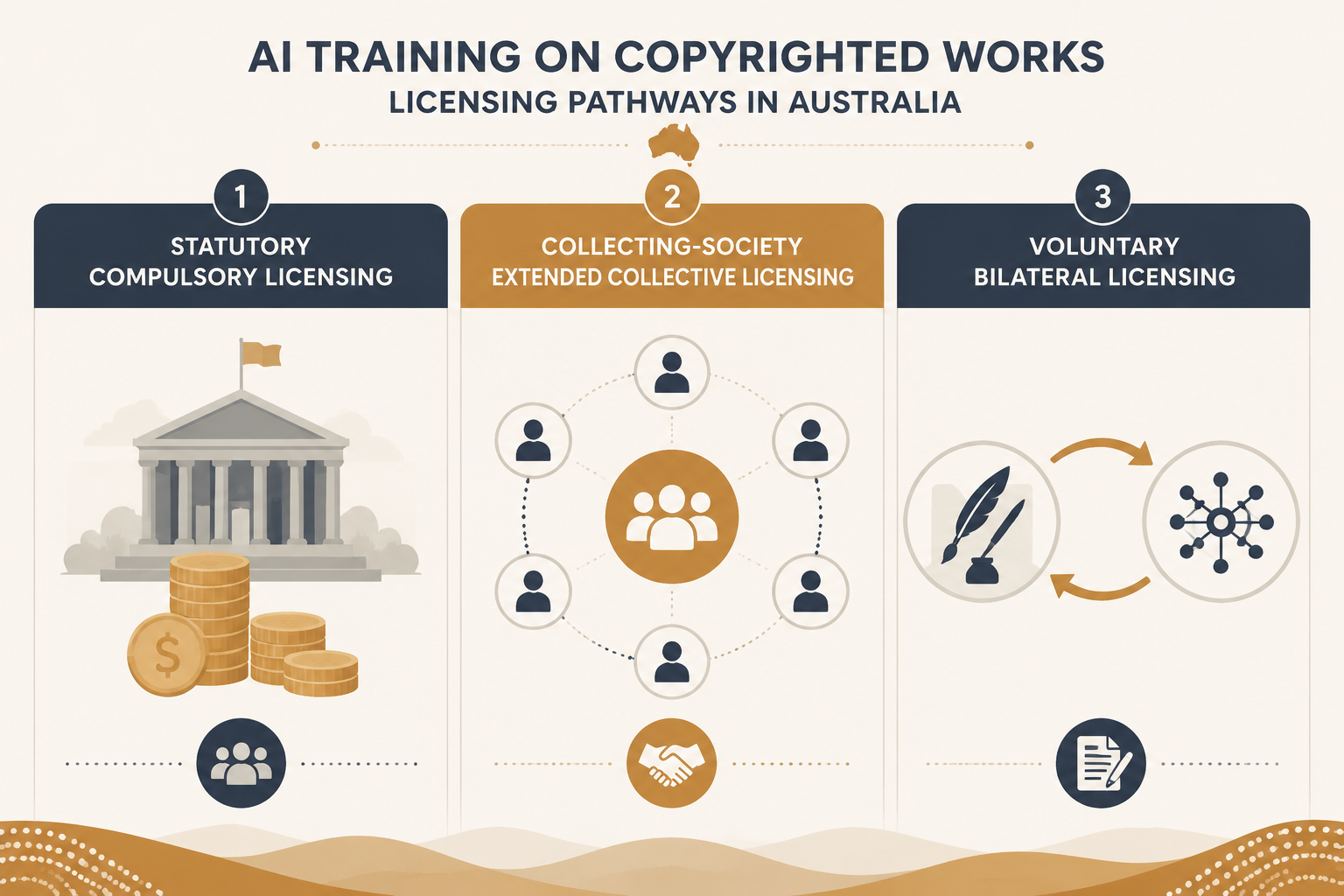
These models are often compressed into a vague phrase such as “lawful content available for licensing.” That is too blunt for legal use. The models allocate power differently, fail differently, and suit different kinds of content markets.
Statutory compulsory licensing
A statutory compulsory licence would allow specified uses if developers meet statutory conditions and pay set or determined remuneration. For AI developers, it offers scale and legal certainty. For rights holders, it offers payment without requiring each owner to negotiate every use. The trade-off is obvious: once the statutory conditions are met, the individual creator’s ability to refuse may be reduced or removed, depending on the design.
That model would require hard drafting choices. Which works are covered? Which acts of copying are licensed? Is the licence limited to training, or does it reach fine-tuning, embeddings, retrieval systems, evaluation, and model updating? Who sets the price? What records must a developer keep? How are foreign works and Australian works treated? The model can produce certainty, but only by making choices that some rights holders will experience as forced access.
Collecting-society extended collective licensing
A collecting-society or extended collective licensing model uses an organization to license on behalf of members and, in an extended form, potentially on behalf of non-members unless they opt out. It fits markets where individual negotiation is impractical but repertoire can be aggregated. It also gives developers a counterparty, which is what many procurement and compliance teams actually need before they can approve a training workflow.
The weakness is representativeness. If a society licenses beyond its members, non-members need notice, objection rights, distribution mechanisms, and confidence that the tariff reflects the value of their work. Small rights holders may prefer collective leverage to isolated negotiation, but only if the collection and distribution system is intelligible. Otherwise, the model risks becoming a permission structure that is efficient for platforms and opaque for creators.
Voluntary bilateral licensing
Voluntary bilateral licensing preserves the strongest version of consent. A developer negotiates with a publisher, studio, archive, news organization, image library, music rightsholder, or other owner. The parties can tailor permitted uses, audit rights, attribution requirements, model restrictions, security controls, and remuneration.
It is also the model most likely to reproduce market power. Large catalog owners can negotiate. Small creators often cannot. Orphan works, fragmented rights, old contracts, and unclear digital training rights make bilateral clearance slow and incomplete. If Australia relies heavily on bilateral licensing alone, it may protect refusal rights in theory while leaving many creators outside the revenue stream and many developers unsure whether their datasets are clean enough to use.
The Copyright Agency’s April 2026 position sits in this licensing debate. It argued that a vast range of content is available for lawful use through efficient licensing and cited recent UK and Japan developments as precedents.[8] That is a serious answer to the claim that permission is impossible at scale. It is not, by itself, a complete map of which content can be licensed, on what terms, with what transparency obligations, and with what coverage for creators outside established licensing channels.
Australia Looks Unusually Protective in Comparative Terms
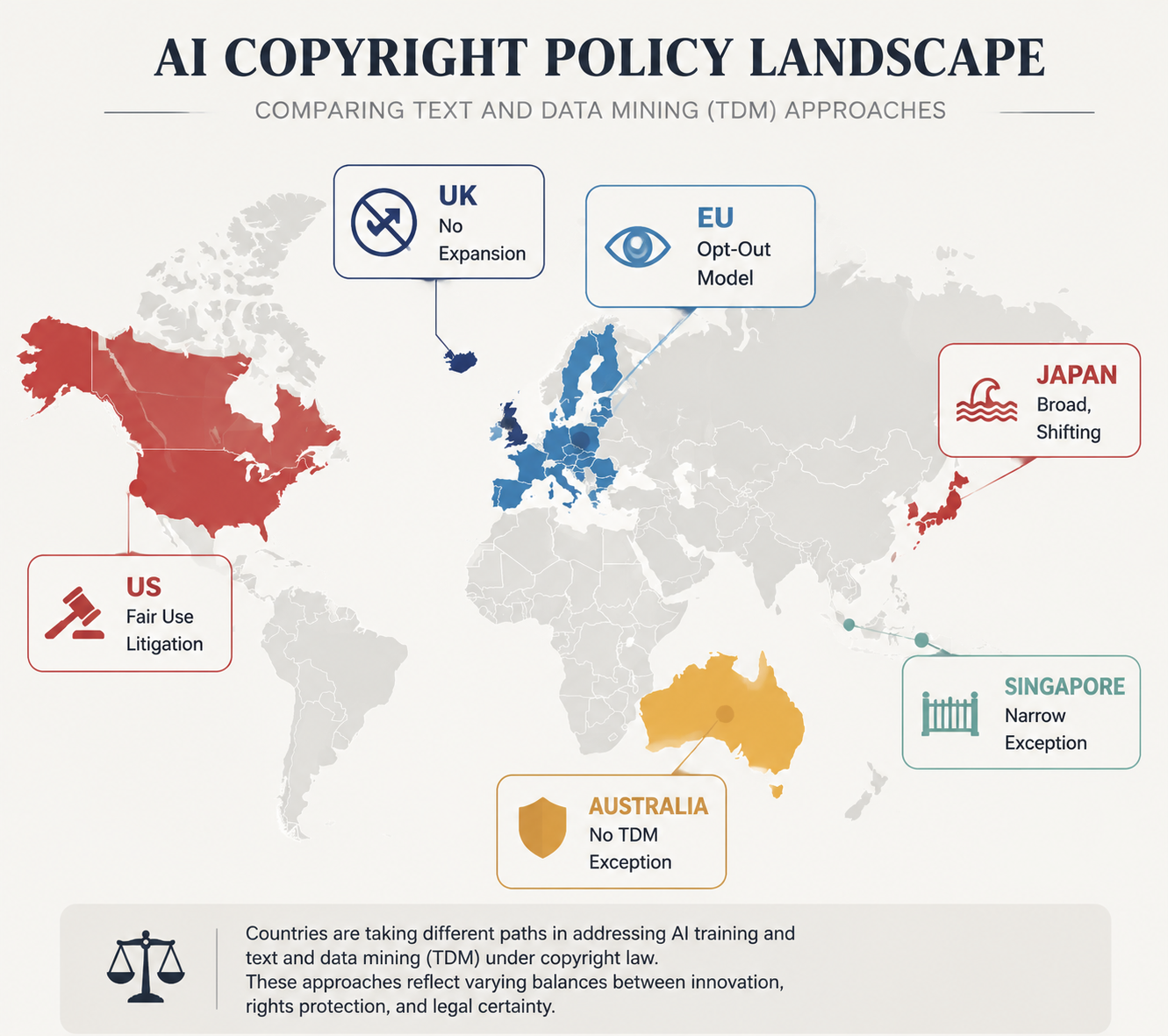
Australia’s position becomes clearer when placed beside other major economies. The comparison should not be used as a crude ranking from innovation-friendly to artist-friendly. Each jurisdiction has its own litigation culture, market structure, and political compromise. Still, Australia’s refusal to create a TDM exception places it toward the more protectionist end of the current spectrum.[7][10]
| Jurisdiction | Current approach | Risk signal for AI training |
|---|---|---|
| Australia | No AI-specific TDM exception after the October 2025 rejection. | Developers face licensing pressure; rights holders have a stronger statutory-negotiation position while CAIRG work continues. |
| European Union | TDM exception with an opt-out mechanism under Article 4 of the DSM Directive. | Training may be possible where rights holders have not reserved rights, but compliance turns on opt-out recognition and transparency obligations. |
| United States | No statutory TDM exception; disputes proceed through fair use litigation. | Risk is case-driven and expensive, with more than 24 active lawsuits against AI developers reported in 2026. |
| United Kingdom | The UK rejected expanding its AI exception in 2025. | The policy direction has moved away from a broad developer exception, though the UK position is not identical to Australia’s. |
| Japan | Broad TDM provisions, with signs of scaling back. | Japan remains more permissive than Australia, but the direction is no longer simply expansionary. |
| Singapore | Narrow TDM exception. | The exception gives a defined statutory route, but not an open-ended answer for every training use. |
The EU is the most important comparator for compliance architecture. Its opt-out model does not give rights holders the same starting position as Australia’s no-exception stance, but it does recognize reservation of rights. The next pressure point is transparency. EU AI Act Article 50 obligations are scheduled to take effect on August 2, 2026 and will require AI models accessed from within the EU to declare training-data sources.[7] The practical effect on Australian content remains prospective, but the direction is clear: dataset visibility is becoming a regulatory issue, not merely a discovery issue after litigation begins.
The United States is the least useful jurisdiction for anyone looking for statutory certainty. It has no TDM exception and relies on fair use, with more than 24 active lawsuits against AI developers reported in 2026.[10] Those cases may shape global settlement behavior and model documentation practices, but they do not supply an Australian rule. No Australian court has yet decided an AI copyright case on the materials available here, so importing US fair use instincts into Australian risk advice would be a category error.
The UK and Japan are useful for a different reason: both complicate the claim that the only modern copyright policy is a broader exception. The UK rejected expanding its AI exception in 2025, and Japan’s broad TDM framework is described in the comparative materials as shifting back from its most permissive posture.[10] Singapore, meanwhile, shows that a TDM exception can be narrow rather than sweeping.[10] Australia is still more protective than these comparators because it rejected the exception route altogether, but it is not alone in encountering political resistance to frictionless AI training.
What Legal Teams Should Treat as Settled, and What They Should Not
The settled point is the absence of a new Australian TDM exception. Training strategies that assume a broad statutory permission in Australia are not aligned with the government’s October 2025 position. Contracts, dataset intake reviews, vendor questionnaires, indemnities, and procurement approvals should reflect that baseline.
- For AI developers, the immediate issue is provenance: what works were copied, where were they sourced, what licences or exceptions were relied on, and can that position be evidenced?
- For rights holders, the immediate issue is leverage: whether to pursue bilateral deals, collective licensing, opt-out notices in foreign regimes, audit rights, or public policy submissions.
- For enterprise customers, the immediate issue is vendor risk: whether a model provider can explain training-data governance well enough to support contractual warranties and downstream deployment.
- For public institutions, the immediate issue is mandate conflict: archives, universities, broadcasters, and cultural bodies may be asked to support AI innovation while stewarding works whose creators expected control.
The unsettled points are just as important. CAIRG’s work is ongoing. The specific design of any licensing model remains open. The July 2026 investment-and-fund allegation remains disputed. EU transparency obligations are not yet in practical operation as of July 15, 2026. And the absence of an Australian AI copyright judgment leaves litigation risk underdeveloped rather than resolved.
The most plausible near-term compliance posture is therefore neither panic nor permissionless optimism. It is documented caution: preserve dataset records, separate Australian content analysis from US fair use assumptions, monitor CAIRG licensing design, and treat creator-facing transparency as a live requirement even before Australian law mandates a final form.
A Creator-Protective Stance Still Under Construction
Australia has entrenched a creator-protective stance for now. The October 2025 rejection of a TDM exception is too clear to treat as a holding pattern. It diverges from the more permissive or exception-based structures used in several comparable economies, and it gives Australian rights holders a stronger negotiating baseline than they would have had under a broad training exception.
But it is not a completed settlement. The licensing mechanism is still being built, the political split over investment remains visible, the Pocock allegation remains denied but revealing of commercial pressure, and EU transparency rules may soon make training-data visibility harder for global model providers to avoid. Australia has said no to one route. The more difficult question is what it is prepared to build in its place.
References
- Attorney-General Mark Dreyfus and Arts Minister Tony Burke joint media release on copyright and AI, Attorney-General’s Department, October 26, 2025, link
- ABC News report on government rejection of AI text-and-data-mining exception, ABC News, October 27, 2025, link
- Productivity Commission interim report coverage on AI’s A$116 billion economic potential, The Strategist / Australian Strategic Policy Institute and The National Law Review, August 2025, link
- Guardian report on Senator David Pocock’s AI copyright and datacentre investment allegation, The Guardian, July 12, 2026, link
- ABC News report on government denial of AI copyright investment allegation, ABC News, July 14, 2026, link
- Anthropic signs AI safety and research memorandum of understanding with Australian government, Anthropic, 2025, link
- Copyright and AI Reference Group analysis of licensing models and EU AI Act Article 50, MinterEllison, 2026, link
- Copyright Agency response on AI and copyright licensing, Copyright Agency, April 2026, link
- NAVA statement on AI, copyright, transparency, attribution and Indigenous Cultural and Intellectual Property, National Association for the Visual Arts, 2025, link
- 3 Key Takeaways on AI and copyright across major jurisdictions, Bird & Bird, 2026, link
Chronological incident history
No sanction cases have named this tool in the tracked record set to date. This does not imply the tool is safe — see Risk Digest for ongoing monitoring.
← Compare peer toolsReport a correction or tip
Spotted an outdated figure, a misstated fact, or a ruling this tool profile should reflect? Public comments are disabled for this content given the professional cost of a misreported case outcome, penalty amount, or rule text — use the structured correction channel instead.
Report a correction or tip for this record →