
Full profile
July 2026. This is an analysis of legal issues, not legal advice. The immediate question is not Bill Pulte's profile; it is whether ODNI personnel actions taken under his authority can stand if the appointment itself is defective [5][6][8].

The succession statute is the anchor
The strongest objection runs through 50 U.S.C. § 3026. Congress did not leave DNI succession open-ended; it said the Principal Deputy DNI 'shall' serve during a vacancy [1]. That is mandatory text, and it points to a specific successor rather than a free-floating acting choice.
That matters because the administration's likely fallback is the FVRA, the general vacancies statute. But a general vacancy law is harder to use when Congress has already written a DNI-specific rule for the same office. The better reading is that § 3026 may constrain the vacancy strategy instead of being displaced by it [1][4].
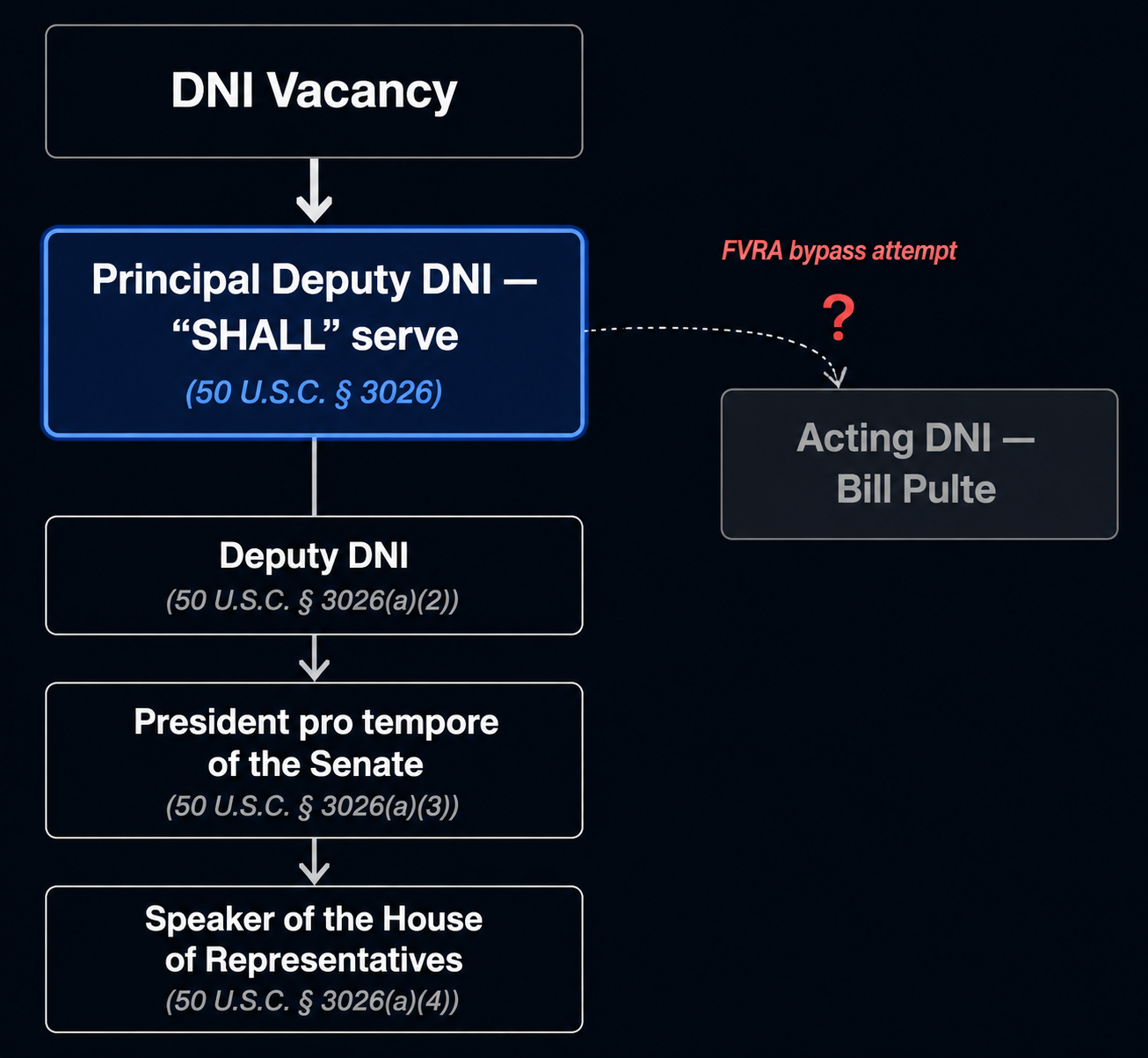
Why the FVRA fight is not settled
The point is not that the FVRA never applies or that every alternative appointment is unlawful. It is that this office is governed by a specific succession provision, and the cleanest statutory reading is the one that gives effect to the word 'shall.' Prior vacancy fights do not solve that problem, because they did not squarely answer how far the FVRA reaches when a separate statute names the acting successor in mandatory terms [4].
The expertise clause is narrower
Section 3023(a)(1) adds a separate difficulty. It says any individual 'nominated for appointment' as DNI shall have extensive national security expertise [2]. Pulte's public record runs through real estate development and FHFA housing regulation, not national security, which makes the criticism easy to understand [6][7]. But the text is aimed at a nominee, and that is where the argument becomes less tidy: if he was installed as acting DNI rather than nominated, the clause is not as clean a fit as the succession statute [2].
What the ODNI firings change
That distinction matters because ODNI personnel actions are already underway. NBC reported mass firings under Pulte's authority, and The Atlantic, summarizing Protect Democracy's position, says fired employees may have reinstatement arguments if the appointment is unlawful [5][3]. That is not the same as saying the firings are automatically void. It means the government may be building a record of actions that a court could later scrutinize for authority, remedy, and reliance.
CBS's announcement story, Roll Call's Senate reaction piece, and The Guardian's timeline mostly explain how quickly the dispute moved from an unusual appointment to a live administrative problem [6][7][8]. They matter because they show scrutiny, not because they resolve the statute.
On the present record, Pulte's acting DNI appointment looks legally precarious. The succession argument under § 3026 is the strongest challenge, the § 3023 expertise argument is plausible but textually narrower, and the real-world effect on ODNI personnel actions depends on litigation that has not yet produced a ruling [1][2][3][4][5]. This remains an informational analysis, not legal advice, and it should be revisited as litigation, the Clayton nomination, and any GAO inquiry develop.
References
- 50 U.S.C. § 3026, Cornell LII
- 50 U.S.C. § 3023, Cornell LII
- Trump Has a Bill Pulte Problem, The Atlantic
- The Acting DNI and the Intelligence Office Trump Wants, Just Security
- Top intelligence agency begins mass firings under new Trump appointee, NBC News
- Trump names controversial housing official Bill Pulte as acting DNI, CBS News
- Days into his new job, Pulte raises eyebrows in Senate, Roll Call
- Bill Pulte acting director of national intelligence timeline, The Guardian
Comments
Join the discussion with an anonymous comment.