
Full profile
This is not, at its core, a story about an odd personnel choice. It is a vacancy-law problem that begins with two verbs. The Director of National Intelligence statute says that, when the DNI office is vacant, the Principal Deputy DNI “shall act for” the Director. The Federal Vacancies Reform Act of 1998, by contrast, generally says the president “may direct” certain officials to perform the functions and duties of a vacant advice-and-consent office. Lawfare’s analysis of Pulte’s acting appointment treats that difference as the hinge: a mandatory office-specific succession rule may leave less room for presidential selection than the FVRA ordinarily provides.[1]
That is the legal oddity now attached to one of the federal government’s most sensitive posts. The Trump administration’s use of Pulte as acting DNI depends on the proposition that the FVRA remains available even though Congress wrote a DNI-specific succession rule. The Justice Department’s Office of Legal Counsel took that position in 2019 in the Coats-to-Maguire transition, when it concluded that the president could use the FVRA to designate an acting DNI notwithstanding 50 U.S.C. § 3026(a)(6).[2] But an OLC opinion is not an Article III judgment, and the question has not been resolved by a court in this office-specific setting.
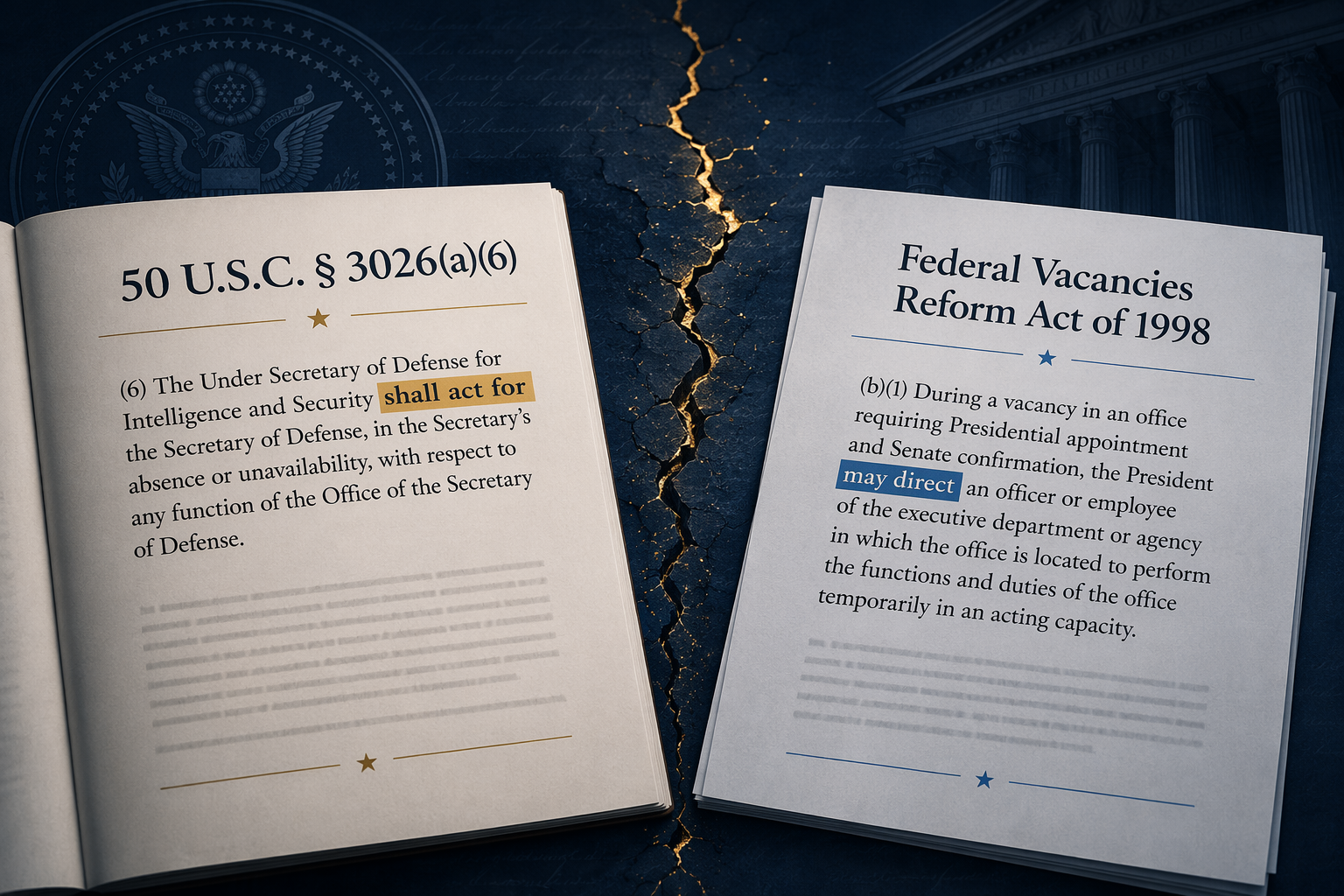
The statutory hinge is small, but it carries the case
The FVRA is the government-wide default for many acting appointments. It allows the president to choose among specified categories of temporary officials, including the first assistant to the vacant office and, in some circumstances, other Senate-confirmed officers or senior agency employees. Its premise is flexibility. When Congress has not written a more particular succession rule, the FVRA gives the executive branch a menu.
The DNI statute reads differently. Section 3026(a)(6) does not say the Principal Deputy DNI may act, or that the president may choose the Principal Deputy. It says the Principal Deputy “shall act for” the DNI during a vacancy. Lawfare argues that this language looks like a mandatory office-specific succession command, not merely another option on the FVRA menu.[1]
OLC’s 2019 opinion accepts the mandatory sound of the DNI provision but does not treat it as exclusive. The opinion reads the FVRA and the DNI statute as coexisting routes unless Congress clearly made the office-specific statute the sole means of filling the acting role. On that view, the Principal Deputy DNI acts by operation of the DNI statute unless the president uses the FVRA to designate someone else.[2]
The opposing reading is not casual formalism. It asks why Congress would say the Principal Deputy “shall act for” the DNI if the president could bypass that instruction through a general vacancies statute. In ordinary legal usage, “shall” performs different work from “may.” When the more specific statute identifies the official who must act, the argument goes, the general FVRA permission should yield.
That does not make OLC’s answer frivolous. The FVRA itself contemplates interaction with other statutes, and prior executive-branch practice matters to lawyers who must keep government operating while vacancies occur. But practice is not the same thing as settlement. Repetition can make a workaround familiar without making it correct.
Why the Ninth Circuit framework matters
The relevant judicial guidance does not come from a DNI case. Lawfare points to a Ninth Circuit framework that asks whether another statute “expressly” designates an acting officer or instead permits the president or another actor to elect among options. Under that approach, permissive language is easier to reconcile with the FVRA; mandatory language creates a stronger displacement argument.[1]
The DNI provision is awkward for the government under that framework because it does not appear to invite election. It names the Principal Deputy DNI and uses mandatory phrasing. The government can still argue, as OLC did, that the FVRA remains available absent an express exclusivity clause. A challenger can respond that a mandatory office-specific succession rule is express enough, especially where Congress could have written a permissive alternative and did not.
The FVRA’s timing rules add another layer. Lawfare explains that the FVRA normally imposes a 210-day limit on acting service, subject to statutory extensions tied to nominations and other events.[1] If Pulte is validly serving under the FVRA, that clock helps define the outer edge of his temporary authority. If the FVRA is unavailable because the DNI statute controls, the clock is beside the point: the defect would not be that Pulte stayed too long, but that he was not the person Congress directed to act in the first place.
Pulte matters because acting authority is still authority
Pulte’s biography and politics explain why the legal issue has drawn attention, but they do not answer it. The Atlantic has reported on the broader implications of Trump placing Pulte in the intelligence role, and Mother Jones has emphasized criticism that Pulte lacks conventional national security experience.[3][4] Those facts may affect Congress’s confidence, agency morale, and the likelihood of litigation. They do not change the statutory sequence.
The reason qualifications matter legally is more practical than atmospheric. An acting DNI is not a ceremonial caretaker. The office sits atop the intelligence community, affects interagency coordination, and can issue or approve decisions that other officials must treat as authoritative. Just Security’s analysis frames the Pulte appointment as significant because the DNI role reaches operational and institutional questions inside the intelligence apparatus, not merely public messaging.[5]
That is where an unresolved vacancy question becomes expensive. If an acting DNI signs personnel actions, approves intelligence community directives, changes reporting lines, or participates in decisions later challenged in court, the government may have to defend not only the substance of those actions but the authority of the signer.
What would be at risk if the appointment were unlawful
The consequences would depend on the action. A court would not necessarily erase every step Pulte took simply because it found his acting designation invalid. Vacancy-law remedies can turn on the statute invoked, the nature of the official function, the plaintiff’s injury, the timing of the challenge, and whether a properly authorized official later ratified the decision.
| Category of action | Likely legal question |
|---|---|
| Personnel actions | Was the decision assigned by law to the DNI personally, and can a later valid official ratify it? |
| Intelligence community directives | Did subordinate agencies rely on a directive whose legal force depends on the acting DNI’s status? |
| Approvals tied to surveillance or national security programs | Was the acting DNI’s participation required by statute, regulation, or interagency process? |
| Internal management decisions | Was the action discretionary housekeeping or an exercise of authority reserved to the DNI? |
The first distinction is between actions that merely pass through the DNI’s office and actions that legally require the DNI’s valid exercise of authority. If a deputy, component head, or other officer had independent authority to act, the vacancy problem may be less consequential. If a statute or regulation specifically requires action by the DNI, the government’s defense becomes harder.
The second distinction is timing. A party who waits may face standing, mootness, harmless-error, or ratification arguments. But those defenses are not cure-alls. Ratification works best when the later official has full authority, understands the prior action, and actually adopts it. It is less persuasive when the challenged act involves a deadline, a completed personnel removal, or a decision whose legal effect depended on the identity of the officer at the moment it was made.
The FVRA itself can impose severe consequences when it applies and is violated, including treating certain functions or duties as having no force or effect. But if the argument is that the FVRA never authorized Pulte because the DNI statute displaced it, the remedial path may be less direct. A challenger would need to connect the unlawful designation to a reviewable action and a concrete legal injury.
The Appointments Clause problem sits behind the statute
Even if the administration wins the statutory argument, a constitutional question remains. The DNI is a principal officer. Temporary acting service has long been accepted in some circumstances, but modern Appointments Clause doctrine has sharpened attention to whether an acting principal officer must already hold a Senate-confirmed office closely connected to the temporary assignment.
That constitutional objection is unsettled in this setting. No court has applied it to invalidate an acting DNI designation like Pulte’s. Cato’s Thomas Berry has argued that modern Appointments Clause doctrine may require an acting principal officer to come from a Senate-confirmed post closely tied to the office. It nevertheless changes the litigation posture. The government would not only have to defend its reading of the FVRA and the DNI statute; it might also have to explain why the temporary exercise of DNI authority by the selected acting official is consistent with the Appointments Clause.
Section 702 raises the stakes without deciding the vacancy question
The Hill has reported that Pulte’s selection complicated the politics around warrantless surveillance powers and Section 702 renewal.[6] That debate is fluid as of July 19, 2026, and it should not be treated as a proxy for the legal validity of the acting appointment. A controversial surveillance policy does not make an acting official unlawful; an unlawful acting designation does not by itself decide the merits of surveillance legislation.
The connection is institutional. If an acting DNI with contested authority participates in intelligence oversight, certification, coordination, or congressional negotiations, the uncertainty follows the office into places where reliance matters. Lawyers inside agencies tend to notice that before the public does, because the question becomes what can safely be signed, implemented, or defended.
Congress has noticed the gap
Sen. Mark Warner’s proposed “Do Not Interfere in our Intelligence Act” is a legislative response to the same pressure point. The Hill reported that the bill would require acting DNIs to be Senate-confirmed principal deputies or other Senate-confirmed intelligence officials.[7] That proposal does not resolve the current statutory dispute. It is evidence that at least some members of Congress see the existing framework as too easy to exploit or too unclear to tolerate in the intelligence context.
A statutory amendment of that kind would narrow future disputes by making the acting-DNI pathway more explicit. It would not necessarily answer whether Pulte’s current designation was lawful under the statutes now on the books, or what remedy would attach to past actions if a court later disagreed with the administration.
The better answer is still unsettled
The strongest defense of Pulte’s acting appointment is the one OLC supplied: the FVRA remains available unless Congress made the DNI succession provision exclusive, and 50 U.S.C. § 3026(a)(6) does not use the words “exclusive,” “only,” or “notwithstanding the FVRA.”[2] That is a serious executive-branch argument, especially for officials who need administrable rules during high-level vacancies.
The strongest challenge is equally serious: Lawfare, Cato, and related scholarship argue that Congress used mandatory office-specific language for a sensitive intelligence office, and the FVRA’s general permission should not override a later or more specific command that the Principal Deputy DNI “shall act for” the Director.[1] On that reading, the administration did not merely choose among available acting officials; it bypassed the official Congress selected for continuity and accountability.
No court has resolved that precise conflict for the DNI. Until one does, the appointment sits in a real statutory gray zone. OLC gives the administration a substantial defense; the DNI statute gives challengers a substantial textual attack; and the Appointments Clause supplies additional constitutional pressure that has not been tested in this context. This analysis is current as of July 19, 2026, including references to Section 702 and pending legislative responses, and is editorial analysis rather than legal advice.
References
- Pulte's Appointment Shows Flaws in the Vacancies Act, Lawfare
- Designating an Acting Director of National Intelligence, DOJ Office of Legal Counsel, 2019
- Trump Has a Bill Pulte Problem, The Atlantic
- Bill Pulte Lacks Intelligence Qualifications, Mother Jones
- The Acting DNI and the Intelligence Office Trump Wants, Just Security
- Pulte pick to lead national intelligence further jeopardizes renewal of warrantless spy powers, The Hill
- Warner introduces bill to require Senate-confirmed acting DNIs, The Hill
Comments
Join the discussion with an anonymous comment.