
Full profile
The CDC Board Still Matters, But Its Silence Means Less Than It Used To
An attorney evaluating a cruise ship passenger illness claim and opening the CDC Vessel Sanitation Program outbreak page in Q3 2026 faces a narrower question than whether the page is “official.” It is official. The harder question is whether it is complete enough to carry the evidentiary weight lawyers have often placed on it.
That distinction matters because cruise illness claims often arrive with compressed proof problems. Passengers disperse across jurisdictions. Medical visits happen after disembarkation. Shipboard records are controlled by the operator. Maritime limitations, including the one-year limitations period under 46 U.S.C. § 30508, forum-selection issues, and in fatality cases the Death on the High Seas Act, can push counsel to evaluate quickly whether a cluster is an isolated complaint or part of a documented outbreak.

For years, the CDC board has supplied a convenient anchor: vessel name, voyage dates, causative agent when identified, passenger and crew counts, and basic response information. It is still a federal signal. But an empty or shorter public table is not the same thing as a clean factual record, especially when the agency unit behind the table has been operating under visible capacity strain.
The Capacity Problem Is Not Speculative
CBS News reported in April 2025 that HHS eliminated all full-time civilian employees in the CDC’s Vessel Sanitation Program, including the program’s lead outbreak epidemiologist, and reduced the program from about 24 people to about 12 U.S. Public Health Service officers. CBS also reported a detail that deserves more attention in litigation files than it is likely to get in headlines: the program was funded entirely by fees paid by cruise lines, not by taxpayers.[1]
That funding point does not prove any outbreak was missed. It does, however, sharpen the institutional question. This was not simply a broad public-spending reduction falling evenly across federal functions. It affected a fee-funded inspection and outbreak-surveillance structure that cruise passengers, operators, insurers, and lawyers had come to use as a practical public record.
The continuity concern deepened in May 2026, when STAT reported that Luis Rodríguez, the longtime head of the Vessel Sanitation Program, retired during the MV Hondius hantavirus crisis, after the CDC division housing VSP had been restructured.[2] A retirement is not evidence of defective data. In an evidentiary file, though, it belongs beside the staffing cuts because it marks another change in institutional memory and leadership during an active vessel-health event.
The practical consequence is not that CDC data should be discarded. It is that the foundation questions have become more important: who collected the information, what threshold made an illness event visible, how quickly it was reviewed, and what capacity existed to investigate when reports came in.
What the 2026 Board Shows—and What It Cannot Show
As of July 15, 2026, the CDC VSP outbreak board listed eight gastrointestinal illness outbreaks for the year: norovirus outbreaks on Ruby Princess, Star Princess, Caribbean Princess, and three National Geographic Sea Bird voyages, plus E. coli outbreaks on Seven Seas Mariner and Oceania Insignia.[3]
| 2026 CDC-posted signal | What it gives counsel | What it does not resolve |
|---|---|---|
| Six norovirus outbreaks, including three National Geographic Sea Bird entries | A federal record of reportable gastrointestinal illness events and named voyages | Whether similar but unposted illness clusters occurred on other voyages |
| Two E. coli outbreaks, on Seven Seas Mariner and Oceania Insignia | A foodborne-pathogen signal that may affect source and causation analysis | Whether the source was shipboard food handling, shore-side supply, passenger exposure, or another pathway |
| National Geographic Sea Bird voyage from July 10–15 with a 29% passenger attack rate | A high-severity data point for evaluating outbreak magnitude on a posted voyage | Whether the posted rate reflects broader operator or industry conditions |
The two E. coli entries are worth separating from the usual norovirus discussion. Norovirus has long dominated cruise gastrointestinal outbreak coverage, but E. coli changes the early case-evaluation questions. It pushes counsel toward food-source records, supply-chain facts, galley handling, shore excursion meals, and laboratory confirmation in a way that a typical person-to-person norovirus theory may not.
There is a temptation to make the count do more work than it can. The CDC board listed 18 outbreaks in all of 2025, after 2024 reached 16 outbreaks, described by Forbes as the highest total since 2012.[4] By July 15, 2026, the board listed eight.[3] That comparison is suggestive, but it is not proof that surveillance cuts caused a decline in posted outbreaks.
Seasonality, actual sanitation changes, voyage mix, passenger behavior, reporting lags, and reduced investigative capacity could all affect the public count. The honest litigation use of the comparison is narrower: the public board now sits inside a documented capacity disruption, so absence from the board should not be treated as strong evidence that no material illness cluster existed.
The Plaintiff-Side Critique States the Anxiety Plainly
Food Poison Journal, published by Marler Clark, has directly questioned whether the apparent decline in cruise outbreaks reflects fewer illnesses or reduced investigative capacity.[5] The source has a plaintiff-side foodborne-illness litigation perspective, and that perspective should be named rather than smuggled into the record as neutral institutional analysis.
Still, the critique identifies a real evidentiary problem. A passenger attorney may want to use the CDC board to show a voyage was part of a larger health event. A defense attorney may want to use the same board to argue that no outbreak was recognized. A risk officer may use it to decide whether a claim belongs in ordinary handling or deserves escalation. Each of those uses depends on the board’s completeness, not merely its official status.
The better framing is not “CDC data is reliable” or “CDC data is worthless.” The better framing is foundation. The board can establish that a federal outbreak record exists for a named voyage. It cannot, by itself, establish that no cluster existed on a voyage that does not appear there, particularly during a period when the program’s staffing and leadership continuity have been publicly disrupted.
How the Data Gap Changes Evidence Work
When the federal outbreak page is sparse or delayed, the task is not to find a single replacement. The task is to build a layered record that can survive the weaknesses of each source. Public-health records, operational logs, medical records, and prior inspection history answer different questions. None is a perfect substitute for an active federal outbreak investigation.
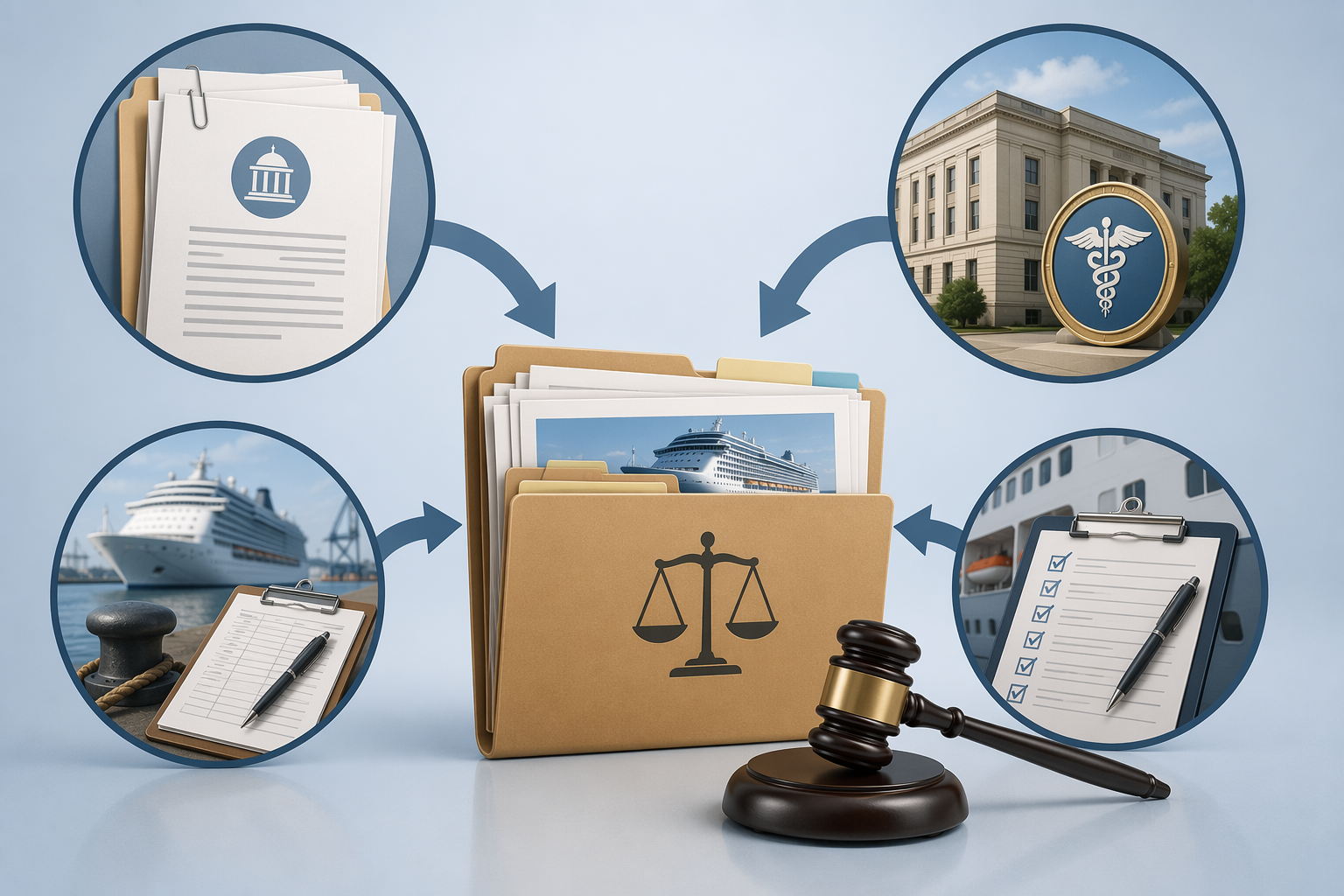
FOIA requests remain the most obvious first layer, but they should be drafted with the capacity problem in mind. A request limited to “outbreak reports” may miss communications that explain why an event did not become a posted outbreak. Requests can seek communications between VSP and the cruise operator, illness report submissions, inspection materials, sanitation corrective actions, and records reflecting referral, triage, or delayed review. The goal is not just to confirm what appears online; it is to see the administrative path behind the absence or appearance of a posting.
State and local health departments may hold the next layer, especially when passengers sought care after returning home or when a port-side response occurred. Those records may not identify a cruise outbreak as neatly as the CDC board would. They may appear as laboratory reports, communicable-disease interviews, cluster notes, or communications with federal counterparts. Their value is often chronological: they can show when symptoms were reported, whether testing confirmed a pathogen, and whether health officials saw connections among passengers.
Port authority logs and terminal records serve a different function. They may show ambulance calls, delayed disembarkation, sanitation activity, waste handling, communications about ill passengers, or operational disruptions. These records rarely prove medical causation on their own. They can, however, corroborate that something operationally unusual happened at the same time passengers describe illness.
Prior-voyage inspection history adds context rather than direct proof. A clean inspection does not defeat a later illness claim, and a poor inspection does not prove causation. But inspection findings can identify recurring sanitation concerns, food-temperature problems, potable-water issues, or corrective-action patterns that help counsel decide which witnesses, logs, and shipboard systems deserve closer discovery.
The Record Should Track Thresholds, Not Just Outcomes
A defensible file should distinguish between an illness event that did not meet a reporting threshold, an event that was reported but not posted, an event that was posted after delay, and an event that was investigated but not attributed to a confirmed pathogen. Those are not interchangeable facts.
- If the CDC board lists the voyage, preserve the posting and compare it against shipboard medical logs, passenger statements, and laboratory records.
- If the CDC board does not list the voyage, document the search date and pursue records that show whether reports were made to VSP or other health authorities.
- If illness reports cluster after disembarkation, look for state health department and laboratory records that may never have been reflected on the federal cruise page.
- If E. coli or another foodborne pathogen is involved, separate food-source, shore-exposure, and person-to-person theories early so discovery does not collapse into a generic “cruise illness” file.
The point is not to overplead uncertainty. It is to prevent a public webpage from becoming the outer boundary of the factual investigation simply because it is easier to cite than scattered administrative records.
What Attorneys Can Fairly Say About the CDC Data
In a demand letter, coverage evaluation, complaint, or early discovery plan, the CDC VSP board is still useful for what it affirmatively shows. A posted outbreak is a federal record that an illness event crossed the program’s public-reporting line. For 2026, the board also gives counsel a concrete list of vessels and pathogens, including the two E. coli outbreaks and the high passenger attack rate reported for the July 10–15 National Geographic Sea Bird voyage.[3]
What attorneys should avoid is the negative inference. A voyage’s absence from the board is weaker evidence than it once may have seemed, not because the CDC has lost all value as a source, but because the public record now has to be read against the documented reduction in VSP staffing and the leadership transition reported in 2026.[1][2]
That distinction should shape both sides of the case. Plaintiff counsel should not treat the staffing cuts as automatic proof that an unposted outbreak occurred. Defense counsel should be cautious about treating nonappearance on the CDC page as dispositive absence of illness. Risk teams should preserve the board as a comparison point while asking what other records would confirm, qualify, or contradict it.
The most defensible evidentiary position is measured: CDC VSP data remains a meaningful federal signal, but in Q3 2026 it should be treated as one source in a corroborated record, not as the outer boundary of possible cruise passenger illness evidence.
References
- CDC cruise ship inspectors hit by layoffs amid outbreaks of norovirus, CBS News, April 2025
- Luis Rodríguez retires from CDC Vessel Sanitation Program amid hantavirus outbreak, STAT News, May 7, 2026
- Cruise Ship Outbreak Updates, CDC Vessel Sanitation Program
- Cruise Line Rankings: CDC Inspections Show Most And Least Healthy, Forbes, January 3, 2025
- Cruise Ships in 2026: What the CDC’s Outbreak List Does and Doesn’t Tell You, Food Poison Journal / Marler Clark, 2026
Comments
Join the discussion with an anonymous comment.